Feed Pellet Mill
ProductOverview
The feed pellet mill is a cornerstone machine in livestock and aquaculture feed production, transforming finely ground grain and additives into uniform cylindrical pellets. Pellets offer significant advantages over loose meal: they prevent ingredient separation during transport and storage, improve feed conversion efficiency in animals, reduce dust in the feed mill environment, and enable standardized dosing of vitamins and medications.
Ring-die pelleting dominates the feed industry due to its simplicity, reliability, and flexibility across grain types and pellet sizes. The machine compresses material through a rotating die using multiple hardened steel rollers, creating pellets 3–8 mm in diameter. The process generates considerable friction heat, requiring careful temperature management to preserve feed quality and prevent binder degradation.
How it works
Ground feedstock (meal) is delivered from a Material Hopper via a Inlet Feeder Assembly into an optional Steam Conditioner Unit if steam-processing is required (common for starch-based feeds). The conditioned material then enters the Die and Roller Assembly assembly.
The Pellet Die is a hardened steel cylinder with 60–200 precision-drilled holes, each tapered slightly. Inside the die cavity rotate two or three Roller Shaft assemblies fitted with hardened Bearing Race Ring bearing races. As the Main Drive Gearbox and Motor turns the die at 150–250 rpm, the rollers remain stationary or turn slowly, forced against the die wall by spring or hydraulic pressure.
Material in the die cavity is trapped between the rotating die and the stationary (or slowly rotating) rollers. Friction and compression forces drive the meal through the tapered holes. As it emerges on the opposite die face, cylindrical pellet strands are cut to length by the Pellet Cutter and Ejector, either by a rotating blade ring or fixed knives, and fall down the Discharge Chute Tube.
The hot pellets (50–80 °C) drop onto the Cooling Grate, where a Cooling Fan blows ambient air upward, cooling them to room temperature while equalizing internal moisture.
Conditioning and steam treatment
Many feed mills use a Steam Conditioner Unit upstream. This device heats the ground meal with steam (up to 80 °C), which plasticizes natural binders (especially starch and proteins) in the grain, improving pellet durability. The Steam Jacket Chambers wraps the Conditioner Tank, and the Conditioning Paddle Mixer ensures uniform heating. For heat-sensitive ingredients (probiotics, vitamins), low-temperature conditioning or no conditioning is used.
Die and roller selection
Die hole diameter determines pellet size; 3 mm dies produce fine poultry pellets, 6–8 mm dies suit swine and cattle. The number of holes (60–200) affects capacity; more holes distribute pressure better but require higher motor power. Die friction and wear are primary concerns; dies are periodically rebored or replaced after 400–800 tons of throughput depending on abrasive ingredients (mineral, silica).
Bearing Race Ring and die surfaces must be matched in hardness (typically 55–62 HRC) to minimize wear and maintain dimensional tolerances that control pellet density and breaking strength.
Electrical control and safety
The Control and Monitoring Panel continuously monitors Motor Current Monitor current draw on the main motor. If current exceeds a preset threshold (indicating die plugging or excessive material), the PLC reduces Feeder Drive Motor speed or activates a Flow Throttle Valve to prevent motor stall and damage. A Die Temperature Sensor at the die face also triggers alarms if die temperature rises above 90 °C, indicating potential binder degradation.
Emergency stop circuits immediately de-energize the Feeder Drive Motor, halting material feed and allowing the die to coast to a stop safely.
Pellet quality metrics
Pellet durability is measured by the Pellet Durability Index (PDI), typically 85–95%. Hard pellets resist breaking during transport and feed handling. Pellet density (bulk density 600–750 kg/m³ for typical feeds) affects intake by animals; denser pellets provide more nutrition per volume but require greater compression power.
Moisture content of finished pellets should match the intended storage environment (10–12% for ambient storage, up to 14% for cold storage with low humidity).
Energy and production economics
Producing one ton of pellets consumes 50–70 kWh of electrical energy plus thermal energy if steam conditioning is used. The major energy sink is the Main Drive Gearbox and Motor main drive; efficiency gains come from optimizing Inlet Feeder Assembly regulation (avoiding overflow and die plugging), selecting the correct die for the grain type, and maintaining sharp Cutting Blade Assembly.
Regular maintenance including die cleaning, roller surface inspection, and bearing lubrication intervals (200–400 hours) is essential to sustain efficiency and pellet quality.
Feed Pellet Mill parts and their functions
8 top-level parts · 72 parts in total · full bill of materials below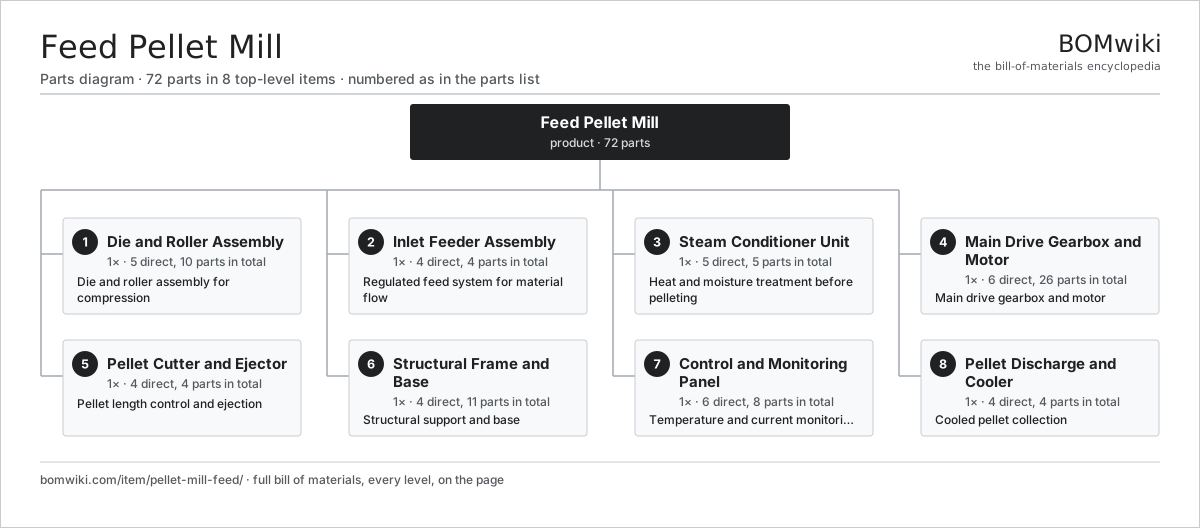
| # | Part | Qty | What it does |
|---|---|---|---|
| 1 | Die and Roller Assembly 5 parts | 1× | Die and roller assembly for compression |
| 2 | Inlet Feeder Assembly 4 parts | 1× | Regulated feed system for material flow |
| 3 | Steam Conditioner Unit 5 parts | 1× | Heat and moisture treatment before pelleting |
| 4 | Main Drive Gearbox and Motor 6 parts | 1× | Main drive gearbox and motor |
| 5 | Pellet Cutter and Ejector 4 parts | 1× | Pellet length control and ejection |
| 6 | Structural Frame and Base 4 parts | 1× | Structural support and base |
| 7 | Control and Monitoring Panel 6 parts | 1× | Temperature and current monitoring |
| 8 | Pellet Discharge and Cooler 4 parts | 1× | Cooled pellet collection |
3D model
No 3D model yet. Have a CAD file of this? Add a 3D model. STL renders right on this page; STEP, FreeCAD, and OpenSCAD sources are welcome too (openly licensed, like all 3D models on BOMwiki).
Build & assembly graph
expand / collapse · shared sub-assemblies converge · links to related products · est. labourTap an assembly to expand/collapse · tap a part to open it · use “Open page” for any node · drag to pan, scroll to zoom.
Bill of materials for Feed Pellet Mill
8 top-level lines · 53 rows shown · 72 parts total · indented to 3 levels| # | Item / sub-assembly | Part no. | Qty/assy | Ext. qty | Parts | Type |
|---|---|---|---|---|---|---|
| 1 | Die and Roller Assembly 5 parts | pellet-mill-feed-die-roller | 1× | 1 | 10 | assembly |
| 1.1 | Pellet Die | pellet-mill-feed-die | 1× | 1 | · | part |
| 1.2 | Roller Shaft | pellet-mill-feed-roller-shaft | 2× | 2 | · | part |
| 1.3 | Bearing Race Ring | pellet-mill-feed-roller-ring | 2× | 2 | · | part |
| 1.4 | Roller Bearing | pellet-mill-feed-roller-bearing | 4× | 4 | · | part |
| 1.5 | Die Housing Assembly | pellet-mill-feed-die-housing | 1× | 1 | · | part |
| 2 | Inlet Feeder Assembly 4 parts | pellet-mill-feed-feeder | 1× | 1 | 4 | assembly |
| 2.1 | Feed Screw Auger | pellet-mill-feed-feed-screw | 1× | 1 | · | part |
| 2.2 | Feeder Drive Motor | pellet-mill-feed-feed-motor | 1× | 1 | · | part |
| 2.3 | Material Hopper | pellet-mill-feed-feed-hopper | 1× | 1 | · | part |
| 2.4 | Flow Throttle Valve | pellet-mill-feed-throttle-valve | 1× | 1 | · | part |
| 3 | Steam Conditioner Unit 5 parts | pellet-mill-feed-conditioner | 1× | 1 | 5 | assembly |
| 3.1 | Conditioner Tank | pellet-mill-feed-conditioner-vessel | 1× | 1 | · | part |
| 3.2 | Steam Jacket Chambers | pellet-mill-feed-steam-jacket | 1× | 1 | · | part |
| 3.3 | Conditioning Paddle Mixer | pellet-mill-feed-paddle-mixer | 1× | 1 | · | part |
| 3.4 | Paddle Drive Motor | pellet-mill-feed-paddle-motor | 1× | 1 | · | part |
| 3.5 | Condensate Trap | pellet-mill-feed-steam-trap | 1× | 1 | · | part |
| 4 | Main Drive Gearbox and Motor 6 parts | pellet-mill-feed-gearbox-motor | 1× | 1 | 26 | assembly |
| 4.1 | Motor Housing | motor-housing | 1× | 1 | · | part |
| 4.2 | Rotor Assembly 4 parts | rotor-assembly | 1× | 1 | 19 | assembly |
| 4.2.1 | Rotor Shaft | rotor-shaft | 1× | 1 | · | part |
| 4.2.2 | Rotor Core | rotor-core | 1× | 1 | · | part |
| 4.2.3 | Neodymium Magnet | neodymium-magnet | 16× | 16 | · | part |
| 4.2.4 | Ball Bearing | ball-bearing | 1× | 1 | · | part |
| 4.3 | Stator Assembly 3 parts | stator-assembly | 1× | 1 | 3 | assembly |
| 4.3.1 | Stator Core (laminations) | stator-core | 1× | 1 | · | part |
| 4.3.2 | Copper Winding | copper-winding | 1× | 1 | · | part |
| 4.3.3 | Slot Insulation | stator-insulation | 1× | 1 | · | part |
| 4.4 | Main Reduction Gearbox | pellet-mill-feed-gearbox | 1× | 1 | · | part |
| 4.5 | Die Drive Shaft | pellet-mill-feed-main-shaft | 1× | 1 | · | part |
| 4.6 | Connector | connector | 1× | 1 | · | part |
| 5 | Pellet Cutter and Ejector 4 parts | pellet-mill-feed-cutter | 1× | 1 | 4 | assembly |
| 5.1 | Cutting Blade Assembly | pellet-mill-feed-cutter-knives | 1× | 1 | · | part |
| 5.2 | Cutter Shroud | pellet-mill-feed-cutter-housing | 1× | 1 | · | part |
| 5.3 | Cutter Drive Motor | pellet-mill-feed-cutter-motor | 1× | 1 | · | part |
| 5.4 | Discharge Deflector | pellet-mill-feed-pellet-deflector | 1× | 1 | · | part |
| 6 | Structural Frame and Base 4 parts | pellet-mill-feed-frame | 1× | 1 | 11 | assembly |
| 6.1 | Side Frame Member | pellet-mill-feed-base-frame | 2× | 2 | · | part |
| 6.2 | Cross-Brace Member | pellet-mill-feed-cross-brace | 4× | 4 | · | part |
| 6.3 | Vibration Isolator Pad | pellet-mill-feed-vibration-isolator | 4× | 4 | · | part |
| 6.4 | Fastener Set | fastener-set | 1× | 1 | · | part |
| 7 | Control and Monitoring Panel 6 parts | pellet-mill-feed-control-system | 1× | 1 | 8 | assembly |
| 7.1 | Microcontroller | mcu | 1× | 1 | · | part |
| 7.2 | Die Temperature Sensor | pellet-mill-feed-temperature-sensor | 1× | 1 | · | part |
| 7.3 | Motor Current Monitor | pellet-mill-feed-current-transducer | 1× | 1 | · | part |
| 7.4 | Relay | relay | 3× | 3 | · | part |
| 7.5 | Power Supply | power-supply | 1× | 1 | · | part |
| 7.6 | Bare PCB | pcb-bare | 1× | 1 | · | part |
| 8 | Pellet Discharge and Cooler 4 parts | pellet-mill-feed-discharge-chute | 1× | 1 | 4 | assembly |
| 8.1 | Discharge Chute Tube | pellet-mill-feed-discharge-tube | 1× | 1 | · | part |
| 8.2 | Cooling Grate | pellet-mill-feed-cooler-grate | 1× | 1 | · | part |
| 8.3 | Cooling Fan | pellet-mill-feed-cooler-fan | 1× | 1 | · | part |
| 8.4 | Pellet Storage Hopper | pellet-mill-feed-collector-bin | 1× | 1 | · | part |
Something wrong in this list? Report a problem with this BOM.
Related products
same domain, ranked by shared parts Bottle Washing Machine
2,388 parts · shares 13 with this page
Brine Chilling System
239 parts · shares 13 with this page
Cheese Vat
276 parts · shares 13 with this page
Continuous Butter Churn
275 parts · shares 13 with this page
Dough Sheeting Line
456 parts · shares 13 with this page
Bottle Washing Machine
2,388 parts · shares 13 with this page
Brine Chilling System
239 parts · shares 13 with this page
Cheese Vat
276 parts · shares 13 with this page
Continuous Butter Churn
275 parts · shares 13 with this page
Dough Sheeting Line
456 parts · shares 13 with this page
Sourcing: possible vendors
Browse the supplier directory → Prices, MOQ, and lead times are algorithmic estimates, not quotes, and not claims about these companies. Company mappings are curated by keyword; est. price band $1k–$500k. How estimates work| Vendor | HQ | Specialty | MOQ | Lead time |
|---|---|---|---|---|
| gea.com ↗ | Düsseldorf, DE | Process technology | 20 units | 12–20 wks |
| buhlergroup.com ↗ | Uzwil, CH | Food & materials processing | 20 units | 12–20 wks |
| tetrapak.com ↗ | Pully, CH | Food packaging & processing | 20 units | 12–20 wks |
| jbtc.com ↗ | Chicago, US | Food processing equipment | 20 units | 12–20 wks |
| alfalaval.com ↗ | Lund, SE | Heat transfer & separation | 20 units | 12–20 wks |
796-word article