Pellet Stove
ProductOverview
A pellet stove burns compressed sawdust pellets in a small, intensely hot fire and delivers the heat to the room with a fan. Unlike a log stove, fuel feed, combustion air, and exhaust draft are all under electronic control, so the fire modulates between roughly 2.5 and 13 kW and holds an efficiency of 85–93%. The fuel is standardized: 6 mm diameter pellets pressed from dry sawdust to EN ISO 17225-2, with about 4.8 kWh/kg of energy and under 10% moisture. A full Pellet Hopper of 18 kg runs a stove for a day or more at low fire.
The machine divides into two air circuits that never mix. The combustion circuit pulls outside air through the Air Intake Tube, through the burning pellet bed, across the Heat Exchanger, and out the Flue Kit. The convection circuit takes room air, passes it over the other side of the exchanger tubes, and blows it back out the Front Outlet Grille 60–80 °C warmer. The Door Gasket and Exhaust Gasket keep the firebox sealed so the two streams stay separate.
Fuel feed
Pellets sit in the sheet-steel Pellet Hopper and fall by gravity onto the Feed Auger, a helical screw driven at 1–4 RPM by the Auger Gearmotor through a Helical Gear Pair. The controller does not vary the motor speed; it pulses it. A duty cycle of, say, one second on and four seconds off delivers about 0.7 kg/h, while continuous running delivers the maximum burn rate. Each pulse lifts a few pellets over the top of the screw and drops them down the Drop Chute into the burn pot. The chute's steep angle and the negative pressure in the firebox prevent flame from creeping back toward the hopper, and the Hopper Lid Switch stops the auger whenever the lid is open.
Combustion
The fire lives in the Burn Pot, a perforated cast-iron crucible about the size of a coffee cup. Primary air enters through holes in its floor at high velocity, fluidizing the pellet bed and driving flame temperatures to 800–1,000 °C. At startup the Cartridge Igniter, a 300–400 W resistive cartridge set into the air passage, heats the incoming air past the pellets' ignition point; first smoke appears within two minutes and stable flame within five. The Exhaust Thermocouple confirms ignition by watching flue temperature climb past a threshold (typically 50–60 °C above ambient), after which the controller de-energizes the igniter.
Draft is induced, not natural. The Combustion Blower sits at the firebox outlet and pulls gas through the system, keeping the entire firebox 10–40 Pa below room pressure. The Vacuum Switch proves this depression continuously; if the flue blocks, the door opens, or the blower fails, the switch opens and the controller stops the auger within seconds, starving the fire. The blower's Exhaust Impeller is a simple paddle wheel that tolerates 250 °C gas and ash without fouling.
Heat exchange and distribution
Hot flue gas leaving the burn pot passes over the Exchanger Tube Bank, a bank of 10–20 steel tubes with room air flowing through their bores. Baffle Plate inserts force the gas to snake across the bank, dropping its temperature from ~600 °C to 120–220 °C before it reaches the flue. Ash film insulates the tubes over time, so most stoves fit a Tube Scraper Rod the owner pulls a few times a week to rake the tube surfaces clean.
On the room side, the Convection System uses a cross-flow rotor (Convection Impeller) to push 100–250 m³/h of air through the Convection Air Duct and across the tube bores. The controller ties convection fan speed to exhaust temperature: more fire, more airflow, so outlet temperature stays roughly constant and the cabinet panels remain touch-safe.
Control and safety
The Control System sequences everything: ignition, feed pulsing, both blower speeds, and shutdown. It reads the Exhaust Thermocouple, the Vacuum Switch, and a Room Thermostat, and switches loads through three Relay channels. Power levels are discrete, typically five, each a calibrated pair of feed rate and combustion-blower speed. On flame-out (exhaust temperature falling with the auger running) the stove stops feeding, purges for ten minutes, and shows a fault on the LCD Panel. Shutdown is never abrupt: the combustion blower keeps running until the firebox cools below about 70 °C, burning out the residual pellets in the pot.
Venting
Pellet exhaust is under slight positive pressure downstream of the blower, so ordinary stovepipe is not acceptable. The Flue Kit uses gasketed twist-lock Flue Pipe Section sections (80 mm bore, stainless liner) rated for pressurized service, a Cleanout Tee at the base of the vertical run for ash cleanout, and a Termination Cap outdoors. Because the blower provides the draft, runs can be short, through-wall installs with under two metres of pipe are common, though a vertical rise gives natural draft for a cleaner burn-out during power loss.
Maintenance
Daily use leaves a few grams of ash per kilogram of pellets. The Ash Pan needs emptying every one to two weeks, the burn pot holes a scrape every few days, and the flue tee an annual brush-out. The ceramic Glass Door stays largely clear thanks to an air-wash slot, but benefits from a wipe between cleanings.
Pellet Stove parts and their functions
8 top-level parts · 51 parts in total · full bill of materials below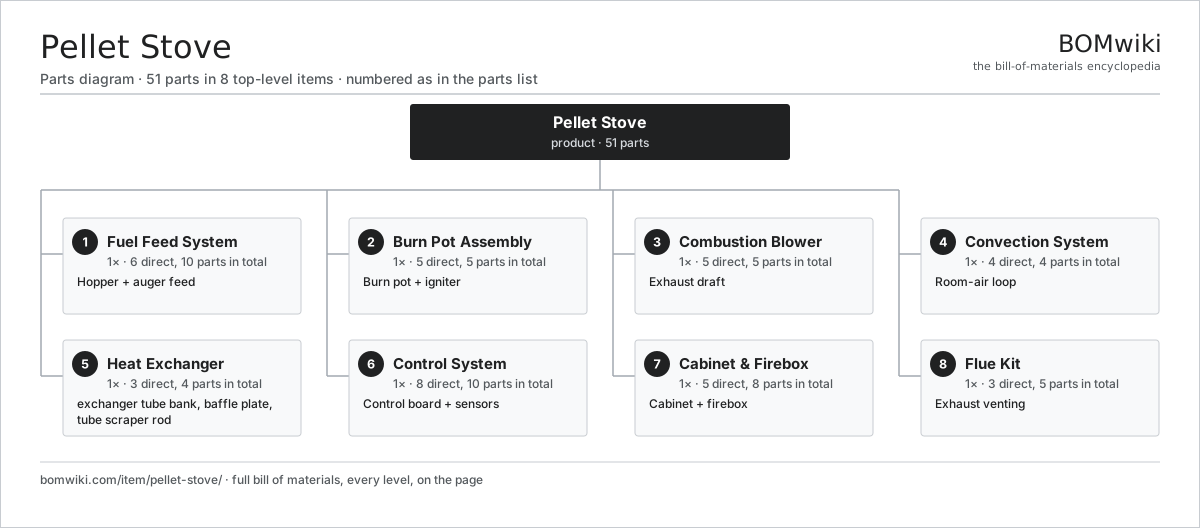
| # | Part | Qty | What it does |
|---|---|---|---|
| 1 | Fuel Feed System 6 parts | 1× | Hopper + auger feed |
| 2 | Burn Pot Assembly 5 parts | 1× | Burn pot + igniter |
| 3 | Combustion Blower 5 parts | 1× | Exhaust draft |
| 4 | Convection System 4 parts | 1× | Room-air loop |
| 5 | Heat Exchanger 3 parts | 1× | Bank of steel tubes between the firebox and the convection path that transfers combustion heat to room air. |
| 6 | Control System 8 parts | 1× | Control board + sensors |
| 7 | Cabinet & Firebox 5 parts | 1× | Cabinet + firebox |
| 8 | Flue Kit 3 parts | 1× | Exhaust venting |
3D model
No 3D model yet. Have a CAD file of this? Add a 3D model. STL renders right on this page; STEP, FreeCAD, and OpenSCAD sources are welcome too (openly licensed, like all 3D models on BOMwiki).
Build & assembly graph
expand / collapse · shared sub-assemblies converge · links to related products · est. labourTap an assembly to expand/collapse · tap a part to open it · use “Open page” for any node · drag to pan, scroll to zoom.
Bill of materials for Pellet Stove
8 top-level lines · 51 rows shown · 51 parts total · indented to 3 levels| # | Item / sub-assembly | Part no. | Qty/assy | Ext. qty | Parts | Type |
|---|---|---|---|---|---|---|
| 1 | Fuel Feed System 6 parts | pellet-stove-fuel-system | 1× | 1 | 10 | assembly |
| 1.1 | Pellet Hopper | pellet-stove-hopper | 1× | 1 | · | part |
| 1.2 | Feed Auger | pellet-stove-auger | 1× | 1 | · | part |
| 1.3 | Auger Gearmotor 4 parts | pellet-stove-auger-motor | 1× | 1 | 5 | assembly |
| 1.3.1 | Copper Winding | copper-winding | 1× | 1 | · | part |
| 1.3.2 | Gearbox Housing | gearbox-housing | 1× | 1 | · | part |
| 1.3.3 | Ball Bearing | ball-bearing | 2× | 2 | · | part |
| 1.3.4 | Connector | connector | 1× | 1 | · | part |
| 1.4 | Drop Chute | pellet-stove-drop-chute | 1× | 1 | · | part |
| 1.5 | Hopper Lid Switch | pellet-stove-hopper-lid-switch | 1× | 1 | · | part |
| 1.6 | Helical Gear Pair | gear-pair | 1× | 1 | · | part |
| 2 | Burn Pot Assembly 5 parts | pellet-stove-burn-assembly | 1× | 1 | 5 | assembly |
| 2.1 | Burn Pot | pellet-stove-burn-pot | 1× | 1 | · | part |
| 2.2 | Cartridge Igniter | pellet-stove-igniter | 1× | 1 | · | part |
| 2.3 | Air Intake Tube | pellet-stove-air-intake-tube | 1× | 1 | · | part |
| 2.4 | Ash Pan | pellet-stove-ash-pan | 1× | 1 | · | part |
| 2.5 | Fastener Set | fastener-set | 1× | 1 | · | part |
| 3 | Combustion Blower 5 parts | pellet-stove-combustion-blower | 1× | 1 | 5 | assembly |
| 3.1 | Blower Motor | blower-motor | 1× | 1 | · | part |
| 3.2 | Exhaust Impeller | pellet-stove-exhaust-impeller | 1× | 1 | · | part |
| 3.3 | Blower Housing | pellet-stove-blower-housing | 1× | 1 | · | part |
| 3.4 | Exhaust Gasket | pellet-stove-exhaust-gasket | 1× | 1 | · | part |
| 3.5 | Connector | connector | 1× | 1 | · | part |
| 4 | Convection System 4 parts | pellet-stove-convection-system | 1× | 1 | 4 | assembly |
| 4.1 | Blower Motor | blower-motor | 1× | 1 | · | part |
| 4.2 | Convection Impeller | pellet-stove-convection-impeller | 1× | 1 | · | part |
| 4.3 | Convection Air Duct | pellet-stove-air-duct | 1× | 1 | · | part |
| 4.4 | Front Outlet Grille | pellet-stove-front-grille | 1× | 1 | · | part |
| 5 | Heat Exchanger 3 parts | pellet-stove-heat-exchanger | 1× | 1 | 4 | assembly |
| 5.1 | Exchanger Tube Bank | pellet-stove-exchanger-tubes | 1× | 1 | · | part |
| 5.2 | Baffle Plate | pellet-stove-baffle-plate | 2× | 2 | · | part |
| 5.3 | Tube Scraper Rod | pellet-stove-scraper-rod | 1× | 1 | · | part |
| 6 | Control System 8 parts | pellet-stove-controller | 1× | 1 | 10 | assembly |
| 6.1 | Bare PCB | pcb-bare | 1× | 1 | · | part |
| 6.2 | Microcontroller | mcu | 1× | 1 | · | part |
| 6.3 | SMD Passive (R/C/L) | smd-passives | 1× | 1 | · | part |
| 6.4 | Relay | relay | 3× | 3 | · | part |
| 6.5 | Exhaust Thermocouple | pellet-stove-exhaust-thermocouple | 1× | 1 | · | part |
| 6.6 | Vacuum Switch | pellet-stove-vacuum-switch | 1× | 1 | · | part |
| 6.7 | Room Thermostat | pellet-stove-room-thermostat | 1× | 1 | · | part |
| 6.8 | LCD Panel | lcd-panel | 1× | 1 | · | part |
| 7 | Cabinet & Firebox 5 parts | pellet-stove-body | 1× | 1 | 8 | assembly |
| 7.1 | Firebox | pellet-stove-firebox | 1× | 1 | · | part |
| 7.2 | Glass Door | pellet-stove-glass-door | 1× | 1 | · | part |
| 7.3 | Door Gasket | pellet-stove-door-gasket | 1× | 1 | · | part |
| 7.4 | Sheet Metal Panel | sheet-panel | 4× | 4 | · | part |
| 7.5 | Fastener Set | fastener-set | 1× | 1 | · | part |
| 8 | Flue Kit 3 parts | pellet-stove-flue-kit | 1× | 1 | 5 | assembly |
| 8.1 | Flue Pipe Section | pellet-stove-flue-pipe | 3× | 3 | · | part |
| 8.2 | Cleanout Tee | pellet-stove-flue-tee | 1× | 1 | · | part |
| 8.3 | Termination Cap | pellet-stove-flue-cap | 1× | 1 | · | part |
Something wrong in this list? Report a problem with this BOM.
Related products
same domain, ranked by shared parts Centrifugal Chiller
340 parts · shares 10 with this page
Centrifugal Chiller
340 parts · shares 10 with this page
 Fan Coil Unit
118 parts · shares 10 with this page
Packaged Rooftop Unit (RTU)
276 parts · shares 10 with this page
Fan Coil Unit
118 parts · shares 10 with this page
Packaged Rooftop Unit (RTU)
276 parts · shares 10 with this page
 Heat Pump
117 parts · shares 10 with this page
Steam Humidifier
207 parts · shares 10 with this page
Heat Pump
117 parts · shares 10 with this page
Steam Humidifier
207 parts · shares 10 with this page
Sourcing: possible vendors
Browse the supplier directory → Prices, MOQ, and lead times are algorithmic estimates, not quotes, and not claims about these companies. Company mappings are curated by keyword; est. price band $100–$20k. How estimates work| Vendor | HQ | Specialty | MOQ | Lead time |
|---|---|---|---|---|
|
🇺🇸Carrier
carrier.com ↗
|
Palm Beach Gardens, US | HVAC | 500 units | 8–14 wks |
| tranetechnologies.com ↗ | Davidson, US | HVAC | 500 units | 8–14 wks |
|
🇯🇵Daikin
daikin.com ↗
|
Osaka, JP | HVAC | 500 units | 8–14 wks |
|
🇺🇸Lennox
lennox.com ↗
|
Richardson, US | HVAC | 500 units | 8–14 wks |
| johnsoncontrols.com ↗ | Milwaukee, US | Building systems | 500 units | 8–14 wks |
956-word article