Pet Microchip Scanner
ProductOverview
A pet microchip scanner reads the passive RFID transponder implanted under the skin of dogs, cats, horses, and other animals, usually between the shoulder blades, and displays the unique 15-digit number that links the animal to its owner in a registry database. The implanted chip is a glass capsule about 2 × 12 mm containing a coil, a tuning capacitor, and an ID chip, with no battery of any kind. Everything needed to power it and hear it answer lives in the scanner, which is why scanner design is dominated by one problem: delivering enough magnetic field to wake a rice-grain-sized device buried in tissue, then detecting a reply signal a million times weaker than the field that provoked it.
How the read works
The scanner's Loop Antenna Coil is a multi-turn loop, 60–120 mm across, resonated at 134.2 kHz by the Tuning Capacitor Network and driven by the Exciter Stage H-bridge. This is inductive near-field coupling, not radio in the propagating sense: the coil and the implant's tiny coil behave like a loosely coupled air-core transformer. Low frequency is the deliberate choice here, 134 kHz fields pass through tissue, fat, and wet coat almost unattenuated, where a UHF tag would be useless inside an animal. The Ferrite Core behind the winding concentrates flux forward and shields the electronics, and the Coil Former keeps winding geometry, and therefore resonance, stable across temperature and drops.
Once the field wakes it, an ISO FDX-B chip replies continuously by load modulation: it switches a resistor across its own coil in the pattern of its data, and that switching reflects back into the reader coil as microvolt-level ripple on the drive carrier. The Band-Pass Filter strips the carrier, the Receive Amplifier lifts the sidebands to logic level, and the Decoder Microcontroller decodes the differential-biphase bitstream, 128 bits at 4.2 kbit/s, including a CRC it verifies before accepting the read. HDX chips, common in livestock, work differently: the reader pulses its field for about 50 ms, then goes silent and listens while the chip transmits an FSK burst from energy stored in a capacitor. A universal scanner alternates FDX-B listening and HDX charge-listen cycles, and retunes via the capacitor network to catch 125 kHz FECAVA and 128 kHz Trovan chips still carried by millions of animals implanted before ISO 11784/11785 harmonization. A complete multi-protocol sweep cycle runs several times per second; the Confirmation Buzzer beeps on a validated read so the operator stops sweeping.
The ID and what it means
The 15-digit ISO number breaks into a 3-digit prefix, either an ISO 3166 country code or a manufacturer code in the 900-series, followed by a 12-digit serial unique within that prefix. The scanner itself stores no owner data and the chip contains none; the number is a database key, and reuniting an animal with its owner means querying the registry the prefix points to. This is why shelters scan every intake animal as standard protocol, and why the universal-frequency capability matters: a legacy-chipped animal read with an ISO-only scanner simply appears unchipped.
Field practicality
Read range is the everyday struggle. An ISO chip reads at 10–20 cm with a good paddle antenna, legacy chips at half that, and range drops further if the chip lies parallel rather than perpendicular to the coil axis or has migrated down a leg, which is why training says sweep the whole animal in an S-pattern, slowly, in both orientations. Metal exam tables detune the antenna and can halve range; experienced staff scan away from the table. The EMI Shield Can and band-pass filtering exist because the reader must hear microvolts while sitting centimeters from LED drivers and switching supplies, including its own.
The rest of the device is field ergonomics. A LiPo Cell with BMS Board protection runs weeks of shelter duty per USB-C charge through the USB-C Charge Port, with the Battery Fuel Gauge reporting state on the backlit LCD Panel. Each read is timestamped by the Real-Time Clock and held in ID Memory, about a thousand records, enough for a mass vaccination clinic, and the Bluetooth LE Module pushes IDs straight into registry-lookup apps on a paired phone. The Housing Shell is flat-faced so it sweeps flush along the animal, the Elastomer Bumper absorbs kennel-floor drops, and the sealed Membrane Keypad and O-Ring Set gasketing tolerate the disinfectant wipe-downs between every animal that shelter protocol requires.
Pet Microchip Scanner parts and their functions
6 top-level parts · 229 parts in total · full bill of materials below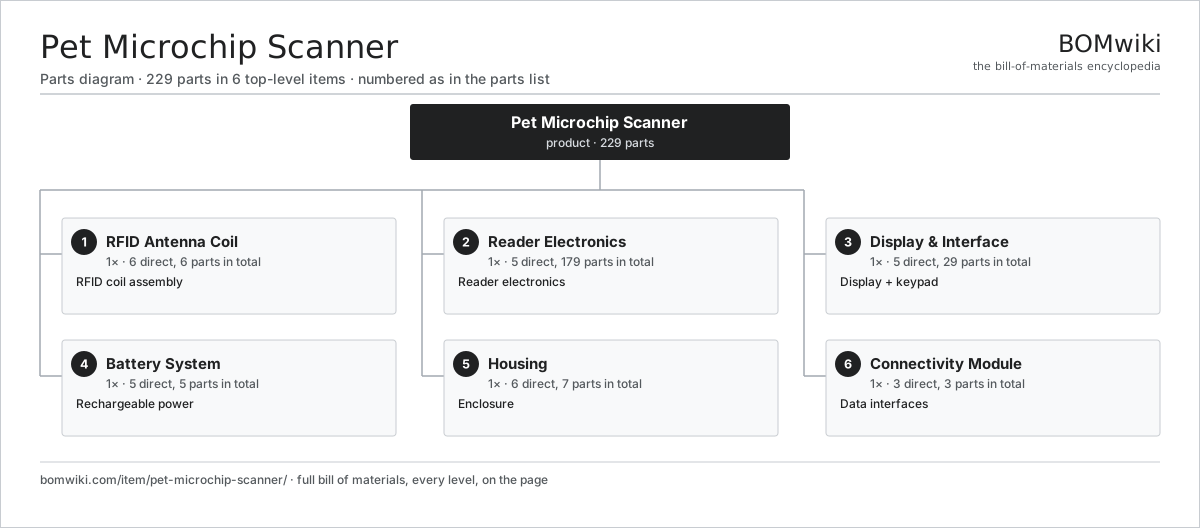
| # | Part | Qty | What it does |
|---|---|---|---|
| 1 | RFID Antenna Coil 6 parts | 1× | RFID coil assembly |
| 2 | Reader Electronics 5 parts | 1× | Reader electronics |
| 3 | Display & Interface 5 parts | 1× | Display + keypad |
| 4 | Battery System 5 parts | 1× | Rechargeable power |
| 5 | Housing 6 parts | 1× | Enclosure |
| 6 | Connectivity Module 3 parts | 1× | Data interfaces |
3D model
No 3D model yet. Have a CAD file of this? Add a 3D model. STL renders right on this page; STEP, FreeCAD, and OpenSCAD sources are welcome too (openly licensed, like all 3D models on BOMwiki).
Build & assembly graph
expand / collapse · shared sub-assemblies converge · links to related products · est. labourTap an assembly to expand/collapse · tap a part to open it · use “Open page” for any node · drag to pan, scroll to zoom.
Bill of materials for Pet Microchip Scanner
6 top-level lines · 46 rows shown · 229 parts total · indented to 3 levels| # | Item / sub-assembly | Part no. | Qty/assy | Ext. qty | Parts | Type |
|---|---|---|---|---|---|---|
| 1 | RFID Antenna Coil 6 parts | pet-microchip-scanner-antenna | 1× | 1 | 6 | assembly |
| 1.1 | Loop Antenna Coil | pet-microchip-scanner-coil | 1× | 1 | · | part |
| 1.2 | Ferrite Core | pet-microchip-scanner-ferrite-core | 1× | 1 | · | part |
| 1.3 | Tuning Capacitor Network | pet-microchip-scanner-tuning-caps | 1× | 1 | · | part |
| 1.4 | Coil Former | pet-microchip-scanner-coil-former | 1× | 1 | · | part |
| 1.5 | EMI Shield Can | pet-microchip-scanner-shield-can | 1× | 1 | · | part |
| 1.6 | Copper Winding | copper-winding | 1× | 1 | · | part |
| 2 | Reader Electronics 5 parts | pet-microchip-scanner-reader | 1× | 1 | 179 | assembly |
| 2.1 | Exciter Stage 3 parts | pet-microchip-scanner-exciter | 1× | 1 | 23 | assembly |
| 2.1.1 | Power MOSFET | mosfet | 2× | 2 | · | part |
| 2.1.2 | SMD Passive (R/C/L) | smd-passives | 20× | 20 | · | part |
| 2.1.3 | Connector | connector | 1× | 1 | · | part |
| 2.2 | Receive Front End 3 parts | pet-microchip-scanner-rx-frontend | 1× | 1 | 37 | assembly |
| 2.2.1 | Band-Pass Filter | pet-microchip-scanner-bpf | 1× | 1 | · | part |
| 2.2.2 | Receive Amplifier | pet-microchip-scanner-rx-amp | 1× | 1 | · | part |
| 2.2.3 | SMD Passive (R/C/L) | smd-passives | 35× | 35 | · | part |
| 2.3 | Decoder Microcontroller | pet-microchip-scanner-decoder-mcu | 1× | 1 | · | part |
| 2.4 | Main Circuit Board 4 parts | pet-microchip-scanner-main-pcb | 1× | 1 | 117 | assembly |
| 2.4.1 | Bare PCB | pcb-bare | 1× | 1 | · | part |
| 2.4.2 | Microcontroller | mcu | 1× | 1 | · | part |
| 2.4.3 | SMD Passive (R/C/L) | smd-passives | 110× | 110 | · | part |
| 2.4.4 | Connector | connector | 5× | 5 | · | part |
| 2.5 | Confirmation Buzzer | pet-microchip-scanner-buzzer | 1× | 1 | · | part |
| 3 | Display & Interface 5 parts | pet-microchip-scanner-display-ui | 1× | 1 | 29 | assembly |
| 3.1 | LCD Panel | lcd-panel | 1× | 1 | · | part |
| 3.2 | Membrane Keypad | pet-microchip-scanner-keypad | 1× | 1 | · | part |
| 3.3 | Display Backlight | pet-microchip-scanner-backlight | 1× | 1 | · | part |
| 3.4 | Bare PCB | pcb-bare | 1× | 1 | · | part |
| 3.5 | SMD Passive (R/C/L) | smd-passives | 25× | 25 | · | part |
| 4 | Battery System 5 parts | pet-microchip-scanner-battery-sys | 1× | 1 | 5 | assembly |
| 4.1 | LiPo Cell | lipo-cell | 1× | 1 | · | part |
| 4.2 | BMS Board | bms-board | 1× | 1 | · | part |
| 4.3 | USB-C Charge Port | pet-microchip-scanner-charge-port | 1× | 1 | · | part |
| 4.4 | Battery Fuel Gauge | pet-microchip-scanner-fuel-gauge | 1× | 1 | · | part |
| 4.5 | Wire Bundle | wire-bundle | 1× | 1 | · | part |
| 5 | Housing 6 parts | pet-microchip-scanner-housing | 1× | 1 | 7 | assembly |
| 5.1 | Housing Shell | pet-microchip-scanner-shell | 2× | 2 | · | part |
| 5.2 | Elastomer Bumper | pet-microchip-scanner-bumper | 1× | 1 | · | part |
| 5.3 | Display Window | pet-microchip-scanner-window | 1× | 1 | · | part |
| 5.4 | O-Ring Set | oring-set | 1× | 1 | · | part |
| 5.5 | Fastener Set | fastener-set | 1× | 1 | · | part |
| 5.6 | Lanyard Post | pet-microchip-scanner-lanyard-post | 1× | 1 | · | part |
| 6 | Connectivity Module 3 parts | pet-microchip-scanner-connectivity | 1× | 1 | 3 | assembly |
| 6.1 | Bluetooth LE Module | pet-microchip-scanner-ble-module | 1× | 1 | · | part |
| 6.2 | ID Memory | pet-microchip-scanner-id-memory | 1× | 1 | · | part |
| 6.3 | Real-Time Clock | pet-microchip-scanner-rtc | 1× | 1 | · | part |
Something wrong in this list? Report a problem with this BOM.
Related products
same domain, ranked by shared parts Dental Diode Laser
441 parts · shares 5 with this page
Veterinary Clipper
178 parts · shares 4 with this page
Dental Diode Laser
441 parts · shares 5 with this page
Veterinary Clipper
178 parts · shares 4 with this page
 Dental Apex Locator
208 parts · shares 5 with this page
Veterinary ICU Cage
293 parts · shares 5 with this page
Veterinary Vital Signs Monitor
858 parts · shares 4 with this page
Dental Apex Locator
208 parts · shares 5 with this page
Veterinary ICU Cage
293 parts · shares 5 with this page
Veterinary Vital Signs Monitor
858 parts · shares 4 with this page
 Veterinary X-Ray System
336 parts · shares 4 with this page
Veterinary X-Ray System
336 parts · shares 4 with this page
Sourcing: possible vendors
Browse the supplier directory → Prices, MOQ, and lead times are algorithmic estimates, not quotes, and not claims about these companies. Company mappings are curated by keyword; est. price band $200–$200k. How estimates work| Vendor | HQ | Specialty | MOQ | Lead time |
|---|---|---|---|---|
| dentsplysirona.com ↗ | Charlotte, US | Dental equipment | 100 units | 10–16 wks |
|
🇺🇸Envista
envistaco.com ↗
|
Brea, US | Dental (KaVo, Nobel) | 100 units | 10–16 wks |
|
🇫🇮Planmeca
planmeca.com ↗
|
Helsinki, FI | Dental units & imaging | 100 units | 10–16 wks |
|
🇺🇸A-dec
a-dec.com ↗
|
Newberg, US | Dental chairs & delivery | 100 units | 10–16 wks |
|
🇺🇸Midmark
midmark.com ↗
|
Versailles, US | Medical & veterinary equipment | 100 units | 10–16 wks |
804-word article