Phoropter
ProductOverview
The phoropter is the lens-bank instrument the optometrist swings in front of a patient's face and asks "which is better, one or two?". It holds more than a hundred ground glass lenses on rotating discs inside two cast housings, one per eye, and lets the examiner present any combination of spherical power, cylindrical power and axis, and prism in fractions of a second, far faster than swapping loose trial lenses. The design is essentially unchanged since the 1920s and is purely mechanical: knobs, geared discs, and detents, no electronics and no power.
Each eye looks through one battery of the Main Body, with the Sphere Lens Bank and Cylinder Mechanism providing the correction, the Jackson Cross Cylinder Unit and Risley Rotary Prism units providing the refinement and binocular tests, and the Auxiliary Lens Disc supplying occluders and special lenses. The PD & Convergence Mechanism mechanism matches the instrument to the patient's pupillary distance, the Near-Point Rod handles reading-distance tests, and the whole 5 kg instrument hangs from the stand by the Mount Arm Interface.
Sphere and cylinder
Spherical power comes from two stacked discs per eye. The Strong Sphere Disc carries high-power lenses in coarse steps; the Weak Sphere Disc adds 0.25 D increments. Geared together behind the Sphere Control Knob, they sum to any value from +16.75 to -19.00 D, with a lever jumping ±3 D blocks during fogging. Every Sphere Lens Cell is an individually surfaced, coated glass lens, and a Detent Click-Stop snaps each disc so the active lens centres exactly on the viewing aperture, a lens decentred by even a millimetre induces unwanted prism.
Astigmatic correction comes from the Cylinder Lens Disc, holding minus-cylinder lenses from 0.25 to 6.00 D in geared rotatable cells. The clever part is the axis drive: every Cylinder Lens Cell meshes with the Axis Ring Gear, so turning the Cylinder Axis Knob rotates whichever cylinder is in place, and all the others, to the same axis. Power changes via the Cylinder Power Knob therefore never disturb the axis setting. American practice uses minus-cylinder instruments; plus-cylinder versions exist mainly for ophthalmological convention.
Refinement and binocular testing
Cylinder axis and power are refined with the Jackson cross cylinder. The Cross Cylinder Lens combines +0.25 and -0.25 D at perpendicular axes (net zero sphere), mounted on a JCC Flip Axle at 45° to those axes. Flipping it presents two mirrored astigmatic states; the examiner straddles the current axis setting, asks which flip is clearer, and walks the axis toward the preferred side, then repeats with the lens axes aligned to refine power. Because the comparison is two equally blurred alternatives rather than blur versus sharp, the endpoint ("both about the same") is precise to a few degrees.
The Risley Rotary Prism implements the Risley principle: two identical Prism Element wedges counter-rotate through a Helical Gear Pair, so their deviations add anywhere from zero to 20 prism diopters as the Prism Power Dial turns. Combined with the Maddox Rod on the auxiliary disc, this measures phorias, latent misalignments of the two eyes, and vergence reserves. The Occluder blanks the untested eye, the Pinhole Disc separates refractive blur from ocular pathology, the Retinoscopy Lens offsets the examiner's 67 cm working distance during objective retinoscopy, and the Polarizing Filter pairs with polarized charts so each eye sees different lines during binocular balance.
Fitting the patient
The PD Leadscrew, threaded left- and right-hand on opposite ends, spreads both batteries symmetrically across a 48–75 mm pupillary distance set on the PD Adjustment Knob. Vertex distance, cornea to lens plane, reference 13.75 mm, is set with the Forehead Rest and checked through the Vertex Distance Scale, because a strong lens moved away from the eye changes its effective power; prescriptions above about ±4 D must be vertex-corrected. The Levelling Bubble Vial and the Levelling Adjuster on the mount keep the 180° axis truly horizontal, without which every measured cylinder axis is rotated.
For near testing the examiner drops the Calibrated Near Rod, slides the Near Vision Card to 40 cm in its Reading Card Holder, and throws the Convergence Lever so both batteries toe in on their Convergence Hinge pivots toward the near point, letting presbyopic add power be tested with the eyes converged as they would be in real reading.
Role today
Autorefractors provide the objective starting point, but the phoropter remains where the final prescription is decided, because only the patient's subjective judgement integrates optics, neural processing, and preference. Digital phoropters motorize the same lens discs under console control; the optical architecture inside is unchanged.
Phoropter parts and their functions
9 top-level parts · 126 parts in total · full bill of materials below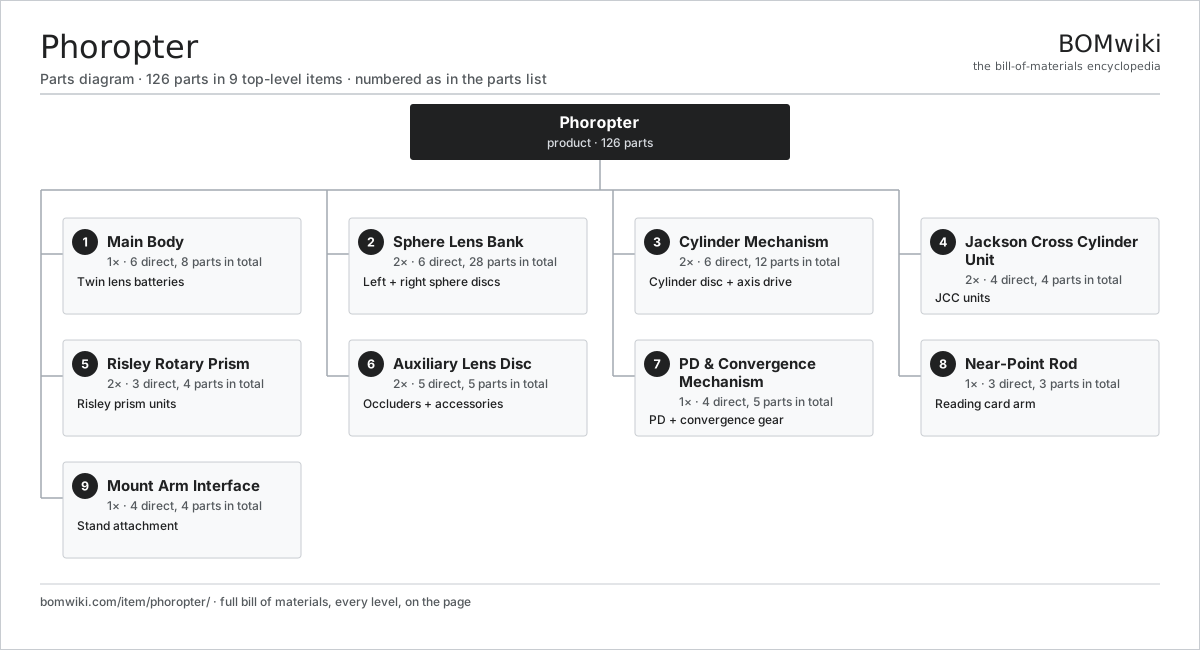
| # | Part | Qty | What it does |
|---|---|---|---|
| 1 | Main Body 6 parts | 1× | Twin lens batteries |
| 2 | Sphere Lens Bank 6 parts | 2× | Left + right sphere discs |
| 3 | Cylinder Mechanism 6 parts | 2× | Cylinder disc + axis drive |
| 4 | Jackson Cross Cylinder Unit 4 parts | 2× | JCC units |
| 5 | Risley Rotary Prism 3 parts | 2× | Risley prism units |
| 6 | Auxiliary Lens Disc 5 parts | 2× | Occluders + accessories |
| 7 | PD & Convergence Mechanism 4 parts | 1× | PD + convergence gear |
| 8 | Near-Point Rod 3 parts | 1× | Reading card arm |
| 9 | Mount Arm Interface 4 parts | 1× | Stand attachment |
3D model
No 3D model yet. Have a CAD file of this? Add a 3D model. STL renders right on this page; STEP, FreeCAD, and OpenSCAD sources are welcome too (openly licensed, like all 3D models on BOMwiki).
Build & assembly graph
expand / collapse · shared sub-assemblies converge · links to related products · est. labourTap an assembly to expand/collapse · tap a part to open it · use “Open page” for any node · drag to pan, scroll to zoom.
Bill of materials for Phoropter
9 top-level lines · 50 rows shown · 126 parts total · indented to 3 levels| # | Item / sub-assembly | Part no. | Qty/assy | Ext. qty | Parts | Type |
|---|---|---|---|---|---|---|
| 1 | Main Body 6 parts | phoropter-main-body | 1× | 1 | 8 | assembly |
| 1.1 | Lens Battery Casting | phoropter-battery-casting | 2× | 2 | · | part |
| 1.2 | Patient Faceplate | phoropter-faceplate | 1× | 1 | · | part |
| 1.3 | Forehead Rest | phoropter-forehead-rest | 1× | 1 | · | part |
| 1.4 | Vertex Distance Scale | phoropter-vertex-scale | 2× | 2 | · | part |
| 1.5 | Levelling Bubble Vial | phoropter-level-vial | 1× | 1 | · | part |
| 1.6 | Fastener Set | fastener-set | 1× | 1 | · | part |
| 2 | Sphere Lens Bank 6 parts | phoropter-sphere-bank | 2× | 2 | 28 | assembly |
| 2.1 | Strong Sphere Disc | phoropter-strong-sphere-disc | 1× | 2 | · | part |
| 2.2 | Weak Sphere Disc | phoropter-weak-sphere-disc | 1× | 2 | · | part |
| 2.3 | Sphere Lens Cell | phoropter-sphere-lens-cell | 21× | 42 | · | part |
| 2.4 | Sphere Control Knob | phoropter-sphere-knob | 1× | 2 | · | part |
| 2.5 | Detent Click-Stop | phoropter-detent-mechanism | 2× | 4 | · | part |
| 2.6 | Ball Bearing | ball-bearing | 2× | 4 | · | part |
| 3 | Cylinder Mechanism 6 parts | phoropter-cylinder-mechanism | 2× | 2 | 12 | assembly |
| 3.1 | Cylinder Lens Disc | phoropter-cylinder-disc | 1× | 2 | · | part |
| 3.2 | Cylinder Lens Cell | phoropter-cylinder-lens-cell | 7× | 14 | · | part |
| 3.3 | Axis Ring Gear | phoropter-axis-ring-gear | 1× | 2 | · | part |
| 3.4 | Cylinder Axis Knob | phoropter-axis-knob | 1× | 2 | · | part |
| 3.5 | Helical Gear Pair | gear-pair | 1× | 2 | · | part |
| 3.6 | Cylinder Power Knob | phoropter-cyl-power-knob | 1× | 2 | · | part |
| 4 | Jackson Cross Cylinder Unit 4 parts | phoropter-cross-cylinder | 2× | 2 | 4 | assembly |
| 4.1 | Cross Cylinder Lens | phoropter-jcc-lens | 1× | 2 | · | part |
| 4.2 | JCC Flip Axle | phoropter-jcc-flip-axle | 1× | 2 | · | part |
| 4.3 | JCC Swing Arm | phoropter-jcc-swing-arm | 1× | 2 | · | part |
| 4.4 | Coil Spring | coil-spring | 1× | 2 | · | part |
| 5 | Risley Rotary Prism 3 parts | phoropter-rotary-prism | 2× | 2 | 4 | assembly |
| 5.1 | Prism Element | phoropter-prism-element | 2× | 4 | · | part |
| 5.2 | Prism Power Dial | phoropter-prism-dial | 1× | 2 | · | part |
| 5.3 | Helical Gear Pair | gear-pair | 1× | 2 | · | part |
| 6 | Auxiliary Lens Disc 5 parts | phoropter-auxiliary-disc | 2× | 2 | 5 | assembly |
| 6.1 | Occluder | phoropter-occluder | 1× | 2 | · | part |
| 6.2 | Pinhole Disc | phoropter-pinhole | 1× | 2 | · | part |
| 6.3 | Maddox Rod | phoropter-maddox-rod | 1× | 2 | · | part |
| 6.4 | Retinoscopy Lens | phoropter-retinoscopy-lens | 1× | 2 | · | part |
| 6.5 | Polarizing Filter | phoropter-polarizer | 1× | 2 | · | part |
| 7 | PD & Convergence Mechanism 4 parts | phoropter-pd-convergence | 1× | 1 | 5 | assembly |
| 7.1 | PD Leadscrew | phoropter-pd-leadscrew | 1× | 1 | · | part |
| 7.2 | PD Adjustment Knob | phoropter-pd-knob | 1× | 1 | · | part |
| 7.3 | Convergence Hinge | phoropter-convergence-hinge | 2× | 2 | · | part |
| 7.4 | Convergence Lever | phoropter-convergence-lever | 1× | 1 | · | part |
| 8 | Near-Point Rod 3 parts | phoropter-near-rod | 1× | 1 | 3 | assembly |
| 8.1 | Calibrated Near Rod | phoropter-rod | 1× | 1 | · | part |
| 8.2 | Reading Card Holder | phoropter-card-holder | 1× | 1 | · | part |
| 8.3 | Near Vision Card | phoropter-near-card | 1× | 1 | · | part |
| 9 | Mount Arm Interface 4 parts | phoropter-mount-arm | 1× | 1 | 4 | assembly |
| 9.1 | Mount Yoke | phoropter-mount-yoke | 1× | 1 | · | part |
| 9.2 | Levelling Adjuster | phoropter-level-adjuster | 1× | 1 | · | part |
| 9.3 | Coil Spring | coil-spring | 1× | 1 | · | part |
| 9.4 | Fastener Set | fastener-set | 1× | 1 | · | part |
Something wrong in this list? Report a problem with this BOM.
Related products
same domain, ranked by shared parts Surgical Microscope
122 parts · shares 3 with this page
Surgical Microscope
122 parts · shares 3 with this page
 Syringe Pump
252 parts · shares 3 with this page
Surgical Stapler
33 parts · shares 2 with this page
Syringe Pump
252 parts · shares 3 with this page
Surgical Stapler
33 parts · shares 2 with this page
 Mobility Scooter
89 parts · shares 2 with this page
Mobility Scooter
89 parts · shares 2 with this page
 Slit Lamp
125 parts · shares 2 with this page
Slit Lamp
125 parts · shares 2 with this page
 Surgical Light
278 parts · shares 2 with this page
Surgical Light
278 parts · shares 2 with this page
Sourcing: possible vendors
Browse the supplier directory → Prices, MOQ, and lead times are algorithmic estimates, not quotes, and not claims about these companies. Company mappings are curated by keyword; est. price band $500–$3M. How estimates work| Vendor | HQ | Specialty | MOQ | Lead time |
|---|---|---|---|---|
| gehealthcare.com ↗ | Chicago, US | Medical imaging & devices | 100 units | 12–20 wks |
| siemens-healthineers.com ↗ | Erlangen, DE | Medical systems | 100 units | 12–20 wks |
|
🇳🇱Philips
philips.com ↗
|
Amsterdam, NL | Health technology | 100 units | 12–20 wks |
| medtronic.com ↗ | Minneapolis, US | Medical devices | 100 units | 12–20 wks |
|
🇨🇳Mindray
mindray.com ↗
|
Shenzhen, CN | Medical devices | 100 units | 12–20 wks |
796-word article