Portative Pipe Organ
ProductOverview
The portative pipe organ is a portable medieval and renaissance orchestral instrument combining twelve to twenty-four flue pipes with a small keyboard and hand-operated bellows. Small enough to rest on the player's lap or a table, it produces a rich, reedy sound suitable for both sacred polyphony and secular song accompaniment. The keyboard typically covers one octave (C to G or full C), allowing melodic support in choral and ensemble settings.
Air supply comes from dual bellows pumped by the player's left hand while the right hand plays the keys. The bellows compress air into the windchest, an internal chamber that distributes pressure to the pipe bank. Register sliders select which pipes sound, enabling timbral variety within the compact design.
Unlike large church organs, portatives were fully portable, often carried in processions or moved between venues. Historical examples survive from the 13th–17th centuries; modern reproductions follow original designs and are played in early music ensembles, religious processions, and historical reenactments.
How it works
The portative organ operates on the principle of air pressure and selective valve opening. When the player squeezes the bellows, air flows through the air duct into the windchest, where pressure stabilizes at 40–80 pascals (a gentle, continuous pressure). This steady pressure is critical: too low and pipes starve for air; too high and the tone becomes coarse.
When a key is pressed, a mechanical linkage (typically a wooden lever and pin mechanism) opens a pallet, a small valve beneath a specific pipe group. Air rushes from the windchest through the open pallet and into a pipe's windway (the narrow channel at the base of the pipe). The air sheet strikes the pipe's languid (a horizontal stopper inside the pipe), creating a pressure discontinuity that causes the air stream to split and oscillate. This oscillation generates sound at the pipe's natural resonant frequency.
Register sliders are wooden rods that can block or expose different groups of pipes. Sliding a register open adds those pipes to the active set; closing it mutes them. A typical portative might have four registers: principal (main 8' tone), flute (softer, wider pipes), stopped (wooden pipes with plugged ends, sounding lower), and diapason (warm, foundational).
The pipe design is critical. Open flue pipes have both ends open and produce bright, clear tones. Stopped wooden pipes have a plugged top, doubling their acoustic length and producing a lower, mellower pitch than the equivalent open pipe. Pipes are ranked by pitch: the smallest pipes sound the highest notes, and the largest produce the lowest.
The bellows must be pumped steadily and evenly, a skilled portative player maintains constant pressure with intuitive hand motions while playing melody with the right hand. Historical accounts describe a two-person team: one playing keys and one pumping, though experienced solo players manage both simultaneously.
Construction and regional variants
Medieval portative organs from France and Spain (13th–14th centuries) featured 8–12 pipes with simple diatonic keyboards. By the 15th–16th centuries, Flemish and Italian makers expanded to 20–30 pipes and added chromatic keys, enabling polyphonic performance. The instrument fell out of favor after 1700 as larger, stationary organs became standard, but revival interest from early music specialists has renewed production.
Authentic reproductions use period materials: spruce and pine for cases, tin-lead for treble pipes, and hardwood (ash, oak, maple) for bass pipes and structure. Hide glue (not modern adhesive) was traditional. Leather for bellows is treated with oil to maintain flexibility and air-tightness. String instruments were often paired with the portative: a portative with vielle (bowed fiddle) or harp was a typical trio sound in court music.
Portatives are among the most challenging historical instruments to restore: 500-year-old leather bellows must be replicated, pipe dents require careful re-planing, and tuning drains hours of skilled work. Museums rarely display fully playable examples; most surviving instruments are visual artifacts.
Portative Pipe Organ parts and their functions
6 top-level parts · 67 parts in total · full bill of materials below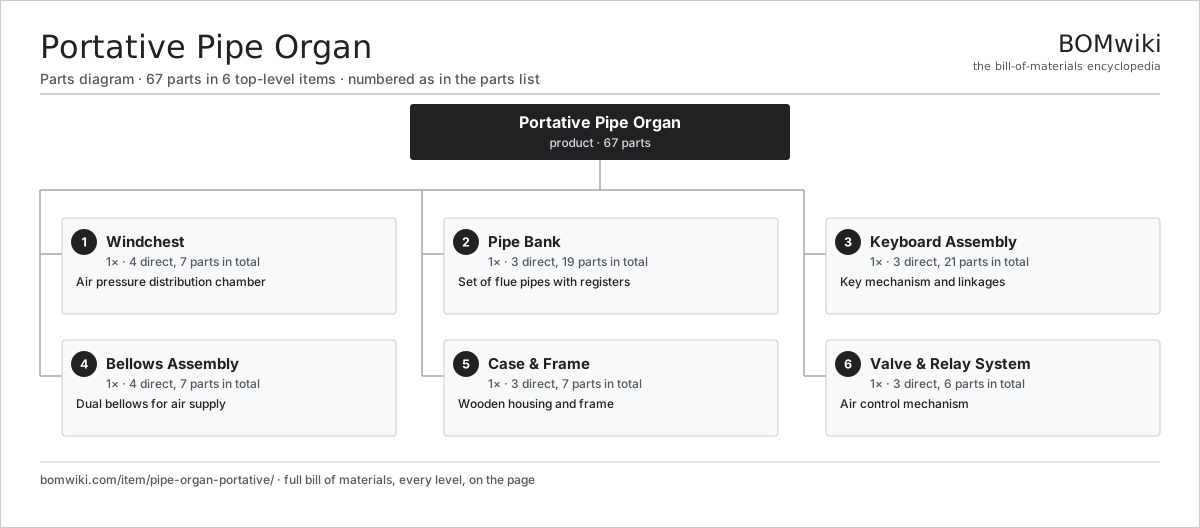
| # | Part | Qty | What it does |
|---|---|---|---|
| 1 | Windchest 4 parts | 1× | Air pressure distribution chamber |
| 2 | Pipe Bank 3 parts | 1× | Set of flue pipes with registers |
| 3 | Keyboard Assembly 3 parts | 1× | Key mechanism and linkages |
| 4 | Bellows Assembly 4 parts | 1× | Dual bellows for air supply |
| 5 | Case & Frame 3 parts | 1× | Wooden housing and frame |
| 6 | Valve & Relay System 3 parts | 1× | Air control mechanism |
3D model
No 3D model yet. Have a CAD file of this? Add a 3D model. STL renders right on this page; STEP, FreeCAD, and OpenSCAD sources are welcome too (openly licensed, like all 3D models on BOMwiki).
Build & assembly graph
expand / collapse · shared sub-assemblies converge · links to related products · est. labourTap an assembly to expand/collapse · tap a part to open it · use “Open page” for any node · drag to pan, scroll to zoom.
Bill of materials for Portative Pipe Organ
6 top-level lines · 26 rows shown · 67 parts total · indented to 3 levels| # | Item / sub-assembly | Part no. | Qty/assy | Ext. qty | Parts | Type |
|---|---|---|---|---|---|---|
| 1 | Windchest 4 parts | pipe-organ-portative-windchest | 1× | 1 | 7 | assembly |
| 1.1 | Windchest Body | pipe-organ-portative-windchest-body | 1× | 1 | · | part |
| 1.2 | Windchest Top Plate | pipe-organ-portative-windchest-top | 1× | 1 | · | part |
| 1.3 | Fastener Set | fastener-set | 1× | 1 | · | part |
| 1.4 | Register Slider | pipe-organ-portative-slider | 4× | 4 | · | part |
| 2 | Pipe Bank 3 parts | pipe-organ-portative-pipes | 1× | 1 | 19 | assembly |
| 2.1 | Open Flue Pipe | pipe-organ-portative-pipe-open | 12× | 12 | · | part |
| 2.2 | Stopped Wooden Pipe | pipe-organ-portative-pipe-stopped | 6× | 6 | · | part |
| 2.3 | Pipe Rank Set | pipe-organ-portative-pipe-rank-set | 1× | 1 | · | part |
| 3 | Keyboard Assembly 3 parts | pipe-organ-portative-keyboard | 1× | 1 | 21 | assembly |
| 3.1 | Key Top | pipe-organ-portative-key-blank | 10× | 10 | · | part |
| 3.2 | Key Lever | pipe-organ-portative-key-lever | 10× | 10 | · | part |
| 3.3 | Fastener Set | fastener-set | 1× | 1 | · | part |
| 4 | Bellows Assembly 4 parts | pipe-organ-portative-bellows | 1× | 1 | 7 | assembly |
| 4.1 | Bellows Frame | pipe-organ-portative-bellows-frame | 2× | 2 | · | part |
| 4.2 | Bellows Leather | pipe-organ-portative-bellows-leather | 2× | 2 | · | part |
| 4.3 | Fastener Set | fastener-set | 2× | 2 | · | part |
| 4.4 | Air Duct | pipe-organ-portative-air-duct | 1× | 1 | · | part |
| 5 | Case & Frame 3 parts | pipe-organ-portative-case | 1× | 1 | 7 | assembly |
| 5.1 | Sheet Metal Panel | sheet-panel | 4× | 4 | · | part |
| 5.2 | Fastener Set | fastener-set | 1× | 1 | · | part |
| 5.3 | Carrying Handle | pipe-organ-portative-carrying-handle | 2× | 2 | · | part |
| 6 | Valve & Relay System 3 parts | pipe-organ-portative-valve-system | 1× | 1 | 6 | assembly |
| 6.1 | Register Slider | pipe-organ-portative-slider | 4× | 4 | · | part |
| 6.2 | Roller Board | pipe-organ-portative-roller-board | 1× | 1 | · | part |
| 6.3 | Fastener Set | fastener-set | 1× | 1 | · | part |
Something wrong in this list? Report a problem with this BOM.
Sourcing: possible vendors
Browse the supplier directory → Prices, MOQ, and lead times are algorithmic estimates, not quotes, and not claims about these companies. Company mappings are curated by keyword; est. price band $50–$5k. How estimates work| Vendor | HQ | Specialty | MOQ | Lead time |
|---|---|---|---|---|
| yamaha.com ↗ | Hamamatsu, JP | Audio & instruments | 200 units | 8–14 wks |
|
🇺🇸Fender
fender.com ↗
|
Los Angeles, US | Guitars & amps | 200 units | 8–14 wks |
|
🇺🇸Gibson
gibson.com ↗
|
Nashville, US | Guitars | 200 units | 8–14 wks |
|
🇯🇵Roland
roland.com ↗
|
Hamamatsu, JP | Electronic instruments | 200 units | 8–14 wks |
| steinway.com ↗ | New York, US | Pianos | 200 units | 8–14 wks |
710-word article