PIR Motion Detector
ProductOverview
A PIR (passive infrared) motion detector is a non-intrusive sensor that detects body heat motion in a monitored space. It contains a pyroelectric infrared sensor that responds to thermal radiation in the 8–14 micrometer wavelength band, which matches the peak radiation of human body heat (approximately 37 °C surface temperature).
PIR detectors are ubiquitous in building security systems. They provide occupancy detection for lighting and HVAC automation, trigger perimeter alarms when an intruder moves through a space, and integrate with access control systems to detect loitering or intrusion. A single PIR detector can monitor an area of 80–120 square meters, making them cost-effective compared to other sensor technologies.
How it works
The pyroelectric sensor element is a small crystal (typically 2×2 mm) that generates an electrical charge proportional to incident infrared radiation. At room temperature, the sensor receives infrared radiation from walls, furniture, and ambient heat. This static radiation produces no output (the sensor equilibrates).
When a warm body (person, animal) moves through the field of view, the infrared radiation pattern changes. The sensor detects this change as a rapid temperature fluctuation and generates a small voltage pulse (micro-volts). The analog signal processor amplifies this pulse by 100,000×, extracting it from thermal noise.
The fresnel lens array is critical to the sensor's function. The lens has multiple segments (16–100 depending on the field-of-view design), each focusing infrared radiation from a different zone of the monitored space onto the sensor element. As a person walks across the lens field, they move from one lens zone to the next. This scanning motion across the lens segments creates a distinctive pattern of alternating warm-cool detection pulses that is unmistakable from the sensor's perspective.
The digital processor analyzes the motion signal to distinguish true human motion from false alarms:
Pattern matching: Human motion creates a specific signature, a series of thermal pulses as the person crosses lens zones. The processor looks for patterns consistent with human gait (0.5–2 Hz motion frequency).
Temperature rate-of-change: A person moving into the detection zone causes a rapid temperature rise (0.5–3 °C per second). Slow thermal drift (ambient temperature change over minutes) does not trigger alarm.
Duration filtering: A valid motion event must last 1–2 seconds (duration of human crossing a lens zone). Brief spikes (<500 ms) are typically noise.
Hysteresis: Once motion is detected, the processor triggers the alarm relay. The relay remains active for a hold time (30–60 seconds) after the last motion is detected. This prevents the relay from chattering on/off if the person is mostly stationary.
Fresnel lens design and field of view
The fresnel lens is a flat plastic diffraction lens etched with concentric rings. Unlike a simple magnifying lens that focuses light to a point, a fresnel lens redirects radiation at different angles based on the zone in which the radiation arrives. The multiple segments in the fresnel array divide the monitored space into a pattern of alternating sensitive and insensitive zones.
For example, a 16-zone lens with 4 vertical and 4 horizontal segments creates a grid of 16 rectangular zones in the field of view. Each zone corresponds to a specific angle from the sensor. As a person walks across the monitored space, they pass through this pattern of zones, creating a distinctive temporal signature of alternating high and low infrared signals.
This zoning provides two benefits:
Motion directionality: By analyzing the sequence of zone activation, advanced processors can determine the direction of motion (left-to-right, approaching, departing). This allows rejection of false alarms from wind-blown curtains or thermal reflections (which create non-directional, random zone patterns).
Coverage efficiency: A single sensor with a 100–120° field of view can cover a large area (up to 300 square meters for a ceiling-mounted detector in a high-ceiling warehouse).
The trade-off is range: a 15-meter range typically assumes a full-size adult human (0.5 m² surface area). Smaller targets (children, animals) or targets moving slowly have reduced detection range.
Pet immunity and false alarm reduction
Standard PIR detectors generate false alarms from pets (cats, dogs) moving through the monitored space. To address this, manufacturers use multiple mitigation strategies:
Pet-immune models: These detectors use signal processing to distinguish human motion from animal motion. The algorithm assumes that humans typically move in a consistent direction at a human walking speed (1–2 m/s), while pets move in erratic patterns and at variable speeds. Some pet-immune models mechanically mask the lower 0.5–1 meter of the fresnel lens, so only motion above pet height triggers alarm. This allows pets to roam freely while detecting taller human intruders.
Dual-element technology: The dual-element sensor has two adjacent pyroelectric crystals. A true motion event (person moving across the lens) activates both elements in sequence. Many false alarms (wind-induced thermal reflections, direct sunlight) activate only one element. The processor requires both elements to show correlated motion before alarming.
Temperature compensation: Ambient temperature drifts over hours or days (especially near windows or vents). The processor subtracts the baseline thermal level, so only rapid temperature changes (indicative of body heat motion) trigger detection. This prevents false alarms from slow thermal expansion or contraction of walls and furniture.
Immunity windows: The processor can be configured to ignore motion in certain time windows. For example, a retail store might disable the PIR detector during business hours (8 AM–8 PM) when legitimate motion is expected, enabling it only after-hours.
Installation and commissioning
PIR detectors should be mounted on walls or ceilings at a height of 1.2–2.4 meters, ideally with an unobstructed view of the monitored area. Placement considerations:
- Height: Mounted at 1.5–2.0 m on a wall (typical human eye level) provides optimal thermal signature detection. Mounting too low (near floor) or too high (near ceiling) reduces sensitivity to human motion.
- Clear sight line: Furniture, curtains, or large objects should not block the field of view. A person should be visible to the detector.
- Avoid direct heat sources: Placement directly above radiators, air vents, or windows can cause false alarms from thermal turbulence. Mounting away from these sources is preferable.
- Angle: Detectors are more sensitive to motion across the field of view (perpendicular to the line of sight) than to motion directly approaching. Optimal mounting angles the detector toward expected traffic corridors.
Commissioning involves verifying detection range and sensitivity. An installer walks through the monitored area at various distances and directions, verifying that motion is consistently detected within the specified range. The sensitivity potentiometer allows fine-tuning for the specific environment. Sensitivity is typically adjusted down (less sensitive) if false alarms occur, and up (more sensitive) if the detector misses legitimate motion.
Alarm output and integration
The relay output is a simple normally-open (NO) contact that closes when motion is detected. The relay remains closed for the hold time (typically 30–60 seconds), then opens if no additional motion is detected. This allows integration with standard intrusion alarm panels:
- Loop supervision: The alarm panel continuously supervises the relay contact to verify the detector is connected and functioning.
- Motion zone: The panel treats the detector as a security zone; motion triggers a zone violation that can be programmed to sound a siren, send a silent alarm to the monitoring station, or unlock doors (in access control mode).
- Multiple detectors: Large facilities connect multiple PIR detectors to separate zones on an alarm panel, allowing different response strategies for different areas (e.g., warehouse perimeter vs. office area).
The tamper switch detects if the detector is removed from its mount or if the fresnel lens is covered. Tampering generates a trouble signal that the alarm panel typically logs and reports, alerting security personnel to a potential intrusion attempt.
Thermal and seasonal effects
PIR detector performance is sensitive to ambient temperature:
- Winter (cold walls): A warm person entering a cold room creates a large thermal contrast. Detection is reliable and sensitive.
- Summer (warm walls): As the room temperature approaches body temperature, the thermal contrast decreases. Detection range degrades and false alarms from ambient thermal reflections increase.
- Direct sunlight: Sunlight through windows can heat walls, creating non-directional thermal patterns that occasionally trigger false alarms.
Modern detectors use temperature-compensated signal processing to adapt to ambient conditions, but performance variations are inevitable. Facilities in harsh seasonal climates (hot summers, cold winters) may require sensitivity adjustment twice yearly.
Maintenance and aging
The pyroelectric sensor element is passive and has no moving parts, so failure is rare. However, the fresnel lens accumulates dust over time. Periodic gentle cleaning of the lens with a soft, dry cloth restores detection range; heavy dust buildup can degrade range by 20–30%.
The analog amplifier circuits occasionally develop age-related drift, especially in high-temperature environments (near vents, direct sunlight). If a detector shows reduced sensitivity despite lens cleaning, component replacement may be necessary after 5–10 years of service.
The relay contacts wear with repeated switching. A relay that has closed/opened millions of times may develop contact oxidation or microweld, causing the relay to stick in the closed or open position. Relay replacement is a straightforward repair.
Comparison with other motion detection technologies
Microwave motion sensors: Use 10.5 GHz radar to detect motion. Microwaves penetrate walls and can detect motion through glass. However, they are prone to false alarms from nearby motion outside the monitored space (people walking in adjacent rooms) and consume more power than PIR.
Dual-technology detectors: Combine PIR and microwave sensing. Both sensors must detect motion before alarming, reducing false alarms to <0.1 per year. Cost is higher but reliability is superior in difficult environments.
Video motion detection: Uses cameras with AI-based analysis to detect human motion. Very reliable but requires adequate lighting and is subject to privacy concerns. More expensive than passive sensors.
Pressure-mat switches: Detect occupants by floor pressure. Require installation under flooring and are high-maintenance. Useful in confined spaces (closets, vaults) where PIR has insufficient range.
For general-purpose intrusion detection, PIR remains the most cost-effective and reliable technology, especially when combined with other sensors (door contacts, glass-break detectors, acoustic sensors) for defense-in-depth.
PIR Motion Detector parts and their functions
8 top-level parts · 20 parts in total · full bill of materials below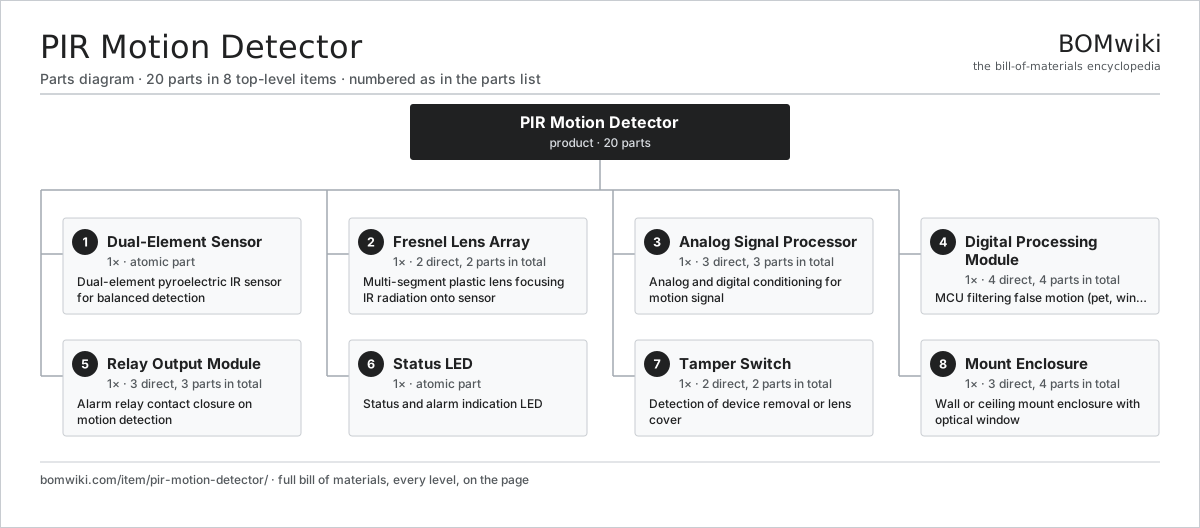
| # | Part | Qty | What it does |
|---|---|---|---|
| 1 | Dual-Element Sensor | 1× | Dual-element pyroelectric IR sensor for balanced detection |
| 2 | Fresnel Lens Array 2 parts | 1× | Multi-segment plastic lens focusing IR radiation onto sensor |
| 3 | Analog Signal Processor 3 parts | 1× | Analog and digital conditioning for motion signal |
| 4 | Digital Processing Module 4 parts | 1× | MCU filtering false motion (pet, wind, thermal drift) |
| 5 | Relay Output Module 3 parts | 1× | Alarm relay contact closure on motion detection |
| 6 | Status LED | 1× | Status and alarm indication LED |
| 7 | Tamper Switch 2 parts | 1× | Detection of device removal or lens cover |
| 8 | Mount Enclosure 3 parts | 1× | Wall or ceiling mount enclosure with optical window |
3D model
No 3D model yet. Have a CAD file of this? Add a 3D model. STL renders right on this page; STEP, FreeCAD, and OpenSCAD sources are welcome too (openly licensed, like all 3D models on BOMwiki).
Build & assembly graph
expand / collapse · shared sub-assemblies converge · links to related products · est. labourTap an assembly to expand/collapse · tap a part to open it · use “Open page” for any node · drag to pan, scroll to zoom.
Bill of materials for PIR Motion Detector
8 top-level lines · 25 rows shown · 20 parts total · indented to 3 levels| # | Item / sub-assembly | Part no. | Qty/assy | Ext. qty | Parts | Type |
|---|---|---|---|---|---|---|
| 1 | Dual-Element Sensor | pir-motion-detector-sensor-element | 1× | 1 | · | part |
| 2 | Fresnel Lens Array 2 parts | pir-motion-detector-fresnel-lens | 1× | 1 | 2 | assembly |
| 2.1 | Sheet Metal Panel | sheet-panel | 1× | 1 | · | part |
| 2.2 | Fastener Set | fastener-set | 1× | 1 | · | part |
| 3 | Analog Signal Processor 3 parts | pir-motion-detector-signal-processor | 1× | 1 | 3 | assembly |
| 3.1 | Bare PCB | pcb-bare | 1× | 1 | · | part |
| 3.2 | SMD Passive (R/C/L) | smd-passives | 1× | 1 | · | part |
| 3.3 | Connector | connector | 1× | 1 | · | part |
| 4 | Digital Processing Module 4 parts | pir-motion-detector-processing-module | 1× | 1 | 4 | assembly |
| 4.1 | Microcontroller | mcu | 1× | 1 | · | part |
| 4.2 | Bare PCB | pcb-bare | 1× | 1 | · | part |
| 4.3 | SMD Passive (R/C/L) | smd-passives | 1× | 1 | · | part |
| 4.4 | Connector | connector | 1× | 1 | · | part |
| 5 | Relay Output Module 3 parts | pir-motion-detector-relay-output | 1× | 1 | 3 | assembly |
| 5.1 | Relay | relay | 1× | 1 | · | part |
| 5.2 | Power MOSFET | mosfet | 1× | 1 | · | part |
| 5.3 | Connector | connector | 1× | 1 | · | part |
| 6 | Status LED | pir-motion-detector-led-indicator | 1× | 1 | · | part |
| 7 | Tamper Switch 2 parts | pir-motion-detector-tamper-switch | 1× | 1 | 2 | assembly |
| 7.1 | Connector | connector | 1× | 1 | · | part |
| 7.2 | Coil Spring | coil-spring | 1× | 1 | · | part |
| 8 | Mount Enclosure 3 parts | pir-motion-detector-housing | 1× | 1 | 4 | assembly |
| 8.1 | Sheet Metal Panel | sheet-panel | 2× | 2 | · | part |
| 8.2 | Fastener Set | fastener-set | 1× | 1 | · | part |
| 8.3 | Connector | connector | 1× | 1 | · | part |
Something wrong in this list? Report a problem with this BOM.
Related products
same domain, ranked by shared parts Access Control Panel
52 parts · shares 4 with this page
Access Control Panel
52 parts · shares 4 with this page
 Automatic Swing Door Operator
43 parts · shares 4 with this page
Electric Strike
23 parts · shares 4 with this page
Automatic Swing Door Operator
43 parts · shares 4 with this page
Electric Strike
23 parts · shares 4 with this page
 Electronic Key Cabinet
92 parts · shares 4 with this page
Electronic Key Cabinet
92 parts · shares 4 with this page
 Glass Break Detector
19 parts · shares 4 with this page
Glass Break Detector
19 parts · shares 4 with this page
 Intrusion Alarm Panel
40 parts · shares 4 with this page
Intrusion Alarm Panel
40 parts · shares 4 with this page
Sourcing: possible vendors
Browse the supplier directory → Prices, MOQ, and lead times are algorithmic estimates, not quotes, and not claims about these companies. Company mappings are curated by keyword; est. price band $50–$10k. How estimates work| Vendor | HQ | Specialty | MOQ | Lead time |
|---|---|---|---|---|
| assaabloy.com ↗ | Stockholm, SE | Locks & access | 1,000 units | 8–12 wks |
|
🇺🇸Allegion
allegion.com ↗
|
Dublin, US | Security products (Schlage) | 1,000 units | 8–12 wks |
| dormakaba.com ↗ | Rümlang, CH | Access & door systems | 1,000 units | 8–12 wks |
| honeywell.com ↗ | Charlotte, US | Building & safety tech | 1,000 units | 8–12 wks |
| hikvision.com ↗ | Hangzhou, CN | Surveillance & security | 1,000 units | 8–12 wks |
1,796-word article