Baseball Pitching Machine
ProductOverview
A two-wheel pitching machine throws baseballs by squeezing them between a pair of counter-rotating wheels spinning at high surface speed. Each ball drops from the Ball Feed System into the Throat Chute, gets pinched by the two Pitching Wheel treads in the Wheel Drive, and leaves the machine at the wheels' surface speed. Because the two wheels are driven by separate motors, running them at different speeds puts spin on the ball, which is how the machine throws curveballs, sliders, and changeups as well as straight fastballs. The head sits on a Head Mount atop a Tripod Base, aimed at the strike zone from the regulation 18.4 m (60 ft 6 in) pitching distance.
How it works
The throwing physics are simple: ball exit speed approximately equals the average surface speed of the two wheels at the pinch point. A 380 mm wheel at 2,200 rpm has a surface speed of about 44 m/s, or 158 km/h, so the full major-league speed range is available from modest motor rpm. The Wheel Gap Adjuster sets the wheel gap so the ball is compressed roughly 20-25 mm as it passes through; too little compression and the wheels slip on the leather, too much and the ball scuffs and the motors bog down.
Spin comes from differential speed. If the top wheel runs faster than the bottom, the ball leaves with topspin and breaks downward like a curveball; bottom-wheel-fast gives backspin and a riding fastball; with the head rolled 45° the same offsets produce sliders and screwballs. Each Pitching Wheel Module therefore has its own Wheel Motor with a Hall Sensor feeding rpm back to the Motor Drive Board, which holds the commanded speed under load. This closed loop matters: every pitch dumps energy out of the wheels (the ball can absorb 100-150 J), and the controller must spin them back up to the setpoint before the next ball arrives, otherwise consecutive pitches drift slower.
Ball feed
The Ball Hopper holds a tray of balls that gravity-feeds the Feed Wheel, a slotted indexing wheel turned by a Servo Motor. Each index step singulates exactly one ball and drops it down the Feed Tube into the throat. A Ball Sensor confirms the drop, which serves two purposes: it restarts the feed-interval timer (typically 5-15 seconds, set on the control panel) and it increments the pitch counter shown on the LCD Panel. The sensor also gives the batter a consistent visual cue window, coaches rely on the fixed delay between the ball disappearing into the machine and the pitch release to train timing.
Controls and safety
The Control Unit carries two Speed Dial encoders, one per wheel, plus the display and the feed-rate control. The Motor Drive Board uses an Microcontroller and four Power MOSFET half-bridges to PWM the motors; a master Relay in series with the motor supply is dropped by the Emergency Stop mushroom switch, coasting both wheels to a stop in a few seconds. Wheels storing several hundred joules of rotational energy are the main hazard, so the Guard Set encloses everything except the ball path: a Wheel Guard over each wheel, a Feed Guard over the indexing wheel, and an Exit Shroud that blocks side access to the pinch gap.
Aiming and stability
Pitch location is set mechanically, not electronically. The Elevation Screw tilts the Pivot Yoke to move the pitch up and down in the zone, and the graduated Swivel Base rotates the whole head for inside/outside location; Lock Handle clamps fix each axis once dialled in. Repeatability depends on the base staying put: each pitch produces a recoil impulse, so the Tripod Base spreads three Tripod Leg feet over a wide footprint, with Leg Lock Collar collars and a rigid Support Mast holding release height near 1.5 m to mimic a pitcher's release point. Two Wheel Assembly transport wheels let one coach roll the 40-60 kg machine on and off the field. Power comes from mains or a field generator through the internal Power Supply, with the Wire Bundle routing motor and sensor lines up the mast.
Machine-pitch accuracy is what makes the tool useful: a well-set two-wheel machine groups pitches within about 10 cm at the plate, letting hitters take hundreds of identical reps per session, far more than any live arm can throw.
Baseball Pitching Machine parts and their functions
9 top-level parts · 144 parts in total · full bill of materials below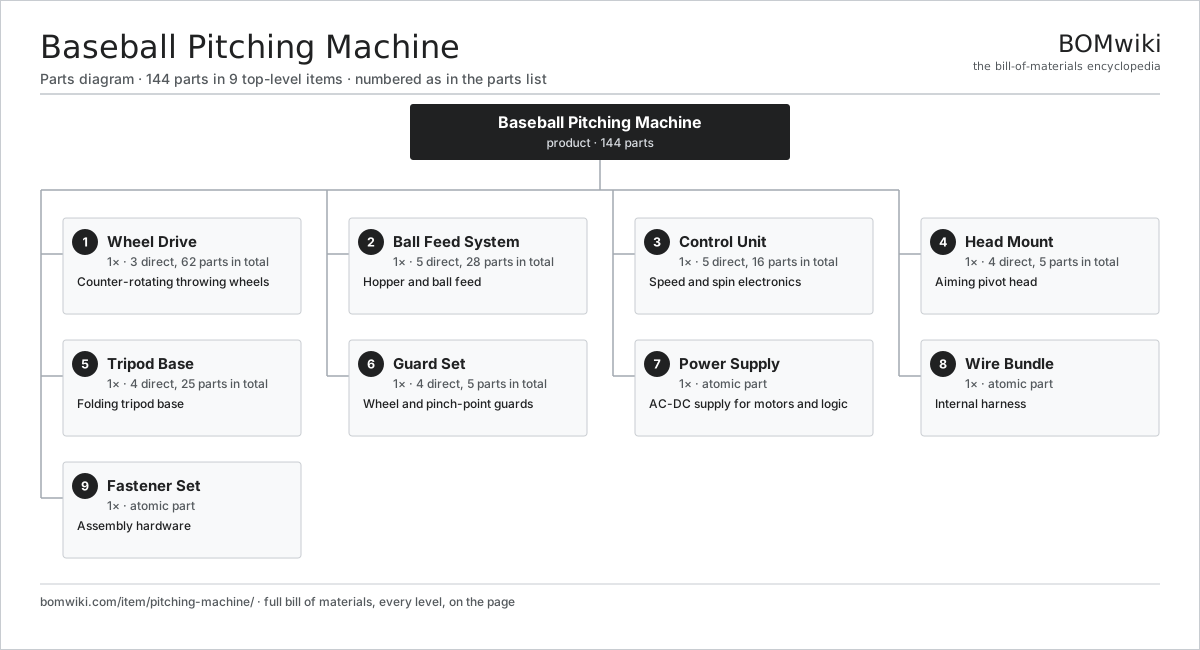
| # | Part | Qty | What it does |
|---|---|---|---|
| 1 | Wheel Drive 3 parts | 1× | Counter-rotating throwing wheels |
| 2 | Ball Feed System 5 parts | 1× | Hopper and ball feed |
| 3 | Control Unit 5 parts | 1× | Speed and spin electronics |
| 4 | Head Mount 4 parts | 1× | Aiming pivot head |
| 5 | Tripod Base 4 parts | 1× | Folding tripod base |
| 6 | Guard Set 4 parts | 1× | Wheel and pinch-point guards |
| 7 | Power Supply | 1× | AC-DC supply for motors and logic |
| 8 | Wire Bundle | 1× | Internal harness |
| 9 | Fastener Set | 1× | Assembly hardware |
3D model
No 3D model yet. Have a CAD file of this? Add a 3D model. STL renders right on this page; STEP, FreeCAD, and OpenSCAD sources are welcome too (openly licensed, like all 3D models on BOMwiki).
Build & assembly graph
expand / collapse · shared sub-assemblies converge · links to related products · est. labourTap an assembly to expand/collapse · tap a part to open it · use “Open page” for any node · drag to pan, scroll to zoom.
Bill of materials for Baseball Pitching Machine
9 top-level lines · 52 rows shown · 144 parts total · indented to 3 levels| # | Item / sub-assembly | Part no. | Qty/assy | Ext. qty | Parts | Type |
|---|---|---|---|---|---|---|
| 1 | Wheel Drive 3 parts | pitching-machine-wheel-drive | 1× | 1 | 62 | assembly |
| 1.1 | Pitching Wheel Module 4 parts | pitching-machine-wheel-module | 2× | 2 | 30 | assembly |
| 1.1.1 | Pitching Wheel | pitching-machine-pitch-wheel | 1× | 2 | · | part |
| 1.1.2 | Wheel Motor 5 parts + deeper › | pitching-machine-wheel-motor | 1× | 2 | 26 | assembly |
| 1.1.3 | Wheel Hub | pitching-machine-wheel-hub | 1× | 2 | · | part |
| 1.1.4 | Ball Bearing | ball-bearing | 2× | 4 | · | part |
| 1.2 | Throat Chute | pitching-machine-throat-chute | 1× | 1 | · | part |
| 1.3 | Wheel Gap Adjuster | pitching-machine-gap-adjuster | 1× | 1 | · | part |
| 2 | Ball Feed System 5 parts | pitching-machine-feed-system | 1× | 1 | 28 | assembly |
| 2.1 | Ball Hopper | pitching-machine-hopper | 1× | 1 | · | part |
| 2.2 | Feed Wheel | pitching-machine-feed-wheel | 1× | 1 | · | part |
| 2.3 | Servo Motor 4 parts | servo-motor | 1× | 1 | 24 | assembly |
| 2.3.1 | Stator Assembly 3 parts + deeper › | stator-assembly | 1× | 1 | 3 | assembly |
| 2.3.2 | Rotor Assembly 4 parts + deeper › | rotor-assembly | 1× | 1 | 19 | assembly |
| 2.3.3 | Encoder | encoder | 1× | 1 | · | part |
| 2.3.4 | Motor Housing | motor-housing | 1× | 1 | · | part |
| 2.4 | Feed Tube | pitching-machine-feed-tube | 1× | 1 | · | part |
| 2.5 | Ball Sensor | pitching-machine-ball-sensor | 1× | 1 | · | part |
| 3 | Control Unit 5 parts | pitching-machine-control-unit | 1× | 1 | 16 | assembly |
| 3.1 | Motor Drive Board 5 parts | pitching-machine-drive-board | 1× | 1 | 11 | assembly |
| 3.1.1 | Bare PCB | pcb-bare | 1× | 1 | · | part |
| 3.1.2 | Microcontroller | mcu | 1× | 1 | · | part |
| 3.1.3 | Power MOSFET | mosfet | 4× | 4 | · | part |
| 3.1.4 | SMD Passive (R/C/L) | smd-passives | 1× | 1 | · | part |
| 3.1.5 | Connector | connector | 4× | 4 | · | part |
| 3.2 | Speed Dial | pitching-machine-speed-dial | 2× | 2 | · | part |
| 3.3 | LCD Panel | lcd-panel | 1× | 1 | · | part |
| 3.4 | Relay | relay | 1× | 1 | · | part |
| 3.5 | Emergency Stop | pitching-machine-estop | 1× | 1 | · | part |
| 4 | Head Mount 4 parts | pitching-machine-head-mount | 1× | 1 | 5 | assembly |
| 4.1 | Pivot Yoke | pitching-machine-pivot-yoke | 1× | 1 | · | part |
| 4.2 | Elevation Screw | pitching-machine-elevation-screw | 1× | 1 | · | part |
| 4.3 | Swivel Base | pitching-machine-swivel-base | 1× | 1 | · | part |
| 4.4 | Lock Handle | pitching-machine-lock-handle | 2× | 2 | · | part |
| 5 | Tripod Base 4 parts | pitching-machine-tripod | 1× | 1 | 25 | assembly |
| 5.1 | Tripod Leg | pitching-machine-tripod-leg | 3× | 3 | · | part |
| 5.2 | Leg Lock Collar | pitching-machine-leg-lock | 3× | 3 | · | part |
| 5.3 | Support Mast | pitching-machine-mast | 1× | 1 | · | part |
| 5.4 | Wheel Assembly 5 parts | wheel-assembly | 2× | 2 | 9 | assembly |
| 5.4.1 | Alloy Wheel | alloy-wheel | 1× | 2 | · | part |
| 5.4.2 | Tire | tire | 1× | 2 | · | part |
| 5.4.3 | TPMS Sensor | tpms-sensor | 1× | 2 | · | part |
| 5.4.4 | Lug Nut | lug-nut | 5× | 10 | · | part |
| 5.4.5 | Valve Stem | valve-stem | 1× | 2 | · | part |
| 6 | Guard Set 4 parts | pitching-machine-guard-set | 1× | 1 | 5 | assembly |
| 6.1 | Wheel Guard | pitching-machine-wheel-guard | 2× | 2 | · | part |
| 6.2 | Feed Guard | pitching-machine-feed-guard | 1× | 1 | · | part |
| 6.3 | Exit Shroud | pitching-machine-exit-shroud | 1× | 1 | · | part |
| 6.4 | Fastener Set | fastener-set | 1× | 1 | · | part |
| 7 | Power Supply | power-supply | 1× | 1 | · | part |
| 8 | Wire Bundle | wire-bundle | 1× | 1 | · | part |
| 9 | Fastener Set | fastener-set | 1× | 1 | · | part |
Something wrong in this list? Report a problem with this BOM.
Related products
same domain, ranked by shared parts Anti-Gravity Treadmill
96 parts · shares 19 with this page
Percussion Massage Gun
71 parts · shares 17 with this page
Anti-Gravity Treadmill
96 parts · shares 19 with this page
Percussion Massage Gun
71 parts · shares 17 with this page
 Treadmill
122 parts · shares 16 with this page
Stair Climber
128 parts · shares 16 with this page
Treadmill
122 parts · shares 16 with this page
Stair Climber
128 parts · shares 16 with this page
 Vibration Plate
77 parts · shares 15 with this page
Vibration Plate
77 parts · shares 15 with this page
Sourcing: possible vendors
Browse the supplier directory → Prices, MOQ, and lead times are algorithmic estimates, not quotes, and not claims about these companies. Company mappings are curated by keyword; est. price band $100–$10k. How estimates work| Vendor | HQ | Specialty | MOQ | Lead time |
|---|---|---|---|---|
| lifefitness.com ↗ | Rosemont, US | Fitness equipment | 200 units | 8–14 wks |
| technogym.com ↗ | Cesena, IT | Fitness equipment | 200 units | 8–14 wks |
|
🇺🇸Peloton
onepeloton.com ↗
|
New York, US | Connected fitness | 200 units | 8–14 wks |
| johnsonhealthtech.com ↗ | Taichung, TW | Fitness (Matrix) | 200 units | 8–14 wks |
|
🇺🇸Precor
precor.com ↗
|
Woodinville, US | Fitness equipment | 200 units | 8–14 wks |
788-word article