Planetary Gearbox
ProductOverview
Planetary gearboxes (also called epicyclic or star gearboxes) are ultra-compact speed reducers achieving 3:1 to 100+:1 ratios in a space smaller than equivalent helical units. They work by having multiple planet gears orbit around a central sun gear while meshing an outer ring gear. This three-element arrangement creates kinematic redundancy, load is shared across 3–4 planets simultaneously, yielding high torque density and compact footprint.
The most common configuration is "reduction mode," where the sun is driven by the motor, the ring is held stationary, and the carrier (holding the planets) delivers reduced-speed output. Efficiency is excellent, 93–97% per stage, and precision variants achieve backlash under 2 arcminutes, making them ideal for robotics, machine tools, and automation.
How it works
Motor torque rotates the sun gear at input speed (500–3600 RPM). The sun drives three or four equally spaced planet gears that orbit concentrically while simultaneously meshing the ring gear. As planets roll around the sun, they also roll on the inside surface of the fixed ring, creating a differential reduction. The carrier physically supports the planet orbits and rotates slower than input, delivering the speed-reduced output torque at output flange.
The load distribution across multiple planets inherently reduces stress per gear tooth and bearing compared to single-mesh helical gearboxes. Three planets share load equally in ideal cases; imbalance adds about 5–10% stress concentration but improves robustness against shock loads.
Reduction calculation
Reduction ratio = (Ring teeth + Sun teeth) / Sun teeth
A sun with 20 teeth and ring with 80 teeth yields: (80 + 20) / 20 = 5:1. Multi-stage designs cascade two planetary stages to reach 25:1, 50:1, or 100:1 in modest external dimensions, a 64:1 unit might occupy just 120 mm of axial length.
Lubrication and cooling
Housing design includes an oil sump; depending on duty, either static splash lubrication or centrifugal circulation via rotating carrier channels supplies the mesh. Typical oils are ISO 46–68 mineral or synthetic PAO, with drain intervals of 2000–5000 operating hours.
Thermal management is less critical than in helical gearboxes due to lower frictional loss per stage, but high-speed (5000+ RPM input) or high-power (>10 kW) planetary units benefit from integral heat jackets. Synthetic oils extend coolant drain intervals and are standard in food, pharmaceutical, and semiconductor equipment.
Precision and backlash control
Industrial-grade planetary gearboxes carry 8–15 arcmin backlash; precision variants (used in machine tools and robotics) are manufactured to tight tolerances, bearing preload, sun-ring center distance, and planet spacing held to ±0.05 mm, yielding <2 arcmin backlash. This precision grade commands 2–3× cost but is mandatory for CNC spindle drives and positioning tables.
Mounting and installation
Input and output flanges conform to SAE-2, SAE-3, or ISO coupling standards. Hollow-bore output designs (15–40 mm ID) allow shrink-fit loads directly onto machine shafts, reducing coupling count. Angular bearing preload is maintained by disc springs or shim stacks, critical for quiet operation and extended life.
Failure modes and maintenance
Typical failure is tooth pitting followed by spalling due to inadequate lubrication or misalignment. Planet bearing spalling manifests as noise and vibration on load. Unlike helical units, planetary shafts have minimal critical speeds in the 500–3600 RPM range, simplifying installation. Preventive maintenance focuses on oil analysis (trending ferrous wear debris) and visual inspection of breather element drying cycles; annual breather replacement is standard in humid climates.
Planetary Gearbox parts and their functions
7 top-level parts · 43 parts in total · full bill of materials below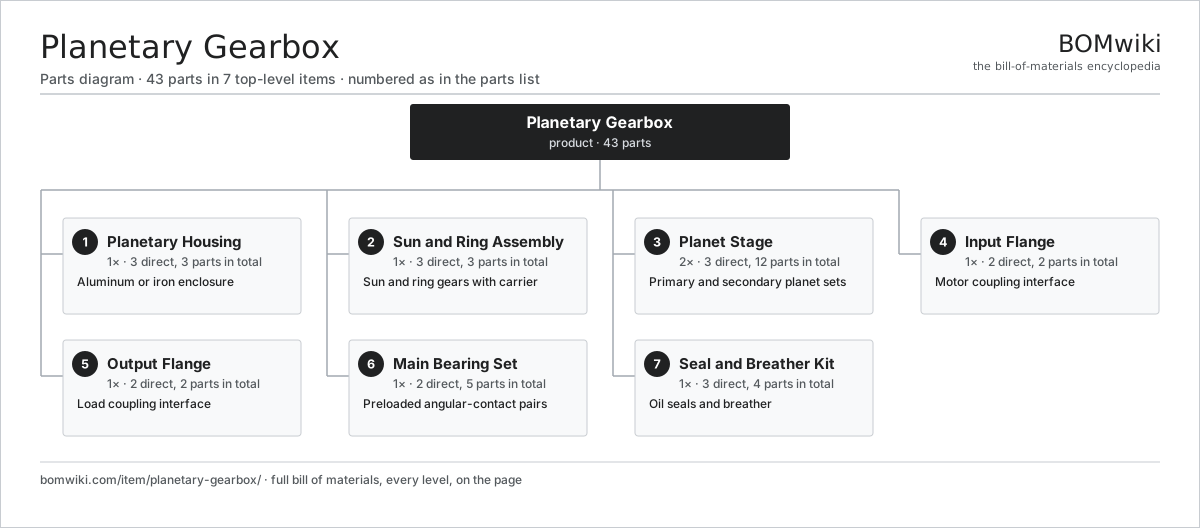
| # | Part | Qty | What it does |
|---|---|---|---|
| 1 | Planetary Housing 3 parts | 1× | Aluminum or iron enclosure |
| 2 | Sun and Ring Assembly 3 parts | 1× | Sun and ring gears with carrier |
| 3 | Planet Stage 3 parts | 2× | Primary and secondary planet sets |
| 4 | Input Flange 2 parts | 1× | Motor coupling interface |
| 5 | Output Flange 2 parts | 1× | Load coupling interface |
| 6 | Main Bearing Set 2 parts | 1× | Preloaded angular-contact pairs |
| 7 | Seal and Breather Kit 3 parts | 1× | Oil seals and breather |
3D model
No 3D model yet. Have a CAD file of this? Add a 3D model. STL renders right on this page; STEP, FreeCAD, and OpenSCAD sources are welcome too (openly licensed, like all 3D models on BOMwiki).
Build & assembly graph
expand / collapse · shared sub-assemblies converge · links to related products · est. labourTap an assembly to expand/collapse · tap a part to open it · use “Open page” for any node · drag to pan, scroll to zoom.
Bill of materials for Planetary Gearbox
7 top-level lines · 25 rows shown · 43 parts total · indented to 3 levels| # | Item / sub-assembly | Part no. | Qty/assy | Ext. qty | Parts | Type |
|---|---|---|---|---|---|---|
| 1 | Planetary Housing 3 parts | planetary-gearbox-housing | 1× | 1 | 3 | assembly |
| 1.1 | Housing Base | planetary-gearbox-base-shell | 1× | 1 | · | part |
| 1.2 | Housing Cover | planetary-gearbox-cover | 1× | 1 | · | part |
| 1.3 | Fastener Set | fastener-set | 1× | 1 | · | part |
| 2 | Sun and Ring Assembly 3 parts | planetary-gearbox-sun-ring-assembly | 1× | 1 | 3 | assembly |
| 2.1 | Sun Gear | planetary-gearbox-sun-gear | 1× | 1 | · | part |
| 2.2 | Ring Gear | planetary-gearbox-ring-gear | 1× | 1 | · | part |
| 2.3 | Planet Carrier | planetary-gearbox-carrier | 1× | 1 | · | part |
| 3 | Planet Stage 3 parts | planetary-gearbox-planet-stage | 2× | 2 | 12 | assembly |
| 3.1 | Planet Gear | planetary-gearbox-planet-gear | 3× | 6 | · | part |
| 3.2 | Planet Shaft | planetary-gearbox-planet-shaft | 3× | 6 | · | part |
| 3.3 | Planet Bearing | planetary-gearbox-planet-bearing | 6× | 12 | · | part |
| 4 | Input Flange 2 parts | planetary-gearbox-input-flange | 1× | 1 | 2 | assembly |
| 4.1 | Input Shaft | planetary-gearbox-input-shaft | 1× | 1 | · | part |
| 4.2 | Flange Plate | planetary-gearbox-flange-plate | 1× | 1 | · | part |
| 5 | Output Flange 2 parts | planetary-gearbox-output-flange | 1× | 1 | 2 | assembly |
| 5.1 | Output Shaft | planetary-gearbox-output-shaft | 1× | 1 | · | part |
| 5.2 | Flange Plate | planetary-gearbox-flange-plate | 1× | 1 | · | part |
| 6 | Main Bearing Set 2 parts | planetary-gearbox-bearing-set | 1× | 1 | 5 | assembly |
| 6.1 | Ball Bearing | ball-bearing | 4× | 4 | · | part |
| 6.2 | Preload Washer | planetary-gearbox-preload-washer | 1× | 1 | · | part |
| 7 | Seal and Breather Kit 3 parts | planetary-gearbox-seal-kit | 1× | 1 | 4 | assembly |
| 7.1 | Oil Seal | oil-seal | 2× | 2 | · | part |
| 7.2 | Housing Gasket | planetary-gearbox-gasket | 1× | 1 | · | part |
| 7.3 | Breather Element | planetary-gearbox-breather | 1× | 1 | · | part |
Something wrong in this list? Report a problem with this BOM.
Related products
same domain, ranked by shared parts Blow Molding Machine
83 parts · shares 2 with this page
Blown Film Extrusion Line
436 parts · shares 2 with this page
Sourcing: possible vendors
Browse the supplier directory → Prices, MOQ, and lead times are algorithmic estimates, not quotes, and not claims about these companies. Company mappings are curated by keyword; est. price band $5k–$2M. How estimates work| Vendor | HQ | Specialty | MOQ | Lead time |
|---|---|---|---|---|
| atlascopco.com ↗ | Stockholm, SE | Compressors & industrial | 10 units | 12–20 wks |
|
🇦🇹Andritz
andritz.com ↗
|
Graz, AT | Process plants & machinery | 10 units | 12–20 wks |
| buhlergroup.com ↗ | Uzwil, CH | Food & materials processing | 10 units | 12–20 wks |
| gea.com ↗ | Düsseldorf, DE | Process technology | 10 units | 12–20 wks |
| mhi.com ↗ | Tokyo, JP | Heavy machinery | 10 units | 12–20 wks |
610-word article