Playground Seesaw
ProductOverview
The seesaw (or teeter-totter) is a two-person playground apparatus that demonstrates the principle of the lever and pivot. Two children sit on opposite ends of a Main Beam; when one pushes down with their legs, they descend and the other ascends. The magic of the seesaw is its simplicity: it requires no power or moving machinery, yet delivers thrilling oscillating motion driven entirely by body weight and muscle.
The Main Beam is typically a steel or aluminum tube 3–4 meters long. Exactly at its midpoint sits the Fulcrum Assembly, a precision bearing assembly that allows the beam to pivot smoothly. At each end are Seat Assembly units, molded or welded platforms that distribute a child's weight and offer a Seat Back and Handle Assembly for grip. The entire system is supported by a Base Structure of four legs anchored to the ground, and Anchor bolts or spikes prevent the structure from tipping or shifting sideways.
How it works
The seesaw operates as a class-one lever. The Fulcrum Assembly is the pivot; the seats are the load points. A child sitting at one end and pushing down with their legs exerts a downward force at a distance from the fulcrum. By the lever principle (Force × Distance = constant), the same mechanical advantage appears at the opposite end: a lighter force is applied, but over a greater distance, producing a larger upward displacement.
When child A (at the left seat) pushes down, they press the left end of the Main Beam downward. The beam rotates about the Fulcrum Assembly. Child B (at the right seat) rises. The Handle Assembly provide hand grips for safety and control. The Seat Back prevents backward tipping and the Armrest stabilizes the torso. Once child A has descended to their lowest point and stops pushing, gravity and child B's weight reverse the motion: child B descends and child A rises. Coordinated pushing and relaxation creates a rhythmic oscillation.
The oscillation frequency depends on the beam's moment of inertia and the children's masses and positions. Closer seating to the fulcrum increases frequency; seating farther out decreases it. Roughly, period is T ≈ 2π√(I / (g × (m_A × r_A + m_B × r_B))), where I is rotational inertia and r is distance from fulcrum.
Bearing and friction
The Fulcrum Assembly must be low-friction to ensure smooth motion. Industrial-grade ball bearings (32–40 mm bore, sealed against dirt and rain) are pressed into a steel or ductile-iron housing. The housing bolts to the Base Structure frame below. A Lubrication Kit cartridge of lithium-soap grease is applied periodically to the bearing cavity; modern sealed bearings require re-lubrication every 1–2 years, depending on use intensity.
The Main Beam is typically a cold-drawn seamless steel tube, 60–80 mm OD and 2.5–3.5 mm wall thickness. Steel is chosen for its stiffness and durability; the wall thickness is calculated to ensure the beam deflects less than L/500 (where L is beam length) under maximum rated load, typically 150 kg per seat. Some composite beams (fiberglass, resin-impregnated wood) exist but are less common; they do not rust but cost more and have lower stiffness-to-weight.
Safety and ground anchoring
The Base Structure is a four-legged frame that anchors the Fulcrum Housing assembly to the ground. Each leg is a vertical steel tube, 50–60 mm diameter, 1.5–2.0 m tall. Cross-bracing between legs (the Cross Brace) prevents lateral sway. At the ground, each leg sits on a foot pad (the Foot Pad) that distributes load. These feet are bolted or welded to the feet, and the feet are concreted into the ground or pinned with Anchor spikes.
Anchoring is critical. A child jumping up at the high end of the seesaw can generate a strong upward torque about the front fulcrum leg. Without proper anchoring, the back legs can lift and the entire apparatus can tip forward. Modern installations anchor all four legs to concrete footings or use long ground screws (augers) driven 1–2 meters into earth. Safety standards (ASTM F1487, EN 1176) mandate that the apparatus resist overturning and that the Seat Back extends high enough to catch a child if they slip backward.
Maintenance
The Main Beam should be inspected monthly for cracks or bending; UV and weathering can degrade exposed epoxy or paint, leading to rust. Annually, the Lubrication Kit kit should be re-applied to the Fulcrum Assembly, and playground-seesaw-fastener-set bolts should be re-torqued if loose. If Grip Coating rubber becomes cracked or missing, it should be replaced to maintain grip safety.
Playground Seesaw parts and their functions
7 top-level parts · 43 parts in total · full bill of materials below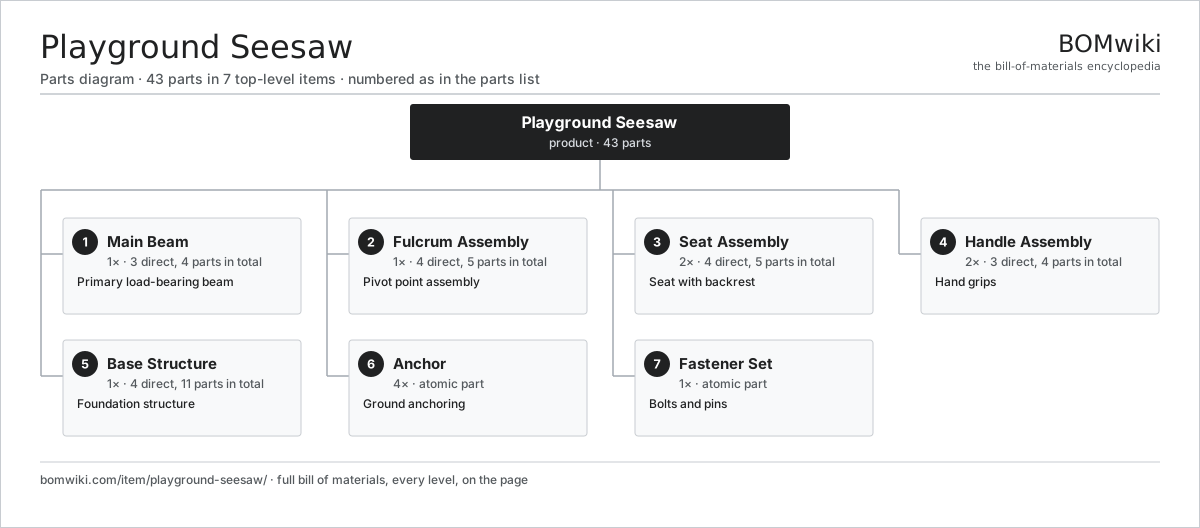
| # | Part | Qty | What it does |
|---|---|---|---|
| 1 | Main Beam 3 parts | 1× | Primary load-bearing beam |
| 2 | Fulcrum Assembly 4 parts | 1× | Pivot point assembly |
| 3 | Seat Assembly 4 parts | 2× | Seat with backrest |
| 4 | Handle Assembly 3 parts | 2× | Hand grips |
| 5 | Base Structure 4 parts | 1× | Foundation structure |
| 6 | Anchor | 4× | Ground anchoring |
| 7 | Fastener Set | 1× | Bolts and pins |
3D model
No 3D model yet. Have a CAD file of this? Add a 3D model. STL renders right on this page; STEP, FreeCAD, and OpenSCAD sources are welcome too (openly licensed, like all 3D models on BOMwiki).
Build & assembly graph
expand / collapse · shared sub-assemblies converge · links to related products · est. labourTap an assembly to expand/collapse · tap a part to open it · use “Open page” for any node · drag to pan, scroll to zoom.
Bill of materials for Playground Seesaw
7 top-level lines · 25 rows shown · 43 parts total · indented to 3 levels| # | Item / sub-assembly | Part no. | Qty/assy | Ext. qty | Parts | Type |
|---|---|---|---|---|---|---|
| 1 | Main Beam 3 parts | playground-seesaw-beam | 1× | 1 | 4 | assembly |
| 1.1 | Beam Tube | playground-seesaw-beam-tube | 1× | 1 | · | part |
| 1.2 | Beam Bracing | playground-seesaw-beam-bracing | 1× | 1 | · | part |
| 1.3 | End Cap | playground-seesaw-beam-endcaps | 2× | 2 | · | part |
| 2 | Fulcrum Assembly 4 parts | playground-seesaw-fulcrum | 1× | 1 | 5 | assembly |
| 2.1 | Fulcrum Housing | playground-seesaw-fulcrum-housing | 1× | 1 | · | part |
| 2.2 | Ball Bearing | ball-bearing | 2× | 2 | · | part |
| 2.3 | Lubrication Kit | playground-seesaw-lubrication | 1× | 1 | · | part |
| 2.4 | Fastener Set | fastener-set | 1× | 1 | · | part |
| 3 | Seat Assembly 4 parts | playground-seesaw-seat-assembly | 2× | 2 | 5 | assembly |
| 3.1 | Seat Pan | playground-seesaw-seat-pan | 1× | 2 | · | part |
| 3.2 | Seat Back | playground-seesaw-seat-back | 1× | 2 | · | part |
| 3.3 | Armrest | playground-seesaw-seat-armrest | 2× | 4 | · | part |
| 3.4 | Fastener Set | fastener-set | 1× | 2 | · | part |
| 4 | Handle Assembly 3 parts | playground-seesaw-handles | 2× | 2 | 4 | assembly |
| 4.1 | Handle Rod | playground-seesaw-handle-rod | 1× | 2 | · | part |
| 4.2 | Grip Coating | playground-seesaw-handle-grip | 2× | 4 | · | part |
| 4.3 | Fastener Set | fastener-set | 1× | 2 | · | part |
| 5 | Base Structure 4 parts | playground-seesaw-base | 1× | 1 | 11 | assembly |
| 5.1 | Leg | playground-seesaw-base-legs | 4× | 4 | · | part |
| 5.2 | Cross Brace | playground-seesaw-base-crossbeam | 2× | 2 | · | part |
| 5.3 | Foot Pad | playground-seesaw-base-feet | 4× | 4 | · | part |
| 5.4 | Fastener Set | fastener-set | 1× | 1 | · | part |
| 6 | Anchor | playground-seesaw-anchor | 4× | 4 | · | part |
| 7 | Fastener Set | fastener-set | 1× | 1 | · | part |
Something wrong in this list? Report a problem with this BOM.
Sourcing: possible vendors
Browse the supplier directory → Prices, MOQ, and lead times are algorithmic estimates, not quotes, and not claims about these companies. Company mappings are curated by keyword; est. price band $20–$3k. How estimates work| Vendor | HQ | Specialty | MOQ | Lead time |
|---|---|---|---|---|
|
🇩🇰LEGO
lego.com ↗
|
Billund, DK | Construction toys | 2,000 units | 6–10 wks |
|
🇺🇸Mattel
mattel.com ↗
|
El Segundo, US | Toys | 2,000 units | 6–10 wks |
|
🇺🇸Hasbro
hasbro.com ↗
|
Pawtucket, US | Toys & games | 2,000 units | 6–10 wks |
| bandainamco.co.jp ↗ | Tokyo, JP | Toys & amusement | 2,000 units | 6–10 wks |
| spinmaster.com ↗ | Toronto, CA | Toys | 2,000 units | 6–10 wks |
817-word article