High-Pressure Plunger Pump
ProductOverview
A high-pressure plunger pump generates pressures far beyond the reach of centrifugal machines by pushing liquid out of a fixed chamber with a solid reciprocating plunger. The dominant format is the triplex: three plungers driven from a common Crankshaft with throws at 120°, so their discharge pulses interleave. Triplex plunger pumps power waterjet cutting (3,000+ bar in intensifier-free designs up to ~1,000 bar), reverse osmosis feed, hydrostatic pipeline testing, sewer jetting, descaling in steel mills, and well-service pumping in the oilfield, where API 674 governs process-duty builds.
The distinction from a piston pump is sealing geometry. A piston carries its seal with it along the bore; a plunger is a plain ground rod that slides through a stationary Packing Set. Because the seal does not move with the displacement element, packing can be compressed, cooled, and flushed externally, which is what makes hundreds of bar sustainable.
How it works
Each crank revolution gives every plunger one suction and one pressure stroke. On the suction stroke the retreating Ceramic Plunger drops chamber pressure; the Suction Valve opens and liquid flows in from the Suction Manifold. At bottom dead center the valve spring closes the Valve Plate onto its Valve Seat. On the return stroke pressure rises almost instantly to discharge level, liquid is nearly incompressible, and the Discharge Valve lifts, expelling the swept volume into the Discharge Manifold. Both valves are simple spring-loaded checks; the pump has no porting or timing other than the valves' own response to pressure difference.
Flow is therefore speed times displacement, independent of pressure apart from a few percent of slip past valves and packing. The corollary is that the pump will raise pressure without limit against a blocked discharge, so the spring Safety Relief Valve, set about 10% above working pressure, is a mandatory fitting, backed by a Pressure Sensor for shutdown.
The summed flow of three 120° cranks still ripples about 6%. A nitrogen-charged Discharge Pulsation Damper absorbs the discharge peaks, while a Suction Stabilizer keeps the suction manifold full between strokes, without it, the accelerating liquid column separates and the chambers cavitate, hammering the valves.
Power end and drive
The Power End is built like a small engine bottom end. The forged crankshaft runs in rolling main bearings (Ball Bearing) inside the Crankcase; each throw drives a Connecting Rod with babbitt big-end shells. The rod's small end articulates on a Wrist Pin in a Crosshead, a sliding block that absorbs all lateral force so the plunger sees pure axial motion. This matters because any side load on the ceramic plunger would wear the packing oval within hours.
Lubrication is pressure-fed: a crank-nose Lube Oil Pump pushes filtered oil through drilled galleries at 2–4 bar, with a Oil Cooler holding sump temperature under 80 °C. Input power arrives from a Drive Motor through a V-belt pair (Drive Belt) on Belt Sheaves, whose ratio sets crank speed in the 300–500 rpm band.
Fluid end and packing
The Fluid End Block is the most highly stressed component: a monoblock forging, usually duplex stainless, with intersecting cross-drilled bores whose corners see fully reversed stress every stroke. Blocks for 500 bar service are autofrettaged, pressurized past yield once during manufacture so residual compressive stress at the bore intersections suppresses fatigue cracking. Every valve is reachable through its own threaded Valve Cover Plug without breaking pipe connections, because valve plates and seats are scheduled wear parts (500–2,000 hours on clean water, far less on abrasive media).
Plungers are solid alumina or zirconia ceramic, ground to Ra 0.1 µm; the packing stack of chevron rings seals against this surface, compressed by a threaded Packing Gland. Correct adjustment leaves a slight weep through the Weep Port, a few drops per minute that lubricate and cool the rings. A Lantern Ring mid-stack admits flush liquid on hot or dirty service, and the Throat Bushing keeps high-velocity chamber flow off the first ring.
Service profile
Wear concentrates in three consumables: valve plates and seats, packing rings, and plungers, in roughly that order of frequency. Packing life on clean water at 500 bar runs 1,000–3,000 hours; a scored plunger shortens it tenfold, which is why ceramic replaced hardened steel almost universally. The power end, kept in clean oil, routinely exceeds 20,000 hours between overhauls.
High-Pressure Plunger Pump parts and their functions
7 top-level parts · 115 parts in total · full bill of materials below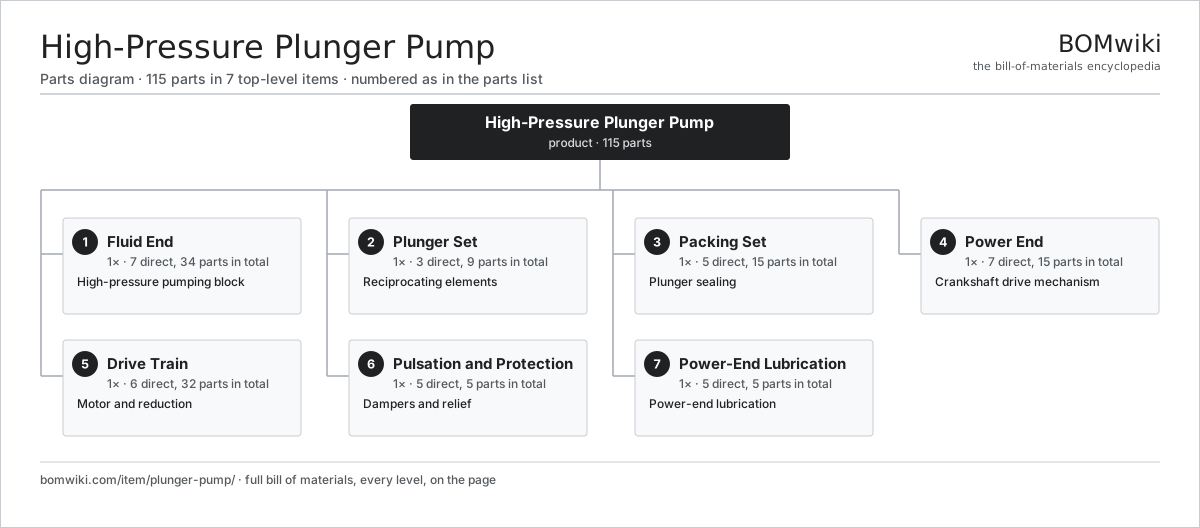
| # | Part | Qty | What it does |
|---|---|---|---|
| 1 | Fluid End 7 parts | 1× | High-pressure pumping block |
| 2 | Plunger Set 3 parts | 1× | Reciprocating elements |
| 3 | Packing Set 5 parts | 1× | Plunger sealing |
| 4 | Power End 7 parts | 1× | Crankshaft drive mechanism |
| 5 | Drive Train 6 parts | 1× | Motor and reduction |
| 6 | Pulsation and Protection 5 parts | 1× | Dampers and relief |
| 7 | Power-End Lubrication 5 parts | 1× | Power-end lubrication |
3D model
No 3D model yet. Have a CAD file of this? Add a 3D model. STL renders right on this page; STEP, FreeCAD, and OpenSCAD sources are welcome too (openly licensed, like all 3D models on BOMwiki).
Build & assembly graph
expand / collapse · shared sub-assemblies converge · links to related products · est. labourTap an assembly to expand/collapse · tap a part to open it · use “Open page” for any node · drag to pan, scroll to zoom.
Bill of materials for High-Pressure Plunger Pump
7 top-level lines · 57 rows shown · 115 parts total · indented to 3 levels| # | Item / sub-assembly | Part no. | Qty/assy | Ext. qty | Parts | Type |
|---|---|---|---|---|---|---|
| 1 | Fluid End 7 parts | plunger-pump-fluid-end | 1× | 1 | 34 | assembly |
| 1.1 | Fluid End Block | plunger-pump-fluid-block | 1× | 1 | · | part |
| 1.2 | Suction Valve 4 parts | plunger-pump-suction-valve | 3× | 3 | 4 | assembly |
| 1.2.1 | Valve Plate | plunger-pump-valve-plate | 1× | 3 | · | part |
| 1.2.2 | Valve Seat | plunger-pump-valve-seat | 1× | 3 | · | part |
| 1.2.3 | Coil Spring | coil-spring | 1× | 3 | · | part |
| 1.2.4 | Valve Guide | plunger-pump-valve-guide | 1× | 3 | · | part |
| 1.3 | Discharge Valve 4 parts | plunger-pump-discharge-valve | 3× | 3 | 4 | assembly |
| 1.3.1 | Valve Plate | plunger-pump-valve-plate | 1× | 3 | · | part |
| 1.3.2 | Valve Seat | plunger-pump-valve-seat | 1× | 3 | · | part |
| 1.3.3 | Coil Spring | coil-spring | 1× | 3 | · | part |
| 1.3.4 | Valve Guide | plunger-pump-valve-guide | 1× | 3 | · | part |
| 1.4 | Valve Cover Plug | plunger-pump-valve-cover | 6× | 6 | · | part |
| 1.5 | Suction Manifold | plunger-pump-suction-manifold | 1× | 1 | · | part |
| 1.6 | Discharge Manifold | plunger-pump-discharge-manifold | 1× | 1 | · | part |
| 1.7 | O-Ring Set | oring-set | 1× | 1 | · | part |
| 2 | Plunger Set 3 parts | plunger-pump-plunger-set | 1× | 1 | 9 | assembly |
| 2.1 | Ceramic Plunger | plunger-pump-plunger | 3× | 3 | · | part |
| 2.2 | Plunger Flange | plunger-pump-plunger-flange | 3× | 3 | · | part |
| 2.3 | Plunger Retaining Bolt | plunger-pump-plunger-bolt | 3× | 3 | · | part |
| 3 | Packing Set 5 parts | plunger-pump-packing-set | 1× | 1 | 15 | assembly |
| 3.1 | Packing Ring Stack | plunger-pump-packing-rings | 3× | 3 | · | part |
| 3.2 | Packing Gland | plunger-pump-packing-gland | 3× | 3 | · | part |
| 3.3 | Lantern Ring | plunger-pump-lantern-ring | 3× | 3 | · | part |
| 3.4 | Throat Bushing | plunger-pump-throat-bushing | 3× | 3 | · | part |
| 3.5 | Weep Port | plunger-pump-weep-port | 3× | 3 | · | part |
| 4 | Power End 7 parts | plunger-pump-power-end | 1× | 1 | 15 | assembly |
| 4.1 | Crankcase | plunger-pump-crankcase | 1× | 1 | · | part |
| 4.2 | Crankshaft | plunger-pump-crankshaft | 1× | 1 | · | part |
| 4.3 | Connecting Rod | plunger-pump-connecting-rod | 3× | 3 | · | part |
| 4.4 | Crosshead | plunger-pump-crosshead | 3× | 3 | · | part |
| 4.5 | Wrist Pin | plunger-pump-wrist-pin | 3× | 3 | · | part |
| 4.6 | Ball Bearing | ball-bearing | 2× | 2 | · | part |
| 4.7 | Oil Seal | oil-seal | 2× | 2 | · | part |
| 5 | Drive Train 6 parts | plunger-pump-drive-train | 1× | 1 | 32 | assembly |
| 5.1 | Drive Motor 4 parts | plunger-pump-motor | 1× | 1 | 25 | assembly |
| 5.1.1 | Stator Assembly 3 parts + deeper › | stator-assembly | 1× | 1 | 3 | assembly |
| 5.1.2 | Rotor Assembly 4 parts + deeper › | rotor-assembly | 1× | 1 | 19 | assembly |
| 5.1.3 | Motor Housing | motor-housing | 1× | 1 | · | part |
| 5.1.4 | Ball Bearing | ball-bearing | 2× | 2 | · | part |
| 5.2 | Drive Belt | drive-belt | 2× | 2 | · | part |
| 5.3 | Belt Sheave | plunger-pump-sheave | 2× | 2 | · | part |
| 5.4 | Belt Guard | plunger-pump-belt-guard | 1× | 1 | · | part |
| 5.5 | Baseframe Skid | plunger-pump-skid | 1× | 1 | · | part |
| 5.6 | Fastener Set | fastener-set | 1× | 1 | · | part |
| 6 | Pulsation and Protection 5 parts | plunger-pump-pulsation-control | 1× | 1 | 5 | assembly |
| 6.1 | Discharge Pulsation Damper | plunger-pump-discharge-damper | 1× | 1 | · | part |
| 6.2 | Suction Stabilizer | plunger-pump-suction-stabilizer | 1× | 1 | · | part |
| 6.3 | Safety Relief Valve | plunger-pump-relief-valve | 1× | 1 | · | part |
| 6.4 | Pressure Sensor | pressure-sensor | 1× | 1 | · | part |
| 6.5 | Pressure Gauge | plunger-pump-gauge | 1× | 1 | · | part |
| 7 | Power-End Lubrication 5 parts | plunger-pump-lube-system | 1× | 1 | 5 | assembly |
| 7.1 | Lube Oil Pump | plunger-pump-oil-pump | 1× | 1 | · | part |
| 7.2 | Oil Filter | plunger-pump-oil-filter | 1× | 1 | · | part |
| 7.3 | Oil Cooler | plunger-pump-oil-cooler | 1× | 1 | · | part |
| 7.4 | Oil Level Glass | plunger-pump-oil-level-glass | 1× | 1 | · | part |
| 7.5 | Pressure Sensor | pressure-sensor | 1× | 1 | · | part |
Something wrong in this list? Report a problem with this BOM.
Related products
same domain, ranked by shared parts Rotary Screw Air Compressor
84 parts · shares 3 with this page
Rotary Screw Air Compressor
84 parts · shares 3 with this page
 Hydraulic Power Unit
91 parts · shares 4 with this page
Hydraulic Power Unit
91 parts · shares 4 with this page
 Irrigation Pump Station
1,881 parts · shares 3 with this page
Irrigation Pump Station
1,881 parts · shares 3 with this page
 Mainline Pipeline Pump
166 parts · shares 3 with this page
Mainline Pipeline Pump
166 parts · shares 3 with this page
 Rotary Vane Pump
57 parts · shares 3 with this page
Rotary Vane Pump
57 parts · shares 3 with this page
Sourcing: possible vendors
Browse the supplier directory → Prices, MOQ, and lead times are algorithmic estimates, not quotes, and not claims about these companies. Company mappings are curated by keyword; est. price band $50–$50k. How estimates work| Vendor | HQ | Specialty | MOQ | Lead time |
|---|---|---|---|---|
|
🇩🇰Grundfos
grundfos.com ↗
|
Bjerringbro, DK | Pumps | 200 units | 6–12 wks |
|
🇺🇸Xylem
xylem.com ↗
|
Washington, US | Water technology | 200 units | 6–12 wks |
| flowserve.com ↗ | Irving, US | Pumps & valves | 200 units | 6–12 wks |
|
🇩🇪KSB
ksb.com ↗
|
Frankenthal, DE | Pumps & valves | 200 units | 6–12 wks |
| parker.com ↗ | Cleveland, US | Motion & fluid control | 200 units | 6–12 wks |
783-word article