Pneumatic Rivet Gun
ProductOverview
A pneumatic rivet gun is a handheld air-powered tool designed to rapidly set solid rivets in sheet metal, aircraft structures, and composite assemblies. Unlike pull-and-break (pop) rivets that use a disposable mandrel, solid rivets (buck rivets) require two operators or a rivet gun paired with a handheld bucking bar: one applies the gun from above, the other supports a bucking bar from behind the workpiece.
The gun operates by high-speed pneumatic percussion, delivering 1000–2000 impacts per minute against the rivet head, plastically deforming the shank until it fills the hole and creates a permanent mechanical joint. Solid rivets are the industry standard in aerospace manufacturing, bridge construction, pressure vessels, and heavy-duty structures where reliability and failure predictability are critical.
How It Works
The pneumatic motor assembly converts compressed air at 50–90 psi into high-speed rotary or reciprocating motion. A vane-type motor (most common) spins at 3000–8000 rpm; internal porting diverts this rotation into reciprocating strikes via a crank mechanism or eccentric pin drive.
The piston rod oscillates at 1000–2000 Hz, impacting the nose piece jaw assembly mounted at the gun tip. The jaws grip the rivet head and squeeze it with each impact, working in concert with the bucking bar behind the workpiece to swage and form the rivet shank.
The hydraulic pressure intensifier is key to the gun's effectiveness. Incoming 50–90 psi air is converted to 150–200 psi hydraulic pressure (via differential piston areas), which is transmitted to solenoid pilots and jaw-actuation circuits, allowing powerful clamping force from modest air pressure.
Jaw Sets and Rivet Compatibility
The interchangeable nose piece contains paired hardened steel jaws contoured to match specific rivet head profiles and diameters. Standard industrial jaw sets include:
- Universal grip jaw: Flat or slightly convex, 6–10 mm diameter rivets
- Flush-head jaw: Matched set for MS20470 or equivalent 100° flush rivets
- Protruding-head jaw: For standard MS20426 universal head rivets (round dome)
- Countersink jaw: For countersunk aircraft rivets
Jaw sets are spring-pinned and quick-change, allowing rapid tool changeover for different rivet types on the same assembly line.
Air Supply and System
Pneumatic rivet guns demand clean, dry, oil-free compressed air at 50–90 psi. The air supply line from the compressor must include:
- Air filter-regulator: Removing moisture and particulates to <5 μm; regulating inlet pressure to 60 psi ±5 psi
- Air hose: 3/8" or 1/2" ID hose rated 150+ psi, with quick-disconnect couplers
- Lubrication: Optional air-line lubricator ( inline or integrated) extending motor life by delivering light ISO VG 32 mist
A compressor rated 30+ CFM (cubic feet per minute) at 90 psi ensures uninterrupted gun operation without pressure drop during sustained firing.
Hydraulic Intensifier Circuit
The hydraulic pressure intensifier uses a differential piston: the large-diameter side receives 50–90 psi pilot pressure from the solenoid valve, while the small-diameter side outlets 150–200 psi intensified hydraulic pressure.
Example intensifier ratio:
- Inlet bore: 25 mm diameter (491 mm²)
- Outlet bore: 15 mm diameter (177 mm²)
- Pressure gain: 491 ÷ 177 = 2.77:1
This intensified pressure feeds solenoid pilots controlling the directional air valve and the jaw-clamping circuits, ensuring robust jaw force even at modest inlet air pressures.
Impact and Rivet Setting
Each impact delivers kinetic energy to the rivet shank. Optimal rivet setting requires:
- Initial seating: Jaws grip and push rivet head firmly against workpiece outer surface
- Bucking bar support: Operator holds bucking bar (flat iron with contoured end) against rivet shank on the back side
- Rapid impacts: 1000–2000 blows over 1–3 seconds compress and plastically deform the shank
- Fill and lock: Shank expands radially, filling the hole completely and creating a tight mechanical interlock
Rivet shank lengths are precisely sized (e.g., 3.2–4.8 mm) so that after swaging, the formed end creates a buttonhead or universal head of standard height (1.5–2 mm protrusion), ensuring repeatable joint geometry.
Mandrel Ejection and Safety
After rivet setting, the mandrel (backing bar) can be struck or pulled away by the operator, leaving the permanently formed rivet in place. The mandrel collector is optional but useful, it captures broken or ejected mandrel fragments in a spring-loaded chamber, preventing debris scatter and floor clutter.
Some gun designs include a magnetic insert in the collector, automatically attracting ferrous mandrel stubs and ejecting them into a collection bin.
Production and Efficiency
Trained operators can set 200–500 rivets per hour, depending on:
- Setup time: Positioning workpiece, marking hole locations, preparing jaws
- Gun accessibility: Reach to all holes without major repositioning
- Rivet size and material: Larger diameter and harder alloys require longer gun dwell times
- Quality inspection: X-ray or ultrasonic verification of joint quality (aerospace applications)
Aerospace manufacturers often employ two-person teams: one on the gun, one on the bucking bar, working in tandem for maximum throughput. Aircraft fuselage assembly can involve 50,000+ rivets per airframe.
Materials and Standards
Rivets are typically:
- Aluminum alloy: 2017-T3, 2024-T3, 5056-H32 (commonest in aircraft)
- Steel: Mild or alloy steel (high-strength structures)
- Titanium: Hypersonic aircraft and engine casings
Head styles and shank diameters are standardized by:
- MS (Military Standard): MS20426 (universal head), MS20470 (flush head)
- ISO 1051–1055: International riveted fastener standards
- NAS (National Aerospace Standard): NAS1097 (close-tolerance rivets)
Regulatory and Occupational Health
- Hearing protection: Mandatory (85+ dB); double hearing protection typical (foam earplugs + earmuffs)
- Vibration exposure: Monitored under ISO 5349; rotation limits may apply to operators with chronic exposure
- Hand-arm vibration syndrome (HAVS): Occupational disease risk with uncontrolled exposure; enforced rest-recovery protocols in most industrial settings
- Air quality: Oil-free, dry compressed air required to prevent respiratory exposure to compressor discharge contaminants
Workplace health and safety regulations in most jurisdictions limit pneumatic percussion tool exposure to 2–4 hours per day without rest breaks.
Pneumatic Rivet Gun parts and their functions
8 top-level parts · 39 parts in total · full bill of materials below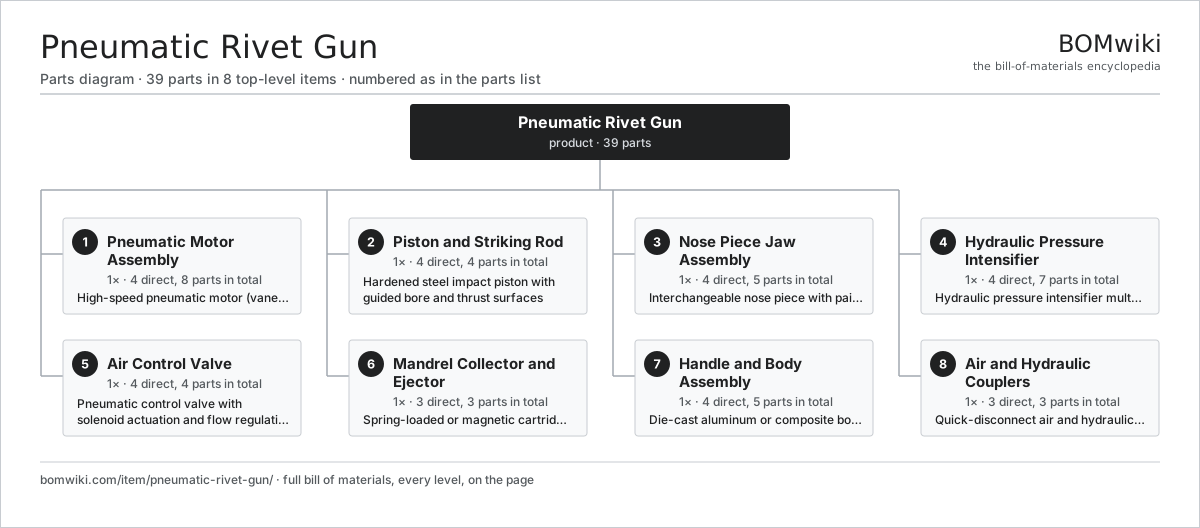
| # | Part | Qty | What it does |
|---|---|---|---|
| 1 | Pneumatic Motor Assembly 4 parts | 1× | High-speed pneumatic motor (vane or piston type) delivering 1000–2000 blows per minute |
| 2 | Piston and Striking Rod 4 parts | 1× | Hardened steel impact piston with guided bore and thrust surfaces |
| 3 | Nose Piece Jaw Assembly 4 parts | 1× | Interchangeable nose piece with pair of clamping jaws for various rivet head diameters |
| 4 | Hydraulic Pressure Intensifier 4 parts | 1× | Hydraulic pressure intensifier multiplying air pressure (50–100 psi) to clamping force (100–200 psi) |
| 5 | Air Control Valve 4 parts | 1× | Pneumatic control valve with solenoid actuation and flow regulation |
| 6 | Mandrel Collector and Ejector 3 parts | 1× | Spring-loaded or magnetic cartridge ejecting broken mandrels after rivet setting |
| 7 | Handle and Body Assembly 4 parts | 1× | Die-cast aluminum or composite body with ergonomic grip and trigger |
| 8 | Air and Hydraulic Couplers 3 parts | 1× | Quick-disconnect air and hydraulic fluid coupling to external pump or compressor |
3D model
No 3D model yet. Have a CAD file of this? Add a 3D model. STL renders right on this page; STEP, FreeCAD, and OpenSCAD sources are welcome too (openly licensed, like all 3D models on BOMwiki).
Build & assembly graph
expand / collapse · shared sub-assemblies converge · links to related products · est. labourTap an assembly to expand/collapse · tap a part to open it · use “Open page” for any node · drag to pan, scroll to zoom.
Bill of materials for Pneumatic Rivet Gun
8 top-level lines · 38 rows shown · 39 parts total · indented to 3 levels| # | Item / sub-assembly | Part no. | Qty/assy | Ext. qty | Parts | Type |
|---|---|---|---|---|---|---|
| 1 | Pneumatic Motor Assembly 4 parts | pneumatic-rivet-gun-air-motor | 1× | 1 | 8 | assembly |
| 1.1 | Motor Housing | pneumatic-rivet-gun-motor-housing | 1× | 1 | · | part |
| 1.2 | Motor Rotor Vanes | pneumatic-rivet-gun-rotor-vanes | 4× | 4 | · | part |
| 1.3 | Motor Drive Shaft | pneumatic-rivet-gun-motor-shaft | 1× | 1 | · | part |
| 1.4 | Ball Bearing | ball-bearing | 2× | 2 | · | part |
| 2 | Piston and Striking Rod 4 parts | pneumatic-rivet-gun-piston-rod | 1× | 1 | 4 | assembly |
| 2.1 | Piston Body | pneumatic-rivet-gun-piston-body | 1× | 1 | · | part |
| 2.2 | Return Spring | pneumatic-rivet-gun-return-spring | 1× | 1 | · | part |
| 2.3 | Piston Bore Cylinder | pneumatic-rivet-gun-piston-guide | 1× | 1 | · | part |
| 2.4 | Ball Bearing | ball-bearing | 1× | 1 | · | part |
| 3 | Nose Piece Jaw Assembly 4 parts | pneumatic-rivet-gun-jaw-set | 1× | 1 | 5 | assembly |
| 3.1 | Jaw Mount Body | pneumatic-rivet-gun-jaw-body | 1× | 1 | · | part |
| 3.2 | Left Jaw | pneumatic-rivet-gun-jaw-left | 1× | 1 | · | part |
| 3.3 | Right Jaw | pneumatic-rivet-gun-jaw-right | 1× | 1 | · | part |
| 3.4 | Fastener Set | fastener-set | 2× | 2 | · | part |
| 4 | Hydraulic Pressure Intensifier 4 parts | pneumatic-rivet-gun-intensifier | 1× | 1 | 7 | assembly |
| 4.1 | Intensifier Cylinder | pneumatic-rivet-gun-intensifier-cylinder | 1× | 1 | · | part |
| 4.2 | Intensifier Piston | pneumatic-rivet-gun-intensifier-piston | 1× | 1 | · | part |
| 4.3 | Check Valve | pneumatic-rivet-gun-check-valve | 2× | 2 | · | part |
| 4.4 | O-Ring Set | oring-set | 3× | 3 | · | part |
| 5 | Air Control Valve 4 parts | pneumatic-rivet-gun-air-valve | 1× | 1 | 4 | assembly |
| 5.1 | Valve Body | pneumatic-rivet-gun-valve-body | 1× | 1 | · | part |
| 5.2 | Solenoid Coil | pneumatic-rivet-gun-solenoid-coil | 1× | 1 | · | part |
| 5.3 | Directional Valve Spool | pneumatic-rivet-gun-spool-valve | 1× | 1 | · | part |
| 5.4 | Pressure Regulator | pneumatic-rivet-gun-pressure-regulator | 1× | 1 | · | part |
| 6 | Mandrel Collector and Ejector 3 parts | pneumatic-rivet-gun-mandrel-collector | 1× | 1 | 3 | assembly |
| 6.1 | Collector Housing | pneumatic-rivet-gun-collector-housing | 1× | 1 | · | part |
| 6.2 | Ejection Spring | pneumatic-rivet-gun-ejector-spring | 1× | 1 | · | part |
| 6.3 | Magnetic Insert | pneumatic-rivet-gun-magnetic-insert | 1× | 1 | · | part |
| 7 | Handle and Body Assembly 4 parts | pneumatic-rivet-gun-handle-body | 1× | 1 | 5 | assembly |
| 7.1 | Body Casting | pneumatic-rivet-gun-body-casting | 1× | 1 | · | part |
| 7.2 | Grip Sleeve | pneumatic-rivet-gun-grip-sleeve | 1× | 1 | · | part |
| 7.3 | Trigger Lever | pneumatic-rivet-gun-trigger-lever | 1× | 1 | · | part |
| 7.4 | Fastener Set | fastener-set | 2× | 2 | · | part |
| 8 | Air and Hydraulic Couplers 3 parts | pneumatic-rivet-gun-coupling | 1× | 1 | 3 | assembly |
| 8.1 | Air Coupler | pneumatic-rivet-gun-air-coupler | 1× | 1 | · | part |
| 8.2 | Hydraulic Coupler | pneumatic-rivet-gun-hydraulic-coupler | 1× | 1 | · | part |
| 8.3 | Connector | connector | 1× | 1 | · | part |
Something wrong in this list? Report a problem with this BOM.
Related products
same domain, ranked by shared parts Airless Paint Sprayer
97 parts · shares 1 with this page
Airless Paint Sprayer
97 parts · shares 1 with this page
 Chainsaw
66 parts · shares 1 with this page
Demolition Hammer
51 parts · shares 1 with this page
Dual-Action Polisher
62 parts · shares 1 with this page
Chainsaw
66 parts · shares 1 with this page
Demolition Hammer
51 parts · shares 1 with this page
Dual-Action Polisher
62 parts · shares 1 with this page
 Electric Grease Gun
62 parts · shares 1 with this page
Handheld Plasma Cutter
54 parts · shares 1 with this page
Electric Grease Gun
62 parts · shares 1 with this page
Handheld Plasma Cutter
54 parts · shares 1 with this page
Sourcing: possible vendors
Browse the supplier directory → Prices, MOQ, and lead times are algorithmic estimates, not quotes, and not claims about these companies. Company mappings are curated by keyword; est. price band $30–$800. How estimates work| Vendor | HQ | Specialty | MOQ | Lead time |
|---|---|---|---|---|
| stanleyblackanddecker.com ↗ | New Britain, US | Tools (DeWalt, Craftsman) | 500 units | 6–12 wks |
| bosch-professional.com ↗ | Leinfelden, DE | Power tools | 500 units | 6–12 wks |
| ttigroup.com ↗ | Hong Kong, CN | Tools (Milwaukee, Ryobi) | 500 units | 6–12 wks |
|
🇯🇵Makita
makita.com ↗
|
Anjo, JP | Power tools | 500 units | 6–12 wks |
|
🇨🇭Hilti
hilti.com ↗
|
Schaan, CH | Construction tools | 500 units | 6–12 wks |
1,024-word article