Pool Access Lift
ProductOverview
A pool access lift (or aquatic lift) is a motorized jib-crane designed specifically to lower disabled swimmers into and raise them out of pools for aquatic therapy or recreational swimming. The device combines a rotating slewing arm (similar to industrial cranes), a battery-powered winch for vertical lifting, and a waterproof seat or sling, all integrated into a pool-deck installation.
Aquatic therapy is transformative for patients with spinal cord injury, stroke, cerebral palsy, arthritis, and musculoskeletal pain. Water's buoyancy eliminates gravity-induced joint loading, allowing pain-free movement and exercise impossible on land. Temperature (typically 32–35 °C in therapy pools) relaxes spastic muscles. Aquatic settings also provide psychological benefit and social engagement. A pool lift enables independent or minimally assisted access to these therapeutic benefits for non-ambulatory or severely mobility-limited patients who would otherwise be unable to enter pools.
How it works
The user arrives at the anchored lift base at the pool's edge, wearing a bathing suit and positioned to sit in the waterproof seat. An attendant secures the safety harness straps around the user's pelvis and thighs. The attendant or user holds the wireless control pendant and manipulates the hoist joystick downward, activating the Hoist Motor Unit.
The Hoist Engine winds or unwinds the stainless steel lifting cable via the Winch Head, lowering the user at a smooth, controlled speed (0.1–0.2 m/s). As the user descends toward the water, the attendant simultaneously manipulates the rotation joystick, commanding the Slew Motor Unit to rotate the entire jib arm. The arm swings around the Slew Bearing, carrying the descending user over the pool toward the deepest point or area of choice.
Once the user is submerged, the hoist controls are released, and the user floats freely while tethered by the cable (or the attendant may hold the cable for guided activity). After therapy or play, the procedure reverses: the hoist joystick is pulled upward, raising the user out of the water and bringing them back to the base location as the arm rotates back.
Pool safety and accessibility
Pool lifts comply with ADA (Americans with Disabilities Act) accessibility standards in the United States and similar regulations internationally. Pools serving public, therapeutic, or residential populations are often required to install at least one lift where steps or ramps cannot accommodate wheelchair users. The deck-level grab railings provide transitional support for users with weak arms or balance challenges.
Pool water chemistry, chlorine, pH, alkalinity, can corrode bare metal; all wetted components are stainless steel 316L or 316 (marine grade) to resist saltwater and chlorine attack. The base ballast is often heavier at the rear (away from pool) to prevent tipping as the user's load moves forward during arm rotation.
Motorized vs. manual rotation
Modern battery-powered pool lifts include motorized slew motors, eliminating manual arm cranking by attendants. This reduces labor, improves safety (attendants no longer struggle with arm rotation while users are suspended over water), and allows users to rotate themselves via proportional joystick control if they have sufficient arm function.
Older manual-rotation lifts required attendants to hand-crank the arm; these are still used in smaller facilities or where electric power is not available, but motorized versions are standard in contemporary installations.
Battery operation and charging
The sealed Li-ion battery pack (typically 48–96 V, 10–20 Ah) provides enough energy for 15–30 transfers per charge, depending on user weight, arm reach distance, and descent/ascent speed. The Charger Unit is a standard AC/DC converter (2–4 hour fast charge), usually connected overnight or between therapy sessions.
Battery placement is in a sealed stainless or epoxy-coated enclosure, isolated from direct water splash and pool chemistry. Monitoring systems include a battery management system (BMS) that balances cell voltages, monitors temperature, and prevents overcharge or deep discharge.
Load monitoring and safety interlocks
The Control Pendant includes a large red emergency stop button that instantly halts both hoist and slew motors. The mechanical brake on the hoist motor engages if power loss occurs, preventing uncontrolled descent.
Some modern systems include load cells monitoring the actual weight in the seat; if weight suddenly drops (indicating a failed harness or user fall), the system triggers an alarm and halts motion. Rotation limit switches prevent over-rotation beyond the safe 270–360 degree range, preventing the arm from rotating into the pool or against deck obstacles.
Maintenance and durability
Annual inspection of the Hoist Cable is mandatory; saltwater exposure and cable flex induce corrosion and fatigue. Cable replacement typically occurs every 5–10 years depending on service intensity. The Slew Bearing (slew ring) requires annual grease lubrication; sealed versions reduce maintenance frequency.
Hydraulic versions (older designs) required regular fluid top-ups and seal inspection; modern battery-electric lifts eliminate hydraulic complexity, improving reliability and reducing environmental contamination risk from fluid leaks into pools.
Typical lifespan: 15–25 years with preventive maintenance, after which seal degradation, bearing wear, and composite fatigue become prevalent. Many facilities refurbish and reuse lifts rather than scrapping them, since the core mechanical structure remains sound.
Pool Access Lift parts and their functions
8 top-level parts · 79 parts in total · full bill of materials below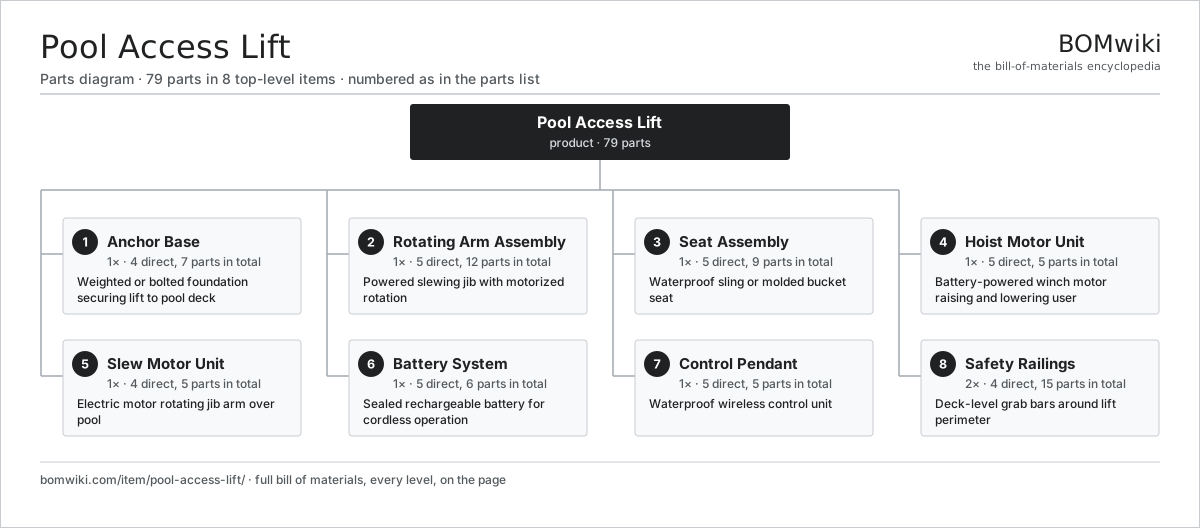
| # | Part | Qty | What it does |
|---|---|---|---|
| 1 | Anchor Base 4 parts | 1× | Weighted or bolted foundation securing lift to pool deck |
| 2 | Rotating Arm Assembly 5 parts | 1× | Powered slewing jib with motorized rotation |
| 3 | Seat Assembly 5 parts | 1× | Waterproof sling or molded bucket seat |
| 4 | Hoist Motor Unit 5 parts | 1× | Battery-powered winch motor raising and lowering user |
| 5 | Slew Motor Unit 4 parts | 1× | Electric motor rotating jib arm over pool |
| 6 | Battery System 5 parts | 1× | Sealed rechargeable battery for cordless operation |
| 7 | Control Pendant 5 parts | 1× | Waterproof wireless control unit |
| 8 | Safety Railings 4 parts | 2× | Deck-level grab bars around lift perimeter |
3D model
No 3D model yet. Have a CAD file of this? Add a 3D model. STL renders right on this page; STEP, FreeCAD, and OpenSCAD sources are welcome too (openly licensed, like all 3D models on BOMwiki).
Build & assembly graph
expand / collapse · shared sub-assemblies converge · links to related products · est. labourTap an assembly to expand/collapse · tap a part to open it · use “Open page” for any node · drag to pan, scroll to zoom.
Bill of materials for Pool Access Lift
8 top-level lines · 45 rows shown · 79 parts total · indented to 3 levels| # | Item / sub-assembly | Part no. | Qty/assy | Ext. qty | Parts | Type |
|---|---|---|---|---|---|---|
| 1 | Anchor Base 4 parts | pool-access-lift-anchor-base | 1× | 1 | 7 | assembly |
| 1.1 | Base Plate | pool-access-lift-base-plate | 1× | 1 | · | part |
| 1.2 | Base Weight | pool-access-lift-base-weight | 1× | 1 | · | part |
| 1.3 | Anchor Bolts | pool-access-lift-anchor-bolts | 4× | 4 | · | part |
| 1.4 | Deck Flange | pool-access-lift-deck-flange | 1× | 1 | · | part |
| 2 | Rotating Arm Assembly 5 parts | pool-access-lift-rotating-arm | 1× | 1 | 12 | assembly |
| 2.1 | Arm Tube | pool-access-lift-arm-tube | 1× | 1 | · | part |
| 2.2 | Slew Bearing | pool-access-lift-slew-bearing | 1× | 1 | · | part |
| 2.3 | Arm Guard | pool-access-lift-arm-guard | 1× | 1 | · | part |
| 2.4 | Counterbalance Arm | pool-access-lift-counterbalance-arm | 1× | 1 | · | part |
| 2.5 | Fastener Set | fastener-set | 8× | 8 | · | part |
| 3 | Seat Assembly 5 parts | pool-access-lift-seat-assembly | 1× | 1 | 9 | assembly |
| 3.1 | Seat Bucket | pool-access-lift-seat-bucket | 1× | 1 | · | part |
| 3.2 | Seat Sling | pool-access-lift-seat-sling | 1× | 1 | · | part |
| 3.3 | Safety Straps | pool-access-lift-seat-straps | 2× | 2 | · | part |
| 3.4 | Sling Spreader | pool-access-lift-sling-spreader | 1× | 1 | · | part |
| 3.5 | Connector | connector | 4× | 4 | · | part |
| 4 | Hoist Motor Unit 5 parts | pool-access-lift-hoist-motor | 1× | 1 | 5 | assembly |
| 4.1 | Hoist Engine | pool-access-lift-hoist-engine | 1× | 1 | · | part |
| 4.2 | Winch Head | pool-access-lift-winch-head | 1× | 1 | · | part |
| 4.3 | Hoist Cable | pool-access-lift-hoist-cable | 1× | 1 | · | part |
| 4.4 | Cable Guard | pool-access-lift-cable-guard | 1× | 1 | · | part |
| 4.5 | Mechanical Brake | pool-access-lift-brake-mechanical | 1× | 1 | · | part |
| 5 | Slew Motor Unit 4 parts | pool-access-lift-slew-motor | 1× | 1 | 5 | assembly |
| 5.1 | Slew Engine | pool-access-lift-slew-engine | 1× | 1 | · | part |
| 5.2 | Slew Gearbox | pool-access-lift-slew-gearbox | 1× | 1 | · | part |
| 5.3 | Limit Switches | pool-access-lift-slew-limit-switches | 2× | 2 | · | part |
| 5.4 | Rotation Encoder | pool-access-lift-encoder | 1× | 1 | · | part |
| 6 | Battery System 5 parts | pool-access-lift-battery-system | 1× | 1 | 6 | assembly |
| 6.1 | Battery Pack | pool-access-lift-battery-pack | 1× | 1 | · | part |
| 6.2 | Battery BMS | pool-access-lift-battery-bms | 1× | 1 | · | part |
| 6.3 | Battery Enclosure | pool-access-lift-battery-box | 1× | 1 | · | part |
| 6.4 | Charger Unit | pool-access-lift-charger | 1× | 1 | · | part |
| 6.5 | Connector | connector | 2× | 2 | · | part |
| 7 | Control Pendant 5 parts | pool-access-lift-control-pendant | 1× | 1 | 5 | assembly |
| 7.1 | Pendant Housing | pool-access-lift-pendant-housing | 1× | 1 | · | part |
| 7.2 | Hoist Joystick | pool-access-lift-hoist-joystick | 1× | 1 | · | part |
| 7.3 | Rotate Joystick | pool-access-lift-rotate-joystick | 1× | 1 | · | part |
| 7.4 | Emergency Button | pool-access-lift-emergency-button | 1× | 1 | · | part |
| 7.5 | Wireless Receiver | pool-access-lift-wireless-receiver | 1× | 1 | · | part |
| 8 | Safety Railings 4 parts | pool-access-lift-safety-railings | 2× | 2 | 15 | assembly |
| 8.1 | Railing Tube | pool-access-lift-railing-tube | 2× | 4 | · | part |
| 8.2 | Railing Posts | pool-access-lift-railing-posts | 4× | 8 | · | part |
| 8.3 | Railing Padding | pool-access-lift-railing-padding | 1× | 2 | · | part |
| 8.4 | Fastener Set | fastener-set | 8× | 16 | · | part |
Something wrong in this list? Report a problem with this BOM.
Sourcing: possible vendors
Browse the supplier directory → Prices, MOQ, and lead times are algorithmic estimates, not quotes, and not claims about these companies. Company mappings are curated by keyword; est. price band $500–$3M. How estimates work| Vendor | HQ | Specialty | MOQ | Lead time |
|---|---|---|---|---|
| gehealthcare.com ↗ | Chicago, US | Medical imaging & devices | 100 units | 12–20 wks |
| siemens-healthineers.com ↗ | Erlangen, DE | Medical systems | 100 units | 12–20 wks |
|
🇳🇱Philips
philips.com ↗
|
Amsterdam, NL | Health technology | 100 units | 12–20 wks |
| medtronic.com ↗ | Minneapolis, US | Medical devices | 100 units | 12–20 wks |
|
🇨🇳Mindray
mindray.com ↗
|
Shenzhen, CN | Medical devices | 100 units | 12–20 wks |
968-word article