Pool Dehumidifier
ProductOverview
An indoor swimming pool is an extreme moisture source: evaporation from the pool surface combined with bather perspiration can release 10–20 kg of water vapor per hour into the enclosed air. Left uncontrolled, this moisture condenses on walls, windows, and structural steel, promoting mold, corrosion, and condensation damage. A dedicated pool dehumidifier removes this excess moisture by running a refrigeration cycle that cools the pool-room air to below its dew point (condensing water vapor), removes the condensed water, and reheats the now-dry air before returning it to the space. A typical indoor pool requires a 5–30 ton refrigeration system running continuously or on demand, depending on pool size and occupancy.
The unit is essentially a window air-conditioner turned inside-out: instead of rejecting condenser heat outdoors, the condenser heat is used to reheat the dried air before it returns to the pool room, maximizing energy efficiency. The system is closed-loop, recirculating pool-room air continuously through the evaporator and condenser.
The dehumidification cycle
Pool-room air enters the Insulated Cabinet through a Return Air Grille and is drawn by the Blower & Motor across the Evaporator Coil. The evaporator is fed with liquid refrigerant at 4–8 °C; as the refrigerant evaporates at low pressure, it absorbs heat from the incoming humid air, cooling it below its dew point. Water vapor in the air condenses on the cold Evaporator Fins and drips into the Condensate Drain Pan, where a Condensate Pump collects it and pumps it out to a floor drain or back to the pool.
The now-cold dry air then passes across the Condenser Coil & Reheat, where hot high-pressure refrigerant from the Compressor Assembly is condensing. The latent heat of condensation warms the dry air back up to 35–45 °C before it exits through the Supply Air Outlet back into the pool room. The net effect: humidity is removed, latent heat is recovered, and the pool room stays at a comfortable, moisture-free condition (typically 50–60% RH).
Refrigeration circuit
The Compressor Unit is a hermetic reciprocating or scroll compressor (5–30 ton capacity), powered by an electric motor, that increases the pressure and temperature of refrigerant vapor returning from the Suction Line. Hot high-pressure vapor flows through the Discharge Line (insulated copper tube) to the Condenser Coil & Reheat inlet.
In the condenser, the vapor loses latent heat and condenses to liquid. The Expansion Valve meters the now-subcooled liquid refrigerant into the Evaporator Coil, where the cycle repeats. The Suction Accumulator protects the compressor from liquid slugging by separating any remaining liquid from the suction vapor, and an Compressor Oil Sump inside the compressor crankcase lubricates bearings and is returned to the compressor via the suction line.
Airflow and blower
The Blower & Motor is a centrifugal fan drawing 1–4 m³/s, driven by a variable-speed Blower Motor. The blower moves pool-room air continuously through the evaporator and condenser coils. Blower Vibration Mount pads under the blower frame decouple vibration from the cabinet and building structure. The blower speed can be modulated by the Control Panel based on humidity readings to save energy during low-occupancy periods.
Moisture removal and drainage
Water condensed on the Evaporator Coil drips into the Condensate Drain Pan below. The Condensate Pump has a float switch that activates when the pan reaches about 5 L; the pump then pushes water through the Check Valve and Drain Discharge Pipe to a building floor drain or back to the pool. Typical condensate production is 20–100 L/day depending on pool area, occupancy, and climate.
Control and humidity management
The Humidity Sensor continuously measures relative humidity in the pool room. The Control Panel compares this to the operator's setpoint (usually 50–60% RH) and modulates the compressor and blower speed accordingly. At part load, the compressor cycles on/off, or an expansion valve throttles to maintain the evaporator temperature and dehumidification rate needed to meet the humidity setpoint. The control panel also monitors refrigerant pressures: a High-Pressure Switch shuts down the compressor if discharge pressure exceeds about 400 psi (overpressure = blocked condenser or high ambient), and a Low-Pressure Switch indicates undercharge (refrigerant leak or expansion-valve failure).
Energy consideration
A well-designed pool dehumidifier recovers the condenser heat (which would normally be rejected to outdoors in an A/C unit), so the system requires less supplemental pool heating. The pool's own evaporative heat loss is recovered during the dehumidification process. However, the system does consume significant electricity: a 15 ton dehumidifier may draw 5–8 kW continuously, so indoor pools are typically operated with scheduled operating hours and night setbacks to manage energy cost.
Maintenance
Annual servicing is recommended: checking refrigerant charge via pressure gauges, inspecting Compressor Oil Sump oil level (adding mineral oil if needed), cleaning the Evaporator Fins of any dust or mold, and checking the Condensate Drain Pan and condensate drain line for algae growth. Sealed-unit designs offer minimal field service; any major repair (compressor, coil) typically requires the unit to be removed and factory-serviced.
Pool Dehumidifier parts and their functions
8 top-level parts · 209 parts in total · full bill of materials below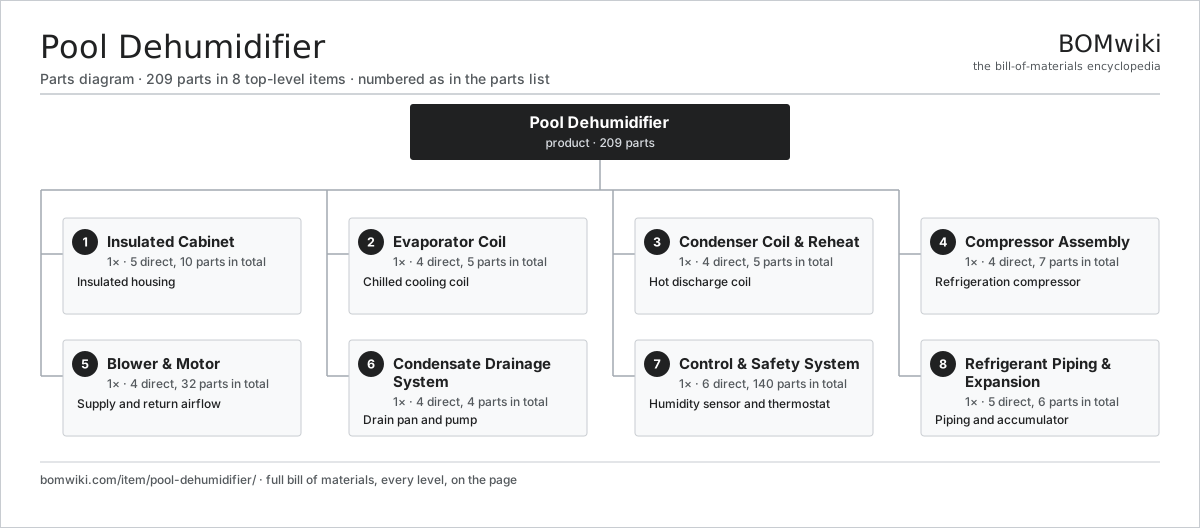
| # | Part | Qty | What it does |
|---|---|---|---|
| 1 | Insulated Cabinet 5 parts | 1× | Insulated housing |
| 2 | Evaporator Coil 4 parts | 1× | Chilled cooling coil |
| 3 | Condenser Coil & Reheat 4 parts | 1× | Hot discharge coil |
| 4 | Compressor Assembly 4 parts | 1× | Refrigeration compressor |
| 5 | Blower & Motor 4 parts | 1× | Supply and return airflow |
| 6 | Condensate Drainage System 4 parts | 1× | Drain pan and pump |
| 7 | Control & Safety System 6 parts | 1× | Humidity sensor and thermostat |
| 8 | Refrigerant Piping & Expansion 5 parts | 1× | Piping and accumulator |
3D model
No 3D model yet. Have a CAD file of this? Add a 3D model. STL renders right on this page; STEP, FreeCAD, and OpenSCAD sources are welcome too (openly licensed, like all 3D models on BOMwiki).
Build & assembly graph
expand / collapse · shared sub-assemblies converge · links to related products · est. labourTap an assembly to expand/collapse · tap a part to open it · use “Open page” for any node · drag to pan, scroll to zoom.
Bill of materials for Pool Dehumidifier
8 top-level lines · 54 rows shown · 209 parts total · indented to 3 levels| # | Item / sub-assembly | Part no. | Qty/assy | Ext. qty | Parts | Type |
|---|---|---|---|---|---|---|
| 1 | Insulated Cabinet 5 parts | pool-dehumidifier-cabinet | 1× | 1 | 10 | assembly |
| 1.1 | Cabinet Frame | pool-dehumidifier-frame | 1× | 1 | · | part |
| 1.2 | Sheet Metal Panel | sheet-panel | 6× | 6 | · | part |
| 1.3 | Cabinet Insulation | pool-dehumidifier-foam-insulation | 1× | 1 | · | part |
| 1.4 | Return Air Grille | pool-dehumidifier-air-return-grille | 1× | 1 | · | part |
| 1.5 | Supply Air Outlet | pool-dehumidifier-supply-outlet | 1× | 1 | · | part |
| 2 | Evaporator Coil 4 parts | pool-dehumidifier-evaporator-coil | 1× | 1 | 5 | assembly |
| 2.1 | Evaporator Tubes | pool-dehumidifier-evap-tubes | 1× | 1 | · | part |
| 2.2 | Evaporator Fins | pool-dehumidifier-evap-fins | 1× | 1 | · | part |
| 2.3 | Evaporator Header | pool-dehumidifier-evap-header | 2× | 2 | · | part |
| 2.4 | Condensate Drain Pan | pool-dehumidifier-drain-pan | 1× | 1 | · | part |
| 3 | Condenser Coil & Reheat 4 parts | pool-dehumidifier-condenser-coil | 1× | 1 | 5 | assembly |
| 3.1 | Condenser Tubes | pool-dehumidifier-cond-tubes | 1× | 1 | · | part |
| 3.2 | Condenser Fins | pool-dehumidifier-cond-fins | 1× | 1 | · | part |
| 3.3 | Condenser Header | pool-dehumidifier-cond-header | 2× | 2 | · | part |
| 3.4 | Discharge Temperature Control | pool-dehumidifier-reheat-thermostat | 1× | 1 | · | part |
| 4 | Compressor Assembly 4 parts | pool-dehumidifier-compressor | 1× | 1 | 7 | assembly |
| 4.1 | Compressor Unit | pool-dehumidifier-compressor-unit | 1× | 1 | · | part |
| 4.2 | Compressor Mounts | pool-dehumidifier-compressor-mounts | 4× | 4 | · | part |
| 4.3 | Suction Accumulator | pool-dehumidifier-suction-line-accumulator | 1× | 1 | · | part |
| 4.4 | Compressor Oil Sump | pool-dehumidifier-oil-sump | 1× | 1 | · | part |
| 5 | Blower & Motor 4 parts | pool-dehumidifier-blower | 1× | 1 | 32 | assembly |
| 5.1 | Blower Wheel | pool-dehumidifier-blower-wheel | 1× | 1 | · | part |
| 5.2 | Blower Motor 5 parts | pool-dehumidifier-blower-motor | 1× | 1 | 26 | assembly |
| 5.2.1 | Stator Assembly 3 parts + deeper › | stator-assembly | 1× | 1 | 3 | assembly |
| 5.2.2 | Rotor Assembly 4 parts + deeper › | rotor-assembly | 1× | 1 | 19 | assembly |
| 5.2.3 | Copper Winding | copper-winding | 1× | 1 | · | part |
| 5.2.4 | Motor Housing | motor-housing | 1× | 1 | · | part |
| 5.2.5 | Ball Bearing | ball-bearing | 2× | 2 | · | part |
| 5.3 | Blower Mounting Frame | pool-dehumidifier-blower-frame | 1× | 1 | · | part |
| 5.4 | Blower Vibration Mount | pool-dehumidifier-blower-isolation | 4× | 4 | · | part |
| 6 | Condensate Drainage System 4 parts | pool-dehumidifier-condensate-system | 1× | 1 | 4 | assembly |
| 6.1 | Condensate Drain Pan | pool-dehumidifier-drain-pan | 1× | 1 | · | part |
| 6.2 | Condensate Pump | pool-dehumidifier-condensate-pump | 1× | 1 | · | part |
| 6.3 | Check Valve | pool-dehumidifier-pump-check-valve | 1× | 1 | · | part |
| 6.4 | Drain Discharge Pipe | pool-dehumidifier-drain-line | 1× | 1 | · | part |
| 7 | Control & Safety System 6 parts | pool-dehumidifier-controls | 1× | 1 | 140 | assembly |
| 7.1 | Humidity Sensor | pool-dehumidifier-humidity-sensor | 1× | 1 | · | part |
| 7.2 | Control Panel 5 parts | pool-dehumidifier-control-panel | 1× | 1 | 128 | assembly |
| 7.2.1 | Bare PCB | pcb-bare | 1× | 1 | · | part |
| 7.2.2 | Microcontroller | mcu | 1× | 1 | · | part |
| 7.2.3 | SMD Passive (R/C/L) | smd-passives | 120× | 120 | · | part |
| 7.2.4 | Relay | relay | 2× | 2 | · | part |
| 7.2.5 | Connector | connector | 4× | 4 | · | part |
| 7.3 | High-Pressure Switch | pool-dehumidifier-high-pressure-switch | 1× | 1 | · | part |
| 7.4 | Low-Pressure Switch | pool-dehumidifier-low-pressure-switch | 1× | 1 | · | part |
| 7.5 | Relay | relay | 3× | 3 | · | part |
| 7.6 | Connector | connector | 6× | 6 | · | part |
| 8 | Refrigerant Piping & Expansion 5 parts | pool-dehumidifier-refrigerant-loop | 1× | 1 | 6 | assembly |
| 8.1 | Discharge Line | pool-dehumidifier-discharge-line | 1× | 1 | · | part |
| 8.2 | Liquid Line | pool-dehumidifier-liquid-line | 1× | 1 | · | part |
| 8.3 | Suction Line | pool-dehumidifier-suction-line | 1× | 1 | · | part |
| 8.4 | Expansion Valve | pool-dehumidifier-expansion-valve | 1× | 1 | · | part |
| 8.5 | Service Valves | pool-dehumidifier-service-valves | 2× | 2 | · | part |
Something wrong in this list? Report a problem with this BOM.
Related products
same domain, ranked by shared parts Air Handling Unit
631 parts · shares 16 with this page
Air Handling Unit
631 parts · shares 16 with this page
 Gas Furnace
308 parts · shares 16 with this page
Gas Furnace
308 parts · shares 16 with this page
 Gas Unit Heater
154 parts · shares 16 with this page
Makeup Air Unit
193 parts · shares 16 with this page
Steam Humidifier
207 parts · shares 16 with this page
Gas Unit Heater
154 parts · shares 16 with this page
Makeup Air Unit
193 parts · shares 16 with this page
Steam Humidifier
207 parts · shares 16 with this page
 VRF Outdoor Unit
801 parts · shares 16 with this page
VRF Outdoor Unit
801 parts · shares 16 with this page
Sourcing: possible vendors
Browse the supplier directory → Prices, MOQ, and lead times are algorithmic estimates, not quotes, and not claims about these companies. Company mappings are curated by keyword; est. price band $100–$20k. How estimates work| Vendor | HQ | Specialty | MOQ | Lead time |
|---|---|---|---|---|
|
🇺🇸Carrier
carrier.com ↗
|
Palm Beach Gardens, US | HVAC | 500 units | 8–14 wks |
| tranetechnologies.com ↗ | Davidson, US | HVAC | 500 units | 8–14 wks |
|
🇯🇵Daikin
daikin.com ↗
|
Osaka, JP | HVAC | 500 units | 8–14 wks |
|
🇺🇸Lennox
lennox.com ↗
|
Richardson, US | HVAC | 500 units | 8–14 wks |
| johnsoncontrols.com ↗ | Milwaukee, US | Building systems | 500 units | 8–14 wks |
907-word article