Dental Porcelain Furnace
ProductOverview
A dental porcelain furnace (or "kiln") is a compact electric oven designed to fire ceramic restorations at precise temperatures and dwell times. The device heats dental porcelain blanks, stain-and-glaze materials, and high-temperature resin-based restorations to the specific temperature required for vitrification, hardening, or color development, typically 700–900°C.
Unlike a laboratory muffle furnace (which heats to 1400°C for full sintering), a dental furnace operates at lower temperatures optimized for porcelain and tooth-colored ceramic processing. The Heating Element Assembly generates heat; the Temperature Control System manages temperature ramps and dwells; the Motorized Lift Platform controls specimen positioning for staged heating. Optional Vacuum System (Optional) reduces atmospheric pressure during early heating to prevent bubble nucleation in the ceramic matrix, a common defect if oxygen pockets are trapped during glaze firing.
How It Works
Loading. Specimens, usually zirconia crowns or lithium disilicate restorations that have been milled and stain-painted, are arranged on a ceramic tray and placed on the Motorized Lift Platform. The tray sits at the bottom of the Heating Chamber during initial heating.
Program Selection. The operator selects a firing schedule on the Control Display and Keypad. Different materials have different profiles: for example, porcelain stain might require a fast heat to 750°C (15°C/min), hold for 1 minute, then cool. Resin-based restorations might follow a slower ramp (5°C/min) to 650°C.
Heating Ramp. The Heating Element Assembly switches on via the Solid-State Relay (SSR), and the Thermocouple Sensor feeds temperature feedback to the Temperature Controller. The controller uses PID (proportional-integral-derivative) control to modulate relay duty cycle, ramping temperature smoothly at the programmed rate. As the chamber heats, the Motorized Lift Platform may rise slowly, moving specimens upward into the hottest zone.
Vacuum Phase (Optional). If Vacuum System (Optional) is engaged, the Vacuum Control Valve opens, drawing chamber pressure down to 0.1–1 bar. This dissolved-oxygen phase lasts 5–10 minutes and removes air pockets that could create white bubble defects in the final glaze. The Slow Release Valve needle valve is set to re-admit air at a slow, controlled rate (typically below 500°C) to prevent thermal shock from rapid pressure relief.
Hold Dwell. Once the chamber reaches the target temperature, the Timer Module triggers a hold phase lasting 1–5 minutes. The controller maintains temperature within ±5°C by modulating heating element power. Porcelain softens and flows slightly, creating a glossy glaze surface.
Cool-Down. After the hold completes, the heating element switches off. Passive cooling takes 4–6 hours as the Chamber Insulation slowly radiates heat to the room. To accelerate cool-down, the Forced-Air Cooling System may activate via a Fan Thermostat, using forced air to cut cool-down to 1–2 hours. The Motorized Lift Platform descends slowly as temperature drops, keeping specimens in the cooler zone to reduce thermal gradient stress.
Unloading. Once cool (typically checked at <100°C), the door is opened and the specimen tray is removed. Restorations now have a fused glaze layer or hardened resin surface.
Material Science
Dental porcelain is a feldspar-silica glass matrix reinforced with alumina or leucite crystals. At 700–800°C, feldspar particles soften and flow together, filling voids between crystalline phases. This process, viscous flow sintering, creates a non-porous, strong ceramic bond without full atom-scale diffusion (which would require higher temperatures and longer times).
Stain pigments (iron, cobalt, manganese oxides) are applied as liquids or pastes onto a pre-sintered surface. Firing melts the stain into the surface, creating permanent color. Different pigments have different optimal firing temperatures; a furnace's ability to hold ±5°C is critical to consistent shade matching.
Lithium disilicate and zirconia are pre-sintered before arriving at the lab. The furnace's role is stain application and glaze: a thin layer of ultra-low-viscosity glass that seals the surface and enhances esthetics.
Vacuum Benefit
Atmospheric oxygen dissolved in pores and on grain boundaries can form gas bubbles when heated. Vacuum during the early heating phase removes this oxygen, preventing bubble nucleation. As the specimen approaches final temperature (when glaze viscosity drops sharply), pressure is slowly re-admitted, allowing atmospheric air to re-dissolve without creating new voids. This step is optional but highly recommended for high-esthetic anterior restorations where bubble defects are visible.
Programmable Cycles
Modern dental furnaces store 10–20 firing programs in internal memory. A single cycle might be:
- Ramp 15°C/min to 750°C
- Hold 2 minutes
- Cool (passive)
Another might be:
- Ramp 5°C/min to 650°C (slow for resin)
- Vacuum engage at 200°C, release at 400°C
- Hold 5 minutes
- Cool (forced air after 400°C)
Advanced furnaces allow segment-by-segment customization, enabling technicians to fine-tune for specific materials or ceramic brands.
Accessory Equipment
- Kiln stilts and trivets: Ceramic supports holding specimens without contact marks
- Ceramic liners: Replaceable shelf and muffle liners preventing contamination
- Thermocouples: Replacement type K or R junctions as sensors degrade
- Relay modules: Replacement solid-state relays for high-use furnaces
Integration Points
- Input: Stain-painted Dental CAD/CAM Mill restorations, pre-sintered zirconia blanks from Zirconia Sintering Furnace, resin-based inlay/onlay blanks
- Output: Glazed, color-matched final restorations ready for seating; temporary resin restorations post-cured and hardened
- Related: Dental Articulator may hold restorations during staining to ensure shade match; Dental Model Trimmer is used to finish model dies before glazing
Clinical Workflow
In a dental laboratory, a technician applies layer-by-layer stains to a milled or sintered restoration, air-dries between applications, then fires the restoration in the furnace. Total staining and firing time is 30 minutes to 1 hour. Multiple firings may be needed for complex shade gradations. Once complete, the restoration is seated on a die model and delivered to the dentist.
Chairside systems rarely include furnaces; chairside milling produces unglazed restorations that are seating-ready or have pre-applied glaze fused at the factory.
Safety
Furnaces operate above 600°C, creating burn and fire hazards. All units include:
- Insulated exterior (< 60°C surface)
- Interlock door switch preventing operation when open
- Audible alarm for cycle completion
- Indicator light showing heating status
Operators wear heat-resistant gloves when loading and unloading near 200°C residual chamber heat.
Dental Porcelain Furnace parts and their functions
7 top-level parts · 32 parts in total · full bill of materials below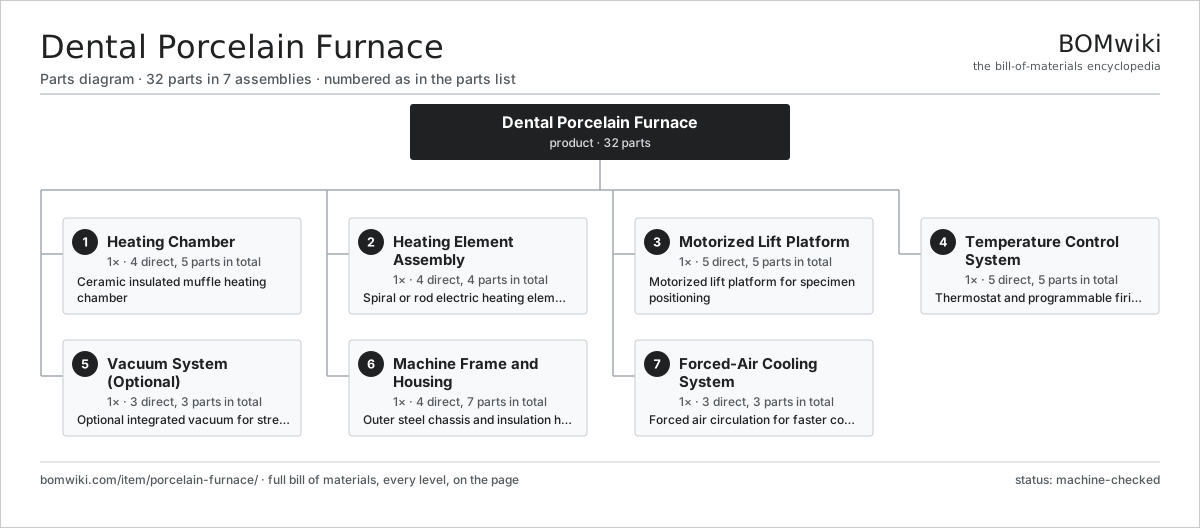
| # | Part | Qty | What it does |
|---|---|---|---|
| 1 | Heating Chamber 4 parts | 1× | Ceramic insulated muffle heating chamber |
| 2 | Heating Element Assembly 4 parts | 1× | Spiral or rod electric heating element |
| 3 | Motorized Lift Platform 5 parts | 1× | Motorized lift platform for specimen positioning |
| 4 | Temperature Control System 5 parts | 1× | Thermostat and programmable firing schedule |
| 5 | Vacuum System (Optional) 3 parts | 1× | Optional integrated vacuum for stress relief |
| 6 | Machine Frame and Housing 4 parts | 1× | Outer steel chassis and insulation housing |
| 7 | Forced-Air Cooling System 3 parts | 1× | Forced air circulation for faster cool-down |
3D model
No 3D model yet. Have a CAD file of this? Add a 3D model — STL renders right on this page; STEP, FreeCAD, and OpenSCAD sources are welcome too (openly licensed, like all 3D models on BOMwiki).
Build & assembly graph
expand / collapse · shared sub-assemblies converge · links to related products · est. labourTap an assembly to expand/collapse · tap a part to open it · use “Open page” for any node · drag to pan, scroll to zoom.
Bill of materials for Dental Porcelain Furnace
7 top-level lines · 35 rows shown · 32 parts total · indented to 3 levels| # | Item / sub-assembly | Part no. | Qty/assy | Ext. qty | Parts | Type |
|---|---|---|---|---|---|---|
| 1 | Heating Chamber 4 parts | porcelain-furnace-chamber | 1× | 1 | 5 | assembly |
| 1.1 | Muffle Liner | porcelain-furnace-chamber-muffle | 1× | 1 | · | part |
| 1.2 | Chamber Insulation | porcelain-furnace-chamber-insulation | 1× | 1 | · | part |
| 1.3 | Access Door Assembly | porcelain-furnace-chamber-door | 1× | 1 | · | part |
| 1.4 | Ceramic Shelf | porcelain-furnace-chamber-shelf | 2× | 2 | · | part |
| 2 | Heating Element Assembly 4 parts | porcelain-furnace-heating-element | 1× | 1 | 4 | assembly |
| 2.1 | Heating Coil | porcelain-furnace-heating-element-wire | 1× | 1 | · | part |
| 2.2 | Coil Support Brackets | porcelain-furnace-heating-element-support | 1× | 1 | · | part |
| 2.3 | Power Lead Assembly | porcelain-furnace-heating-element-lead | 1× | 1 | · | part |
| 2.4 | Thermocouple Sensor | porcelain-furnace-heating-element-thermocouple | 1× | 1 | · | part |
| 3 | Motorized Lift Platform 5 parts | porcelain-furnace-lift-table | 1× | 1 | 5 | assembly |
| 3.1 | Lift Motor | porcelain-furnace-lift-table-motor | 1× | 1 | · | part |
| 3.2 | Lift Screw | porcelain-furnace-lift-table-screw | 1× | 1 | · | part |
| 3.3 | Lift Platform Plate | porcelain-furnace-lift-table-plate | 1× | 1 | · | part |
| 3.4 | Linear Guide System | porcelain-furnace-lift-table-guide | 1× | 1 | · | part |
| 3.5 | Limit Sensors | porcelain-furnace-lift-table-limit-switch | 1× | 1 | · | part |
| 4 | Temperature Control System 5 parts | porcelain-furnace-control-panel | 1× | 1 | 5 | assembly |
| 4.1 | Temperature Controller | porcelain-furnace-control-panel-controller | 1× | 1 | · | part |
| 4.2 | Solid-State Relay (SSR) | porcelain-furnace-control-panel-relay | 1× | 1 | · | part |
| 4.3 | Control Display and Keypad | porcelain-furnace-control-panel-display | 1× | 1 | · | part |
| 4.4 | Timer Module | porcelain-furnace-control-panel-timer | 1× | 1 | · | part |
| 4.5 | Alert System | porcelain-furnace-control-panel-alarm | 1× | 1 | · | part |
| 5 | Vacuum System (Optional) 3 parts | porcelain-furnace-vacuum-pump | 1× | 1 | 3 | assembly |
| 5.1 | Vacuum Motor | porcelain-furnace-vacuum-pump-motor | 1× | 1 | · | part |
| 5.2 | Vacuum Control Valve | porcelain-furnace-vacuum-pump-valve | 1× | 1 | · | part |
| 5.3 | Slow Release Valve | porcelain-furnace-vacuum-pump-release | 1× | 1 | · | part |
| 6 | Machine Frame and Housing 4 parts | porcelain-furnace-frame | 1× | 1 | 7 | assembly |
| 6.1 | Steel Frame Structure | porcelain-furnace-frame-steel | 1× | 1 | · | part |
| 6.2 | Exterior Insulation Wrap | porcelain-furnace-frame-exterior-insulation | 1× | 1 | · | part |
| 6.3 | Cable Entry Panel | porcelain-furnace-frame-cable-entry | 1× | 1 | · | part |
| 6.4 | Leveling Feet | porcelain-furnace-frame-feet | 4× | 4 | · | part |
| 7 | Forced-Air Cooling System 3 parts | porcelain-furnace-cooling-fan | 1× | 1 | 3 | assembly |
| 7.1 | Cooling Blower Motor | porcelain-furnace-cooling-fan-motor | 1× | 1 | · | part |
| 7.2 | Cooling Duct | porcelain-furnace-cooling-fan-duct | 1× | 1 | · | part |
| 7.3 | Fan Thermostat | porcelain-furnace-cooling-fan-thermostat | 1× | 1 | · | part |
Sourcing: possible vendors
Prices, MOQ, and lead times are algorithmic estimates, not quotes, and not claims about these companies. Company mappings are curated by keyword; est. price band $200–$200k. How estimates work| Vendor | HQ | Specialty | MOQ | Lead time |
|---|---|---|---|---|
| dentsplysirona.com ↗ | Charlotte, US | Dental equipment | 100 units | 10–16 wks |
|
🇺🇸Envista
envistaco.com ↗
|
Brea, US | Dental (KaVo, Nobel) | 100 units | 10–16 wks |
|
🇫🇮Planmeca
planmeca.com ↗
|
Helsinki, FI | Dental units & imaging | 100 units | 10–16 wks |
|
🇺🇸A-dec
a-dec.com ↗
|
Newberg, US | Dental chairs & delivery | 100 units | 10–16 wks |
|
🇺🇸Midmark
midmark.com ↗
|
Versailles, US | Medical & veterinary equipment | 100 units | 10–16 wks |
1,080-word article