Portable 4-Gas Detector
ProductOverview
Portable multigas detectors are handheld instruments used by safety professionals, industrial hygienists, and emergency responders to identify hazardous atmospheres in confined spaces, underground work, chemical plants, and enclosed rooms. This four-gas model combines electrochemical, catalytic bead, and infrared detection to simultaneously monitor carbon monoxide (CO), oxygen depletion (O₂), lower explosive limit (LEL), and carbon dioxide (CO₂).
The instrument samples ambient air via a diaphragm Pump System, passes it through four independent Sensor Array modules, and displays real-time readings on an integrated touchscreen. Audible and visual alarms trigger when concentrations exceed operator-programmable thresholds. The Power System provides 8 hours of operation per charge, with USB-C fast charging.
How it works
Air enters through the Intake Tube Assembly particle filter at the device's base. The Diaphragm Pump draws air at 0.5–2 L/min, a rate controlled by the Flow Regulator, and routes it through the Sensor Array.
The Electrochemical CO Sensor and Electrochemical O2 Sensor sensors are electrochemical cells. When target gas molecules reach the electrode, they undergo oxidation or reduction, generating a current proportional to gas concentration. The signal is extremely small (picoamperes), requiring precision op-amp conditioning before analog-to-digital conversion.
The Catalytic Bead LEL Sensor is a combustible gas sensor based on the Wheatstone bridge principle. Two platinum-coated ceramic beads, one catalytically inert reference, one active, heat from an electric current. When combustible gas contacts the active bead, it burns (oxidizes at the platinum surface), raising temperature and resistance. The bridge circuit detects the imbalance and outputs a voltage swing proportional to LEL percentage.
The Infrared CO2 Cell is a non-dispersive infrared (NDIR) sensor for CO₂. An infrared source emits broadband light across a sample chamber. CO₂ absorbs at 4.26 µm. A pyroelectric detector measures transmitted intensity; lower transmission equals higher CO₂. A reference wavelength cancels out dust and optical drift.
All four sensor outputs feed into the Electronics, where the Microcontroller samples each analog signal at 860 Hz via the ADC Integrated Circuit. Firmware applies sensor-specific linearization curves (factory calibrated per unit), compensates for temperature drift using an onboard thermistor, and applies a 1 Hz low-pass filter to suppress noise. Results are logged to onboard flash memory at 1 Hz resolution.
When any gas exceeds its alarm threshold, the firmware triggers the Alarm Module: the Piezo Buzzer pulses at 2 Hz, the LED Board flashes red, and a normally open Relay closes to drive external horns or strobe lights.
The Li-Ion Battery Pack is a lithium-ion cell with an BMS Board that disconnects the pack if cell temperature exceeds 60 °C or if external overcharge voltage appears. USB charging via the USB Charging IC runs at 500 mA constant-current until full, then trickle-charges at 50 mA. A full charge from empty takes 6 hours.
The Enclosure is injection-molded ABS polycarbonate with a rubberized TPR Handle and Fastener Set for field disassembly. Gasket Seal seals maintain IP54 rating (dust and splash resistant). The LCD Panel and Button Pad are mounted behind a clear window on the face, accessible via three function buttons for menu navigation and sensor bump-test initiation.
Sensor Technology Deep Dive
Electrochemical Cells (CO and O₂) rely on diffusion of gas through a membrane into the electrode chamber. The electrode material and electrolyte composition are gas-specific; a CO cell uses different chemistry than an O₂ cell. Electrodes are polarized to a fixed potential by the Op-Amp Conditioning, which supplies constant voltage and measures the resulting current. The sensor output is not linear; firmware maps picoamp currents to ppm via polynomial fit coefficients burned into the MCU at factory calibration.
Catalytic Bead (LEL) is sensitive to any combustible compound (methane, propane, hydrogen, acetone vapors, etc.) but cannot distinguish them. The bridge circuit is self-oscillating; the MCU reads bridge voltage at 1 kHz and computes moving average. Catalytic beads do not respond to carbon monoxide, making them ideal for confined-space entry where both hazards exist.
NDIR CO₂ Sensor (infrared) is non-catalytic and non-consumable, allowing unlimited measurement cycles. A Wien oscillator or modulated LED source (typically at 5 Hz) prevents baseline drift. Dual-wavelength designs (one at CO₂ absorption peak, one outside) eliminate interference from dust accumulation. Response time is dominated by sample chamber volume; typical lag is 8–12 seconds.
Calibration and Maintenance
All sensors are factory-calibrated against traceable gas standards (NIST or equivalent). The device stores calibration coefficients in flash memory. Field users should perform a bump test monthly, exposing the detector briefly to a known gas concentration to verify response. Sensors in high-use environments are typically replaced annually; the Sensor Array is field-replaceable via snap connectors.
Electrochemical cells degrade at ~10% per year of rated span in normal storage; CO₂ NDIR sensors and catalytic beads last 3–5 years if kept dry and cool. Moisture, temperature extremes, and high-concentration exposure accelerate aging.
Safety Standards
This class of detector falls under industrial gas detection and occupational safety. Many regions mandate 4-gas detection for confined-space entry (OSHA permit-space, NFPA 1670 rescue operations). The device must meet CSA C22.2 No. 61010-1 (safety of electrical measuring apparatus) and typically holds ATEX II 2G marking for use in explosive atmospheres.
Portable 4-Gas Detector parts and their functions
7 top-level parts · 38 parts in total · full bill of materials below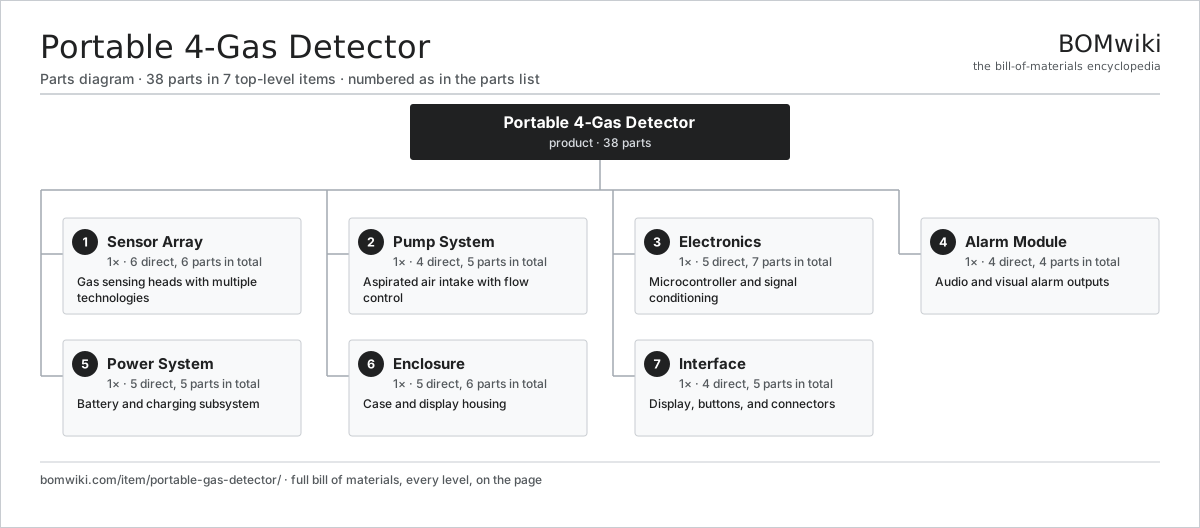
| # | Part | Qty | What it does |
|---|---|---|---|
| 1 | Sensor Array 6 parts | 1× | Gas sensing heads with multiple technologies |
| 2 | Pump System 4 parts | 1× | Aspirated air intake with flow control |
| 3 | Electronics 5 parts | 1× | Microcontroller and signal conditioning |
| 4 | Alarm Module 4 parts | 1× | Audio and visual alarm outputs |
| 5 | Power System 5 parts | 1× | Battery and charging subsystem |
| 6 | Enclosure 5 parts | 1× | Case and display housing |
| 7 | Interface 4 parts | 1× | Display, buttons, and connectors |
3D model
No 3D model yet. Have a CAD file of this? Add a 3D model. STL renders right on this page; STEP, FreeCAD, and OpenSCAD sources are welcome too (openly licensed, like all 3D models on BOMwiki).
Build & assembly graph
expand / collapse · shared sub-assemblies converge · links to related products · est. labourTap an assembly to expand/collapse · tap a part to open it · use “Open page” for any node · drag to pan, scroll to zoom.
Bill of materials for Portable 4-Gas Detector
7 top-level lines · 40 rows shown · 38 parts total · indented to 3 levels| # | Item / sub-assembly | Part no. | Qty/assy | Ext. qty | Parts | Type |
|---|---|---|---|---|---|---|
| 1 | Sensor Array 6 parts | portable-gas-detector-sensor-array | 1× | 1 | 6 | assembly |
| 1.1 | Electrochemical CO Sensor | portable-gas-detector-ec-co | 1× | 1 | · | part |
| 1.2 | Electrochemical O2 Sensor | portable-gas-detector-ec-o2 | 1× | 1 | · | part |
| 1.3 | Catalytic Bead LEL Sensor | portable-gas-detector-cat-bead | 1× | 1 | · | part |
| 1.4 | Infrared CO2 Cell | portable-gas-detector-ir-cell | 1× | 1 | · | part |
| 1.5 | Sensor PCB | portable-gas-detector-sensor-pcb | 1× | 1 | · | part |
| 1.6 | Connector | connector | 1× | 1 | · | part |
| 2 | Pump System 4 parts | portable-gas-detector-pump-system | 1× | 1 | 5 | assembly |
| 2.1 | Diaphragm Pump | portable-gas-detector-diaphragm-pump | 1× | 1 | · | part |
| 2.2 | Intake Tube Assembly | portable-gas-detector-pump-intake | 1× | 1 | · | part |
| 2.3 | Flow Regulator | portable-gas-detector-flow-regulator | 1× | 1 | · | part |
| 2.4 | Sampling Tubing | portable-gas-detector-tubing | 2× | 2 | · | part |
| 3 | Electronics 5 parts | portable-gas-detector-electronics | 1× | 1 | 7 | assembly |
| 3.1 | Microcontroller | mcu | 1× | 1 | · | part |
| 3.2 | Bare PCB | pcb-bare | 1× | 1 | · | part |
| 3.3 | SMD Passive (R/C/L) | smd-passives | 3× | 3 | · | part |
| 3.4 | ADC Integrated Circuit | portable-gas-detector-adc-ic | 1× | 1 | · | part |
| 3.5 | Op-Amp Conditioning | portable-gas-detector-opamp-board | 1× | 1 | · | part |
| 4 | Alarm Module 4 parts | portable-gas-detector-alarm-module | 1× | 1 | 4 | assembly |
| 4.1 | Piezo Buzzer | portable-gas-detector-buzzer | 1× | 1 | · | part |
| 4.2 | LED Board | portable-gas-detector-led-board | 1× | 1 | · | part |
| 4.3 | Relay | relay | 1× | 1 | · | part |
| 4.4 | Alarm PCB | portable-gas-detector-alarm-pcb | 1× | 1 | · | part |
| 5 | Power System 5 parts | portable-gas-detector-power-system | 1× | 1 | 5 | assembly |
| 5.1 | Li-Ion Battery Pack | portable-gas-detector-li-pack | 1× | 1 | · | part |
| 5.2 | BMS Board | bms-board | 1× | 1 | · | part |
| 5.3 | USB Charging IC | portable-gas-detector-charging-ic | 1× | 1 | · | part |
| 5.4 | Boost Converter | portable-gas-detector-boost-converter | 1× | 1 | · | part |
| 5.5 | Power Supply | power-supply | 1× | 1 | · | part |
| 6 | Enclosure 5 parts | portable-gas-detector-enclosure | 1× | 1 | 6 | assembly |
| 6.1 | Upper Case | portable-gas-detector-case-upper | 1× | 1 | · | part |
| 6.2 | Lower Case | portable-gas-detector-case-lower | 1× | 1 | · | part |
| 6.3 | Gasket Seal | portable-gas-detector-gasket | 2× | 2 | · | part |
| 6.4 | Handle | portable-gas-detector-handle | 1× | 1 | · | part |
| 6.5 | Fastener Set | fastener-set | 1× | 1 | · | part |
| 7 | Interface 4 parts | portable-gas-detector-interface | 1× | 1 | 5 | assembly |
| 7.1 | LCD Panel | lcd-panel | 1× | 1 | · | part |
| 7.2 | Button Pad | portable-gas-detector-button-board | 1× | 1 | · | part |
| 7.3 | Connector | connector | 2× | 2 | · | part |
| 7.4 | Display Bracket | portable-gas-detector-display-bracket | 1× | 1 | · | part |
Something wrong in this list? Report a problem with this BOM.
Used in 1 assembly
Related products
same domain, ranked by shared parts Smart Parcel Locker
278 parts · shares 4 with this page
Smart Parcel Locker
278 parts · shares 4 with this page
 Parking Meter
40 parts · shares 3 with this page
Parking Meter
40 parts · shares 3 with this page
 Motorized Blinds
65 parts · shares 2 with this page
Smart Bench
52 parts · shares 2 with this page
Motorized Blinds
65 parts · shares 2 with this page
Smart Bench
52 parts · shares 2 with this page
 Video Doorbell
231 parts · shares 2 with this page
Video Doorbell
231 parts · shares 2 with this page
 AAC Block Plant
155 parts · shares 3 with this page
AAC Block Plant
155 parts · shares 3 with this page
Sourcing: possible vendors
Browse the supplier directory → Prices, MOQ, and lead times are algorithmic estimates, not quotes, and not claims about these companies. Company mappings are curated by keyword; est. price band $50–$10k. How estimates work| Vendor | HQ | Specialty | MOQ | Lead time |
|---|---|---|---|---|
| assaabloy.com ↗ | Stockholm, SE | Locks & access | 1,000 units | 8–12 wks |
|
🇺🇸Allegion
allegion.com ↗
|
Dublin, US | Security products (Schlage) | 1,000 units | 8–12 wks |
| dormakaba.com ↗ | Rümlang, CH | Access & door systems | 1,000 units | 8–12 wks |
| honeywell.com ↗ | Charlotte, US | Building & safety tech | 1,000 units | 8–12 wks |
| hikvision.com ↗ | Hangzhou, CN | Surveillance & security | 1,000 units | 8–12 wks |
942-word article