Postal Scale
ProductOverview
The postal scale is an electronic instrument designed for small offices, shipping departments, and mail centers to quickly and accurately determine the weight of outgoing mail and small parcels, and to look up the corresponding USPS, UPS, FedEx, or international postal rate. Unlike a general-purpose kitchen or warehouse scale, a postal scale integrates rate computation directly, allowing the operator to immediately quote shipping cost to a customer, print a postage label, or log shipping weight for invoicing.
Postal scales have been in use since the 1980s and remain standard equipment in retail shipping centers, law offices, and any business that routinely dispatches mail. Modern scales are compact, battery-operated, and frequently updated with the latest postal rates.
How it works
Load Measurement: The package is placed on the flat weighing platform. The platform is supported at four corners by precision load cells, strain-gauge sensors that measure the applied force. As weight presses down, the strain gauges experience stress, causing their electrical resistance to change in a proportional manner.
Signal Conditioning: Each load cell produces a very weak millivolt-level signal. These four signals are summed and amplified by the load cell amplifier board, which includes precision instrumentation amplifiers and low-noise filtering. The amplified signal is then converted to a digital value by a high-resolution (16–24 bit) analog-to-digital converter.
Weight Calculation: The microcontroller in the rate computer receives the digitized weight value and performs a moving-average filter to smooth brief fluctuations. The result is displayed in pounds/ounces or kilograms/grams on the LCD display.
Rate Lookup: The operator uses the keypad to select the postal service type (e.g., USPS First Class, Priority Mail, UPS Ground, FedEx Express). The microcontroller accesses a lookup table stored in its ROM or EEPROM that maps {weight, service type} to postage cost. The resulting postage amount is displayed next to the weight.
Output and Documentation: The operator reads the display to determine shipping cost and either:
- Manually applies the correct denomination of postage stamp.
- Prints a postage label via a connected label printer (on models with serial or USB output).
- Records the weight and cost in a shipping log.
Rate Updates: Postal rates change periodically (typically 1–3 times per year). Postal scale operators update rate tables via:
- A button sequence entered on the keypad (for USPS rates, which follow a predictable structure).
- A memory card or USB device provided by the scale manufacturer.
- A dial-in modem or internet connection (on higher-end models).
Load Cell and Weighing Accuracy
The strain-gauge load cell is the core of the weighing system. Typical accuracy is:
- Repeatability: ±0.1 oz (2.8 g) or better, meaning successive measurements of the same package vary by less than this amount.
- Linearity: ±0.5% of full-scale capacity across the weighing range.
- Temperature Compensation: Many load cells include internal temperature sensors to correct for drift caused by thermal expansion or contraction.
A four-point mounting system (one load cell at each corner) ensures that weight is sensed equally regardless of where the package is placed on the platform, as long as the scale is level (checked by calibration at installation).
Display and User Interface
The LCD display typically shows:
- Primary Line: Weight (e.g., "5 LB 3 OZ" or "2.3 KG")
- Secondary Line: Postage amount (e.g., "USPS $4.95" or "Priority $18.45")
The keypad buttons allow rapid mode selection:
- First Class: Standard USPS letter/small parcel rates
- Priority: USPS Priority Mail (2–3 day delivery)
- Express: USPS Priority Express (overnight/guaranteed)
- Flat Rate: USPS flat-rate envelope or box pricing (fixed cost regardless of weight)
- International: Foreign postage rates
- Mode Buttons: Additional buttons for UPS, FedEx, or carrier selection on multi-carrier scales
On some models, the display driver provides a menu-driven interface with arrow buttons to navigate through options.
Rate Accuracy and Compliance
Postal scales must adhere to accuracy standards set by:
- USPS: Publishes official postage rates; scales must reflect current rates.
- Weights and Measures Agencies: In some jurisdictions, postal scales must be certified as accurate to specific tolerances (e.g., Class III or Class IIIL per NIST guidelines).
Manufacturers provide periodic updates to ensure scales remain compliant. Failure to update rates can result in:
- Under-postaging: Mail is returned due to insufficient postage.
- Over-postaging: Extra money spent on unnecessary postage; cumulative cost over large mailing campaigns can be significant.
Multi-Carrier Support
Modern postal scales often support multiple carriers:
- USPS (domestic and international)
- UPS (ground, 2nd day, overnight, international)
- FedEx (ground, express, overnight, international)
A single-carrier scale typically costs $50–200. Multi-carrier scales range from $200–500+. The rate ROM is updated for each carrier's rate changes.
Power Supply and Portability
Postal scales typically operate in one of two modes:
- AC-Powered: Connected to 120V AC outlet via power adapter. Provides stable, continuous power and is suitable for fixed installations.
- Battery-Operated: Uses 4–6 AA or AAA alkaline batteries, providing 6–12 months of operation depending on usage frequency. Allows portability and installation in locations without nearby outlets.
Some scales feature dual operation: USB power when docked in a shipping workstation, battery power when moved to remote locations.
Integration with Shipping and Accounting
Postal scales integrate with shipping workflows via:
- Thermal Label Printers: A serial or USB connection allows the scale to transmit weight and service selection to a label printer, automating label generation.
- Shipping Software: Integration with UPS WorldShip, FedEx Ship Manager, or USPS Click-N-Ship allows the scale to feed weight data into the software for automatic rate calculation and label printing.
- Accounting Systems: Weight and postage data can be logged to spreadsheets or accounting software for cost tracking and billing.
Maintenance and Recalibration
Calibration: Postal scales must be recalibrated periodically (typically yearly or if moved) using calibration weights:
- An empty-scale zero calibration is performed.
- A known test weight (e.g., 5 lbs) is placed on the platform.
- The scale is adjusted (via button sequence or technician software) until it displays the correct known weight.
Leveling: The platform must be level to ensure accurate weight distribution across all four load cells. Leveling feet or shims are adjusted if the scale is installed on an uneven surface.
Cleaning: The platform should be wiped clean of dust and debris to ensure accurate readings. Water should be avoided (non-sealed scales).
Parts Replacement: If accuracy degrades beyond repair (typically after 10+ years or 100,000+ weighing cycles), the load cell or amplifier board can often be replaced as field-service items, extending scale life.
Legacy vs. Modern Postal Scales
| Aspect | Mechanical (1950s–1980s) | Electronic (1980s–present) |
|---|---|---|
| Operation | Spring scale, manual rate lookup | Digital weight, automatic lookup |
| Accuracy | ±0.5 oz (14 g) | ±0.1 oz (2.8 g) or better |
| Speed | 30–60 seconds per package | 3–10 seconds per package |
| Rate Updates | Manual (operator writes rate) | Electronic (firmware or ROM update) |
| Cost | $20–50 (used market) | $100–400 (new) |
Mechanical scales are now primarily collector items or emergency backups. Electronic scales have become ubiquitous due to rapid rate changes and the need for precise, auditable shipping records.
Postal Scale parts and their functions
8 top-level parts · 35 parts in total · full bill of materials below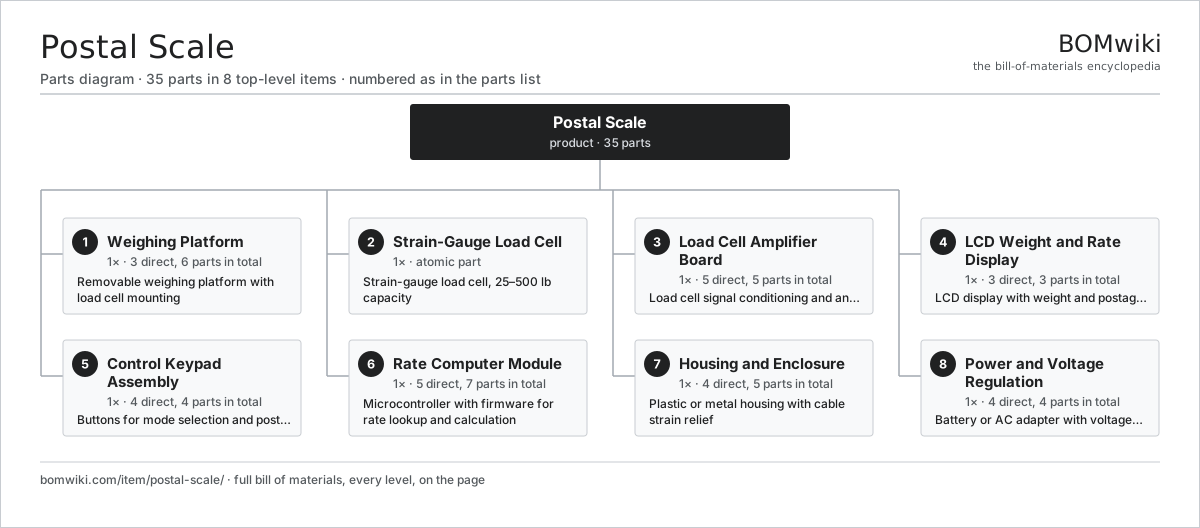
| # | Part | Qty | What it does |
|---|---|---|---|
| 1 | Weighing Platform 3 parts | 1× | Removable weighing platform with load cell mounting |
| 2 | Strain-Gauge Load Cell | 1× | Strain-gauge load cell, 25–500 lb capacity |
| 3 | Load Cell Amplifier Board 5 parts | 1× | Load cell signal conditioning and analog-to-digital conversion |
| 4 | LCD Weight and Rate Display 3 parts | 1× | LCD display with weight and postage cost readout |
| 5 | Control Keypad Assembly 4 parts | 1× | Buttons for mode selection and postal rate adjustment |
| 6 | Rate Computer Module 5 parts | 1× | Microcontroller with firmware for rate lookup and calculation |
| 7 | Housing and Enclosure 4 parts | 1× | Plastic or metal housing with cable strain relief |
| 8 | Power and Voltage Regulation 4 parts | 1× | Battery or AC adapter with voltage regulation |
3D model
No 3D model yet. Have a CAD file of this? Add a 3D model. STL renders right on this page; STEP, FreeCAD, and OpenSCAD sources are welcome too (openly licensed, like all 3D models on BOMwiki).
Build & assembly graph
expand / collapse · shared sub-assemblies converge · links to related products · est. labourTap an assembly to expand/collapse · tap a part to open it · use “Open page” for any node · drag to pan, scroll to zoom.
Bill of materials for Postal Scale
8 top-level lines · 36 rows shown · 35 parts total · indented to 3 levels| # | Item / sub-assembly | Part no. | Qty/assy | Ext. qty | Parts | Type |
|---|---|---|---|---|---|---|
| 1 | Weighing Platform 3 parts | postal-scale-platform | 1× | 1 | 6 | assembly |
| 1.1 | Scale Platform Deck | postal-scale-platform-plate | 1× | 1 | · | part |
| 1.2 | Load Cell Bracket | postal-scale-load-cell-mount | 4× | 4 | · | part |
| 1.3 | Fastener Set | fastener-set | 1× | 1 | · | part |
| 2 | Strain-Gauge Load Cell | postal-scale-load-cell | 1× | 1 | · | part |
| 3 | Load Cell Amplifier Board 5 parts | postal-scale-amplifier | 1× | 1 | 5 | assembly |
| 3.1 | Bare PCB | pcb-bare | 1× | 1 | · | part |
| 3.2 | SMD Passive (R/C/L) | smd-passives | 1× | 1 | · | part |
| 3.3 | Analog-to-Digital Converter | postal-scale-adc | 1× | 1 | · | part |
| 3.4 | Connector | connector | 1× | 1 | · | part |
| 3.5 | Fastener Set | fastener-set | 1× | 1 | · | part |
| 4 | LCD Weight and Rate Display 3 parts | postal-scale-display | 1× | 1 | 3 | assembly |
| 4.1 | LCD Panel | lcd-panel | 1× | 1 | · | part |
| 4.2 | Display Driver Board | postal-scale-display-controller | 1× | 1 | · | part |
| 4.3 | Fastener Set | fastener-set | 1× | 1 | · | part |
| 5 | Control Keypad Assembly 4 parts | postal-scale-keypad | 1× | 1 | 4 | assembly |
| 5.1 | Button Set | postal-scale-button-set | 1× | 1 | · | part |
| 5.2 | Keypad Controller Board | postal-scale-keypad-pcb | 1× | 1 | · | part |
| 5.3 | Connector | connector | 1× | 1 | · | part |
| 5.4 | Fastener Set | fastener-set | 1× | 1 | · | part |
| 6 | Rate Computer Module 5 parts | postal-scale-controller | 1× | 1 | 7 | assembly |
| 6.1 | Microcontroller | mcu | 1× | 1 | · | part |
| 6.2 | Bare PCB | pcb-bare | 1× | 1 | · | part |
| 6.3 | Postal Rate ROM/EEPROM | postal-scale-rom-chip | 1× | 1 | · | part |
| 6.4 | Connector | connector | 3× | 3 | · | part |
| 6.5 | Fastener Set | fastener-set | 1× | 1 | · | part |
| 7 | Housing and Enclosure 4 parts | postal-scale-case | 1× | 1 | 5 | assembly |
| 7.1 | Case Enclosure Shell | postal-scale-case-body | 1× | 1 | · | part |
| 7.2 | Case Cover Panel | postal-scale-case-top | 1× | 1 | · | part |
| 7.3 | O-Ring Set | oring-set | 1× | 1 | · | part |
| 7.4 | Fastener Set | fastener-set | 2× | 2 | · | part |
| 8 | Power and Voltage Regulation 4 parts | postal-scale-power-supply | 1× | 1 | 4 | assembly |
| 8.1 | Power Supply | power-supply | 1× | 1 | · | part |
| 8.2 | Voltage Regulator Module | postal-scale-voltage-regulator | 1× | 1 | · | part |
| 8.3 | Connector | connector | 1× | 1 | · | part |
| 8.4 | Fastener Set | fastener-set | 1× | 1 | · | part |
Something wrong in this list? Report a problem with this BOM.
Related products
same domain, ranked by shared parts Pneumatic Tube Station
201 parts · shares 5 with this page
Pneumatic Tube Station
201 parts · shares 5 with this page
 Guillotine Paper Cutter
261 parts · shares 4 with this page
Produce Misting System
137 parts · shares 4 with this page
Guillotine Paper Cutter
261 parts · shares 4 with this page
Produce Misting System
137 parts · shares 4 with this page
 Electric Typewriter
47 parts · shares 2 with this page
Electric Typewriter
47 parts · shares 2 with this page
 POS Cash Drawer
31 parts · shares 2 with this page
POS Cash Drawer
31 parts · shares 2 with this page
 Motorized Projector Screen
52 parts · shares 1 with this page
Motorized Projector Screen
52 parts · shares 1 with this page
Sourcing: possible vendors
Browse the supplier directory → Prices, MOQ, and lead times are algorithmic estimates, not quotes, and not claims about these companies. Company mappings are curated by keyword; est. price band $50–$15k. How estimates work| Vendor | HQ | Specialty | MOQ | Lead time |
|---|---|---|---|---|
|
🇯🇵Canon
canon.com ↗
|
Tokyo, JP | Imaging & optics | 500 units | 8–12 wks |
|
🇯🇵Ricoh
ricoh.com ↗
|
Tokyo, JP | Office imaging | 500 units | 8–12 wks |
|
🇺🇸Xerox
xerox.com ↗
|
Norwalk, US | Printers & copiers | 500 units | 8–12 wks |
|
🇯🇵Epson
epson.com ↗
|
Suwa, JP | Printers & projectors | 500 units | 8–12 wks |
|
🇯🇵Brother
brother.com ↗
|
Nagoya, JP | Printers & sewing | 500 units | 8–12 wks |
1,252-word article