Pottery Wheel
ProductOverview
A pottery wheel is a rotating platform that allows an artist or craftsperson to hand-form clay into symmetrical vessels using a technique called throwing. The wheel has been used for millennia, but modern electric-powered models dominate professional studios and educational settings, while traditional treadle wheels remain popular for their mechanical simplicity and meditative quality.
The fundamental principle is centrifugal force: clay placed on a spinning wheel head naturally centers under the potter's guiding hands. As the wheel rotates, the potter applies gentle inward and upward pressure, gradually drawing the clay upward into thin walls. The result is vessels like bowls, cups, vases, and plates, limited only by the potter's skill and the properties of the clay.
How It Works
An electric pottery wheel is powered by a Motor, typically a 250–750 watt single-phase AC induction motor running at 1500 rpm. The Motor Pulley is relatively small (50–100 mm diameter), while the Spindle Pulley mounted to the spindle shaft is much larger (150–250 mm). This pulley ratio reduces motor speed by a factor of 2–4, delivering wheel head speeds of 0–300 rpm.
The Motor Control module, either an electronic variable-frequency drive (VFD) or mechanical rheostat, allows the potter to adjust wheel speed using the Foot Pedal or a hand-operated Speed Dial. Modern wheels allow the potter to dial in a precise speed (e.g., 60 rpm for centering, 120 rpm for throwing walls) or use proportional foot-pedal control, where pressure on the pedal gradually increases speed.
The Drive Belt connects the motor pulley to the spindle pulley, transmitting torque with minimal slippage. The Belt Tensioner maintains optimal tension to prevent belt slip and wear. The Spindle Bearing pair, typically large preloaded ball bearings, supports the rotating spindle shaft with minimal runout (<1 mm) and friction.
The Wheel Head, a round wooden or composite work surface (300–500 mm diameter), is mounted to the spindle shaft via Bat Pin Set pins. The potter places a ball of clay on the spinning wheel head and applies steady inward and upward pressure with their hands. The centrifugal force and friction cause the clay to center, and as the potter's hands guide the rotating clay, it draws upward and outward, forming thin walls.
Water is essential: the potter dips a sponge in water and applies it periodically, reducing friction and keeping the clay plastic. Excess water flows down into the Splash Pan, a basin surrounding the wheel head that contains splatter and drippings. The Pan Drain Valve allows periodic draining of the accumulated water and clay slurry.
Treadle Wheels
Traditional treadle wheels replace the Motor and Motor Control with a Pedal Treadle. A Flywheel, a heavy cast iron or steel disk (3–10 kg), is mounted directly below the wheel head. The potter stands on a Pedal Platform and rocks forward and backward, driving the pedal down and up. A Mechanical Linkage (rod or cable) couples this pedal motion to the flywheel, spinning it up. The potter's hands control the wheel speed: as they press clay in, resistance slows the wheel; as they pull up, reduced resistance allows it to speed up.
Treadle wheels require no electricity and are mechanically elegant, but demand greater physical effort and coordination. Many potters prefer them for the direct mechanical feedback and meditative rhythm. Professional studios often maintain both electric and treadle wheels.
Wheel Design for Different Uses
Studio wheels (as described above) have open wheel heads and large splash pans, facilitating hand-throwing of vessels. Industrial wheels or trimming wheels are optimized for slab production or greenware trimming, with different tool mounting systems. Kiln-loading wheels are massive, heavy units designed for high-production repetitive throwing of identical shapes.
Centering and Throwing
Centering, the first step in throwing, is the most technically demanding phase. The potter applies steady inward pressure, working the clay against centrifugal force until it spins without wobbling. This stage typically uses slower speeds (20–60 rpm) for better control. Once centered, the potter opens a hole in the clay, using thumb or fingers to define wall thickness, gradually pulling upward and outward. Wall thickness must be uniform throughout; thicker areas cause uneven drying and cracking during kiln drying.
Clay Characteristics and Wheel Requirements
Different clay bodies throw differently. Smooth, fine-grained stoneware (porcelain) throws cleanly but demands precise centering. Earthenware and terracotta clays are more forgiving but are less translucent when fired thin. Gritty clays with coarse minerals are harder to throw and wear down wheel heads faster.
Spindle Design and Runout
The Spindle Bearing pair is critical: poor bearings or worn spindles result in runout (visible wobble of the wheel head), making centering difficult and causing wall-thickness variation. Wheel heads must be balanced within ±50 grams across a diameter; unbalanced wheels vibrate and tire the potter.
Production and Education
Professional potters can hand-throw 10–20 finished vessels per hour, depending on size and complexity. Educational settings use wheels to teach clay fundamentals; a 12-station wheel room allows a group class of students to work simultaneously. Commercial production shops use both hand-throwing (for sculptural or one-off pieces) and slip-casting or pressing (for high-volume identical shapes).
Historical Notes
The potter's wheel appeared in Mesopotamia around 3000 BCE and rapidly spread across civilizations. The mechanical design, wheel, spindle, bearings, pedal drive, remained largely unchanged for 3000 years until electric motors became available in the early 20th century. Many traditional wheels in use today are wooden structures 50–100 years old, testament to the robustness of the basic design.
Pottery Wheel parts and their functions
8 top-level parts · 42 parts in total · full bill of materials below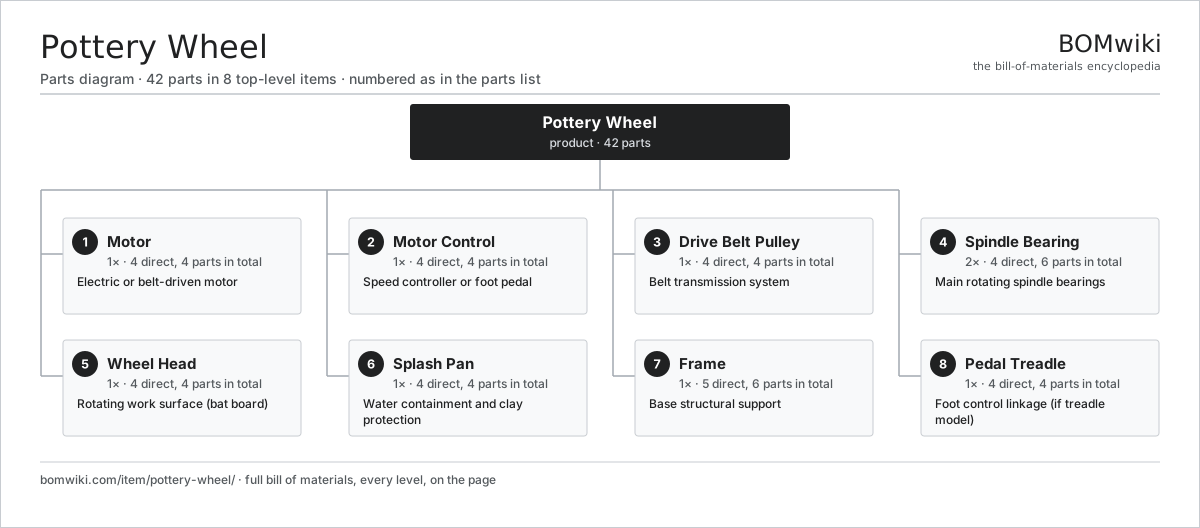
| # | Part | Qty | What it does |
|---|---|---|---|
| 1 | Motor 4 parts | 1× | Electric or belt-driven motor |
| 2 | Motor Control 4 parts | 1× | Speed controller or foot pedal |
| 3 | Drive Belt Pulley 4 parts | 1× | Belt transmission system |
| 4 | Spindle Bearing 4 parts | 2× | Main rotating spindle bearings |
| 5 | Wheel Head 4 parts | 1× | Rotating work surface (bat board) |
| 6 | Splash Pan 4 parts | 1× | Water containment and clay protection |
| 7 | Frame 5 parts | 1× | Base structural support |
| 8 | Pedal Treadle 4 parts | 1× | Foot control linkage (if treadle model) |
3D model
No 3D model yet. Have a CAD file of this? Add a 3D model. STL renders right on this page; STEP, FreeCAD, and OpenSCAD sources are welcome too (openly licensed, like all 3D models on BOMwiki).
Build & assembly graph
expand / collapse · shared sub-assemblies converge · links to related products · est. labourTap an assembly to expand/collapse · tap a part to open it · use “Open page” for any node · drag to pan, scroll to zoom.
Bill of materials for Pottery Wheel
8 top-level lines · 41 rows shown · 42 parts total · indented to 3 levels| # | Item / sub-assembly | Part no. | Qty/assy | Ext. qty | Parts | Type |
|---|---|---|---|---|---|---|
| 1 | Motor 4 parts | pottery-wheel-motor | 1× | 1 | 4 | assembly |
| 1.1 | Electric Motor | pottery-wheel-electric-motor | 1× | 1 | · | part |
| 1.2 | Capacitor | pottery-wheel-capacitor | 1× | 1 | · | part |
| 1.3 | Motor Pulley | pottery-wheel-motor-pulley | 1× | 1 | · | part |
| 1.4 | Mounting Bracket | pottery-wheel-mounting-bracket | 1× | 1 | · | part |
| 2 | Motor Control 4 parts | pottery-wheel-motor-control | 1× | 1 | 4 | assembly |
| 2.1 | Speed Controller | pottery-wheel-speed-controller | 1× | 1 | · | part |
| 2.2 | Foot Pedal | pottery-wheel-foot-pedal | 1× | 1 | · | part |
| 2.3 | Speed Dial | pottery-wheel-speed-dial | 1× | 1 | · | part |
| 2.4 | Power Supply | power-supply | 1× | 1 | · | part |
| 3 | Drive Belt Pulley 4 parts | pottery-wheel-drive-belt-pulley | 1× | 1 | 4 | assembly |
| 3.1 | Spindle Pulley | pottery-wheel-spindle-pulley | 1× | 1 | · | part |
| 3.2 | Drive Belt | pottery-wheel-drive-belt | 1× | 1 | · | part |
| 3.3 | Belt Tensioner | pottery-wheel-belt-tensioner | 1× | 1 | · | part |
| 3.4 | Fastener Set | fastener-set | 1× | 1 | · | part |
| 4 | Spindle Bearing 4 parts | pottery-wheel-spindle-bearing | 2× | 2 | 6 | assembly |
| 4.1 | Ball Bearing | ball-bearing | 2× | 4 | · | part |
| 4.2 | Bearing Housing | pottery-wheel-bearing-housing | 1× | 2 | · | part |
| 4.3 | Bearing Preload Spring | pottery-wheel-bearing-preload-spring | 1× | 2 | · | part |
| 4.4 | Oil Seal | oil-seal | 2× | 4 | · | part |
| 5 | Wheel Head 4 parts | pottery-wheel-wheel-head | 1× | 1 | 4 | assembly |
| 5.1 | Bat Board | pottery-wheel-bat-board | 1× | 1 | · | part |
| 5.2 | Head Shaft | pottery-wheel-head-shaft | 1× | 1 | · | part |
| 5.3 | Bat Pin Set | pottery-wheel-bat-pin-set | 1× | 1 | · | part |
| 5.4 | Shaft Key | pottery-wheel-shaft-key | 1× | 1 | · | part |
| 6 | Splash Pan 4 parts | pottery-wheel-splash-pan | 1× | 1 | 4 | assembly |
| 6.1 | Pan Basin | pottery-wheel-pan-basin | 1× | 1 | · | part |
| 6.2 | Pan Drain Valve | pottery-wheel-pan-drain-valve | 1× | 1 | · | part |
| 6.3 | Pan Mount Bracket | pottery-wheel-pan-mounting-bracket | 1× | 1 | · | part |
| 6.4 | Water Catch Tray | pottery-wheel-water-catch-tray | 1× | 1 | · | part |
| 7 | Frame 5 parts | pottery-wheel-frame | 1× | 1 | 6 | assembly |
| 7.1 | Base Frame | pottery-wheel-base-frame | 1× | 1 | · | part |
| 7.2 | Support Column | pottery-wheel-support-columns | 2× | 2 | · | part |
| 7.3 | Motor Mount Plate | pottery-wheel-motor-mount-plate | 1× | 1 | · | part |
| 7.4 | Treadle Linkage Rod | pottery-wheel-treadle-linkage-rod | 1× | 1 | · | part |
| 7.5 | Foot Rest | pottery-wheel-foot-rest | 1× | 1 | · | part |
| 8 | Pedal Treadle 4 parts | pottery-wheel-pedal-treadle | 1× | 1 | 4 | assembly |
| 8.1 | Pedal Platform | pottery-wheel-pedal-platform | 1× | 1 | · | part |
| 8.2 | Treadle Pivot | pottery-wheel-treadle-pivot | 1× | 1 | · | part |
| 8.3 | Flywheel | pottery-wheel-flywheel | 1× | 1 | · | part |
| 8.4 | Mechanical Linkage | pottery-wheel-mechanical-linkage | 1× | 1 | · | part |
Something wrong in this list? Report a problem with this BOM.
Related products
same domain, ranked by shared parts Continuous Galvanizing Line
1,296 parts · shares 3 with this page
Continuous Galvanizing Line
1,296 parts · shares 3 with this page
Sourcing: possible vendors
Browse the supplier directory → Prices, MOQ, and lead times are algorithmic estimates, not quotes, and not claims about these companies. Company mappings are curated by keyword; est. price band $5k–$2M. How estimates work| Vendor | HQ | Specialty | MOQ | Lead time |
|---|---|---|---|---|
| atlascopco.com ↗ | Stockholm, SE | Compressors & industrial | 10 units | 12–20 wks |
|
🇦🇹Andritz
andritz.com ↗
|
Graz, AT | Process plants & machinery | 10 units | 12–20 wks |
| buhlergroup.com ↗ | Uzwil, CH | Food & materials processing | 10 units | 12–20 wks |
| gea.com ↗ | Düsseldorf, DE | Process technology | 10 units | 12–20 wks |
| mhi.com ↗ | Tokyo, JP | Heavy machinery | 10 units | 12–20 wks |
976-word article