Power Line Conditioner
ProductOverview
A power line conditioner is a regulated AC power supply designed to protect sensitive electronic equipment from utility-grid disturbances. The Isolation Transformer decouples the load from ground-loop currents and common-mode noise. The Voltage Regulation maintains output voltage within ±5 % despite input fluctuations of ±20 %. The Surge Suppression and EMI Low-Pass Filter attenuate transients and high-frequency noise to harmless levels.
Power conditioners are essential for laboratories, recording studios, medical devices, and precision manufacturing. A single utility transient can corrupt solid-state memory, trip digital logic, or induce ground loops in audio systems. Industrial power quality is often poor: voltage sags during motor starting, switching transients from utility capacitor banks, and harmonics from neighboring nonlinear loads. A quality conditioner isolates equipment from these disturbances while remaining transparent to normal operation.
How it works
Incoming AC voltage enters the Isolation Transformer, which steps the voltage down or up to the nominal range and floats the secondary winding from the primary ground. This breaks ground-loop coupling that would otherwise inject 50/60 Hz and harmonic currents into equipment chassis. The Electrostatic Shield between windings blocks capacitive coupling of high-frequency noise.
The MOV Array acts as a parallel voltage clamp, draining transients when voltage exceeds 150 % nominal. The Series Inductor in series provides complementary action, current-limiting fast dv/dt events. Together, they attenuate impulses to the microsecond range, fast enough to protect modern CMOS circuits.
The Voltage Regulation circuit senses output voltage and modulates a switching regulator, raising low input voltage or lowering high input voltage. This keeps output at 120 V AC ±5 %, ideal for equipment designed for nominal supply.
The EMI Low-Pass Filter is a two-stage L-network (inductor–capacitor per phase) that attenuates switching-mode noise and RF interference above 1 kHz. The Common-Mode Choke choke suppresses noise conducted equally on hot and neutral (common-mode), which is invisible to differential EMI filters but couples into equipment via parasitic capacitance.
The Outlet Panel provides multiple outlets, each with dedicated surge suppression to prevent crosstalk between loads. The Metering & Display circuit samples voltage and current in real time, computing RMS values and total harmonic distortion (THD).
Protection strategies
The conditioner does NOT provide UPS (uninterruptible power supply) functionality, it has no battery backup. It protects against:
- Voltage sags (brown-outs): The regulator boosts low input voltage.
- Voltage spikes (transients): Varistors and inductors clamp overvoltage.
- Ground loops: Isolation transformer floating secondary.
- EMI and RFI: LC filters and common-mode choke.
- Harmonic distortion: Transformer inductance limits current rise time.
Equipment sensitive to power quality (audio pre-amps, laboratory instruments, medical monitors) typically require a 2–5 kVA unit. General-purpose office equipment may tolerate a 1 kVA model.
Comparison with surge protectors and UPS
Surge suppressor strips (cheap): Varistors only, clamping transients but providing no isolation or filtering. Ground-loop noise passes through unchanged. Multi-outlet interference is common.
Line conditioner + UPS combination: A conditioner cleans steady-state voltage and noise; a separate UPS with battery backup tolerates short outages. Cost is 2× but provides both isolation and continuity.
Isolation transformer alone: 1:1 isolation with no voltage regulation. Removes ground loops and some common-mode noise but does not stabilize voltage swings or suppress transients.
Installation and commissioning
The conditioner should be connected directly to the utility inlet (or facility circuit panel), not through extension cords or other conditioning devices. The IEC inlet provides 15 A fuse protection; this breaker is sized for the conditioner itself, not the load. Customer loads attach to the Outlet Panel sockets.
Initial commissioning should measure input and output voltage under various load conditions (light, moderate, full). The Metering & Display display confirms output regulation and current balance across outlets. If frequency drifts beyond ±0.1 %, the transformer core may be saturating; input voltage is likely out of spec.
Maintenance and failure modes
The Isolation Transformer core can develop inter-laminar short circuits after 10–20 years of continuous duty, indicated by excessive core heating and THD rise. Core replacement requires a complete transformer rewind.
The Cooling Fan may fail, causing internal temperature rise. A thermistor should trigger alarm before shutdown. The MOV Array degrades in high-surge environments, becoming ineffective; visual inspection may reveal blackening or cracking of the varistor bodies.
The Switching MOSFET and Buck-Boost Converter filtering inductors are the most failure-prone solid-state components. Replacement requires desoldering and respotting.
Power Line Conditioner parts and their functions
7 top-level parts · 40 parts in total · full bill of materials below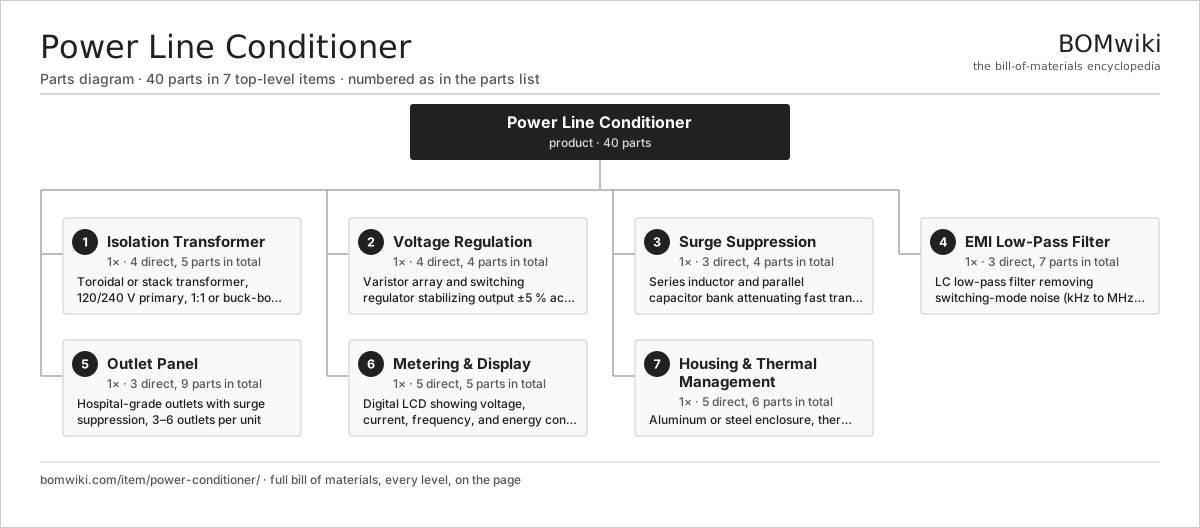
| # | Part | Qty | What it does |
|---|---|---|---|
| 1 | Isolation Transformer 4 parts | 1× | Toroidal or stack transformer, 120/240 V primary, 1:1 or buck-boost secondary |
| 2 | Voltage Regulation 4 parts | 1× | Varistor array and switching regulator stabilizing output ±5 % across ±10 % input range |
| 3 | Surge Suppression 3 parts | 1× | Series inductor and parallel capacitor bank attenuating fast transients |
| 4 | EMI Low-Pass Filter 3 parts | 1× | LC low-pass filter removing switching-mode noise (kHz to MHz range) |
| 5 | Outlet Panel 3 parts | 1× | Hospital-grade outlets with surge suppression, 3–6 outlets per unit |
| 6 | Metering & Display 5 parts | 1× | Digital LCD showing voltage, current, frequency, and energy consumption |
| 7 | Housing & Thermal Management 5 parts | 1× | Aluminum or steel enclosure, thermal management fans, IEC inlet |
3D model
No 3D model yet. Have a CAD file of this? Add a 3D model. STL renders right on this page; STEP, FreeCAD, and OpenSCAD sources are welcome too (openly licensed, like all 3D models on BOMwiki).
Build & assembly graph
expand / collapse · shared sub-assemblies converge · links to related products · est. labourTap an assembly to expand/collapse · tap a part to open it · use “Open page” for any node · drag to pan, scroll to zoom.
Bill of materials for Power Line Conditioner
7 top-level lines · 34 rows shown · 40 parts total · indented to 3 levels| # | Item / sub-assembly | Part no. | Qty/assy | Ext. qty | Parts | Type |
|---|---|---|---|---|---|---|
| 1 | Isolation Transformer 4 parts | power-conditioner-isolation-transformer | 1× | 1 | 5 | assembly |
| 1.1 | Transformer Core | power-conditioner-transformer-core | 1× | 1 | · | part |
| 1.2 | Copper Winding | copper-winding | 2× | 2 | · | part |
| 1.3 | Electrostatic Shield | power-conditioner-faraday-shield | 1× | 1 | · | part |
| 1.4 | Transformer Tank | power-conditioner-transformer-tank | 1× | 1 | · | part |
| 2 | Voltage Regulation 4 parts | power-conditioner-voltage-regulation | 1× | 1 | 4 | assembly |
| 2.1 | MOV Array | power-conditioner-varistor-array | 1× | 1 | · | part |
| 2.2 | Buck-Boost Converter | power-conditioner-buck-boost-converter | 1× | 1 | · | part |
| 2.3 | Switching MOSFET | power-conditioner-switching-mosfet | 1× | 1 | · | part |
| 2.4 | Output Voltage Sensor | power-conditioner-output-sensor | 1× | 1 | · | part |
| 3 | Surge Suppression 3 parts | power-conditioner-surge-filter | 1× | 1 | 4 | assembly |
| 3.1 | Series Inductor | power-conditioner-series-inductor | 1× | 1 | · | part |
| 3.2 | Capacitor Bank | power-conditioner-capacitor-bank | 1× | 1 | · | part |
| 3.3 | Bypass MOV | power-conditioner-bypass-varistor | 2× | 2 | · | part |
| 4 | EMI Low-Pass Filter 3 parts | power-conditioner-emi-filter | 1× | 1 | 7 | assembly |
| 4.1 | EMI Inductor | power-conditioner-emi-inductor | 2× | 2 | · | part |
| 4.2 | EMI Capacitor | power-conditioner-emi-capacitor | 4× | 4 | · | part |
| 4.3 | Common-Mode Choke | power-conditioner-emi-common-mode | 1× | 1 | · | part |
| 5 | Outlet Panel 3 parts | power-conditioner-outlet-panel | 1× | 1 | 9 | assembly |
| 5.1 | Hospital-Grade Outlet | power-conditioner-outlet-socket | 4× | 4 | · | part |
| 5.2 | Outlet Suppression | power-conditioner-outlet-suppression | 4× | 4 | · | part |
| 5.3 | Outlet Bezel | power-conditioner-outlet-bezel | 1× | 1 | · | part |
| 6 | Metering & Display 5 parts | power-conditioner-metering | 1× | 1 | 5 | assembly |
| 6.1 | Voltage Sampling Network | power-conditioner-voltage-input | 1× | 1 | · | part |
| 6.2 | Current Transformer | power-conditioner-current-transformer | 1× | 1 | · | part |
| 6.3 | Dual-Channel ADC | power-conditioner-adc | 1× | 1 | · | part |
| 6.4 | Microcontroller | mcu | 1× | 1 | · | part |
| 6.5 | LCD Panel | lcd-panel | 1× | 1 | · | part |
| 7 | Housing & Thermal Management 5 parts | power-conditioner-housing | 1× | 1 | 6 | assembly |
| 7.1 | Sheet Metal Panel | sheet-panel | 2× | 2 | · | part |
| 7.2 | Copper Busbar | power-conditioner-copper-busbar | 1× | 1 | · | part |
| 7.3 | Cooling Fan | power-conditioner-cooling-fan | 1× | 1 | · | part |
| 7.4 | Aluminum Heatsink | power-conditioner-heatsink | 1× | 1 | · | part |
| 7.5 | IEC C14 Inlet | power-conditioner-iec-inlet | 1× | 1 | · | part |
Something wrong in this list? Report a problem with this BOM.
Related products
same domain, ranked by shared parts Automatic Voltage Regulator
83 parts · shares 3 with this page
Biogas Generator (CHP)
338 parts · shares 3 with this page
Bottom Ash Handling System
1,782 parts · shares 3 with this page
Automatic Voltage Regulator
83 parts · shares 3 with this page
Biogas Generator (CHP)
338 parts · shares 3 with this page
Bottom Ash Handling System
1,782 parts · shares 3 with this page
 Combined Heat and Power Unit
522 parts · shares 3 with this page
Containerized Diesel Genset
655 parts · shares 3 with this page
Combined Heat and Power Unit
522 parts · shares 3 with this page
Containerized Diesel Genset
655 parts · shares 3 with this page
Sourcing: possible vendors
Browse the supplier directory → Prices, MOQ, and lead times are algorithmic estimates, not quotes, and not claims about these companies. Company mappings are curated by keyword; est. price band $5k–$50M. How estimates work| Vendor | HQ | Specialty | MOQ | Lead time |
|---|---|---|---|---|
| gevernova.com ↗ | Cambridge, US | Power generation | made to order | 20–40 wks |
| siemens-energy.com ↗ | Munich, DE | Power & grid | made to order | 20–40 wks |
| hitachienergy.com ↗ | Zurich, CH | Grid & transformers | made to order | 20–40 wks |
|
🇨🇭ABB
abb.com ↗
|
Zurich, CH | Electrification & automation | made to order | 20–40 wks |
| se.com ↗ | Rueil-Malmaison, FR | Electrical & automation | made to order | 20–40 wks |
770-word article