Prepreg Layup Table
ProductOverview
A prepreg layup table is a semi-automated workstation designed for manual placement of pre-impregnated (prepreg) composite plies on a precision substrate. Prepreg is fiber (unidirectional, woven, or multidirectional) pre-saturated with partially-cured epoxy resin, supplied on rolls. The material has limited tack (adhesion) at room temperature and requires proper storage (freezer, below −18°C) until use.
The Vacuum Table holds plies in position with low vacuum (0.5–1.5 bar), the Laser Projection System system guides ply placement accuracy, and the integrated Material Cutter Interface trims plies to pattern. Operators manually lay plies following the laser outline, achieving complex shapes (curved fuselage, branching wing ribs, doublers) that automated tape layers (ATL) or fiber placement (AFP) systems cannot easily reach. This manual-with-aids approach dominates aerospace (Boeing, Airbus, Dassault) for large, low-volume structural components.
Vacuum Table Principle
The Vacuum Table is a porous aluminum or composite Porous Surface Panel (1–2 mm nominal pore diameter) backed by a Vacuum Manifold cavity connected to a Vacuum Pump System. As the pump draws vacuum (0.5–1.5 bar below atmospheric), air flows through the pores, creating a gentle but uniform downward pressure holding prepreg plies flat and preventing wrinkles.
Vacuum distribution:
- The Vacuum Manifold internal passages distribute vacuum over the entire table area.
- Edge sealing via Sealing Gasket (nitrile or EPDM) prevents air bypass around perimeter.
- Vacuum level is controlled via Vacuum Regulator proportional solenoid valve; excess vacuum (>1.5 bar) risks fiber waviness or delamination from the porous surface.
Key advantage: Unlike mechanical clamps (which require custom fixtures per shape), vacuum holds any flat layup without part-specific tooling. Ply changes (switching between unidirectional and woven fabric) require no setup.
Laser Projection Guidance
Composite layup requires placement accuracy: ply edges must align with the tool boundary, and ply overlap must follow design intent. Manual operators use printed templates or spray paint, slow and error-prone. The Laser Projection System system projects the ply outline directly onto the table surface.
System design:
- Laser Diode Modules (3 or multiline, red/green/blue ~10–50 mW Class 3B) mounted overhead via Projection Mount.
- Projection Optics (lenses, mirrors) focus and steer the beam.
- Laser Driver PWM-modulates laser diodes to display pattern ply-by-ply (red outline for ply 1, green for ply 2, etc.).
- Sync Camera (RGB camera) verifies pattern position and brightness for operator feedback on touchscreen.
Accuracy: ±1–2 mm typical, sufficient for aerospace tolerance (layup tolerance ±2–3 mm in most aerospace drawings). The operator places the ply within the projected outline, presses down on the vacuum table to activate hold, and the ply sticks. Next ply outline appears, and the cycle repeats.
Material Cutting Interface
Prepreg rolls are wide (500–1000 mm) and long; plies are cut to shape before layup. The Material Cutter Interface integrates a Cutter Head (hot knife or oscillating blade) on a two-axis stage:
- X-Axis Linear Stage and Y-Axis Linear Stage: Precision rails carrying the cutter in X (1–2 m travel) and Y (0.5–1.5 m travel).
- X-Servo Motor and Y-Servo Motor: Brushless servos (0.5–1 kW each) driving ballscrews.
- Position Encoders: Rotary encoders providing position feedback to the control PC.
Cutter options:
- Hot knife: Heated ceramic or teflon blade (100–200°C), separates plies cleanly by melting resin.
- Oscillating blade: Ultrasonic or mechanical oscillation (500–1000 Hz) cutting through fiber without melt or fuzz.
The control PC receives CAM patterns (typically a DXF or STEP part outline), converts to G-code, and the PLC executes cutting paths. A typical ply (1×2 m unidirectional) is cut in 1–2 minutes.
Vacuum Pump System
The Vacuum Pump System comprises:
- Vacuum Pump: Rotary vane pump (5–15 m³/h, −1 bar maximum) driven by a Pump Motor (0.5–1.5 kW AC induction).
- Vacuum Reservoir: Steel tank (20–50 L) with baffles and Vacuum Filter (oil mist and particulate).
- Vacuum Regulator: Proportional solenoid valve (normally closed) regulating vacuum to 0.5–1.5 bar setpoint (operator selectable via HMI).
- Vacuum Gauge: Analog or digital manometer (0 to −1 bar) for feedback.
Operational sequence:
- Operator loads prepreg roll onto Material Cutter Interface.
- CAM program cuts ply to pattern; operator transfers cut ply to Vacuum Table.
- Operator positions ply over projected laser outline.
- Operator activates vacuum via HMI or footswitch; Vacuum Regulator energizes, drawing vacuum.
- Ply adheres to table via tack and vacuum hold.
- Next ply outline projects (different laser color).
- Operator repeats until all plies are stacked.
- Layup is then removed as a single stack and placed in an autoclave for full cure.
Control Software & Coordination
The Control & Pattern Software PC runs CAM layup planning software (e.g., CATIA, NX, or open-source tools like Fusion 360) linked to the machine via PLC Motion Module (motion controller):
Workflow:
- Engineer creates composite laminate schedule (ply 1: 0° unidirectional, ply 2: ±45° woven, etc.) in CAD.
- CAM software nests all plies into cutting patterns (minimizing waste), exports G-code for Material Cutter Interface.
- Operator launches job on Touchscreen HMI; PLC executes cutting path via X-Servo Drive and Y-Servo Drive.
- Operator loads first cut ply, presses start; Laser Projection System projects ply 1 outline.
- Operator places ply, presses foot switch or button to activate Vacuum Regulator.
- System automatically sequences: laser outline changes (color), vacuum releases after a dwell time, next ply outline appears.
- Repeat until all plies stacked.
Real-time Sync Camera feedback (image processing) can detect ply position errors (edge shift >2 mm) and alert the operator via visual/audible alarm.
Ergonomic Work Platform
The Work Platform & Frame must accommodate operator comfort and safety:
- Frame Structure: Welded steel base (1.5–2 m × 1 m × 0.8–0.9 m high when at standard operating height).
- Height Adjuster: Pneumatic or electric cylinders (2–4 units) allow table height to adjust 0.2–0.4 m, accommodating different operator heights and reducing fatigue.
- Caster Wheels: Mobile base (optional), allowing table repositioning in the shop.
- Drip Pan: Stainless or epoxy-lined tray underneath to contain solvent spills or prepreg scrap.
Lighting for Precision Work
The Work Lighting provides shadow-free, color-correct illumination critical for detecting fiber wrinkles and ply misalignment:
- LED Strip Lights: Two linear 20–30 W, 5600 K daylight bars along table edges.
- Ring Light: Overhead coaxial LED ring (500–1000 lux at table surface) synchronized with Laser Projection System (avoiding glare interference).
- Light Controller: Adjustable intensity and color temperature (5600–6500 K for fiber, 4000 K for resin).
Typical Prepreg Layup Sequence
Scenario: Boeing 737 fuselage door frame, 20-ply layup, material: carbon fiber/epoxy prepreg.
- Preparation: Prepreg stored at −18°C, removed 30 min before use to reach 15–20°C ambient.
- Ply 1: 0° unidirectional. Operator loads roll into Material Cutter Interface; CAM cuts 800 × 600 mm blank, hot knife is activated (150°C), ply cut in 90 seconds.
- Transfer: Ply transferred to Vacuum Table; red laser outline projects. Operator aligns ply edges (±1 mm accuracy). Activates vacuum (1.0 bar); ply adheres. Dwell 10 seconds.
- Ply 2: ±45° biaxial fabric. Green laser outline appears (offset by thickness and fiber direction). Operator cuts, transfers, aligns. Vacuum hold. Dwell.
- Repeat: Plies 3–20 similar. Estimated time: 12–18 plies per hour for a skilled operator. Total layup time: ~90 minutes.
- Curing: After layup complete, entire stack (20 plies, ~2 kg) is removed from Vacuum Table and placed in a pressure autoclave (700 kPa, 120–180°C, 2–4 hour cycle) for final cure and consolidation.
Quality Metrics & Challenges
Advantages:
- Flexibility: any shape, any fiber orientation, complex doublers/stiffeners.
- Speed: 5–15 plies/hour/operator beats hand layup (1–3 plies/hour).
- Accuracy: laser projection ±1–2 mm beats template by 2–3×.
Challenges:
- Prepreg cost: Typically 5–10× more than dry fiber + resin system per kg of composite.
- Tack loss: Prepreg tack degrades after 5–7 days at room temperature; must refresh or retire material.
- Wrinkles: Excessive vacuum (>1.5 bar) or slow deposition speed creates fiber waviness, reducing strength 10–20%.
- Void content: Manual layup's porous fiber-to-fiber contact introduces 3–5% voids unless postprocessing (edge trimming, consolidation) is rigorous.
Inspection: Visual (fiber wrinkles, ply misalignment), ultrasonic (void content, delamination) post-cure.
Production Economics
For aerospace/high-performance structures:
- Capital cost: $50k–200k (vacuum table, control electronics, LED lighting, pneumatic infrastructure).
- Prepreg material: $20–40/kg (carbon/epoxy), ~$200–400 per typical door frame or composite panel.
- Labor: 1–2 operators, $20–30/hour, ~$30–45 per frame or panel.
- Selling price: Finished composite component $500–2000 (depending on size and fiber type).
Large aircraft programs (Airbus A350, Boeing 787) employ 50–200 dedicated prepreg layup tables in climate-controlled facilities, achieving production rates of 10–50 fuselage sections per month with strict quality control.
Prepreg Layup Table parts and their functions
7 top-level parts · 43 parts in total · full bill of materials below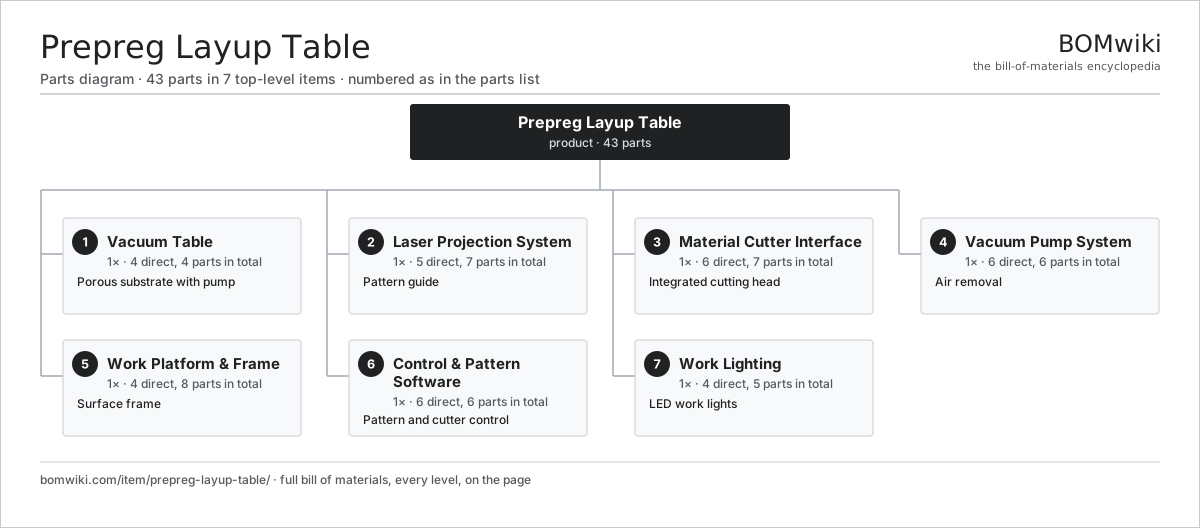
| # | Part | Qty | What it does |
|---|---|---|---|
| 1 | Vacuum Table 4 parts | 1× | Porous substrate with pump |
| 2 | Laser Projection System 5 parts | 1× | Pattern guide |
| 3 | Material Cutter Interface 6 parts | 1× | Integrated cutting head |
| 4 | Vacuum Pump System 6 parts | 1× | Air removal |
| 5 | Work Platform & Frame 4 parts | 1× | Surface frame |
| 6 | Control & Pattern Software 6 parts | 1× | Pattern and cutter control |
| 7 | Work Lighting 4 parts | 1× | LED work lights |
3D model
No 3D model yet. Have a CAD file of this? Add a 3D model. STL renders right on this page; STEP, FreeCAD, and OpenSCAD sources are welcome too (openly licensed, like all 3D models on BOMwiki).
Build & assembly graph
expand / collapse · shared sub-assemblies converge · links to related products · est. labourTap an assembly to expand/collapse · tap a part to open it · use “Open page” for any node · drag to pan, scroll to zoom.
Bill of materials for Prepreg Layup Table
7 top-level lines · 42 rows shown · 43 parts total · indented to 3 levels| # | Item / sub-assembly | Part no. | Qty/assy | Ext. qty | Parts | Type |
|---|---|---|---|---|---|---|
| 1 | Vacuum Table 4 parts | prepreg-layup-table-vacuum-table | 1× | 1 | 4 | assembly |
| 1.1 | Porous Surface Panel | prepreg-layup-table-porous-surface | 1× | 1 | · | part |
| 1.2 | Vacuum Manifold | prepreg-layup-table-vacuum-manifold | 1× | 1 | · | part |
| 1.3 | Porting Block | prepreg-layup-table-porting-block | 1× | 1 | · | part |
| 1.4 | Sealing Gasket | prepreg-layup-table-sealing-gasket | 1× | 1 | · | part |
| 2 | Laser Projection System 5 parts | prepreg-layup-table-laser-projection | 1× | 1 | 7 | assembly |
| 2.1 | Laser Diode Module | prepreg-layup-table-laser-module | 3× | 3 | · | part |
| 2.2 | Projection Optics | prepreg-layup-table-projection-optics | 1× | 1 | · | part |
| 2.3 | Laser Driver | prepreg-layup-table-laser-driver | 1× | 1 | · | part |
| 2.4 | Projection Mount | prepreg-layup-table-projection-mount | 1× | 1 | · | part |
| 2.5 | Sync Camera | prepreg-layup-table-sync-camera | 1× | 1 | · | part |
| 3 | Material Cutter Interface 6 parts | prepreg-layup-table-material-cutter | 1× | 1 | 7 | assembly |
| 3.1 | Cutter Head | prepreg-layup-table-cutter-head | 1× | 1 | · | part |
| 3.2 | X-Axis Linear Stage | prepreg-layup-table-linear-stage-x | 1× | 1 | · | part |
| 3.3 | Y-Axis Linear Stage | prepreg-layup-table-linear-stage-y | 1× | 1 | · | part |
| 3.4 | X-Servo Motor | prepreg-layup-table-servo-motor-x | 1× | 1 | · | part |
| 3.5 | Y-Servo Motor | prepreg-layup-table-servo-motor-y | 1× | 1 | · | part |
| 3.6 | Position Encoder | prepreg-layup-table-cutter-encoder | 2× | 2 | · | part |
| 4 | Vacuum Pump System 6 parts | prepreg-layup-table-vacuum-system | 1× | 1 | 6 | assembly |
| 4.1 | Vacuum Pump | prepreg-layup-table-vacuum-pump | 1× | 1 | · | part |
| 4.2 | Pump Motor | prepreg-layup-table-pump-motor | 1× | 1 | · | part |
| 4.3 | Vacuum Reservoir | prepreg-layup-table-vacuum-reservoir | 1× | 1 | · | part |
| 4.4 | Vacuum Filter | prepreg-layup-table-vacuum-filter | 1× | 1 | · | part |
| 4.5 | Vacuum Regulator | prepreg-layup-table-vacuum-regulator | 1× | 1 | · | part |
| 4.6 | Vacuum Gauge | prepreg-layup-table-vacuum-gauge | 1× | 1 | · | part |
| 5 | Work Platform & Frame 4 parts | prepreg-layup-table-work-platform | 1× | 1 | 8 | assembly |
| 5.1 | Frame Structure | prepreg-layup-table-frame-structure | 1× | 1 | · | part |
| 5.2 | Height Adjuster | prepreg-layup-table-height-adjuster | 2× | 2 | · | part |
| 5.3 | Caster Wheel | prepreg-layup-table-caster-wheel | 4× | 4 | · | part |
| 5.4 | Drip Pan | prepreg-layup-table-drip-pan | 1× | 1 | · | part |
| 6 | Control & Pattern Software 6 parts | prepreg-layup-table-control-panel | 1× | 1 | 6 | assembly |
| 6.1 | Control PC | prepreg-layup-table-control-pc | 1× | 1 | · | part |
| 6.2 | PLC Motion Module | prepreg-layup-table-plc-module | 1× | 1 | · | part |
| 6.3 | X-Servo Drive | prepreg-layup-table-servo-drive-x | 1× | 1 | · | part |
| 6.4 | Y-Servo Drive | prepreg-layup-table-servo-drive-y | 1× | 1 | · | part |
| 6.5 | Touchscreen HMI | prepreg-layup-table-touchscreen-interface | 1× | 1 | · | part |
| 6.6 | E-Stop Button | prepreg-layup-table-safety-estop | 1× | 1 | · | part |
| 7 | Work Lighting 4 parts | prepreg-layup-table-lighting-system | 1× | 1 | 5 | assembly |
| 7.1 | LED Strip Light | prepreg-layup-table-led-strip | 2× | 2 | · | part |
| 7.2 | Ring Light | prepreg-layup-table-ring-light | 1× | 1 | · | part |
| 7.3 | Light Controller | prepreg-layup-table-light-controller | 1× | 1 | · | part |
| 7.4 | Lamp Mount | prepreg-layup-table-lamp-mount | 1× | 1 | · | part |
Something wrong in this list? Report a problem with this BOM.
Sourcing: possible vendors
Browse the supplier directory → Prices, MOQ, and lead times are algorithmic estimates, not quotes, and not claims about these companies. Company mappings are curated by keyword; est. price band $5k–$2M. How estimates work| Vendor | HQ | Specialty | MOQ | Lead time |
|---|---|---|---|---|
| atlascopco.com ↗ | Stockholm, SE | Compressors & industrial | 10 units | 12–20 wks |
|
🇦🇹Andritz
andritz.com ↗
|
Graz, AT | Process plants & machinery | 10 units | 12–20 wks |
| buhlergroup.com ↗ | Uzwil, CH | Food & materials processing | 10 units | 12–20 wks |
| gea.com ↗ | Düsseldorf, DE | Process technology | 10 units | 12–20 wks |
| mhi.com ↗ | Tokyo, JP | Heavy machinery | 10 units | 12–20 wks |
1,643-word article