Process pH Analyzer
ProductOverview
A process pH analyzer measures acidity or alkalinity on-line by sensing the electrochemical potential of hydrogen ions in solution. It comprises a Glass Electrode whose thin glass membrane selectively passes H+ ions while blocking larger anions and cations, creating a voltage proportional to pH at its surface. This voltage is referenced against a Reference Electrode maintained at a constant potential, and the difference between them (typically 0–1000 mV for 0–14 pH) is measured by a Input Amplifier with 10¹⁴ Ω input impedance, essential to prevent current draw from the high-impedance glass membrane. The Transmitter Electronics linearizes the voltage to pH using two-point calibration, compensates for temperature drift using an Temperature Compensator, and outputs 4–20 mA.
The electrodes are housed in a retractable Electrode Holder Assembly that can be withdrawn from the process for cleaning and maintenance without stopping the analyzer or venting the vessel. A Sample Conditioner cools or warms the sample to standard temperature (usually 20–25 °C) because pH is highly temperature dependent, and a Calibration System dispenses buffer solutions for routine two-point calibration.
How it works
The glass electrode develops a potential across its sensing membrane that obeys the Nernst equation: E = E₀ + (RT/nF) × ln([H+]), where [H+] is hydrogen ion concentration in molarity. At 25 °C, the slope simplifies to approximately 59 mV per pH unit. The Reference Electrode maintains a stable half-cell potential (typically Ag/AgCl with internal KCl electrolyte) so that the measured voltage reflects only the pH-dependent membrane potential. The measuring circuit is a differential high-impedance amplifier because the glass electrode is a high-impedance source: any current draw would distort the measurement.
The Preamplifier Pod sits physically near the electrode to minimize cable length and shield against electromagnetic interference. The signal travels through shielded cable to the transmitter Input Amplifier, which drives a precision ADC. The Microcontroller applies the two-point calibration slope and offset: during commissioning, the operator places the electrode in pH 4 and pH 10 standard buffers and stores the measured voltages. Thereafter, any measured voltage is linearly interpolated between these two points to yield pH directly.
Temperature affects glass electrode response; a 25 °C change alters slope by ~0.3%/°C. The Temperature Compensator senses sample temperature via an RTD and applies automatic temperature compensation (ATC) to the calibration curve. The Electrode Holder Assembly can be mechanically retracted via a solenoid and Retraction Spring, allowing the operator to withdraw the electrode without depressurizing the vessel. A compressed-air jet from Cleaning Nozzle dislodges deposits that foul the glass membrane.
Glass electrodes drift and age due to hydration of the sensing membrane and loss of internal electrolyte; they typically last 1–2 years. Reference electrodes can dry out if the internal KCl bridge is not maintained; some designs include a refillable salt bridge reservoir. Daily two-point calibration (or weekly for stable conditions) compensates for slow drift; if the two-point offset exceeds ±0.5 pH from the previous calibration, the electrode should be inspected for fouling or age.
Process pH Analyzer parts and their functions
6 top-level parts · 31 parts in total · full bill of materials below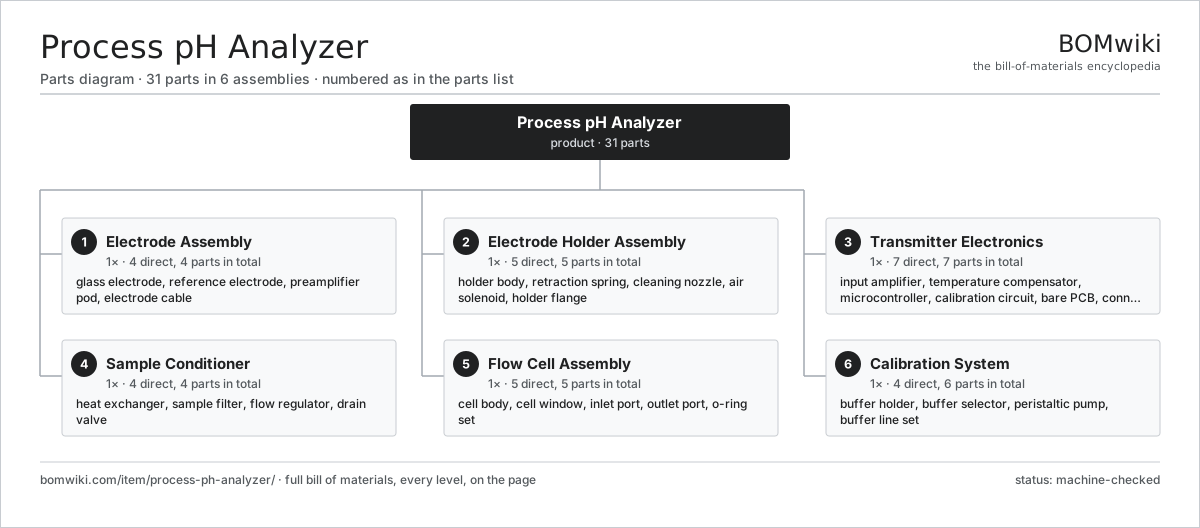
| # | Part | Qty | What it does |
|---|---|---|---|
| 1 | Electrode Assembly 4 parts | 1× | Glass and reference electrodes mounted coaxially with integrated preamplifier. |
| 2 | Electrode Holder Assembly 5 parts | 1× | Mechanical mount holding electrodes in process stream with retraction and cleaning actuators. |
| 3 | Transmitter Electronics 7 parts | 1× | pH measurement amplifier with temperature compensation and 4–20 mA output driver. |
| 4 | Sample Conditioner 4 parts | 1× | Pretreatment module conditioning process liquid temperature and removing particles. |
| 5 | Flow Cell Assembly 5 parts | 1× | Transparent chamber holding electrodes in sample stream for optical and electrochemical measurement. |
| 6 | Calibration System 4 parts | 1× | Buffer solution dispensing and electrode cleaning accessories for routine calibration. |
3D model
No 3D model yet. Have a CAD file of this? Add a 3D model — STL renders right on this page; STEP, FreeCAD, and OpenSCAD sources are welcome too (openly licensed, like all 3D models on BOMwiki).
Build & assembly graph
expand / collapse · shared sub-assemblies converge · links to related products · est. labourTap an assembly to expand/collapse · tap a part to open it · use “Open page” for any node · drag to pan, scroll to zoom.
Bill of materials for Process pH Analyzer
6 top-level lines · 35 rows shown · 31 parts total · indented to 3 levels| # | Item / sub-assembly | Part no. | Qty/assy | Ext. qty | Parts | Type |
|---|---|---|---|---|---|---|
| 1 | Electrode Assembly 4 parts | process-ph-analyzer-electrode-assembly | 1× | 1 | 4 | assembly |
| 1.1 | Glass Electrode | process-ph-analyzer-glass-electrode | 1× | 1 | · | part |
| 1.2 | Reference Electrode | process-ph-analyzer-reference-electrode | 1× | 1 | · | part |
| 1.3 | Preamplifier Pod | process-ph-analyzer-preamplifier-pot | 1× | 1 | · | part |
| 1.4 | Electrode Cable | process-ph-analyzer-electrode-cable | 1× | 1 | · | part |
| 2 | Electrode Holder Assembly 5 parts | process-ph-analyzer-electrode-holder | 1× | 1 | 5 | assembly |
| 2.1 | Holder Body | process-ph-analyzer-holder-body | 1× | 1 | · | part |
| 2.2 | Retraction Spring | process-ph-analyzer-electrode-retraction-spring | 1× | 1 | · | part |
| 2.3 | Cleaning Nozzle | process-ph-analyzer-cleaning-nozzle | 1× | 1 | · | part |
| 2.4 | Air Solenoid | process-ph-analyzer-compressed-air-solenoid | 1× | 1 | · | part |
| 2.5 | Holder Flange | process-ph-analyzer-holder-flange | 1× | 1 | · | part |
| 3 | Transmitter Electronics 7 parts | process-ph-analyzer-transmitter | 1× | 1 | 7 | assembly |
| 3.1 | Input Amplifier | process-ph-analyzer-input-amplifier | 1× | 1 | · | part |
| 3.2 | Temperature Compensator | process-ph-analyzer-temperature-compensator | 1× | 1 | · | part |
| 3.3 | Microcontroller | mcu | 1× | 1 | · | part |
| 3.4 | Calibration Circuit | process-ph-analyzer-calibration-circuit | 1× | 1 | · | part |
| 3.5 | Bare PCB | pcb-bare | 1× | 1 | · | part |
| 3.6 | Connector | connector | 1× | 1 | · | part |
| 3.7 | Power Supply | power-supply | 1× | 1 | · | part |
| 4 | Sample Conditioner 4 parts | process-ph-analyzer-sample-conditioner | 1× | 1 | 4 | assembly |
| 4.1 | Heat Exchanger | process-ph-analyzer-heat-exchanger | 1× | 1 | · | part |
| 4.2 | Sample Filter | process-ph-analyzer-sample-filter | 1× | 1 | · | part |
| 4.3 | Flow Regulator | process-ph-analyzer-flow-regulator | 1× | 1 | · | part |
| 4.4 | Drain Valve | process-ph-analyzer-drain-valve | 1× | 1 | · | part |
| 5 | Flow Cell Assembly 5 parts | process-ph-analyzer-flow-cell | 1× | 1 | 5 | assembly |
| 5.1 | Cell Body | process-ph-analyzer-flow-cell-body | 1× | 1 | · | part |
| 5.2 | Cell Window | process-ph-analyzer-cell-window | 1× | 1 | · | part |
| 5.3 | Inlet Port | process-ph-analyzer-inlet-port | 1× | 1 | · | part |
| 5.4 | Outlet Port | process-ph-analyzer-outlet-port | 1× | 1 | · | part |
| 5.5 | O-Ring Set | oring-set | 1× | 1 | · | part |
| 6 | Calibration System 4 parts | process-ph-analyzer-calibration-system | 1× | 1 | 6 | assembly |
| 6.1 | Buffer Holder | process-ph-analyzer-buffer-bottle-holder | 1× | 1 | · | part |
| 6.2 | Buffer Selector | process-ph-analyzer-buffer-selector-valve | 1× | 1 | · | part |
| 6.3 | Peristaltic Pump | process-ph-analyzer-peristaltic-pump | 1× | 1 | · | part |
| 6.4 | Buffer Line Set | process-ph-analyzer-buffer-line-set | 3× | 3 | · | part |
Related products
same domain, ranked by shared parts Atomic Absorption Spectrometer
648 parts · shares 2 with this page
Autoclave Sterilizer
282 parts · shares 2 with this page
Automatic Titrator
65 parts · shares 2 with this page
Benchtop Bioreactor
487 parts · shares 2 with this page
Atomic Absorption Spectrometer
648 parts · shares 2 with this page
Autoclave Sterilizer
282 parts · shares 2 with this page
Automatic Titrator
65 parts · shares 2 with this page
Benchtop Bioreactor
487 parts · shares 2 with this page
 Climate Test Chamber
64 parts · shares 2 with this page
Climate Test Chamber
64 parts · shares 2 with this page
 Digital Refractometer
42 parts · shares 2 with this page
Digital Refractometer
42 parts · shares 2 with this page
Sourcing: possible vendors
Prices, MOQ, and lead times are algorithmic estimates, not quotes, and not claims about these companies. Company mappings are curated by keyword; est. price band $1k–$500k. How estimates work| Vendor | HQ | Specialty | MOQ | Lead time |
|---|---|---|---|---|
| thermofisher.com ↗ | Waltham, US | Lab instruments | 100 units | 10–18 wks |
|
🇺🇸Agilent
agilent.com ↗
|
Santa Clara, US | Analytical instruments | 100 units | 10–18 wks |
|
🇺🇸Bruker
bruker.com ↗
|
Billerica, US | Scientific instruments | 100 units | 10–18 wks |
|
🇯🇵Shimadzu
shimadzu.com ↗
|
Kyoto, JP | Analytical instruments | 100 units | 10–18 wks |
|
🇺🇸Waters
waters.com ↗
|
Milford, US | Chromatography & MS | 100 units | 10–18 wks |
554-word article