Pulp Digester
ProductOverview
The pulp digester is a pressure vessel that separates cellulose fibers from lignin, hemicellulose, and other wood constituents through alkaline or acidic cooking. In kraft (sulfate) pulping, the dominant process globally, wood chips are cooked with sodium hydroxide and sodium sulfide at 150–170°C for 2–4 hours. The digester is the most thermally demanding and expensive equipment in a pulp mill, requiring heavy stainless or carbon steel construction, precise temperature control, and multiple safety interlocks to manage a 1000 kPa pressure vessel filled with hot corrosive liquor and solid wood.
A modern continuous digester feeds 10–50 tonnes of chips per hour, consumes 4–6 tonnes of steam per tonne of pulp produced, and operates 24/7 with minimal downtime. The cooking process converts raw wood into brown pulp (unbleached kraft) or serves as the first stage in a bleaching sequence for white papers. Digester capacity typically ranges from 10 m³ (batch/lab) to 100+ m³ (industrial continuous), with industrial batch digesters producing 10–50 tonnes of cooked pulp per cook cycle.
How It Works
Charge and Pressurization
Wood chips arrive at the Feed Hopper, a sealed pressurized vessel, where they accumulate above the digester. A Rotary Chip Screw (metering screw, 10–50 t/h) introduces chips into the digester at controlled rate; a Sealing Screw sealing screw below the feed prevents cooking liquor from escaping upward. The Feed Rate Sensor (weight cell or belt scale) confirms feed rate in real time. Level Control System maintains chip bed height via differential pressure sensors at the top and bottom of the Digester Vessel.
Once charged, the Circulation Pump begins recirculating hot cooking liquor (sodium hydroxide + sodium sulfide solution) at 100–500 m³/h through the Heating Coil, a submerged steam heat exchanger. The Steam Control Valve modulates 0.6–1.0 MPa steam to the coil, raising the digester temperature at 1–2°C/minute according to a recipe programmed into the Digester PLC.
Cooking Stages
Heat-up (0–90 min): Temperature rises from 20°C to 140°C; chemical diffusion into the chip begins. The cooking liquor penetrates the wood and begins dissolving hemicelluloses.
Cooking (90–300 min): Temperature holds at 150–170°C (depending on pulp grade desired). Sodium hydroxide delignification proceeds via nucleophilic substitution; sodium sulfide acts as a supplemental reducing agent, reacting with lignin intermediates and preventing repolycondensation. Temperature Sensor readings drive proportional adjustments to steam flow. The digester Pressure Gauge typically reads 800–900 kPa (setpoint 900 kPa via Main Relief Valve); vapor pressure of hot aqueous solution accounts for most of this pressure.
Cool-down (optional): Some recipes include a slow cool to 100°C before blow to prevent flash steam and improve pulp strength.
Blow and Discharge
At cook completion, the Blow Valve Actuator (air or hydraulic cylinder) opens the Blow Valve Body suddenly. Cooked pulp slurry (now 50–55% dissolved solids) is discharged explosively into a blow tank or diffuser. The sudden pressure drop (flash) converts hot water to steam, physically separating fiber bundles and individual fibers. Before blow, the Relief Cooler reduces slurry temperature from 165°C to 80–90°C to minimize flash and energy loss. The Blow Line Strainer (6–12 mm wedge-wire screen) removes partially separated wood (shive) and incompletely separated material.
Pressure and Temperature Management
The Pressure Relief System comprises a Main Relief Valve (pilot-operated, 900 kPa setpoint) and Backup Safety Valve (direct-acting, 950 kPa, ASME code) to prevent overpressure. A Rupture Disc bursts at 1000 kPa as a final safeguard. The Relief Silencer attenuates relief discharge to <85 dB(A). If temperature deviates >5°C from recipe, the Alarm Horn sounds and the DCS logs the deviation; sustained deviation triggers a hold or cook abort.
The Level Control System maintains chip and liquor distribution: a Low Level Sensor at ~200 mm from the bottom triggers a Feed Solenoid Valve solenoid to cut feed if underflow occurs, preventing uncontrolled pressure rise. A High Level Sensor capacitive sensor prevents overfilling. The Level Indicator provides 4–20 mA feedback for DCS display.
Cooking Chemistry
Kraft pulping consumes approximately 20–25 kg of active alkali (NaOH + Na₂S) per tonne of wood (dry basis). The reaction proceeds via nucleophilic displacement of C–O bonds in the lignin macromolecule; sulfide acts as a nucleophile and reducing agent, breaking C–C bonds that form crosslinks in heated aqueous solution. Yield is typically 40–50% (tonnes of unbleached pulp per tonne of wood, dry basis); the spent liquor (black liquor) is burned for steam recovery, offsetting digester heating costs by 30–50%.
Cooking time is typically 60–180 minutes at isothermal temperature, depending on chip size, liquor-to-wood ratio, and target Kappa number (a measure of residual lignin, 25–35 for kraft pulp destined for bleaching). Over-cooking reduces yield and pulp strength; under-cooking leaves unacceptable lignin content.
Instrumentation and Control
Modern digesters use programmable Digester PLC (Siemens S7-1200 or ABB AC500) to execute recipes. Inputs include Temperature Sensor (RTD Pt100 or thermocouple, two zones), Pressure Transmitter (4–20 mA), Low Level Sensor and High Level Sensor (float or capacitive), and Feed Rate Sensor (chip mass flow). The PLC logs all parameters to a Data Logger (SD card or cloud upload) for quality traceability and troubleshooting.
Safety and Reliability
Digester explosions are rare in modern systems but catastrophic; dual-function Pressure Relief System and rigorous maintenance schedules (5-yearly ASME code inspections) are mandatory. Corrosion of carbon steel internals by hot alkaline black liquor limits vessel life to 20–30 years before retubing or replacement. Stainless-steel-lined versions cost 2–3× more but survive 50+ years. Most downtime results from Heating Coil tube plugging (due to scale) or Circulation Pump failure, both managed by regular chemical cleaning and spare pump inventory.
Pulp Digester parts and their functions
8 top-level parts · 39 parts in total · full bill of materials below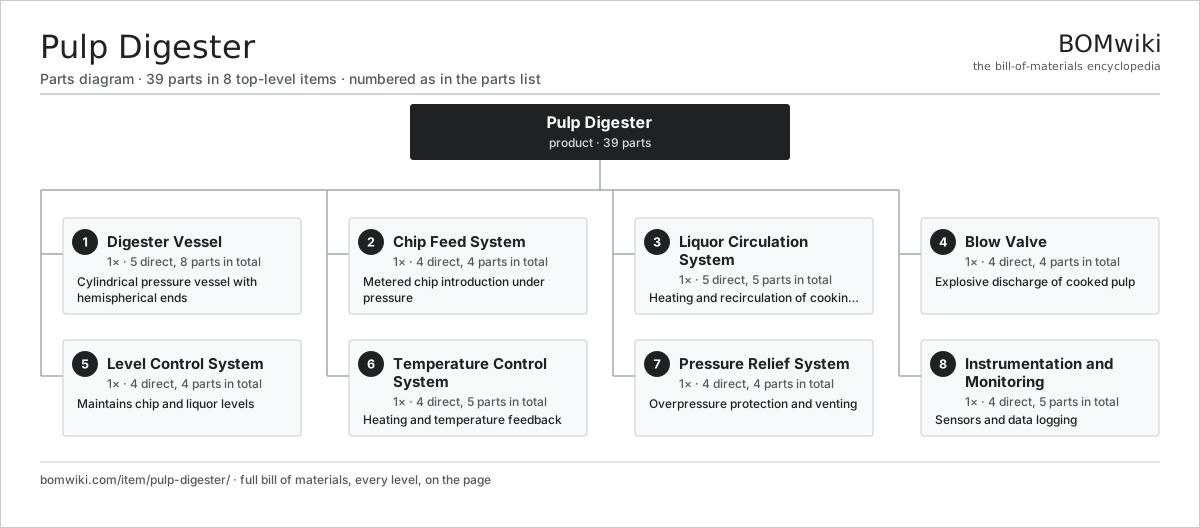
| # | Part | Qty | What it does |
|---|---|---|---|
| 1 | Digester Vessel 5 parts | 1× | Cylindrical pressure vessel with hemispherical ends |
| 2 | Chip Feed System 4 parts | 1× | Metered chip introduction under pressure |
| 3 | Liquor Circulation System 5 parts | 1× | Heating and recirculation of cooking liquor |
| 4 | Blow Valve 4 parts | 1× | Explosive discharge of cooked pulp |
| 5 | Level Control System 4 parts | 1× | Maintains chip and liquor levels |
| 6 | Temperature Control System 4 parts | 1× | Heating and temperature feedback |
| 7 | Pressure Relief System 4 parts | 1× | Overpressure protection and venting |
| 8 | Instrumentation and Monitoring 4 parts | 1× | Sensors and data logging |
3D model
No 3D model yet. Have a CAD file of this? Add a 3D model. STL renders right on this page; STEP, FreeCAD, and OpenSCAD sources are welcome too (openly licensed, like all 3D models on BOMwiki).
Build & assembly graph
expand / collapse · shared sub-assemblies converge · links to related products · est. labourTap an assembly to expand/collapse · tap a part to open it · use “Open page” for any node · drag to pan, scroll to zoom.
Bill of materials for Pulp Digester
8 top-level lines · 42 rows shown · 39 parts total · indented to 3 levels| # | Item / sub-assembly | Part no. | Qty/assy | Ext. qty | Parts | Type |
|---|---|---|---|---|---|---|
| 1 | Digester Vessel 5 parts | pulp-digester-vessel | 1× | 1 | 8 | assembly |
| 1.1 | Steel Shell | pulp-digester-steel-shell | 1× | 1 | · | part |
| 1.2 | Top Head | pulp-digester-top-head | 1× | 1 | · | part |
| 1.3 | Bottom Head | pulp-digester-bottom-head | 1× | 1 | · | part |
| 1.4 | Lifting Trunnions | pulp-digester-lifting-lugs | 4× | 4 | · | part |
| 1.5 | Manhole Cover | pulp-digester-manhole-cover | 1× | 1 | · | part |
| 2 | Chip Feed System 4 parts | pulp-digester-chip-feed-system | 1× | 1 | 4 | assembly |
| 2.1 | Feed Hopper | pulp-digester-feed-hopper | 1× | 1 | · | part |
| 2.2 | Rotary Chip Screw | pulp-digester-rotary-feeder | 1× | 1 | · | part |
| 2.3 | Sealing Screw | pulp-digester-lock-screw | 1× | 1 | · | part |
| 2.4 | Feed Rate Sensor | pulp-digester-flow-sensor | 1× | 1 | · | part |
| 3 | Liquor Circulation System 5 parts | pulp-digester-liquor-circulation | 1× | 1 | 5 | assembly |
| 3.1 | Circulation Pump | pulp-digester-circulation-pump | 1× | 1 | · | part |
| 3.2 | Heating Coil | pulp-digester-heating-coil | 1× | 1 | · | part |
| 3.3 | Steam Control Valve | pulp-digester-steam-valve | 1× | 1 | · | part |
| 3.4 | Optional Cooler | pulp-digester-cooler | 1× | 1 | · | part |
| 3.5 | Relief Cooler | pulp-digester-relief-cooler | 1× | 1 | · | part |
| 4 | Blow Valve 4 parts | pulp-digester-blow-valve | 1× | 1 | 4 | assembly |
| 4.1 | Blow Valve Body | pulp-digester-blow-valve-body | 1× | 1 | · | part |
| 4.2 | Blow Valve Actuator | pulp-digester-blow-valve-actuator | 1× | 1 | · | part |
| 4.3 | Blow Line Strainer | pulp-digester-blow-valve-strainer | 1× | 1 | · | part |
| 4.4 | Sequencing Valve | pulp-digester-sequencing-valve | 1× | 1 | · | part |
| 5 | Level Control System 4 parts | pulp-digester-level-control | 1× | 1 | 4 | assembly |
| 5.1 | Low Level Sensor | pulp-digester-level-sensor-low | 1× | 1 | · | part |
| 5.2 | High Level Sensor | pulp-digester-level-sensor-high | 1× | 1 | · | part |
| 5.3 | Level Indicator | pulp-digester-chip-level-indicator | 1× | 1 | · | part |
| 5.4 | Feed Solenoid Valve | pulp-digester-solenoid-feed-block | 1× | 1 | · | part |
| 6 | Temperature Control System 4 parts | pulp-digester-temperature-control | 1× | 1 | 5 | assembly |
| 6.1 | Temperature Sensor | pulp-digester-temperature-sensor | 2× | 2 | · | part |
| 6.2 | Heating Control Valve | pulp-digester-heating-control-valve | 1× | 1 | · | part |
| 6.3 | Cooling Valve | pulp-digester-cooling-valve | 1× | 1 | · | part |
| 6.4 | Digester PLC | pulp-digester-plc-controller | 1× | 1 | · | part |
| 7 | Pressure Relief System 4 parts | pulp-digester-relief-system | 1× | 1 | 4 | assembly |
| 7.1 | Main Relief Valve | pulp-digester-main-relief | 1× | 1 | · | part |
| 7.2 | Backup Safety Valve | pulp-digester-backup-relief | 1× | 1 | · | part |
| 7.3 | Rupture Disc | pulp-digester-rupture-disc | 1× | 1 | · | part |
| 7.4 | Relief Silencer | pulp-digester-exhaust-silencer | 1× | 1 | · | part |
| 8 | Instrumentation and Monitoring 4 parts | pulp-digester-instrumentation | 1× | 1 | 5 | assembly |
| 8.1 | Pressure Gauge | pulp-digester-pressure-gauge | 2× | 2 | · | part |
| 8.2 | Pressure Transmitter | pulp-digester-pressure-transmitter | 1× | 1 | · | part |
| 8.3 | Data Logger | pulp-digester-data-logger | 1× | 1 | · | part |
| 8.4 | Alarm Horn | pulp-digester-alarm-horn | 1× | 1 | · | part |
Something wrong in this list? Report a problem with this BOM.
Sourcing: possible vendors
Browse the supplier directory → Prices, MOQ, and lead times are algorithmic estimates, not quotes, and not claims about these companies. Company mappings are curated by keyword; est. price band $5k–$2M. How estimates work| Vendor | HQ | Specialty | MOQ | Lead time |
|---|---|---|---|---|
| atlascopco.com ↗ | Stockholm, SE | Compressors & industrial | 10 units | 12–20 wks |
|
🇦🇹Andritz
andritz.com ↗
|
Graz, AT | Process plants & machinery | 10 units | 12–20 wks |
| buhlergroup.com ↗ | Uzwil, CH | Food & materials processing | 10 units | 12–20 wks |
| gea.com ↗ | Düsseldorf, DE | Process technology | 10 units | 12–20 wks |
| mhi.com ↗ | Tokyo, JP | Heavy machinery | 10 units | 12–20 wks |
1,032-word article