Pultrusion Machine
ProductOverview
Pultrusion is an automated continuous process for manufacturing constant-cross-section fiber-reinforced composite profiles: structural beams, decking, handrails, automotive chassis components, and utility poles. Unlike filament winding (rotational symmetry) or hand layup (complex shapes), pultrusion excels at linear extrusions with consistent properties, high production rates, and minimal labor.
The process feeds continuous fiber roving and mat from a Fiber Creel through a Resin Impregnation Bath, then through a heated Heated Die & Shaping where fibers saturate, align, and cure in the die cavity. A Puller & Drive System grips and pulls the emerging profile at constant speed, overcoming resin viscous drag. The profile exits the die partially cured, is cooled on a Conveyor & Transport, and a Cutoff Saw Assembly trims it to length.
A typical installation produces 10–20 metric tons per day of I-beam or channel stock, with production speeds 0.5–5 m/min (faster for thin profiles, slower for thick beams). The process achieves fiber volume fractions 50–60% and excellent repeatability, every meter of pulled profile is geometrically and mechanically identical.
Fiber Creel & Feed
The Fiber Creel holds 8–16 spools of roving (200–2400 tex), plus rolls of continuous glass mat or chopped-strand mat. Rovings are unwound at controlled tension, diverging via Fiber Guide eyes (ceramic tubes) into the resin bath. Continuous mat may be fed alongside rovings for surface finish and transverse stiffness.
The Tension Compensator (weights or springs) applies constant load to each spool, ensuring steady fiber pull-off, critical because if tension is too low, fibers bunch and create wrinkles in the profile; if too high, fibers break or filaments separate.
Feed rate balance:
- Puller speed = 2 m/min = 2000 mm/min.
- If profile cross-section is 50 × 50 mm with 55% fiber volume, the linear roving speed must equal the puller speed (accounting for fiber volume density).
- Excess roving speed beyond the puller creates slack and wrinkles; insufficient speed starves the die of fiber and causes voids.
Resin Impregnation Bath
All fibers pass through a single open Resin Impregnation Bath (200–1000 L) containing mixed resin (polyester, vinyl-ester, or epoxy) at 20–30°C. The resin is catalyzed (peroxide for polyester, amine hardener for epoxy) and recirculated via a Bath Pump to maintain even viscosity and temperature.
Resin bath design:
- Fiber entry: Fibers dive into the bath at a shallow angle (to minimize turbulence and entrained air).
- Path through tank: Fibers follow a tortuous path (wire guides or submerged rails) to maximize soak time and saturation (typically 20–40 seconds residence).
- Squeegee rollers: Precision Squeegee Rollers (one above, one below the fiber bundle) squeeze excess resin, controlling final fiber volume fraction (target 50–60%, remainder is resin/voids).
- Resin circulation: A Bath Pump and Bath Heater maintain temperature and viscosity, with a Return Filter preventing catalyst particles and cured bits from accumulating.
Physics of resin saturation: A roving bundle is porous; resin wicks into the fibers via capillary action. Residence time (bundle transit time through bath) must exceed the characteristic diffusion time:
- Diffusion time ≈ (bundle radius)² / diffusivity (fibers are ~20 microns, diffusivity ~10^−7 cm²/s, so ~0.5–1 second).
- Required residence time: 20–40 seconds to saturate the bundle interior fully.
Heated Die & Profile Formation
The Heated Die & Shaping is a precision-machined aluminum or composite block drilled and profiled to the desired cross-section. Fibers enter the die cavity (after squeezing) and conform to the shape while resin polymerizes via exothermic heat and internal Die Heaters.
Die temperature strategy:
- Inlet (cooler zone, 60–80°C): Low temperature to control resin flow and allow fiber settling into the die cavity geometry.
- Cure zone (120–160°C): Aggressive heating to accelerate polymerization (halving cure time every ~10°C increase, per Arrhenius kinetics).
- Outlet (hot zone, die exit): Resin is gel-like or soft solid, profile is self-supporting.
The Breaker Plate (perforated plate at die entry) aligns and separates roving strands, preventing bridging and uneven fiber distribution inside the die cavity. Dies are custom-built per profile; changing cross-section requires purchasing or fabricating a new die (~$10k–50k depending on complexity).
Residence time in die: Typically 2–5 minutes (depending on profile thickness and resin cure kinetics). At 1 m/min puller speed, the die is 2–5 m long, a major equipment footprint.
Puller & Drive System
The Puller & Drive System consists of a series of rotating nip rollers (typically three sets) or a caterpillar-belt puller gripping the profile and pulling it through the die at constant speed. A Puller Motor (1–5 kW AC or DC) drives a Puller Gearbox (10–30:1 reducer), rotating the Nip Rollers (elastomer-coated steel cylinders) at high grip force.
Puller force balance:
- Fiber drag force = resin viscosity × fiber length in die × fiber surface area.
- For a typical 1 m/min speed, 50 × 50 mm profile, 3 m die length: drag force ~500–2000 N.
- Nip roller grip force must exceed drag, typically 5–10 kN applied pneumatically or mechanically.
The Puller Encoder provides real-time speed feedback to the Control & Automation PLC; if speed drifts, the Puller VFD adjusts motor voltage to maintain setpoint, ensuring constant fiber layup rate and mechanical properties.
Cutoff & Conveyor
After exiting the die, the profile is warm and slightly flexible. A Cutoff Saw Assembly equipped with a carbide or diamond Saw Blade (2000–5000 RPM) automatically cuts the profile to specified length. A Length Stop (mechanical or sensor-based) triggers the saw at preset intervals, and a Saw Actuator (pneumatic or servo) advances the blade into the profile.
The trimmed profile is carried on a Conveyor & Transport (belt or roller conveyor) to a cooling section or stacking area. Profiles cool and fully cure over 24 hours at ambient temperature (or faster in an oven if desired). The conveyor Part Sensors detect parts and can trigger downstream operations (packaging, banding).
Ventilation & Environmental Control
Polyester and vinyl-ester resins release styrene vapor during cure, a health and environmental hazard. The Ventilation & Vapor Control includes a Extraction Hood above the resin bath and die exit, ducting vapor to a Vapor Scrubber (charcoal filter or wet scrubber) before an Exhaust Fan (2–5 kW blower) exhausts to atmosphere or recirculation.
Modern facilities employ closed-system resin management: enclosing the resin bath, venting through activated charcoal filters, and segregating pultruders with separate HVAC zones to capture and treat vapors centrally.
Control & Automation
The Control & Automation PLC synchronizes:
- Puller speed (via Puller VFD), typically 0.5–5 m/min.
- Saw actuation (via Saw Spindle VFD spindle motor and Saw Actuator), triggered every preset length.
- Die temperature (via Temperature Controller PID heater control).
- Conveyor speed (typically synchronized to puller speed to avoid jams).
Operators set via HMI Touchscreen touchscreen:
- Puller speed (m/min).
- Cut length (mm).
- Die setpoint temperature (°C).
- Fiber type and roving count (affecting fiber volume target).
The PLC monitors Puller Encoder feedback, adjusting VFD output to maintain constant speed despite resin temperature drift or viscosity changes. If puller stalls (die blockage), Emergency Stop Relay halts the puller motor and saw, and an alarm sounds.
Quality & Production Metrics
Pultruded profiles are highly repeatable if process parameters (speed, temperature, resin viscosity) remain stable. Typical quality metrics:
- Dimensional tolerance: ±0.5–1 mm on cross-sectional dimensions (better than hand layup, worse than injection-molded plastics).
- Surface finish: Excellent (from die cavity), no wrinkles or voids if feed and speed are correct.
- Fiber orientation: Longitudinal (80–90%), with 0–15% transverse mat for stiffness.
- Strength: Longitudinal tensile 150–400 MPa (E-glass/polyester), modulus 10–20 GPa; transverse strength is much lower (limited by matrix).
Common defects:
- Fiber waviness: Wrinkles or orange-peel surface, caused by excessive roving tension or uneven feed.
- Voids: White spots visible on surface, caused by air entrapment or inadequate resin saturation.
- Resin-rich bands: Visible bands of darker color, caused by excessive nip roller squeeze or slow puller speed.
- Delamination: Plies separate, caused by insufficient die temperature or roving friction.
Typical Economics
A mid-sized pultrusion line (1 m/min speed, 100 × 100 mm profile):
- Capital cost: $200k–500k (die alone $30k–50k, machine frame and motor drive $150k–200k, controls and auxiliary $50k–100k).
- Production capacity: 5–10 metric tons/day (depending on density and speed).
- Material cost: E-glass roving + polyester resin ~$2–4/kg; labor ~$1–2/kg (assuming single operator monitoring multiple machines).
- Finished product selling price: $8–15/kg (depending on complexity, finish, and market).
Large composite producers (owens-corning, hexcel, Strongwell) operate dedicated pultruders for high-volume product lines (rebar, decking, structural beams), achieving economies of scale and market-leading prices.
Pultrusion Machine parts and their functions
8 top-level parts · 76 parts in total · full bill of materials below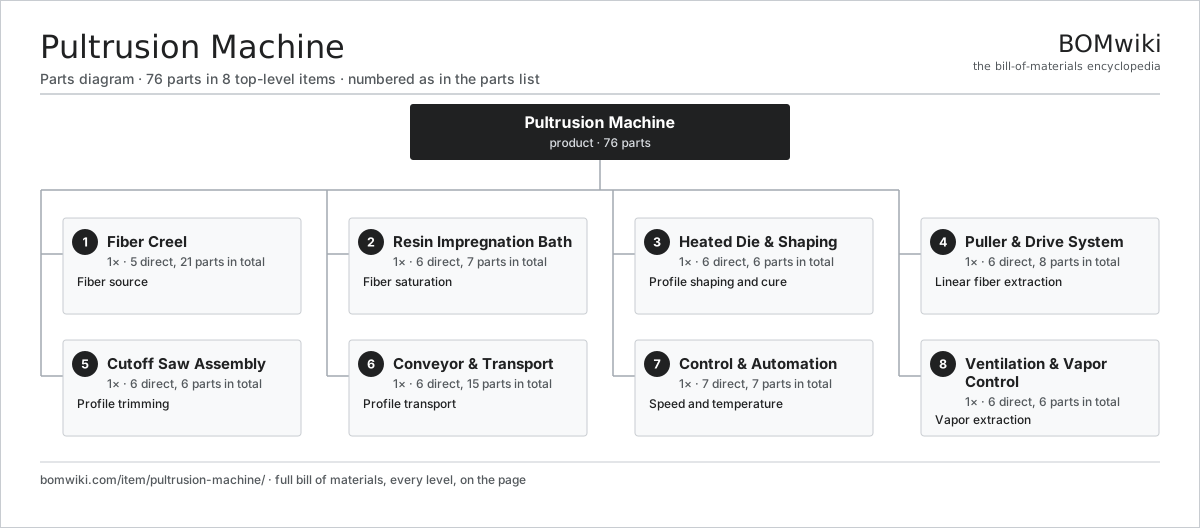
| # | Part | Qty | What it does |
|---|---|---|---|
| 1 | Fiber Creel 5 parts | 1× | Fiber source |
| 2 | Resin Impregnation Bath 6 parts | 1× | Fiber saturation |
| 3 | Heated Die & Shaping 6 parts | 1× | Profile shaping and cure |
| 4 | Puller & Drive System 6 parts | 1× | Linear fiber extraction |
| 5 | Cutoff Saw Assembly 6 parts | 1× | Profile trimming |
| 6 | Conveyor & Transport 6 parts | 1× | Profile transport |
| 7 | Control & Automation 7 parts | 1× | Speed and temperature |
| 8 | Ventilation & Vapor Control 6 parts | 1× | Vapor extraction |
3D model
No 3D model yet. Have a CAD file of this? Add a 3D model. STL renders right on this page; STEP, FreeCAD, and OpenSCAD sources are welcome too (openly licensed, like all 3D models on BOMwiki).
Build & assembly graph
expand / collapse · shared sub-assemblies converge · links to related products · est. labourTap an assembly to expand/collapse · tap a part to open it · use “Open page” for any node · drag to pan, scroll to zoom.
Bill of materials for Pultrusion Machine
8 top-level lines · 56 rows shown · 76 parts total · indented to 3 levels| # | Item / sub-assembly | Part no. | Qty/assy | Ext. qty | Parts | Type |
|---|---|---|---|---|---|---|
| 1 | Fiber Creel 5 parts | pultrusion-machine-creel | 1× | 1 | 21 | assembly |
| 1.1 | Creel Frame | pultrusion-machine-creel-frame | 1× | 1 | · | part |
| 1.2 | Spool Holder Assembly | pultrusion-machine-spool-holder | 8× | 8 | · | part |
| 1.3 | Fiber Guide | pultrusion-machine-fiber-guide | 6× | 6 | · | part |
| 1.4 | Mat Support Rail | pultrusion-machine-mat-support | 2× | 2 | · | part |
| 1.5 | Tension Compensator | pultrusion-machine-tension-compensator | 4× | 4 | · | part |
| 2 | Resin Impregnation Bath 6 parts | pultrusion-machine-resin-bath | 1× | 1 | 7 | assembly |
| 2.1 | Resin Tank | pultrusion-machine-resin-tank | 1× | 1 | · | part |
| 2.2 | Bath Heater | pultrusion-machine-bath-heater | 1× | 1 | · | part |
| 2.3 | Bath Pump | pultrusion-machine-bath-circulation-pump | 1× | 1 | · | part |
| 2.4 | Return Filter | pultrusion-machine-bath-filter | 1× | 1 | · | part |
| 2.5 | Squeegee Roller | pultrusion-machine-squeegee-roller | 2× | 2 | · | part |
| 2.6 | Pressure Sensor | pressure-sensor | 1× | 1 | · | part |
| 3 | Heated Die & Shaping 6 parts | pultrusion-machine-heated-die | 1× | 1 | 6 | assembly |
| 3.1 | Die Block | pultrusion-machine-die-block | 1× | 1 | · | part |
| 3.2 | Die Heater | pultrusion-machine-die-heater | 1× | 1 | · | part |
| 3.3 | Die Temperature Sensor | pultrusion-machine-die-temperature-sensor | 1× | 1 | · | part |
| 3.4 | Die Thermostat | pultrusion-machine-die-thermostat | 1× | 1 | · | part |
| 3.5 | Die Insulation | pultrusion-machine-die-insulation | 1× | 1 | · | part |
| 3.6 | Breaker Plate | pultrusion-machine-breaker-plate | 1× | 1 | · | part |
| 4 | Puller & Drive System 6 parts | pultrusion-machine-puller-unit | 1× | 1 | 8 | assembly |
| 4.1 | Puller Frame | pultrusion-machine-puller-frame | 1× | 1 | · | part |
| 4.2 | Puller Motor | pultrusion-machine-puller-motor | 1× | 1 | · | part |
| 4.3 | Puller Gearbox | pultrusion-machine-puller-gearbox | 1× | 1 | · | part |
| 4.4 | Nip Roller | pultrusion-machine-nip-roller | 3× | 3 | · | part |
| 4.5 | Puller Encoder | pultrusion-machine-puller-encoder | 1× | 1 | · | part |
| 4.6 | Puller VFD | pultrusion-machine-puller-vfd | 1× | 1 | · | part |
| 5 | Cutoff Saw Assembly 6 parts | pultrusion-machine-cutoff-saw | 1× | 1 | 6 | assembly |
| 5.1 | Saw Spindle Motor | pultrusion-machine-saw-motor | 1× | 1 | · | part |
| 5.2 | Saw Blade | pultrusion-machine-saw-blade | 1× | 1 | · | part |
| 5.3 | Saw Frame | pultrusion-machine-saw-frame | 1× | 1 | · | part |
| 5.4 | Saw Guard | pultrusion-machine-saw-guard | 1× | 1 | · | part |
| 5.5 | Saw Actuator | pultrusion-machine-saw-actuator | 1× | 1 | · | part |
| 5.6 | Length Stop | pultrusion-machine-length-stop | 1× | 1 | · | part |
| 6 | Conveyor & Transport 6 parts | pultrusion-machine-conveyor-system | 1× | 1 | 15 | assembly |
| 6.1 | Conveyor Frame | pultrusion-machine-conveyor-frame | 1× | 1 | · | part |
| 6.2 | Conveyor Motor | pultrusion-machine-conveyor-motor | 1× | 1 | · | part |
| 6.3 | Conveyor Belt | pultrusion-machine-conveyor-belt | 1× | 1 | · | part |
| 6.4 | Conveyor Roller | pultrusion-machine-conveyor-roller | 8× | 8 | · | part |
| 6.5 | Profile Guide | pultrusion-machine-conveyor-guide | 2× | 2 | · | part |
| 6.6 | Part Sensor | pultrusion-machine-conveyor-sensor | 2× | 2 | · | part |
| 7 | Control & Automation 7 parts | pultrusion-machine-control-unit | 1× | 1 | 7 | assembly |
| 7.1 | PLC Unit | pultrusion-machine-plc | 1× | 1 | · | part |
| 7.2 | HMI Touchscreen | pultrusion-machine-hmi-panel | 1× | 1 | · | part |
| 7.3 | Puller VFD | pultrusion-machine-puller-vfd | 1× | 1 | · | part |
| 7.4 | Saw Spindle VFD | pultrusion-machine-saw-vfd | 1× | 1 | · | part |
| 7.5 | Temperature Controller | pultrusion-machine-die-controller | 1× | 1 | · | part |
| 7.6 | Control Power Supply | pultrusion-machine-power-supply | 1× | 1 | · | part |
| 7.7 | Emergency Stop Relay | pultrusion-machine-emergency-stop-relay | 1× | 1 | · | part |
| 8 | Ventilation & Vapor Control 6 parts | pultrusion-machine-ventilation-system | 1× | 1 | 6 | assembly |
| 8.1 | Extraction Hood | pultrusion-machine-extraction-hood | 1× | 1 | · | part |
| 8.2 | Exhaust Duct | pultrusion-machine-exhaust-duct | 1× | 1 | · | part |
| 8.3 | Vapor Scrubber | pultrusion-machine-scrubber-unit | 1× | 1 | · | part |
| 8.4 | Exhaust Fan | pultrusion-machine-exhaust-fan | 1× | 1 | · | part |
| 8.5 | Damper Valve | pultrusion-machine-duct-damper | 1× | 1 | · | part |
| 8.6 | Extraction Filter | pultrusion-machine-extraction-filter | 1× | 1 | · | part |
Something wrong in this list? Report a problem with this BOM.
Related products
same domain, ranked by shared parts Bead Mill
37 parts · shares 1 with this page
Bead Mill
37 parts · shares 1 with this page
Sourcing: possible vendors
Browse the supplier directory → Prices, MOQ, and lead times are algorithmic estimates, not quotes, and not claims about these companies. Company mappings are curated by keyword; est. price band $5k–$2M. How estimates work| Vendor | HQ | Specialty | MOQ | Lead time |
|---|---|---|---|---|
| atlascopco.com ↗ | Stockholm, SE | Compressors & industrial | 10 units | 12–20 wks |
|
🇦🇹Andritz
andritz.com ↗
|
Graz, AT | Process plants & machinery | 10 units | 12–20 wks |
| buhlergroup.com ↗ | Uzwil, CH | Food & materials processing | 10 units | 12–20 wks |
| gea.com ↗ | Düsseldorf, DE | Process technology | 10 units | 12–20 wks |
| mhi.com ↗ | Tokyo, JP | Heavy machinery | 10 units | 12–20 wks |
1,521-word article