Quickshifter
ProductOverview
A quickshifter is an electronic module that enables seamless gear shifting without using the clutch, reducing shift time to under 100 milliseconds. During a conventional shift, the rider must: (1) release throttle, (2) pull the clutch lever, (3) move the shift lever, (4) release the clutch, and (5) reapply throttle. This sequence takes 300–500 ms and causes a brief loss of traction. A quickshifter automates the ignition-cut process: when the shift lever is pulled, the Quickshifter ECU Module immediately cuts ignition to the engine, removing load from the gearbox. The rider can then shift while the engine spins freely, re-engaging instantly once the new gear is selected. This technique originated in MotoGP and has now trickled down to affordable aftermarket kits for street bikes.
Principle of Operation
The Four-Stroke Gear Shift Dynamics
In a manual gearbox, the transmission is under constant load from the engine. When shifting:
- Neutral entry: The shifter moves into the neutral gate.
- Synchromesh sync: Internal cone brakes (synchros) in the gearbox slow the input shaft to match the next gear's speed.
- Engagement: The next gear teeth mesh with the synchromesh ring.
- Load reapplication: The engine re-applies torque through the clutch.
Conventional clutch operation:
- Clutch pulled: Disconnects engine from gearbox, unloading the gearbox, allowing gear teeth to mesh freely.
- Shift executed: Shifter moves into the new gear.
- Clutch released: Re-engages engine torque gradually (20–30 ms ramp).
Time for entire cycle: 300–500 ms. Average throttle loss: 20–30%.
Quickshifter Ignition-Cut Method
The Shift Rod Sensor detects the shift command (lever movement) and the Quickshifter ECU Module commands the Ignition Cut Relay to disconnect ignition:
- Shift lever pulled: Sensor sends digital signal to ECU (0–5 V pulse, <1 ms latency).
- Ignition cut: ECU opens the relay, cutting power to the ignition coils. Engine speed drops immediately (500–1000 RPM/ms deceleration).
- Shift window: With zero engine compression opposing the gear teeth, the shift lever can move smoothly. Window: 30–150 ms (adjustable, typically 80–120 ms for a race bike).
- Re-ignition: ECU closes the relay, restoring spark. Engine fire resumes within 10–20 ms.
- Full cycle: 50–100 ms total (vs. 300–500 ms for clutch shifting).
Why This Matters for Performance
At high RPM (e.g., 13,000 RPM engine speed):
- Conventional shift: Engine spins down 2–5% during the 300–500 ms clutch ramp, losing 200–300 RPM. Rider must reapply throttle to recover speed.
- Quickshifter shift: Engine only loses 50–150 RPM during the 50–100 ms ignition-cut window. Much faster recovery, minimal RPM loss.
For a 200 hp motorcycle at 8000 RPM, shifting to the next gear:
- Conventional: 0.5 s cycle, 25% throttle loss, ~2 km/h speed loss per shift.
- Quickshifter: 0.08 s cycle, <5% throttle loss, ~0.3 km/h speed loss per shift.
Over a 10-shift race (typical at a short circuit), quickshifter saves: ~20 km/h accumulated speed ≈ 1–2 seconds per 10-lap race.
Sensor Technology
The Shift Rod Sensor detects gear-shift intent using one of two methods:
Mechanical Microswitch
A sealed microswitch (normally-open, SPST):
- Mounted on the shift mechanism housing.
- Shift rod moves 5–10 mm when the rider pulls the lever; this movement actuates a spring-loaded pushbutton.
- Contact closes, sending ground or 5 V signal to the Quickshifter ECU Module.
- Response time: <5 ms mechanical latency.
- Advantages: Simple, cheap (~USD 10), proven.
- Disadvantages: Contacts can bounce (requiring debouncing firmware), mechanical wear after 50,000+ shifts.
Hall-Effect Magnetic Sensor
A contactless sensor using magnetic field detection:
- A small neodymium Rotating Magnet (5×5×5 mm, ~0.3 T) is mounted on the shift rod.
- A Hall-effect IC probe (Microcontroller or dedicated sensor chip) detects the magnet's presence as it rotates past.
- Shift rod rotates 10–20° when the rider pulls the lever; the magnet triggers the Hall probe at the peak of travel.
- Response time: <2 ms electronic latency.
- Advantages: No moving contacts, no bounce, no wear, IP67-sealed.
- Disadvantages: Slightly more expensive (~USD 40–80), requires alignment, temperature-dependent (Hall probe output changes with temperature).
Signal Integrity
The Electrical Harness is critical for signal integrity:
- Shielded twisted pair (18–20 AWG) prevents EMI coupling from the ignition system or high-voltage spark plug wires.
- Twisted pair reduces differential-mode noise; shield provides common-mode rejection.
- Total harness length: 5–8 meters (from sensor at rear, to ECU usually mounted under the seat).
Without proper shielding, ignition noise (10–100 V pulses at spark timing) can couple into the shift signal, causing false triggers and unintended ignition cuts.
ECU Module Architecture
The Quickshifter ECU Module is the intelligent decision-maker. Modern systems are fully programmable:
Processing Chain
- Input: Shift signal from Shift Rod Sensor (0–5 V pulse).
- Debounce: Firmware filters mechanical bounce by waiting for the signal to stabilize (debounce time: 1–2 ms).
- Throttle-cut condition: Some ECUs check throttle position (from OEM ECU via CAN) and only cut if throttle is above a threshold (e.g., >20% position). This prevents false shifts during coasting or idle.
- Cut duration lookup: ECU calculates cut duration based on:
- Current engine RPM (from OEM ECU CAN message).
- Current gear (if available).
- Rider-adjustable software setting.
- Typical duration: 60–120 ms at mid-range RPM, shorter at low RPM, longer at high RPM.
- Relay command: Ignition Cut Relay is switched open (SSR or mechanical relay) for the calculated duration.
- Re-engagement: After the timer expires, relay is switched closed, restoring ignition.
CAN Bus Integration
Modern bikes (2010+) have a CAN bus carrying engine parameters:
- Engine RPM
- Throttle position
- Gear position (on bikes with electronic transmission).
- Engine load.
The Microcontroller listens to CAN traffic and uses this data to optimize shift timing. For example:
- At 6000 RPM in 4th gear, if shift signal comes, ECU calculates that synchromesh needs 80 ms to sync, so cut window = 80 ms.
- At 12,000 RPM in 6th gear, synchromesh is slower, so cut window = 120 ms.
- If throttle is <10%, ECU ignores the shift signal (rider is likely coasting, not racing).
Ignition-Cut Relay Specifications
The Ignition Cut Relay must:
- Switch fast: Solid-state relay (SSR) preferred for <2 ms response time (vs. ~50 ms for mechanical relays).
- Handle high current: Ignition coil primary circuit draws 10–20 A at 12 V (resistance ~0.6 Ω). Relay must switch this inductive load without arcing.
- Zero-crossing detection: To minimize EMI, SSR should switch at the zero-crossing point of the coil's flyback voltage (when inductive energy is minimum).
A typical IGN-cut SSR is rated for 30 A at 12 V DC, with <5 V dropout. Mechanical relay: mechanical contacts, simpler but slower.
Failsafe Operation
If the ECU loses power or malfunctions:
- Relay defaults to closed (ignition stays on).
- Bike operates normally without quickshifter.
- Rider must use clutch manually.
This failsafe design prevents any dangerous condition (e.g., no ignition on a shift, causing the engine to die mid-corner).
Installation & Tuning
Installation on a modern motorcycle typically involves:
- Sensor bracket mounting: Sensor Mounting Bracket is bolted to the shift mechanism housing using M6 socket-head bolts.
- Sensor gap adjustment: Using Adjustment Shim shim stock, the gap between the sensor and shift rod is set to 2–3 mm (too loose = missed signals; too tight = constant triggering).
- Harness routing: Shielded cable is routed along the frame away from ignition coils and spark plug wires. Secured with P-clips every 10–15 cm.
- ECU connector splice: The OBD-II connector is tapped into the OEM engine ECU using a T-connector or splice connector on the IGN circuit. Proper polarity and insulation are critical.
- Power feed: 12 V DC and ground are spliced into the bike's electrical system upstream of any relays or switches (directly to the battery or starter solenoid for maximum voltage stability).
- Software tuning: Using a laptop or smartphone app, the technician uploads firmware settings (cut duration, throttle threshold, etc.). Most kits come pre-configured for the bike model, but track-specific tuning may be needed.
Installation time: 2–4 hours for a professional; 6–8 hours for a DIY enthusiast.
Limitations & Trade-Offs
Engine Stress
Repeated ignition cuts can stress:
- Spark plug ceramic: Thermal stress from repeated cold-cranking can cause cracking (rare, but possible on very high-RPM engines).
- Valve timing: Ignition cut disrupts the normal combustion cycle; some energy is wasted in the cut phase. Long-term effects are minimal on modern engines.
- Transmission bearing wear: The rapid shift (no clutch damping) transfers full engine shock to the gearbox. High-mileage bikes may experience slightly accelerated wear (unmeasurable on bikes under 50,000 km).
Most race teams accept these trade-offs for the lap-time gain.
Compatibility
Quickshifters work best on:
- Fuel-injected bikes (CAN bus diagnostics, precise ignition control).
- Sequential gearboxes (sport bikes, not adventure bikes with multi-directional shifters).
- Bikes with modern ECUs supporting ignition-control taps.
Not suitable for:
- Carbureted engines (no CAN, ignition is points-based on older bikes).
- Dual-clutch transmissions (DCT) on some Honda/BMW models (transmission handles shift logic electronically; external quickshifters conflict with ECU).
- CVT scooters (continuously variable, no gear selection).
Market & Availability
Aftermarket quickshifters are available for:
- Kawasaki Ninja H2/H2 SX (2015+)
- Yamaha YZF-R1 (2015+)
- Ducati Panigale (2013+)
- KTM 1290 SuperDuke (2019+)
- BMW S1000RR (2010+)
Pricing: USD 200–500 (kit), USD 400–800 (installed at an authorized dealer).
Some manufacturers (e.g., Ducati) now offer quickshifters as optional OEM equipment on their sport bikes, improving accessibility and reliability.
Racing Regulations
Quickshifters are legal in most racing series (FIM, WSBK, MotoGP), but some club-level series restrict them to limit the technological gap between competitors. Check local series rules before installing on a track bike.
Quickshifter parts and their functions
4 top-level parts · 15 parts in total · full bill of materials below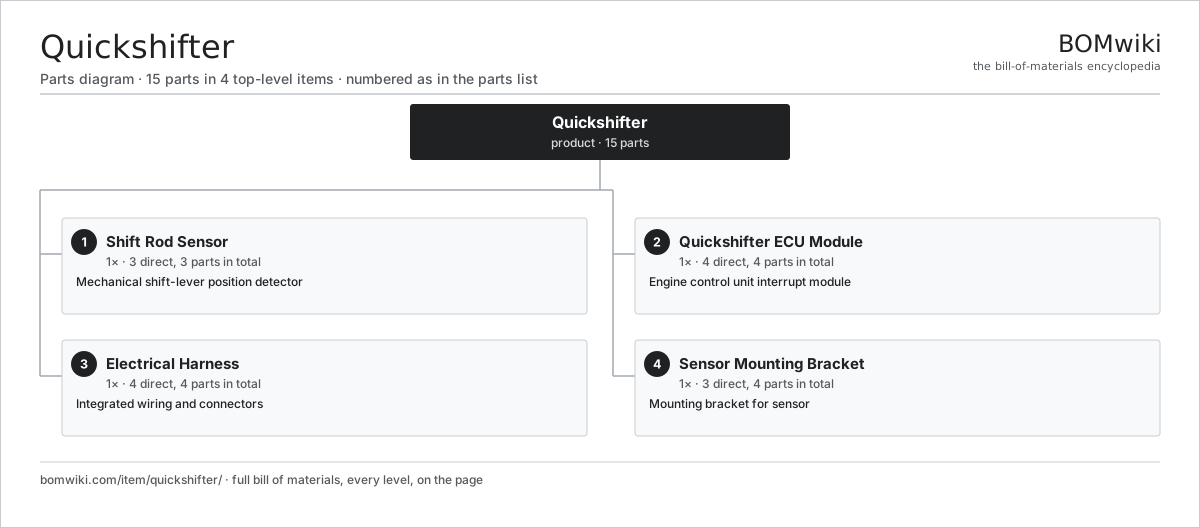
| # | Part | Qty | What it does |
|---|---|---|---|
| 1 | Shift Rod Sensor 3 parts | 1× | Mechanical shift-lever position detector |
| 2 | Quickshifter ECU Module 4 parts | 1× | Engine control unit interrupt module |
| 3 | Electrical Harness 4 parts | 1× | Integrated wiring and connectors |
| 4 | Sensor Mounting Bracket 3 parts | 1× | Mounting bracket for sensor |
3D model
No 3D model yet. Have a CAD file of this? Add a 3D model. STL renders right on this page; STEP, FreeCAD, and OpenSCAD sources are welcome too (openly licensed, like all 3D models on BOMwiki).
Build & assembly graph
expand / collapse · shared sub-assemblies converge · links to related products · est. labourTap an assembly to expand/collapse · tap a part to open it · use “Open page” for any node · drag to pan, scroll to zoom.
Bill of materials for Quickshifter
4 top-level lines · 18 rows shown · 15 parts total · indented to 3 levels| # | Item / sub-assembly | Part no. | Qty/assy | Ext. qty | Parts | Type |
|---|---|---|---|---|---|---|
| 1 | Shift Rod Sensor 3 parts | quickshifter-shift-rod-sensor | 1× | 1 | 3 | assembly |
| 1.1 | Lever Switch | quickshifter-sensor-switch | 1× | 1 | · | part |
| 1.2 | Rotating Magnet | quickshifter-sensor-magnet | 1× | 1 | · | part |
| 1.3 | Sensor Housing | quickshifter-sensor-housing | 1× | 1 | · | part |
| 2 | Quickshifter ECU Module 4 parts | quickshifter-ecu | 1× | 1 | 4 | assembly |
| 2.1 | Microcontroller | quickshifter-ecu-processor | 1× | 1 | · | part |
| 2.2 | Ignition Cut Relay | quickshifter-ecu-relay | 1× | 1 | · | part |
| 2.3 | Precision Timer | quickshifter-ecu-timing | 1× | 1 | · | part |
| 2.4 | ECU Connector | quickshifter-ecu-connector | 1× | 1 | · | part |
| 3 | Electrical Harness 4 parts | quickshifter-harness | 1× | 1 | 4 | assembly |
| 3.1 | Shielded Wire Bundle | quickshifter-harness-wire | 1× | 1 | · | part |
| 3.2 | Sensor Input Connector | quickshifter-harness-connector-sensor | 1× | 1 | · | part |
| 3.3 | OEM ECU Connector | quickshifter-harness-connector-oem | 1× | 1 | · | part |
| 3.4 | Inline Fuse | quickshifter-harness-fuse | 1× | 1 | · | part |
| 4 | Sensor Mounting Bracket 3 parts | quickshifter-sensor-bracket | 1× | 1 | 4 | assembly |
| 4.1 | Mounting Plate | quickshifter-bracket-body | 1× | 1 | · | part |
| 4.2 | Mounting Bolt | quickshifter-bracket-fastener | 2× | 2 | · | part |
| 4.3 | Adjustment Shim | quickshifter-bracket-shim | 1× | 1 | · | part |
Something wrong in this list? Report a problem with this BOM.
Sourcing: possible vendors
Browse the supplier directory → Prices, MOQ, and lead times are algorithmic estimates, not quotes, and not claims about these companies. Company mappings are curated by keyword; est. price band $300–$15k. How estimates work| Vendor | HQ | Specialty | MOQ | Lead time |
|---|---|---|---|---|
| global.honda ↗ | Tokyo, JP | Motorcycles & power products | made to order | 10–16 wks |
| yamaha-motor.com ↗ | Iwata, JP | Motorcycles & marine | made to order | 10–16 wks |
| heromotocorp.com ↗ | New Delhi, IN | Motorcycle & scooter maker | made to order | 10–16 wks |
| bajajauto.com ↗ | Pune, IN | Two- & three-wheeler maker | made to order | 10–16 wks |
| harley-davidson.com ↗ | Milwaukee, US | Motorcycles | made to order | 10–16 wks |
1,658-word article