Weather Radiosonde
ProductOverview
A radiosonde is the instrument behind every upper-air observation on a weather chart. Twice a day, at 00:00 and 12:00 UTC, roughly 900 stations worldwide release a hydrogen- or helium-filled balloon carrying one of these 110-gram packages. Over the next two hours it rises through 35 kilometres of atmosphere at about 5 m/s, sampling pressure, temperature and humidity (the "PTU" triplet) once per second and radioing each frame to the ground. GPS tracking adds wind: the sonde drifts with the air, so its velocity is the wind vector. The resulting vertical profile feeds directly into numerical weather prediction models, radiosonde data remains the calibration anchor against which satellite soundings are corrected.
The instrument is expendable by design. At around US$200 per unit, recovering and refurbishing sondes from wherever the wind drops them costs more than building new ones; most are never seen again, which is why the Identification Label politely explains itself to whoever finds one in a field.
Sensors
Measurement quality lives or dies on sensor exposure, so the PTU Sensor Suite rides on a Sensor Boom angled up and away from the body, outside the package's thermal wake. The Temperature Sensor is a platinum resistance wire about 0.1 mm across, small enough to respond in under a second and to shrug off solar heating, the dominant daytime error source, which is further suppressed by the boom's reflective coating and corrected in ground processing using sun-angle tables.
The Humidity Sensor is a thin-film capacitive polymer whose dielectric tracks relative humidity. Its enemy is ice: passing through a supercooled cloud coats the sensor and freezes the reading. Modern sondes fit twin elements that an integral Heating Element pulses alternately, so one element measures while the other bakes its ice off. Pressure comes from a silicon Pressure Sensor; some current designs omit it entirely and derive pressure from GPS height through the hydrostatic equation, trading a sensor for arithmetic.
Every sensor is individually calibrated at the factory, and the correction polynomials ship inside the unit in a Calibration EEPROM, the ground station applies them after reception, so no two sondes need identical sensors, only known ones.
Telemetry and tracking
The Telemetry Transmitter operates in the protected 400.15–406 MHz meteorological-aids band at about 60 mW, sufficient for 200 km or more to a ground station with a directional antenna, because the link is line-of-sight from altitude. The synthesised Transmitter IC is frequency-agile so that simultaneous launches from nearby stations (or research campaigns lofting dozens of sondes) can deconflict channels, with a RF Filter holding emissions in-band. The antenna is nothing more than a quarter-wave wire, the Transmit Antenna, hanging below the package.
Wind finding once required tracking radars or radio-theodolites; the GPS Receiver receiver replaced all of it. The GNSS Receiver Chip reports Doppler-derived velocity good to about 0.1 m/s, which after filtering out the pendulum swing of the balloon train yields wind to 0.15 m/s at every level. The GPS Patch Antenna patch faces up at the satellites; the telemetry wire faces down at the station.
Surviving the stratosphere
Conditions at 35 km are a design constraint masquerading as trivia: −60 to −90 °C, under 1 % of sea-level pressure, and full unfiltered sun. The Enclosure is two halves of moulded expanded polystyrene, the Foam Shell, whose insulation keeps the electronics' own dissipation trapped inside the case. The Battery Pack uses lithium iron-disulfide Lithium Primary Cell chemistry because alkaline cells deliver almost nothing below −20 °C; two AA cells run the sonde for three hours with margin. A pull-tab on the Battery Holder activates the unit during launch preparation, and the operator verifies telemetry through the ground-check Connector before release.
The balloon train
The sonde never hangs directly from the balloon. The Balloon Train Interface places it 30–55 m below on a Suspension Cord, clear of the balloon's wake, air warmed and moistened by the envelope would contaminate exactly the measurements the flight exists to make. A Unwinder spool pays the cord out over the first half-minute of flight so the train deploys without a snatch load, and a Rigging Clip ties cord, balloon neck and parachute apex together.
The balloon, perhaps 1.5 m across at release, swells past 8 m in the thin stratospheric air and bursts. The Descent Parachute then brakes the descent to roughly 5 m/s, mainly so the package does not arrive at the ground, or someone's roof, at speed. Many stations also process the descent data: a free bonus profile from an instrument that has already done its job.
Weather Radiosonde parts and their functions
7 top-level parts · 33 parts in total · full bill of materials below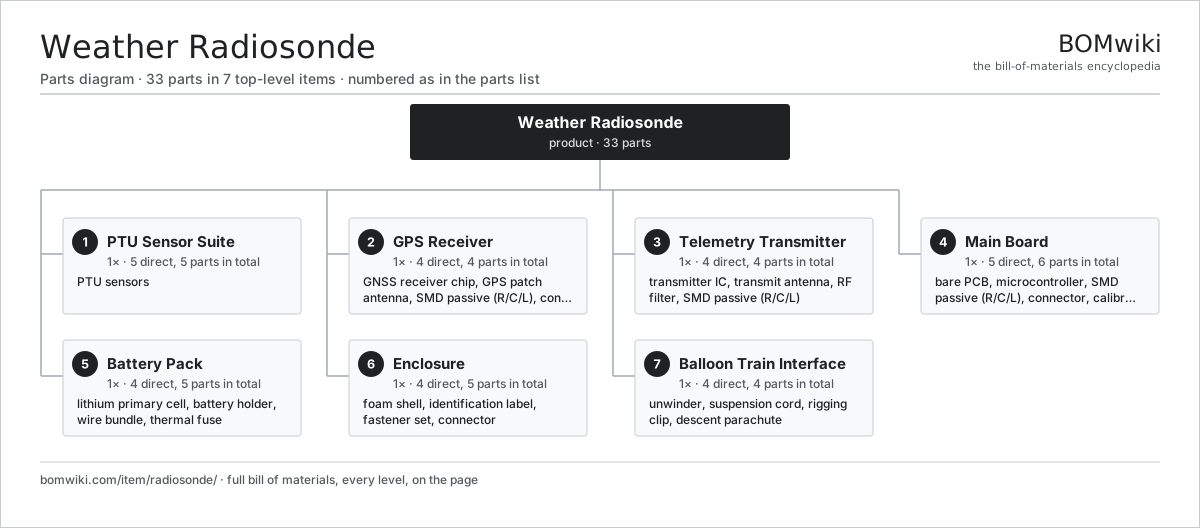
| # | Part | Qty | What it does |
|---|---|---|---|
| 1 | PTU Sensor Suite 5 parts | 1× | PTU sensors |
| 2 | GPS Receiver 4 parts | 1× | Satellite receiver whose Doppler-derived velocity gives wind speed and direction; height replaces a pressure sensor in some designs. |
| 3 | Telemetry Transmitter 4 parts | 1× | 400–406 MHz meteorological-band transmitter sending one full PTU/wind frame per second at about 60 mW. |
| 4 | Main Board 5 parts | 1× | Single PCB hosting the microcontroller that samples sensors, frames telemetry and manages power. |
| 5 | Battery Pack 4 parts | 1× | Lithium primary cells delivering about 3 hours of operation down to −90 °C ambient. |
| 6 | Enclosure 4 parts | 1× | White expanded-polystyrene shell insulating the electronics against −90 °C while weighing under 30 g. |
| 7 | Balloon Train Interface 4 parts | 1× | Unwinder and rigging that lower the sonde 30–55 m below the balloon, clear of its wake and pendulum motion. |
3D model
No 3D model yet. Have a CAD file of this? Add a 3D model. STL renders right on this page; STEP, FreeCAD, and OpenSCAD sources are welcome too (openly licensed, like all 3D models on BOMwiki).
Build & assembly graph
expand / collapse · shared sub-assemblies converge · links to related products · est. labourTap an assembly to expand/collapse · tap a part to open it · use “Open page” for any node · drag to pan, scroll to zoom.
Bill of materials for Weather Radiosonde
7 top-level lines · 37 rows shown · 33 parts total · indented to 3 levels| # | Item / sub-assembly | Part no. | Qty/assy | Ext. qty | Parts | Type |
|---|---|---|---|---|---|---|
| 1 | PTU Sensor Suite 5 parts | radiosonde-sensor-suite | 1× | 1 | 5 | assembly |
| 1.1 | Temperature Sensor | radiosonde-temp-sensor | 1× | 1 | · | part |
| 1.2 | Humidity Sensor | radiosonde-humidity-sensor | 1× | 1 | · | part |
| 1.3 | Sensor Boom | radiosonde-sensor-boom | 1× | 1 | · | part |
| 1.4 | Pressure Sensor | pressure-sensor | 1× | 1 | · | part |
| 1.5 | Heating Element | heating-element | 1× | 1 | · | part |
| 2 | GPS Receiver 4 parts | radiosonde-gps | 1× | 1 | 4 | assembly |
| 2.1 | GNSS Receiver Chip | radiosonde-gnss-chip | 1× | 1 | · | part |
| 2.2 | GPS Patch Antenna | radiosonde-gps-antenna | 1× | 1 | · | part |
| 2.3 | SMD Passive (R/C/L) | smd-passives | 1× | 1 | · | part |
| 2.4 | Connector | connector | 1× | 1 | · | part |
| 3 | Telemetry Transmitter 4 parts | radiosonde-transmitter | 1× | 1 | 4 | assembly |
| 3.1 | Transmitter IC | radiosonde-tx-ic | 1× | 1 | · | part |
| 3.2 | Transmit Antenna | radiosonde-tx-antenna | 1× | 1 | · | part |
| 3.3 | RF Filter | radiosonde-rf-filter | 1× | 1 | · | part |
| 3.4 | SMD Passive (R/C/L) | smd-passives | 1× | 1 | · | part |
| 4 | Main Board 5 parts | radiosonde-mainboard | 1× | 1 | 6 | assembly |
| 4.1 | Bare PCB | pcb-bare | 1× | 1 | · | part |
| 4.2 | Microcontroller | mcu | 1× | 1 | · | part |
| 4.3 | SMD Passive (R/C/L) | smd-passives | 1× | 1 | · | part |
| 4.4 | Connector | connector | 2× | 2 | · | part |
| 4.5 | Calibration EEPROM | radiosonde-calibration-eeprom | 1× | 1 | · | part |
| 5 | Battery Pack 4 parts | radiosonde-battery | 1× | 1 | 5 | assembly |
| 5.1 | Lithium Primary Cell | radiosonde-lithium-cell | 2× | 2 | · | part |
| 5.2 | Battery Holder | radiosonde-battery-holder | 1× | 1 | · | part |
| 5.3 | Wire Bundle | wire-bundle | 1× | 1 | · | part |
| 5.4 | Thermal Fuse | thermal-fuse | 1× | 1 | · | part |
| 6 | Enclosure 4 parts | radiosonde-enclosure | 1× | 1 | 5 | assembly |
| 6.1 | Foam Shell | radiosonde-foam-shell | 2× | 2 | · | part |
| 6.2 | Identification Label | radiosonde-id-label | 1× | 1 | · | part |
| 6.3 | Fastener Set | fastener-set | 1× | 1 | · | part |
| 6.4 | Connector | connector | 1× | 1 | · | part |
| 7 | Balloon Train Interface 4 parts | radiosonde-train-interface | 1× | 1 | 4 | assembly |
| 7.1 | Unwinder | radiosonde-unwinder | 1× | 1 | · | part |
| 7.2 | Suspension Cord | radiosonde-suspension-cord | 1× | 1 | · | part |
| 7.3 | Rigging Clip | radiosonde-rigging-clip | 1× | 1 | · | part |
| 7.4 | Descent Parachute | radiosonde-parachute | 1× | 1 | · | part |
Something wrong in this list? Report a problem with this BOM.
Related products
same domain, ranked by shared parts


Sourcing: possible vendors
Browse the supplier directory → Prices, MOQ, and lead times are algorithmic estimates, not quotes, and not claims about these companies. Company mappings are curated by keyword; est. price band $50k–$300M. How estimates work| Vendor | HQ | Specialty | MOQ | Lead time |
|---|---|---|---|---|
|
🇺🇸Boeing
boeing.com ↗
|
Arlington, US | Aerospace OEM | made to order | 40–80 wks |
|
🇫🇷Airbus
airbus.com ↗
|
Toulouse, FR | Aerospace OEM | made to order | 40–80 wks |
| lockheedmartin.com ↗ | Bethesda, US | Aerospace & defense | made to order | 40–80 wks |
|
🇧🇷Embraer
embraer.com ↗
|
São José dos Campos, BR | Aircraft OEM | made to order | 40–80 wks |
| txtav.com ↗ | Wichita, US | Aircraft OEM | made to order | 40–80 wks |
803-word article