Ballast Tamping Machine
ProductOverview
A ballast tamping machine compacts stone ballast beneath railway sleepers using cyclic impact and vibration. The process is essential in track maintenance: every few years of heavy service, ballast settles, loses its interlocking, and requires re-compaction to restore bearing capacity and track geometry (level and alignment).
Modern tamping machines couple eccentric-driven tine vibration with synchronized lifting and lateral adjustment. The tamping unit oscillates vertically at 10–20 Hz, driving tines into ballast and forcing stone particles into denser packing. Simultaneously, lifting cylinders raise the sleeper in controlled increments, creating voids beneath to be filled and compacted. The measuring system monitors geometry in real-time, adjusting tamping intensity based on track profile feedback.
Typical tamping cycles take 15–30 seconds per sleeper location (depending on ballast condition and depth), with a production rate of 120–180 sleepers per hour. A standard 30 km track section requires 3–5 days of continuous tamping, depending on weather and existing ballast state.
Ballast Compaction Mechanics
Tine Vibration & Ballast Dynamics
The eccentric masses on the tine motor rotate counter-directionally, generating a resultant vertical oscillating force. At 15 Hz and 60 kN peak amplitude:
- Upstroke: Tines retract as eccentric rotates downward, lifting ballast particles slightly.
- Downstroke: Tines impact ballast with high acceleration (>5 g), driving particles downward and laterally.
Ballast particles (25–50 mm stone) behave as a granular medium: interlocking friction initially resists motion, but high acceleration impulses overcome static friction, allowing particles to settle into lower-energy configurations with greater contact area. Multiple impact cycles progressively reduce void ratio (porosity).
Settlement and Resonance
Tamping effectiveness depends on ballast natural frequency. Stone ballast under a 3 m × 0.3 m sleeper (roughly 1.2 ton supported mass) has resonant frequency ~10–15 Hz. Matching tine frequency to ballast resonance maximizes energy transfer and minimizes machine vibration reaction. Off-resonance operation (e.g., 5 Hz or 30 Hz) results in reduced compaction and increased operator fatigue due to transmitted vibration.
The frequency governor holds tine motion within ±1 Hz of target using a hydraulic proportional valve.
System Components & Operation
Tamping Cycle Workflow
- Approach: Machine positions itself over sleeper. Lateral cylinders fine-tune horizontal alignment.
- Lift Phase (2–3 seconds):
- Vertical lift cylinders extend, raising sleeper 40–60 mm.
- Ballast below sleeper is sheared and begins to flow laterally into void space.
- Vibration Phase (8–15 seconds):
- Tines oscillate at high frequency. Multiple impact cycles compact ballast.
- Load sensors monitor compaction progress; operator adjusts frequency and dwell time based on ballast response.
- Lower & Release (2–3 seconds):
- Lift cylinders retract, lowering sleeper back onto freshly compacted bed.
- Machine advances to next sleeper position.
Total cycle: 15–30 seconds. For a standard 2.4 m sleeper spacing (41 sleepers per 100 m), one tamping pass completes 500–1000 m of track in 2–3 hours.
Hydraulic Power Distribution
The main diesel engine drives the variable-displacement pump, which supplies 280 bar pressure to three independent circuits via the sectional valve manifold:
- Tamping circuit: High flow (50–80 cc/s) to tine motor, proportionally metered by frequency valve.
- Lift & lining circuit: Dual vertical cylinders + lateral cylinders, proportional control enabling smooth multi-axis movement.
- Traction/steering circuit: Front bogie steering and rear drive motors for propulsion.
All circuits share the accumulator for energy smoothing and the cooler to maintain oil at 50–55 °C under sustained operation.
Real-Time Geometry Feedback
The measuring system integrates:
- IMU accelerometers: Mounted on machine frame, capturing vertical and lateral vibration to assess ground stiffness modulus (proxy for ballast compaction).
- Laser displacement sensors: Mounted on tine frame, measuring actual rail surface height before and after tamping.
- Pressure transducers: Load feedback on lift cylinders, indicating whether ballast is being mobilized (pressure rise = resistance encountered).
Onboard data logger processes these streams at 50 Hz, flagging over-compaction (excessive force), under-compaction (insufficient force), or geometry drift (misaligned lift), and adjusts dwell time or frequency automatically.
Common Failure Modes & Maintenance
Ballast Pockets (Voids)
Under sleeper after initial compaction, ballast may still contain pockets of loosely-settling stone. These are addressed by:
- Multi-pass strategy: Two to three tamping passes over same section, spaced 1–2 days apart, allow ballast to settle progressively and settle voids between passes.
- Vibration hold: Keeping tines running (but not lifting) for extended periods (30–60 seconds) helps fine particles migrate into voids.
Tine Wear
Wear plates are carbide-tipped and replaceable. Wear rates depend on ballast composition:
- Clean stone (granite, limestone): 0.5–1 mm wear per 10,000 sleeper-tamping cycles.
- Mixed ballast (recycled stone with fines): 2–3 mm wear per 10,000 cycles due to abrasion from silty fines.
Operators visually inspect tine wear weekly and replace worn plates (2-hour job with on-site tooling).
Hydraulic System Contamination
High-frequency vibration and high-pressure jets generate airborne dust. The return filtration system must be inspected and cartridges replaced every 100–200 hours of operation. Neglect leads to silt silt buildup in proportional valves, causing sluggish response or stiction.
Economics & Operational Constraints
Productivity
- Tamping rate: 120–180 sleepers/hour (3–5 hour shift with operator breaks).
- Cost per sleeper: ~€1–2 labor + fuel (larger capital equipment amortization).
- Track readiness: Ballast must drain freely; waterlogged ballast cannot be compacted effectively. Wet periods may require drainage work before tamping.
Weather Constraints
- Rain: Active precipitation reduces operator visibility and surface adhesion. Tamping is typically halted in heavy rain.
- Frost: Hard-frozen ballast resists compaction and risks equipment damage. Machines are parked during winter months in cold climates.
- Heat: Sustained >40 °C air temperature increases hydraulic oil viscosity and cooling demand.
Track Access & Safety
Tamping machines operate at line speed (5–30 km/h) between tamping positions, but require line closure or speed restriction (40 km/h maximum) for safety. European railways typically schedule tamping work during night hours (0000–0600) to minimize passenger service disruption.
Specifications & Standards
Modern machines comply with:
- EN 13305: Railway applications – Infrastructure – Rail vehicles – Geometric test method.
- ISO 3864: Safety signs (operator cabin contains hazard warnings).
- Directive 2006/42/EC: Machinery safety (EU certification required).
- Stage V emissions (EU): Diesel engine tier III reduces NOx and particulates.
History & Trends
Early tamping machines (1970s–1980s) used purely mechanical eccentric drives with operator-adjusted frequency. Modern systems (2000s onward) employ variable-displacement hydraulics with PLC feedback loops, enabling automatic frequency adaptation and real-time geometry optimization.
Emerging technologies include:
- Machine learning: Predictive models correlating vibration signatures to ballast condition, adjusting tamping strategy proactively.
- Autonomous operation: Driverless prototype systems using RTK-GPS for positioning (under evaluation by European rail operators).
- 3D laser scanning: High-speed profiling of track geometry over full wavelength (5–30 m) to identify tamping zones requiring highest intensity.
Ballast Tamping Machine parts and their functions
6 top-level parts · 51 parts in total · full bill of materials below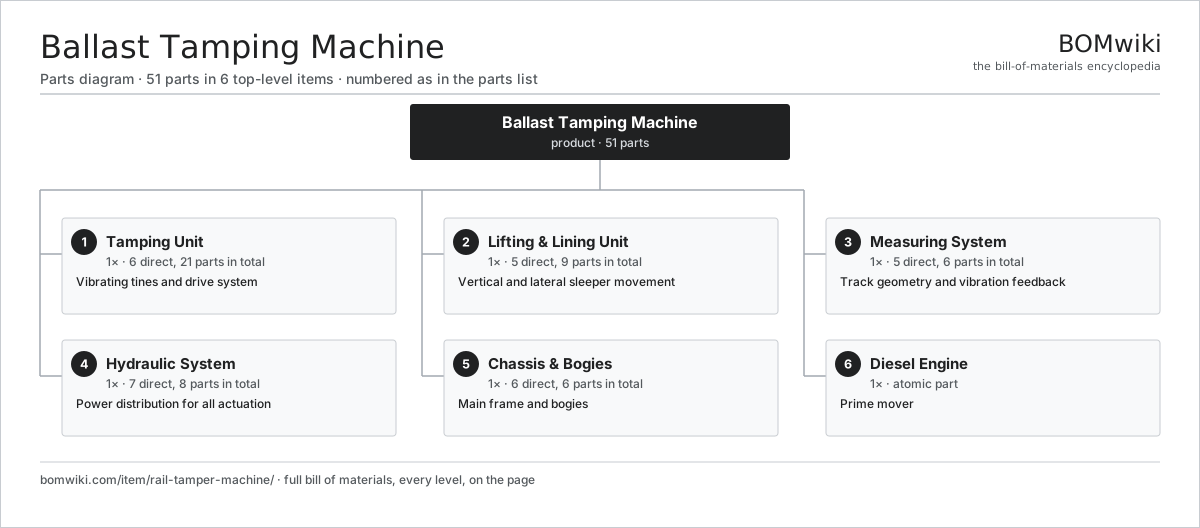
| # | Part | Qty | What it does |
|---|---|---|---|
| 1 | Tamping Unit 6 parts | 1× | Vibrating tines and drive system |
| 2 | Lifting & Lining Unit 5 parts | 1× | Vertical and lateral sleeper movement |
| 3 | Measuring System 5 parts | 1× | Track geometry and vibration feedback |
| 4 | Hydraulic System 7 parts | 1× | Power distribution for all actuation |
| 5 | Chassis & Bogies 6 parts | 1× | Main frame and bogies |
| 6 | Diesel Engine | 1× | Prime mover |
3D model
No 3D model yet. Have a CAD file of this? Add a 3D model. STL renders right on this page; STEP, FreeCAD, and OpenSCAD sources are welcome too (openly licensed, like all 3D models on BOMwiki).
Build & assembly graph
expand / collapse · shared sub-assemblies converge · links to related products · est. labourTap an assembly to expand/collapse · tap a part to open it · use “Open page” for any node · drag to pan, scroll to zoom.
Bill of materials for Ballast Tamping Machine
6 top-level lines · 35 rows shown · 51 parts total · indented to 3 levels| # | Item / sub-assembly | Part no. | Qty/assy | Ext. qty | Parts | Type |
|---|---|---|---|---|---|---|
| 1 | Tamping Unit 6 parts | rail-tamper-machine-tamping-unit | 1× | 1 | 21 | assembly |
| 1.1 | Eccentric Mass | rail-tamper-machine-eccentric-mass | 2× | 2 | · | part |
| 1.2 | Tine Frame | rail-tamper-machine-tine-frame | 1× | 1 | · | part |
| 1.3 | Tamping Tine | rail-tamper-machine-tine | 8× | 8 | · | part |
| 1.4 | Tine Wear Plate | rail-tamper-machine-tine-wear-plate | 8× | 8 | · | part |
| 1.5 | Motor Housing | motor-housing | 1× | 1 | · | part |
| 1.6 | Vibration Frequency Control | rail-tamper-machine-vibration-frequency-control | 1× | 1 | · | part |
| 2 | Lifting & Lining Unit 5 parts | rail-tamper-machine-lifting-lining-unit | 1× | 1 | 9 | assembly |
| 2.1 | Vertical Lift Cylinder | rail-tamper-machine-vertical-lift-cylinder | 2× | 2 | · | part |
| 2.2 | Lateral Alignment Cylinder | rail-tamper-machine-lateral-cylinder | 2× | 2 | · | part |
| 2.3 | Arm Linkage | rail-tamper-machine-arm-linkage | 1× | 1 | · | part |
| 2.4 | Grip Plate | rail-tamper-machine-grip-plate | 2× | 2 | · | part |
| 2.5 | Pressure Sensor | pressure-sensor | 2× | 2 | · | part |
| 3 | Measuring System 5 parts | rail-tamper-machine-measuring-system | 1× | 1 | 6 | assembly |
| 3.1 | IMU Unit | rail-tamper-machine-imu-unit | 1× | 1 | · | part |
| 3.2 | Rail Contact Probe | rail-tamper-machine-rail-contact-probe | 2× | 2 | · | part |
| 3.3 | Data Logger PC | rail-tamper-machine-data-logger | 1× | 1 | · | part |
| 3.4 | Bare PCB | pcb-bare | 1× | 1 | · | part |
| 3.5 | Laser Displacement Sensor | rail-tamper-machine-laser-displacement | 1× | 1 | · | part |
| 4 | Hydraulic System 7 parts | rail-tamper-machine-hydraulic-system | 1× | 1 | 8 | assembly |
| 4.1 | Main Hydraulic Pump | rail-tamper-machine-main-pump | 1× | 1 | · | part |
| 4.2 | Valve Manifold | rail-tamper-machine-valve-manifold | 1× | 1 | · | part |
| 4.3 | Accumulator | rail-tamper-machine-accumulator | 1× | 1 | · | part |
| 4.4 | Filter Assembly | rail-tamper-machine-filter-assembly | 2× | 2 | · | part |
| 4.5 | Hose Harness | rail-tamper-machine-hose-harness | 1× | 1 | · | part |
| 4.6 | Cooler | rail-tamper-machine-cooler | 1× | 1 | · | part |
| 4.7 | Reservoir | rail-tamper-machine-reservoir | 1× | 1 | · | part |
| 5 | Chassis & Bogies 6 parts | rail-tamper-machine-chassis | 1× | 1 | 6 | assembly |
| 5.1 | Main Frame | rail-tamper-machine-main-frame | 1× | 1 | · | part |
| 5.2 | Front Bogie | rail-tamper-machine-front-bogie | 1× | 1 | · | part |
| 5.3 | Rear Bogie | rail-tamper-machine-rear-bogie | 1× | 1 | · | part |
| 5.4 | Cab Frame | rail-tamper-machine-cab-frame | 1× | 1 | · | part |
| 5.5 | Brake System | rail-tamper-machine-brake-system | 1× | 1 | · | part |
| 5.6 | Encoder | encoder | 1× | 1 | · | part |
| 6 | Diesel Engine | rail-tamper-machine-diesel-engine | 1× | 1 | · | part |
Something wrong in this list? Report a problem with this BOM.
Related products
same domain, ranked by shared parts Automated People Mover
450 parts · shares 2 with this page
Automated People Mover
450 parts · shares 2 with this page
 Ballast Undercutter
38 parts · shares 2 with this page
Ballast Undercutter
38 parts · shares 2 with this page
 Bus Rapid Transit Vehicle
4,251 parts · shares 2 with this page
Bus Rapid Transit Vehicle
4,251 parts · shares 2 with this page
 Coach Bus
999 parts · shares 2 with this page
Coach Bus
999 parts · shares 2 with this page
 Commuter EMU
14,010 parts · shares 2 with this page
Commuter EMU
14,010 parts · shares 2 with this page
 Diesel Multiple Unit
12,609 parts · shares 2 with this page
Diesel Multiple Unit
12,609 parts · shares 2 with this page
Sourcing: possible vendors
Browse the supplier directory → Prices, MOQ, and lead times are algorithmic estimates, not quotes, and not claims about these companies. Company mappings are curated by keyword; est. price band $500k–$60M. How estimates work| Vendor | HQ | Specialty | MOQ | Lead time |
|---|---|---|---|---|
|
🇨🇳CRRC
crrcgc.cc ↗
|
Beijing, CN | Rolling stock & rail systems | made to order | 40–72 wks |
|
🇫🇷Alstom
alstom.com ↗
|
Saint-Ouen, FR | Rail rolling stock | made to order | 40–72 wks |
| mobility.siemens.com ↗ | Munich, DE | Rail systems | made to order | 40–72 wks |
| stadlerrail.com ↗ | Bussnang, CH | Rail rolling stock | made to order | 40–72 wks |
|
🇺🇸Wabtec
wabteccorp.com ↗
|
Pittsburgh, US | Rail equipment | made to order | 40–72 wks |
1,268-word article