Rail Threading Machine
ProductOverview
Rail threading machines are precision gantry devices that align two rail ends for welding by:
- Constraining rail geometry: Dual precision roller guide rails ensure each rail end runs true (straight and level) along the welding station.
- Positioning transversely: Dual threaded rods translate each rail left-right, converging them to a precise gap (2–5 mm, optimized for the subsequent flash butt welder).
- Measuring & correcting: Laser gap detector and machine vision monitor end-to-end gap and angular alignment in real-time, with feedback control adjusting roller positions.
Threading machines are stationary (portal-mounted) and precede flash butt welders in a continuous welding train (CWT) or deployment sequence. Perfect alignment at threading improves weld quality and reduces defect rates.
Rail Joining Context
Why Threading Matters
Rail ends arriving at the threading station are not naturally aligned:
- Rail storage & transport: Rails are stacked, transported by truck or rail car; end-to-end planarity is ±10–20 mm.
- Field handling: Rails are manually positioned by workers; precision is limited by visual judgment.
- Rail curvature: Worn rails are not perfectly straight; lateral bow (sag) of 5–10 mm over a 12 m rail length is common.
Misaligned rail ends at the flash butt welder cause:
- Uneven current distribution: If one rail end is offset (e.g., 3 mm to the left), electrical current density concentrates, causing local overheating and voids in the weld.
- Incomplete fusion: Misaligned surfaces prevent full melt-pool contact, leaving oxide layers (cold weld).
- Symmetry loss: Asymmetric flashing and upset lead to eccentric weld bead, reducing strength.
Threading enforces:
- Gap uniformity: ±1 mm end-to-end gap (not ±3 mm).
- Alignment precision: Rails coaxial to ±3 mm (not ±15 mm random).
- Angular alignment: Rail ends perpendicular to flash axis within ±0.5° (not random bevel).
This precision reduces weld defect rates from ~10% (poor threading) to <1% (good threading).
Threading Machine Subsystems
Precision Roller Guide System
The roller guide assembly is the critical precision component. Each guide consists of:
- Guide rail body: Ductile iron or steel channel, precision-ground to V-profile on both sides (left and right running surfaces).
- Rollers: Four precision rollers per guide:
- Two side rollers (left & right V-grooves): Constrain lateral position of rail, maintaining centerline alignment.
- Two vertical rollers (upper & lower): Constrain vertical position, keeping rail running surface level.
Roller adjustment mechanism: Each roller is mounted on an eccentric collar eccentric adjustment mechanism. Rotating the eccentric changes roller gap from ~0.2 mm (loose, low friction) to zero clearance (tight, high friction, minimum play).
Precision requirement:
- Parallelism between left and right V-surfaces: <0.1 mm per meter.
- Roller runout (radial or axial wobble): <0.05 mm Total Indicated Runout (TIR).
- Roller hardness: 58–62 HRC (hardened to resist deformation under ~10 kN per-roller load).
With these tolerances maintained, rail travel through guides remains centered to ±5 mm over a 15 m threading length.
Hydraulic Clamping & Positioning
The movable clamp assembly at the downstream end (opposite the clamping jaw at entrance):
- Hinged jaw: Mounted on a pivot, powered by double-acting hydraulic cylinder.
- Clamping pressure: 50–100 kN (sufficient to grip rail foot without local deformation).
- Position feedback: LVDT linear position transducer mounted on jaw pivot, measuring jaw displacement (proxy for rail position as jaw advances).
Feedback signals the PLC to modulate proportional valve flow, translating jaw at controlled speed (0.5–2 m/min). As rail end enters the clamping jaw:
- Initial contact (light pressure, ~5 kN): Jaw touches rail end, pressure transducer detects load.
- Ramp pressure (1 sec): Cylinder pressure ramps to 80 kN over 1 second, clamping rail firmly.
- Hold: Jaw maintains fixed pressure; position sensor locks jaw position.
Dual Threaded-Rod Positioning System
The dual threaded-rod system (left and right) provides transverse (lateral) positioning:
- Threaded rods: M16 or M20 precision ACME threads, typically 3 mm pitch (1 full rotation = 3 mm linear travel).
- Motor drive: Stepper or servo motor rotates both rods synchronously via timing belt.
- Carriage nuts: Sleeper carriage suspended from both rod nuts; as rods rotate, carriage moves left-right.
Accuracy: With 3 mm pitch and stepper motor (1.8° steps = 50 steps/revolution):
$$ ext{Position resolution} = 3 ext{ mm} / 50 = 0.06 ext{ mm/step}$$
Multi-step sequences (e.g., 100 steps) achieve 6 mm positioning with ~0.06 mm repeatability, well-suited for ±50 mm range adjustment.
Feedback loop: Position sensor array (multiple LVDTs on the guiding frame) confirms actual carriage position; if motor commands deviate from sensor feedback, PLC adjusts motor frequency to re-synchronize.
Measuring & Alignment System
The measuring system monitors three critical dimensions:
Gap measurement: Laser displacement sensor mounted at welding-station location, targeting the rail end gap. Gap is scanned at 50 Hz; setpoint is typically 3–5 mm (operator-adjustable).
Angular alignment: High-resolution camera (5 MP, <1 mm/pixel resolution at 12 m distance) captures end-to-end view. Image processing detects rail edges and calculates skew angle (deviation from 90° perpendicular to thread axis). Skew <0.5° is acceptable.
Lateral positioning: Comparison of gap measurement at left side vs. right side. If gap at left is 4 mm and right is 6 mm, threading is asymmetric; PLC commands motor adjustment to bias left-side thread faster.
Closed-loop feedback: PLC samples all three measurements every 100 ms:
- Gap feedback: If measured gap >5 mm, motor speed increases (faster advance).
- Skew feedback: If angle >0.3°, eccentric threading adjustment (slow one rod, normal-speed other).
- Asymmetry feedback: If left-right gap difference >1 mm, threaded-rod speed differential applied.
Typical convergence time: 2–5 minutes of threading to reach setpoint gap ±1 mm, angle ±0.3°.
Operational Workflow
Pre-Threading Setup
- Rail staging: Two rail ends are manually positioned in the threading machine entrance, resting on guide rail bodies.
- Visual alignment: Workers use visual marks and simple tools (straightedge, level) to rough-align rails to within ±20 mm.
- Clamp engagement: Operator activates clamp cylinder (light pressure, 20 kN), securing rail ends from rolling backward.
Automatic Threading Sequence
System initialization (30 sec):
- PLC zeroes all position sensors and activates measurement system.
- Laser sensor targets gap and confirms visible (laser spot detects metal surface).
- Camera focuses and confirms rail edges are visible in frame.
Threading initiation (1–5 min):
- Threaded-rod motor begins rotating, advancing rails together.
- Traction motor engages, driving first rail forward at 1 m/min (slow, allowing precision control).
- PLC monitors gap feedback continuously:
- If gap >5 mm: Increase motor speed to 1.5 m/min.
- If gap 3–5 mm: Maintain speed.
- If gap <3 mm: Reduce motor speed to 0.5 m/min.
Precision convergence (3–10 min):
- As rails approach (gap <10 mm), motor speed drops to <0.5 m/min.
- Position sensors and camera feedback achieve tight tolerance.
- Skew correction: If camera detects skew >0.3°, PLC adjusts rod motor frequency asymmetrically (e.g., left rod 10 Hz, right rod 12 Hz), rotating one rail faster to correct angle.
Final alignment (2–3 min):
- Gap reaches setpoint (3–5 mm ±1 mm).
- Skew angle <0.3°.
- Asymmetry (left-right gap difference) <0.5 mm.
- PLC signals "READY FOR WELDING" to operator and sends rail photos to flash butt welder control system.
Hold & Handoff (1–2 min):
- Clamp jaw is secured at high pressure (100 kN).
- Threading machine hydraulics go to neutral (no further movement).
- Flash butt welder advances its clamping head and engages rail ends.
- Once welder clamps are seated, threading machine releases its clamp (signaled via interlock signal from welder PLC).
Ejection & Reset (1 min):
- Welded rail joint advances onto next station (cooling, straightening, or inspection).
- Threading machine retracts all carriages (rods rotate backward) to entrance position.
- System readies for next rail pair.
Total cycle time: 15–25 minutes per joint (depending on initial misalignment). For a continuous welding train processing 10–15 joints per shift:
- Rails joined per shift: 10–15 (8-hour shift with ~50 min overhead per joint average).
- Threading lane throughput: ~2–3 joints/hour sustained (accounting for setup, handoffs, occasional rejections).
Quality Assurance & Rejection Criteria
Acceptable vs. Rejected
Threading machine monitors and rejects joints that fall outside tolerances:
- Gap: Must be 3–5 mm ±1 mm. Gap >6 mm risks incomplete fusion; gap <2 mm risks collision and wire-burn.
- Skew angle: <0.5° (perpendicularity). Skew >0.5° leads to asymmetric weld.
- Asymmetry: Left-right gap difference <1 mm. Difference >1 mm indicates roller guide wear or rail curvature beyond tolerance.
If tolerances are violated:
- Reject signal: PLC generates alert "THREADING FAILURE – REVIEW SETUP."
- Operator action: Worker manually inspects. Causes can be:
- Rail end is severely curved (bow >10 mm): Rail must be straightened before re-threading.
- Roller guides are dull or out of alignment: Maintenance required.
- Initial positioning was poor: Operator re-positions and retries threading.
Retry success rate: ~95% (most rejections are recoverable with re-positioning).
Maintenance & Calibration
Roller Guide Wear
Precision rollers experience wear at ~0.1–0.2 mm per 1000 joints (dependent on rail grade and surface cleanliness). After ~50,000 joints (typical 5-year service life):
- Roller diameter reduction: ~5–10 mm cumulative wear.
- Roller centering: Wear-induced wobble increases from <0.05 mm to >0.1 mm TIR.
At this point, rollers must be replaced (€800–€1,500 per roller, labor-intensive).
Eccentric Collar Calibration
The roller adjustment mechanism (eccentric collar) requires periodic re-zeroing:
- Tool: Precision feeler gauges (0.05 mm steps) or go-no-go gauges.
- Procedure: Manually rotate eccentric collar until roller gap is exactly zero (light drag resistance when rail is pushed by hand).
- Frequency: Every 5,000 joints or monthly, whichever comes first.
Without calibration, roller clearance drifts, leading to:
- Excessive play: Rails wander (alignment accuracy degrades to ±10 mm).
- Binding: Excessive friction, motor stalls, cycle time extends.
Threaded-Rod Maintenance
The ACME threads and carriage nuts experience wear at ~0.01 mm clearance increase per 10,000 cycles. When clearance exceeds 0.2 mm:
- Backlash compensation: Software in PLC must offset motor commands (+/- 5 steps) to account for play.
- Re-lubrication: PTFE or lithium-based grease on threads prevents binding and oxidation.
Economics & Deployment Context
Equipment Cost
- Stationary portal threading machine: €300k–€500k (fixed installation).
- Mobile CWT-integrated threading unit: €800k–€1.2M (includes rail car, hydraulic power unit, data systems).
Amortization (10-year life): €30k–€120k/year depending on configuration.
Operational Cost
- Operator: €50–€80/hour (skilled technician).
- Per-joint labor cost: €15–€25 (threading time ~15–20 minutes).
- Maintenance & wear: €5–€10 per joint.
- Total cost per joint: €25–€40 labor + overhead.
Comparison to Unaided Flashing
Without threading machine (manual alignment):
- Operator uses hand tools and eye to position rail ends.
- Alignment accuracy: ±10–20 mm, misalignment angle ±1–2°.
- Weld defect rate: ~10% (cold welds, voids, cracks from misalignment).
- Rework cost: €200–€500 per defect (cutting, re-flashing).
With threading machine:
- Alignment accuracy: ±3 mm, angle <0.5°.
- Weld defect rate: <1%.
- Cost per joint: +€25–€40 (threading labor), but -€50–€150 (reduced rework).
- Net savings: ~€25–€100 per joint over 1000+ joint projects.
For a 50 km continuous welding project (21,000 joints), threading cost €525k–€840k, but rework avoidance saves €1.05M–€2.1M, netting €600k–€1.5M benefit.
Standards & Acceptance Criteria
Threaded and welded rail joints must meet:
- EN 14587: Railway applications – Infrastructure – Rail welding – Flash butt welds.
- Gap tolerance: 3–5 mm (railway authority specification).
- Perpendicularity: <0.5° angular deviation.
- Weld strength: >95% of parent rail tensile strength post-testing.
Quality assurance relies on:
- Visual inspection: Macro surface cracks, asymmetric bead.
- Destructive sampling (tensile, bend, impact): 1 per 100–500 welds.
- Non-destructive testing (ultrasonic): 5–10% sampling on high-speed lines.
Rail Threading Machine parts and their functions
6 top-level parts · 68 parts in total · full bill of materials below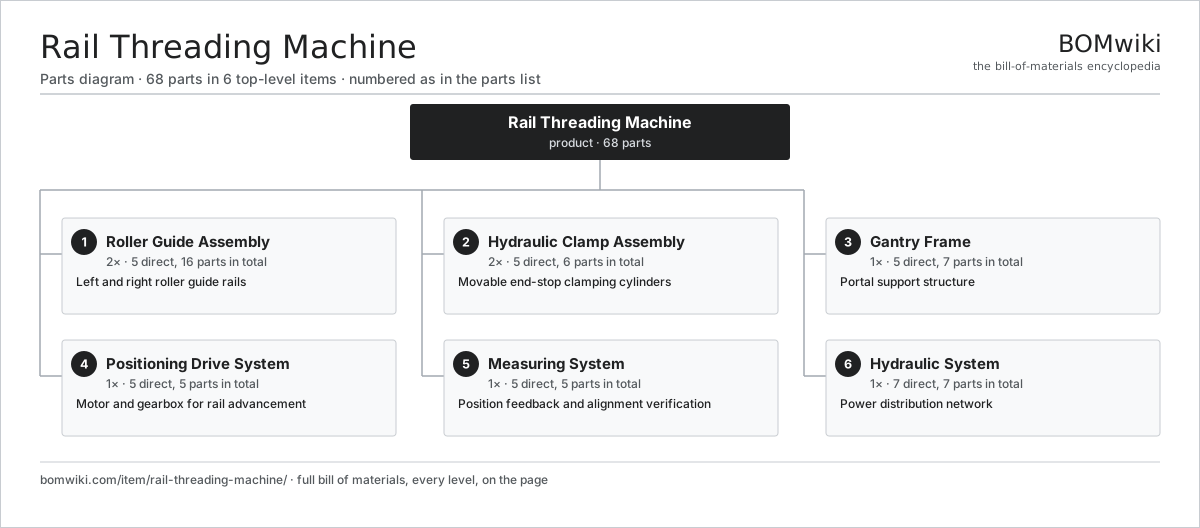
| # | Part | Qty | What it does |
|---|---|---|---|
| 1 | Roller Guide Assembly 5 parts | 2× | Left and right roller guide rails |
| 2 | Hydraulic Clamp Assembly 5 parts | 2× | Movable end-stop clamping cylinders |
| 3 | Gantry Frame 5 parts | 1× | Portal support structure |
| 4 | Positioning Drive System 5 parts | 1× | Motor and gearbox for rail advancement |
| 5 | Measuring System 5 parts | 1× | Position feedback and alignment verification |
| 6 | Hydraulic System 7 parts | 1× | Power distribution network |
3D model
No 3D model yet. Have a CAD file of this? Add a 3D model. STL renders right on this page; STEP, FreeCAD, and OpenSCAD sources are welcome too (openly licensed, like all 3D models on BOMwiki).
Build & assembly graph
expand / collapse · shared sub-assemblies converge · links to related products · est. labourTap an assembly to expand/collapse · tap a part to open it · use “Open page” for any node · drag to pan, scroll to zoom.
Bill of materials for Rail Threading Machine
6 top-level lines · 38 rows shown · 68 parts total · indented to 3 levels| # | Item / sub-assembly | Part no. | Qty/assy | Ext. qty | Parts | Type |
|---|---|---|---|---|---|---|
| 1 | Roller Guide Assembly 5 parts | rail-threading-machine-roller-guide-assembly | 2× | 2 | 16 | assembly |
| 1.1 | Guide Rail Body | rail-threading-machine-guide-rail-body | 1× | 2 | · | part |
| 1.2 | Guide Roller | rail-threading-machine-guide-roller | 4× | 8 | · | part |
| 1.3 | Roller Bearing | rail-threading-machine-roller-bearing | 8× | 16 | · | part |
| 1.4 | Roller Adjuster | rail-threading-machine-roller-adjuster | 2× | 4 | · | part |
| 1.5 | Guide Support | rail-threading-machine-guide-support | 1× | 2 | · | part |
| 2 | Hydraulic Clamp Assembly 5 parts | rail-threading-machine-hydraulic-clamp | 2× | 2 | 6 | assembly |
| 2.1 | Clamp Jaw | rail-threading-machine-clamp-jaw | 1× | 2 | · | part |
| 2.2 | Clamp Cylinder | rail-threading-machine-clamp-cylinder | 1× | 2 | · | part |
| 2.3 | Jaw Pad | rail-threading-machine-jaw-pad | 2× | 4 | · | part |
| 2.4 | Position Sensor | rail-threading-machine-clamp-position-sensor | 1× | 2 | · | part |
| 2.5 | Load Cell | rail-threading-machine-clamp-load-cell | 1× | 2 | · | part |
| 3 | Gantry Frame 5 parts | rail-threading-machine-gantry-frame | 1× | 1 | 7 | assembly |
| 3.1 | Vertical Mast | rail-threading-machine-vertical-mast | 2× | 2 | · | part |
| 3.2 | Horizontal Beam | rail-threading-machine-horizontal-beam | 1× | 1 | · | part |
| 3.3 | Guide Carriage | rail-threading-machine-guide-carriage | 2× | 2 | · | part |
| 3.4 | Clamp Carriage | rail-threading-machine-clamp-carriage | 1× | 1 | · | part |
| 3.5 | Carriage Motor | rail-threading-machine-carriage-motor | 1× | 1 | · | part |
| 4 | Positioning Drive System 5 parts | rail-threading-machine-positioning-drive | 1× | 1 | 5 | assembly |
| 4.1 | Drive Motor | rail-threading-machine-drive-motor | 1× | 1 | · | part |
| 4.2 | Drive Gearbox | rail-threading-machine-drive-gearbox | 1× | 1 | · | part |
| 4.3 | Drive Coupling | rail-threading-machine-drive-coupling | 1× | 1 | · | part |
| 4.4 | Drive Wheel | rail-threading-machine-drive-wheel | 1× | 1 | · | part |
| 4.5 | Speed Regulator | rail-threading-machine-speed-regulator | 1× | 1 | · | part |
| 5 | Measuring System 5 parts | rail-threading-machine-measuring-system | 1× | 1 | 5 | assembly |
| 5.1 | Position Sensor Array | rail-threading-machine-position-sensor-array | 1× | 1 | · | part |
| 5.2 | Gap Detector | rail-threading-machine-gap-detector | 1× | 1 | · | part |
| 5.3 | Alignment Camera | rail-threading-machine-alignment-camera | 1× | 1 | · | part |
| 5.4 | Data Logger PC | rail-threading-machine-data-logger | 1× | 1 | · | part |
| 5.5 | Bare PCB | pcb-bare | 1× | 1 | · | part |
| 6 | Hydraulic System 7 parts | rail-threading-machine-hydraulic-system | 1× | 1 | 7 | assembly |
| 6.1 | Hydraulic Pump | rail-threading-machine-hydraulic-pump | 1× | 1 | · | part |
| 6.2 | Proportional Valve | rail-threading-machine-proportional-valve | 1× | 1 | · | part |
| 6.3 | Flow Control Valve | rail-threading-machine-flow-control | 1× | 1 | · | part |
| 6.4 | Filter Unit | rail-threading-machine-filter | 1× | 1 | · | part |
| 6.5 | Cooler | rail-threading-machine-cooler | 1× | 1 | · | part |
| 6.6 | Reservoir | rail-threading-machine-reservoir | 1× | 1 | · | part |
| 6.7 | Pressure Sensor | pressure-sensor | 1× | 1 | · | part |
Something wrong in this list? Report a problem with this BOM.
Sourcing: possible vendors
Browse the supplier directory → Prices, MOQ, and lead times are algorithmic estimates, not quotes, and not claims about these companies. Company mappings are curated by keyword; est. price band $500k–$60M. How estimates work| Vendor | HQ | Specialty | MOQ | Lead time |
|---|---|---|---|---|
|
🇨🇳CRRC
crrcgc.cc ↗
|
Beijing, CN | Rolling stock & rail systems | made to order | 40–72 wks |
|
🇫🇷Alstom
alstom.com ↗
|
Saint-Ouen, FR | Rail rolling stock | made to order | 40–72 wks |
| mobility.siemens.com ↗ | Munich, DE | Rail systems | made to order | 40–72 wks |
| stadlerrail.com ↗ | Bussnang, CH | Rail rolling stock | made to order | 40–72 wks |
|
🇺🇸Wabtec
wabteccorp.com ↗
|
Pittsburgh, US | Rail equipment | made to order | 40–72 wks |
2,131-word article