BOMwiki the bill-of-materials encyclopedia

Railway Point Machine Product

Overview

A railway point machine is an electrically-powered actuator that switches the rails of a railway point (junction) to direct traffic from one track to another. The machine houses a small induction motor connected to a leadscrew transmission, which converts rotary motion into linear reciprocating throw. The linear drive rod couples mechanically to the point lever, pushing or pulling it through its full throw distance in 4–8 seconds. Position confirmation is provided by dual-channel detection cams that trigger safety relays.

Modern point machines are compact, sealed against weather and track dust, and highly reliable. They replace manual hand-levers, enabling remote operation from a central control room and providing the safety interlocking essential to railway operations.

How it works

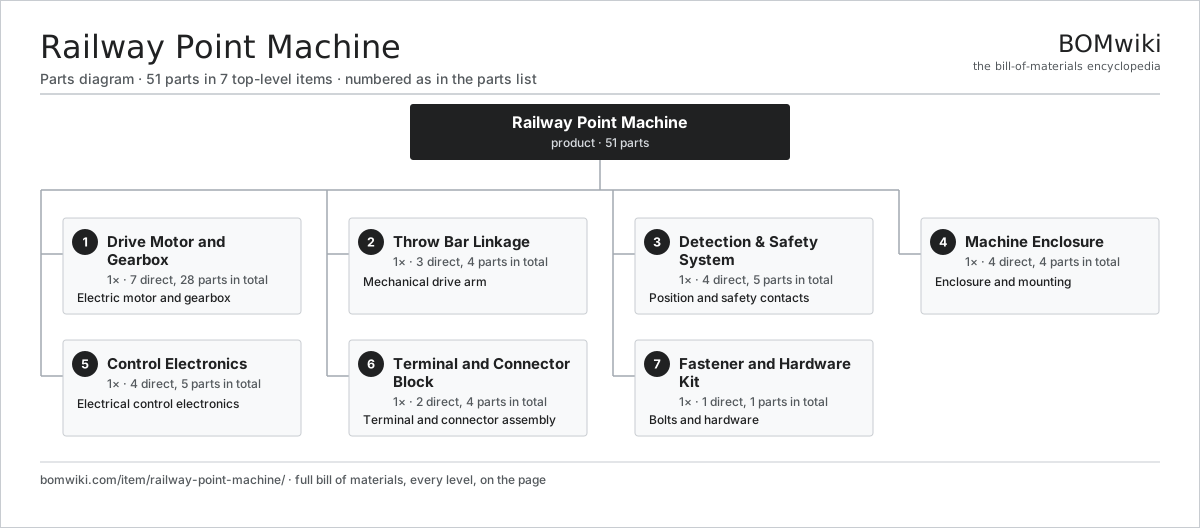
When the signalling system sends an "advance" command, the Control Electronics energises the motor winding. The motor drives the Gearbox Housing reduction stage, stepping down motor speed to turn the Ball Screw slowly. The Clevis Drive Rod translates that rotation into a fixed travel distance, pulling or pushing the Throw Bar Linkage linkage through its full stroke.

As the Drive Motor and Gearbox rotates, a cam works the dual Detection Cam. When the point reaches full travel, the cam breaks one safety relay circuit and makes another, ensuring both signals are mutually exclusive. The Machine Enclosure provides IP54 ingress protection.', },

'railway-turntable': { specs: [ ['Platform diameter', '9–22 m typical for mainline stock'], ['Load capacity', '100–250 tonnes (loco + tender or coach)'], ['Pit depth', '3–4 m'], ['Rotation speed', '3–10 rpm normal operation'], ['Drive motors', 'Twin 2–5 kW motors, independent clutch and brake'], ['Drive wheels', 'Rubber-tyred friction wheels on circular rail'], ['Locking mechanism', 'Vertical drop-lock or horizontal pin-lock'], ['Rotation tolerance', '±10 mm radial run-out at the deck edges'], ['Cycle time', 'Full 360° rotation 2–4 minutes'], ['Emergency manual release', 'Manual handwheel unlocking the lock for staff evacuation'], ['Standards', 'EN 13879 (railway turntables), UIC standards'], ], body: '## Overview

A railway turntable is a rotating bridge carrying a complete locomotive or coach on a circular rail track. The bridge rotates around a massive center pivot bearing, allowing the vehicle to point in a new direction without moving under its own power. Modern turntables are electrically driven with dual motors powering friction wheels that grip the circular rail.

How it works

When the depot operator signals the turntable control, the Mechanical Lock disengages. The two Drive Units simultaneously energise their motors, driving [[railway-turntable-drive-wheel|drive wheels]] against the Circular Rail Track. The wheels roll the Rotating Bridge Deck around the Center Pivot Bearing.

The Guide Wheel System constrain the deck laterally as it spins. An Encoder on the motor feeds back rotation angle to the control system. Once the Control Panel confirms the desired orientation, the motor drive disengages and the Mechanical Lock re-engages mechanically, dropping or sliding a [[railway-turntable-lock-hook|lock pin]] into a pit-mounted catch.', },

'flash-butt-rail-welder': { specs: [ ['Weld type', 'Flash-butt (resistance heating + upset)'], ['Rail types', 'All gauges: 54, 60, 65, 75 kg/m rail'], ['Transformer power', '800–1500 kVA three-phase'], ['Secondary voltage', '3–6 V secondary (very high current)'], ['Clamp force', '500–1500 kN depending on rail mass'], ['Upset force', '20–40% of clamp force'], ['Electrode current', '10,000–50,000 A flash current'], ['Flash duration', '1–3 seconds'], ['Gap tolerance', '±0.5 mm for consistent flash'], ['Weld strength', '>95% parent rail strength (defect-free)'], ['Shear head milling', 'Removes flash bead to smooth rail profile'], ['Installed power', '200–300 kW supply required'], ], body: '## Overview

A flash-butt rail welder joins two abutting rail ends by electrical resistance heating and mechanical squeezing. Two rails are clamped vertically end-to-end with a small gap. The transformer secondary (extremely high current, very low voltage) is connected to the clamps, and electrical resistance generates intense localised heating. The rail ends reach plastic deformation temperature, at which point the Upset Pressure System applies massive axial force, squeezing the molten zone and fusing the rails.

How it works

The two rails are positioned vertically and clamped in the Fixed Clamp Block and Moving Clamp Carriage. Misalignment is corrected by the Rail Alignment System system using fine hydraulic cylinders. A capacitive Gap Sensor monitors the gap between the rail ends.

When the welder initiates a cycle, the Moving Clamp Carriage moves forward, closing the gap to 2–3 mm. An SCR thyristor controller ramps up secondary current, and the air gap arcs at the rail contact surfaces. Timing is critical: when the ends reach the right temperature, the Upset Pressure System applies a high-pressure pulse, squeezing the molten zone and bonding the rails. The Milling and Shear Head then cuts away the flash bead.', },

'track-geometry-car': { specs: [ ['Vehicle type', 'Self-powered measurement coach'], ['Measurement frequency', '25–100 kHz laser sampling rate'], ['Data points per km', '100,000–500,000 depending on speed'], ['Laser wavelength', 'Typically 650–850 nm (visible/IR)'], ['Lateral accuracy', '±1–2 mm at gauge and alignment'], ['Vertical accuracy', '±2–3 mm for profile and twist'], ['Operating speed', '5–40 km/h measurement speed'], ['Imaging resolution', 'Line-scan 2048–4096 pixels'], ['Data storage', '1–2 TB SSD per 1000 km recording'], ['Power supply', 'Pantograph 750 V DC or onboard 24 V battery'], ['Wheelset load', '10–15 tonnes total coach mass'], ['Standards', 'EN 13848 (track geometry), various national railway RFCs'], ], body: '## Overview

A track geometry measurement car is a specialised railway vehicle carrying laser, optical and acceleration sensors to measure the precise shape and alignment of the track bed. Every railway must monitor its track geometry periodically—the rail alignment, gauge, profile, cant, twist, and ride quality. Worn or misaligned track causes accelerated damage and increases energy consumption.

How it works

The Coach Body houses the sensor stack and data processing electronics. The two [[track-geometry-car-bogie|measurement bogies]] carry wheels at precisely measured axle spacing with stiff springs and dampers.

The Laser Measurement Head is a non-contact laser head mounted below the car. It emits a laser beam at the rail top, and a photodiode receiver detects the reflection. The system builds a point cloud of the rail profile at speeds of 10–20 km/h.

The Imaging & Lighting System captures high-resolution line-scan images with [[track-geometry-car-led-light-array|high-brightness LED lighting]]. The Data Acquisition System system samples laser signals and acceleration data synchronously.', },

'axle-counter-system': { specs: [ ['Detection principle', 'Electromagnetic (inductive coil) wheel sensors'], ['Sensor frequency response', '0–10 kHz (wheel passage fundamental)'], ['Axle detection distance', 'Coil positioned 40–80 mm below rail foot'], ['Evaluation delay', '<500 ms from wheel passage to relay output'], ['Train in section time', '0.5–2 seconds per section typically 200–400 m'], ['Safety integrity level (SIL)', 'SIL 2 or SIL 3 depending on configuration'], ['Supply voltage', '24 V DC typical'], ['Power consumption', '2–5 W per sensor + 5–10 W processor'], ['Ambient temperature', '−30 to +60°C'], ['Section length', '100–1500 m typical block length'], ['Standards', 'EN 60679 (axle counters), IEC 61375 (railway comms)'], ], body: '## Overview

An axle counter system detects the presence of a train within a track section by counting axle passages at the section entrance and exit. When entry and exit counts are unequal, the system asserts "train in section" to the signalling system, preventing other trains from entering the same track block.

How it works

Two [[axle-counter-wheel-sensor|sensors]] are installed below the rail foot at each block boundary, one per rail. Each sensor is an inductive pickup coil tuned to the frequency at which a passing wheel generates eddy currents in the rail. When a wheel passes, the magnetic field changes, inducing a pulse in the coil.

The Axle Counter Evaluation Unit is a dual-channel safety processor receiving pulse streams. It counts each pulse and maintains the running count for the section. When entry count > exit count, the [[axle-counter-relay-output|safety relay output]] energises, signalling the interlocking system.

Each Axle Detection Sensor is wired back to a [[axle-counter-junction-box|junction box]] at the lineside, which houses surge protection and signal terminals.', },

'platform-screen-doors': { specs: [ ['Door type', 'Automatic sliding glass passenger barriers'], ['Typical platform height', '1100–1200 mm above rail level'], ['Door panel height', '1500–2200 mm covering platform edge gap'], ['Overall frame width', 'Custom to fit platform length; segments 2–5 m'], ['Opening width', 'Typically 1200–1500 mm train door alignment'], ['Drive motor power', '1.5–3 kW'], ['Opening/closing time', '3–8 seconds per cycle'], ['Safety sensors', 'Dual infrared edges on each door, position limit switches'], ['Control protocol', 'Radio (2.4 GHz) or wired link to train door controller'], ['Synchronisation tolerance', '±200 ms between platform and train doors'], ['Glass specification', 'Laminated safety glass 6–8 mm thick, 100+ dB noise attenuation'], ['Standards', 'EN 50106 (platform screen doors for metros)'], ], body: '## Overview

Platform screen doors (PSDs) are automatic sliding barriers installed along the metro or rapid-transit platform edge. When the train arrives and stops, the PSDs open in synchronisation with the train doors. When the train is about to depart, the PSDs close, sealing the platform and ensuring no passengers can fall onto the tracks.

How it works

The Frame Assembly is welded to the platform edge. Two [[platform-screen-doors-door-panels|sliding glass doors]] run on overhead [[platform-screen-doors-overhead-rail|rails]], their motion driven by a Sliding Motor Drive. The motor turns a [[platform-screen-doors-timing-belt|timing belt]], linked to both door carriages via pulleys, ensuring both doors move in sync.

The Control & Synchronisation System is a safety-rated PLC that communicates with the train's door control system. When the train arrives, the platform control sends an "open" command. The PSD Controller Board energises the motor, and [[platform-screen-doors-door-roller|door rollers]] ride the rails smoothly.

[[platform-screen-doors-safety-sensors|Infrared obstruction sensors]] on each door edge are monitored continuously. If detected, the door immediately reverses and opens further, preventing entrapment.', },

'buffer-stop': { specs: [ ['Buffer type', 'Friction shoe with hydraulic damping'], ['Typical installation', 'End of siding, yard dead-end, test track terminus'], ['Design speed', '15–30 km/h impact design speed (varies by standard)'], ['Kinetic energy absorption', '50–500 kJ per impact (varies by vehicle mass)'], ['Friction shoe material', 'Composite, elastomer, or laminated steel/rubber'], ['Shoe travel distance', '150–600 mm typical design stroke'], ['Restitution coefficient', '<0.1 (highly damped, no bounce)'], ['Hydraulic damper flow', 'Metered orifice providing smooth load rise'], ['Maximum deceleration', '<0.5 g (passenger comfort consideration)'], ['Shoe replacement interval', 'Every 50–500 impacts depending on design'], ['Standards', 'EN 15081 (railway buffers and couplers), UIC 235'], ], body: '## Overview

A friction buffer stop is a track-end safety device designed to stop a runaway or over-speed train with minimal passenger discomfort. The friction buffer absorbs the train's kinetic energy by deforming resilient "shoes" sandwiched between the moving train and a fixed end plate. The shoes slide apart with very high friction, dissipating energy as heat, and hydraulic dampers meter the load rise.

How it works

The Base and Guide Frame is bolted to the track bed at the end of the siding or yard lead. The Sliding Rail Frame sits within the frame, with the [[buffer-stop-buffer-head|contact plate]] at the front and two [[buffer-stop-friction-shoes|friction shoes]] sandwiched on either side.

When a train strikes the [[buffer-stop-buffer-head|buffer head]], the train's momentum drives the Sliding Platform backward against the friction and the [[buffer-stop-shock-absorber|hydraulic dampers]]. The Friction Shoe Assembly are compressed between the moving platform and the fixed [[buffer-stop-side-guide-rail|guides]].

The friction material generates a large resistive force proportional to the normal pressure. The [[buffer-stop-shock-absorber|hydraulic dampers]] meter the speed of platform retraction.', },

'rail-lubricator': { specs: [ ['Lubricant type', 'Railway-grade grease (NLGI grade 2–3)'], ['Reservoir capacity', '20–100 kg depending on track tonnage'], ['Dispense trigger', 'Inductive or mechanical wheel sensor'], ['Grease output per trigger', '50–500 g per passing train'], ['Pump flow rate', '0.5–2 litres/min at operating pressure'], ['Motor power', '0.25–1 kW fractional HP'], ['Applicator nozzles', '2 (one per rail)'], ['Nozzle spray pattern', 'Direct line to rail head, width ~50–100 mm'], ['Grease replenishment', 'Monthly to quarterly refilling depending on tonnage'], ['Operating temperature', '−20 to +50°C'], ['Service life', '1–3 years between major overhauls'], ['Standards', 'Railway infrastructure management (RIM) guidelines'], ], body: '## Overview

A wayside rail lubricator is a trackside dispenser applying grease to the rail head as trains pass over. On heavily-trafficked routes with tight curves, rail wear accelerates due to friction. Applying a thin grease film reduces friction, heat generation, and noise—and extends rail life.

How it works

The Wheel Detection Sensor is installed at the trackside, positioned to detect approaching wheels. As the leading wheel passes, the Sensor Element (inductive proximity sensor or mechanical contact) sends a pulse signal to the [[rail-lubricator-control-electronics|control board]].

The Pump Drive Motor turns the Gear Pump, which draws grease from the [[rail-lubricator-reservoir-assembly|reservoir]] and pressurises it at 1–5 bar. The pressurised grease flows through [[rail-lubricator-nozzle-valve|control valves]] into the [[rail-lubricator-applicator-nozzle|nozzles]], which spray a fine stream onto the rail head.

The pump runs for a precise duration (typically 0.5–2 seconds), dispensing 100–500 g of grease per trigger event.', },

'ticket-gate': { specs: [ ['Gate type', 'Fare control automatic barrier'], ['Barrier mechanism', 'Rotating tripod arm or swinging flap'], ['Barrier cycle time', '2–4 seconds open-to-close or close-to-open'], ['Reader types', 'Magnetic stripe, RFID/NFC, QR camera (multi-modal)'], ['Processing time', '<200 ms transaction validation'], ['Throughput', '20–30 passengers/minute (single gate)'], ['Passage width', '600–800 mm typical'], ['Display', '7–10 inch LCD status panel'], ['Obstruction detection', 'IR edge sensors on barrier arms'], ['Power supply', '110/220 V AC (local) or 48 V DC backup'], ['Network connection', 'Ethernet (wired) or 3G/4G cellular (wireless)'], ['Standards', 'ISO 16022 (QR codes), EMVCo (card reading)'], ], body: '## Overview

A fare gate is an automated ticket-checking barrier at the entrance to a metro station or airport rail connection. Passengers tap their ticket or card on the reader, the gate validates the ticket against a central database, and if valid, a rotating arm or swinging flap rotates open to permit passage.

How it works

A passenger approaches the Ticket & Card Reader System and taps or swipes their ticket or card. The Magnetic Stripe Reader (if magnetic stripe), RFID/NFC Reader (if tap), or QR Camera Module (if phone display or printed QR) captures the ticket data and sends it to the Validator CPU Board.

The Validator CPU Board is a hardened, safety-rated PLC that looks up the ticket identifier in a local or remote database. It checks: is the ticket valid? Does the bearer have a valid fare entitlement? All this happens within 100–200 ms.

If the result is valid, the Gate Control Electronics energises the Barrier Motor. The motor drives the Gear Reducer, which rotates the Barrier Arm (Tripod or Flap) open by approximately 90 degrees. Once the passenger has cleared the gate, the Gate Control Electronics reverses the motor.', },

'derailer': { specs: [ ['Derailer type', 'Fixed or portable mechanical device'], ['Derailing block material', 'Hardened steel or tungsten carbide'], ['Blade height', '30–50 mm above the railhead'], ['Operating lever', 'Manual or electric motor drive'], ['Motor power (if motorized)', '0.5–2 kW'], ['Operating force (manual)', '100–300 N typical hand lever force'], ['Lock-hold device', 'Mechanical pin or latch'], ['Operating cycle time', '10–30 seconds manual; 5–10 seconds motorised'], ['Mounting', 'Bolted to rail foot or portable castors'], ['Target sign', 'High-visibility warning placard'], ['Service life', '10–20 years typical'], ['Standards', 'Railway Rule of Competent Authorities (varies by region)'], ], body: '## Overview

A railroad derailer is a mechanical safety device placed on track to forcibly derail any train that attempts to pass without authorization. A train rolling onto a derailer engages a hardened blade that strikes the wheel flange, lifting the wheel off the rail and bringing the train to a violent stop. Derailers are used to protect workers and prevent unauthorised movement of rolling stock.

How it works

A fixed derailer is bolted to the rail at the entrance to a siding or protected area. The Derailing Block and Blade sits between the two rails, with the [[derailer-blade-element|derailing blade]] angled upward into the wheel path. Normally, the Operating Lever is positioned in an "out" or "safe" state, with the [[derailer-block-body|block]] swung or withdrawn clear of the wheels.

When the derailer is to be activated, the operator pulls or motorises the Operating Lever, which rotates about a [[derailer-pivot-pin|pivot pin]]. The Linkage Rod Assembly couples the lever such that pulling drives the Derailing Block and Blade into the wheel path. A [[derailer-lock-latch|mechanical latch]] then engages, holding the block in place.

If a train attempts to enter at speed, the leading wheel contacts the [[derailer-blade-element|blade]]. The blade angle causes the wheel to climb as the train's momentum drives it forward. The wheel lifts clear of the rail and the wheel and axle drop between the rails—a derailment.

Build & assembly graph

expand / collapse · shared sub-assemblies converge · links to related products · est. labour
product / assembly shared across products atomic part related product

Tap an assembly to expand/collapse · tap a part to open it · use “Open page” for any node · drag to pan, scroll to zoom.

Bill of materials

7 top-level lines · 39 rows shown · 51 parts total · indented to 3 levels
# Item / sub-assembly Part no. Qty/assy Ext. qty Parts Type
1 Drive Motor and Gearbox 7 parts railway-point-machine-drive-unit 1 28 assembly
1.1 Stator Assembly 3 parts stator-assembly 1 3 assembly
1.1.1 Stator Core (laminations) stator-core 1 part
1.1.2 Copper Winding copper-winding 1 part
1.1.3 Slot Insulation stator-insulation 1 part
1.2 Rotor Assembly 4 parts rotor-assembly 1 19 assembly
1.2.1 Rotor Shaft rotor-shaft 1 part
1.2.2 Rotor Core rotor-core 1 part
1.2.3 Neodymium Magnet neodymium-magnet 16× 16 part
1.2.4 Ball Bearing ball-bearing 1 part
1.3 Ball Bearing ball-bearing 2 part
1.4 Gearbox Housing railway-point-machine-gearbox-housing 1 part
1.5 Helical Gear Pair gear-pair 1 part
1.6 Ball Screw ball-screw 1 part
1.7 Oil Seal oil-seal 1 part
2 Throw Bar Linkage 3 parts railway-point-machine-throw-bar 1 4 assembly
2.1 Clevis Drive Rod railway-point-machine-clevis-rod 1 part
2.2 Rod-End Bearing railway-point-machine-rod-end-bearing 2 part
2.3 Fastener Set fastener-set 1 part
3 Detection & Safety System 4 parts railway-point-machine-detection-assembly 1 5 assembly
3.1 Detection Cam railway-point-machine-detection-cam 1 part
3.2 Left Contact Block railway-point-machine-contact-block-left 1 part
3.3 Right Contact Block railway-point-machine-contact-block-right 1 part
3.4 Relay relay 2 part
4 Machine Enclosure 4 parts railway-point-machine-housing 1 4 assembly
4.1 Cast Housing Body railway-point-machine-cast-body 1 part
4.2 End Cover railway-point-machine-end-cover 1 part
4.3 Cable Entry Gland railway-point-machine-cable-entry 1 part
4.4 O-Ring Set oring-set 1 part
5 Control Electronics 4 parts railway-point-machine-control-board 1 5 assembly
5.1 Bare PCB pcb-bare 1 part
5.2 Microcontroller mcu 1 part
5.3 Relay relay 2 part
5.4 SMD Passive (R/C/L) smd-passives 1 part
6 Terminal and Connector Block 2 parts railway-point-machine-connector-block 1 4 assembly
6.1 Connector connector 3 part
6.2 Fastener Set fastener-set 1 part
7 Fastener and Hardware Kit 1 parts railway-point-machine-fastener-kit 1 1 assembly
7.1 Fastener Set fastener-set 1 part

Sourcing — likely vendors

Companies that make this · indicative price $500k–$60M · MOQ & lead are typical
VendorHQSpecialtyMOQLead time
🇨🇳CRRC
crrcgc.cc ↗
Beijing, CN Rolling stock & rail systems made to order 40–72 wks
🇫🇷Alstom
alstom.com ↗
Saint-Ouen, FR Rail rolling stock made to order 40–72 wks
mobility.siemens.com ↗ Munich, DE Rail systems made to order 40–72 wks
🇨🇭Stadler Rail
stadlerrail.com ↗
Bussnang, CH Rail rolling stock made to order 40–72 wks
🇺🇸Wabtec
wabteccorp.com ↗
Pittsburgh, US Rail equipment made to order 40–72 wks

2,963-word article