Railway Station Clock
ProductOverview
A railway station clock is not an independent timekeeper. It is a slave display on a wired time-distribution network: somewhere in the station or the operator's central facility a master clock keeps the time, and every platform clock merely steps when told to. This architecture, dating to the late 19th century, solved the problem that actually created standardized time zones, railways cannot run on clocks that disagree. Every clock on the network shows the identical minute because every one advances on the identical electrical impulse.
The visible product is the double-faced drum hanging over the platform: two large dials in the Dial Set reading in both directions, balanced hands, and the Drum Housing that seals everything against weather and washdown. The canonical visual design is Hans Hilfiker's 1944 clock for the Swiss Federal Railways, plain bar markers, no numerals, and a red Second Hand shaped like a guard's signalling paddle, now licensed on Mondaine watches.
The impulse system
The master clock closes a line circuit once per minute, placing roughly 24 V DC on a two-wire bus that loops through every clock in the station, with the polarity reversed on alternate impulses. Inside each clock the Master Clock Interface passes this pulse to the impulse coil (Copper Winding) of the Slave Movement. The Polarized Armature is polarized, it carries a permanent magnet, so a pulse of one polarity rocks it left and the next rocks it right, each rock driving the Ratchet Wheel forward exactly one of its sixty teeth. The minute arbor therefore turns once per hour, and a Helical Gear Pair reduction derives the hour hand. Polarity alternation is the system's error protection: a noise spike of the wrong polarity cannot advance the clock a second step, and a clock wired backwards simply steps on the opposite phase rather than running wrong.
Because the line may run hundreds of metres through cable trays shared with traction and signalling power, the interface board carries a Surge Suppressor, and modern units add a Supervision Circuit that flags a stalled movement or missing pulses to the station's monitoring system. Setting the network right after an outage is the master's job: it streams catch-up impulses at a few per second until every slave has stepped forward to the correct time.
The stopping second hand
The most famous behaviour of the Swiss design comes from giving the second hand its own small self-starting motor rather than deriving it from the minute train. The motor sweeps the hand around the dial in about 58 seconds, then a mechanical stop holds it at 12 until the next minute impulse arrives and releases it. The pause guarantees that the minute hand of every clock in the station jumps at the same instant the second hand leaves 12, and it absorbs the timing slack of the impulse line. Passengers read it as the clock taking a breath; engineers read it as a phase-locked loop implemented in 1940s hardware.
Dials, hands, and housing
Legibility at distance drives the graphic design. Each Dial Plate uses thick minute bars on white, proportioned so a 600 mm dial reads reliably at about 50 metres; the Retaining Ring clamps it flat and the Dial Spacer keeps the two faces parallel around the central movement. The Hour Hand and Minute Hand are counterweighted aluminium bars, balance matters because the stepping movement must move the same load whether the hand points up or down, and an unbalanced hand makes the step lag measurably around the dial. Hands key to concentric arbors through the Hub Bushes.
The Case Drum is a spun aluminium ring with a Bezel Ring and Glazing on each face, gasketed with an O-Ring Set to roughly IP54. Night legibility comes from the Illumination: an LED Ring behind an opal Diffuser Disc backlights each translucent dial on a few watts, replacing the fluorescent tubes of mid-century units. The clock hangs from a Suspension Tube bolted to the canopy, or cantilevers from a Wall Bracket, with the line entering through a sealed Cable Gland.
Modern practice
New installations increasingly replace the impulse line with NTP over Ethernet or a DCF77/GPS receiver in each clock, and manufacturers such as Mobatime and Bodet sell the same drum housings with either movement. But impulse networks are durable infrastructure, many stations still run buses installed in the 1960s, and a slave movement with one coil, one armature, and one ratchet has very little that can fail. The double-faced drum over the platform has outlived several generations of the electronics that drive it.
Railway Station Clock parts and their functions
7 top-level parts · 43 parts in total · full bill of materials below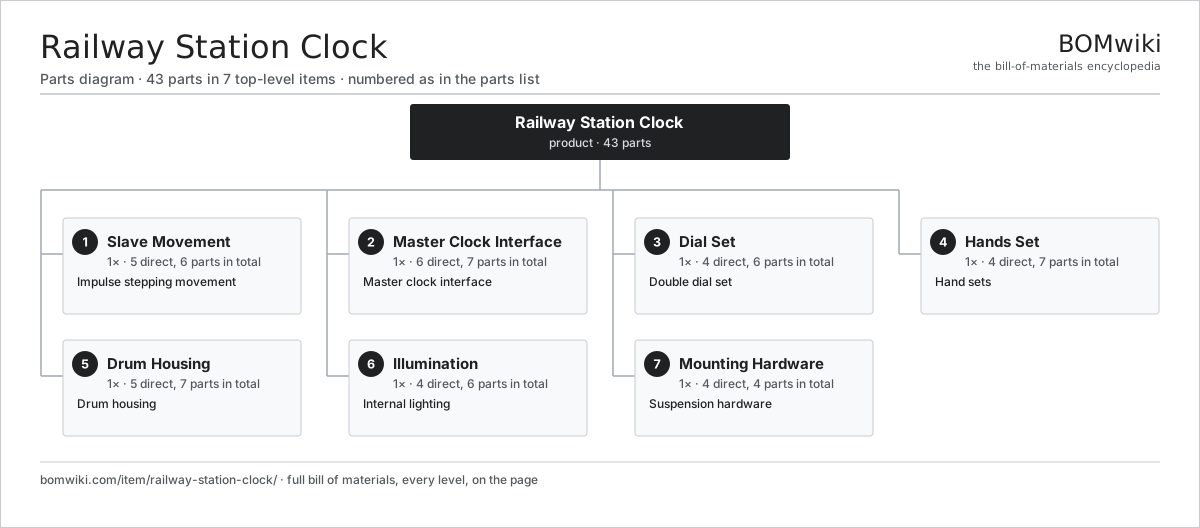
| # | Part | Qty | What it does |
|---|---|---|---|
| 1 | Slave Movement 5 parts | 1× | Impulse stepping movement |
| 2 | Master Clock Interface 6 parts | 1× | Master clock interface |
| 3 | Dial Set 4 parts | 1× | Double dial set |
| 4 | Hands Set 4 parts | 1× | Hand sets |
| 5 | Drum Housing 5 parts | 1× | Drum housing |
| 6 | Illumination 4 parts | 1× | Internal lighting |
| 7 | Mounting Hardware 4 parts | 1× | Suspension hardware |
3D model
No 3D model yet. Have a CAD file of this? Add a 3D model. STL renders right on this page; STEP, FreeCAD, and OpenSCAD sources are welcome too (openly licensed, like all 3D models on BOMwiki).
Build & assembly graph
expand / collapse · shared sub-assemblies converge · links to related products · est. labourTap an assembly to expand/collapse · tap a part to open it · use “Open page” for any node · drag to pan, scroll to zoom.
Bill of materials for Railway Station Clock
7 top-level lines · 39 rows shown · 43 parts total · indented to 3 levels| # | Item / sub-assembly | Part no. | Qty/assy | Ext. qty | Parts | Type |
|---|---|---|---|---|---|---|
| 1 | Slave Movement 5 parts | railway-station-clock-slave-movement | 1× | 1 | 6 | assembly |
| 1.1 | Polarized Armature | railway-station-clock-armature | 1× | 1 | · | part |
| 1.2 | Copper Winding | copper-winding | 1× | 1 | · | part |
| 1.3 | Ratchet Wheel | railway-station-clock-ratchet-wheel | 1× | 1 | · | part |
| 1.4 | Helical Gear Pair | gear-pair | 2× | 2 | · | part |
| 1.5 | Movement Frame | railway-station-clock-movement-frame | 1× | 1 | · | part |
| 2 | Master Clock Interface 6 parts | railway-station-clock-line-interface | 1× | 1 | 7 | assembly |
| 2.1 | Bare PCB | pcb-bare | 1× | 1 | · | part |
| 2.2 | Surge Suppressor | railway-station-clock-surge-suppressor | 1× | 1 | · | part |
| 2.3 | Supervision Circuit | railway-station-clock-supervision-circuit | 1× | 1 | · | part |
| 2.4 | Relay | relay | 1× | 1 | · | part |
| 2.5 | Connector | connector | 2× | 2 | · | part |
| 2.6 | SMD Passive (R/C/L) | smd-passives | 1× | 1 | · | part |
| 3 | Dial Set 4 parts | railway-station-clock-dial-set | 1× | 1 | 6 | assembly |
| 3.1 | Dial Plate | railway-station-clock-dial-plate | 2× | 2 | · | part |
| 3.2 | Retaining Ring | railway-station-clock-retaining-ring | 2× | 2 | · | part |
| 3.3 | Dial Spacer | railway-station-clock-dial-spacer | 1× | 1 | · | part |
| 3.4 | Fastener Set | fastener-set | 1× | 1 | · | part |
| 4 | Hands Set 4 parts | railway-station-clock-hands-set | 1× | 1 | 7 | assembly |
| 4.1 | Hour Hand | railway-station-clock-hour-hand | 2× | 2 | · | part |
| 4.2 | Minute Hand | railway-station-clock-minute-hand | 2× | 2 | · | part |
| 4.3 | Second Hand | railway-station-clock-second-hand | 2× | 2 | · | part |
| 4.4 | Hub Bushes | railway-station-clock-hub-bushes | 1× | 1 | · | part |
| 5 | Drum Housing 5 parts | railway-station-clock-housing | 1× | 1 | 7 | assembly |
| 5.1 | Case Drum | railway-station-clock-case-drum | 1× | 1 | · | part |
| 5.2 | Bezel Ring | railway-station-clock-bezel-ring | 2× | 2 | · | part |
| 5.3 | Glazing | railway-station-clock-glazing | 2× | 2 | · | part |
| 5.4 | O-Ring Set | oring-set | 1× | 1 | · | part |
| 5.5 | Fastener Set | fastener-set | 1× | 1 | · | part |
| 6 | Illumination 4 parts | railway-station-clock-illumination | 1× | 1 | 6 | assembly |
| 6.1 | LED Ring | railway-station-clock-led-ring | 2× | 2 | · | part |
| 6.2 | Diffuser Disc | railway-station-clock-diffuser | 2× | 2 | · | part |
| 6.3 | Power Supply | power-supply | 1× | 1 | · | part |
| 6.4 | Wire Bundle | wire-bundle | 1× | 1 | · | part |
| 7 | Mounting Hardware 4 parts | railway-station-clock-mounting | 1× | 1 | 4 | assembly |
| 7.1 | Suspension Tube | railway-station-clock-suspension-tube | 1× | 1 | · | part |
| 7.2 | Wall Bracket | railway-station-clock-wall-bracket | 1× | 1 | · | part |
| 7.3 | Cable Gland | railway-station-clock-cable-gland | 1× | 1 | · | part |
| 7.4 | Fastener Set | fastener-set | 1× | 1 | · | part |
Something wrong in this list? Report a problem with this BOM.
Related products
same domain, ranked by shared parts Watch Winder
39 parts · shares 6 with this page
Digital Desk Clock
33 parts · shares 5 with this page
GPS NTP Time Server
37 parts · shares 5 with this page
Watch Winder
39 parts · shares 6 with this page
Digital Desk Clock
33 parts · shares 5 with this page
GPS NTP Time Server
37 parts · shares 5 with this page
 Flip Clock
119 parts · shares 4 with this page
Flip Clock
119 parts · shares 4 with this page
 World Time Clock
30 parts · shares 4 with this page
World Time Clock
30 parts · shares 4 with this page
 Radio-Controlled Atomic Clock
130 parts · shares 5 with this page
Radio-Controlled Atomic Clock
130 parts · shares 5 with this page
Sourcing: possible vendors
Browse the supplier directory → Prices, MOQ, and lead times are algorithmic estimates, not quotes, and not claims about these companies. Company mappings are curated by keyword; est. price band $20–$50k. How estimates work| Vendor | HQ | Specialty | MOQ | Lead time |
|---|---|---|---|---|
|
🇯🇵Seiko
seikowatches.com ↗
|
Tokyo, JP | Watches | 500 units | 8–14 wks |
|
🇯🇵Citizen
citizenwatch-global.com ↗
|
Tokyo, JP | Watches | 500 units | 8–14 wks |
|
🇯🇵Casio
casio.com ↗
|
Tokyo, JP | Watches & electronics | 500 units | 8–14 wks |
| swatchgroup.com ↗ | Biel, CH | Watches (Omega, Tissot) | 500 units | 8–14 wks |
| titancompany.in ↗ | Bengaluru, IN | Watches & timepieces | 500 units | 8–14 wks |
838-word article