Rangefinder Binoculars
ProductOverview
Rangefinder binoculars merge optical magnification with laser distance measurement and ballistic computation, so a user can acquire a target, measure distance, and instantly know the aim-off needed to hit it. Hunters and long-range shooters use these to evaluate shots beyond 200–300 yards, where a miss is costly. The Optical System provide a clear magnified view. The Rangefinder Module fires a pulsed laser and times the return to compute distance. The Ballistics Processor solves for wind, gravity drop, elevation angle, and spin drift to compute the hold-over or turret-adjustment correction. The Reticle Display Module shows the calculated aiming point overlaid on the target.
The device is powered by Battery Compartment AA or Li-ion cells. The optical path uses roof or Porro prisms (Prism Assembly) to fold light and achieve a compact form. Everything is housed in a precision Mechanical Chassis.
How it works
The optical path is conventional binoculars: light from the target enters the Left Objective Lens and Right Objective Lens, travels through prisms to erect the image, and reaches the eyepieces. Magnification (say, 8×) makes distant targets appear 8 times closer. The exit pupil (the image of the objective, as seen from the eyepiece) is sized so it matches or exceeds the user's dilated pupil (typically 5–7 mm), ensuring all light reaching the eye is used.
When the user presses the range button, the Laser Transmitter emits a brief infrared laser pulse (1–100 microseconds duration, repetition rate 1–10 kHz). The laser light travels to the target, bounces off its surface, and returns. The Receiver Optics collects the faint reflected photons and focuses them onto a Photodiode Array. The ToF Signal Processor measures the time from emission to detection and divides by the speed of light, yielding distance.
Accuracy is typically ±1 yard at 100 yards (±1%), limited by the precision of timing electronics and the target's reflectivity. Highly reflective surfaces (white wall) extend range; absorptive surfaces (dark forest) reduce range.
Once distance is known, the Ballistics Processor solves a complex trajectory equation. For a rifle shooting a .308 Winchester bullet at a distant elk:
- Gravity drop: A 500-yard shot requires ~5 m of vertical hold-over compared to a 100-yard zero.
- Wind drift: A 10 mph crosswind might deflect the bullet 12 inches.
- Spin drift: Clockwise spin from a right-hand rifled bore causes a deflection (Coriolis and Magnus effect).
- Angle to target: An uphill or downhill shot changes the ballistic trajectory (the "ballistic range" is less than the true distance).
- Density altitude: Air density (function of altitude and temperature, measured by the Altitude Sensor barometer) affects drag.
The processor receives distance from the rangefinder, altitude from the barometer, and environmental inputs (gunpowder type, bullet weight) and stores them in a ballistic database. Using the target's horizontal and vertical angle (inclinometer), it computes the firing solution and outputs a correction: either as hold-over (aim a certain number of inches above the target) or as turret adjustment (e.g., "adjust elevation 3 clicks right, windage 1 click left").
The Reticle Display Module is an etched glass plate in the eyepiece focal plane, illuminated by a Reticle LED Illuminator LED. The reticle shows a primary aiming point and several subtension marks for common ranges (e.g., 200 m, 300 m, 400 m). After the ballistics processor computes the correction, it can control servo motors to mechanically tilt the reticle plate (rare, due to complexity) or simply display the correction as a colored dot or indicator for the shooter to apply manually.
The eyepieces have a Eyepiece Focus Wheel diopter ring to accommodate individual vision correction (typical range ±5 diopters). The Eyecup Assembly rubber eyecups block stray light and provide comfort.
Battery life is dominated by the rangefinder laser pulsing. A 20-hour battery run assumes light use; continuous rangefinding drains cells faster. Some models support Battery Compartment rechargeable Li-ion; others use user-replaceable AAs.
Thermal stability is important: optical path length and refractive index shift with temperature, causing rangefinder and ballistic errors. Quality units include optical alignment adjustments and temperature-compensated ballistic tables.
Rangefinder Binoculars parts and their functions
11 top-level parts · 257 parts in total · full bill of materials below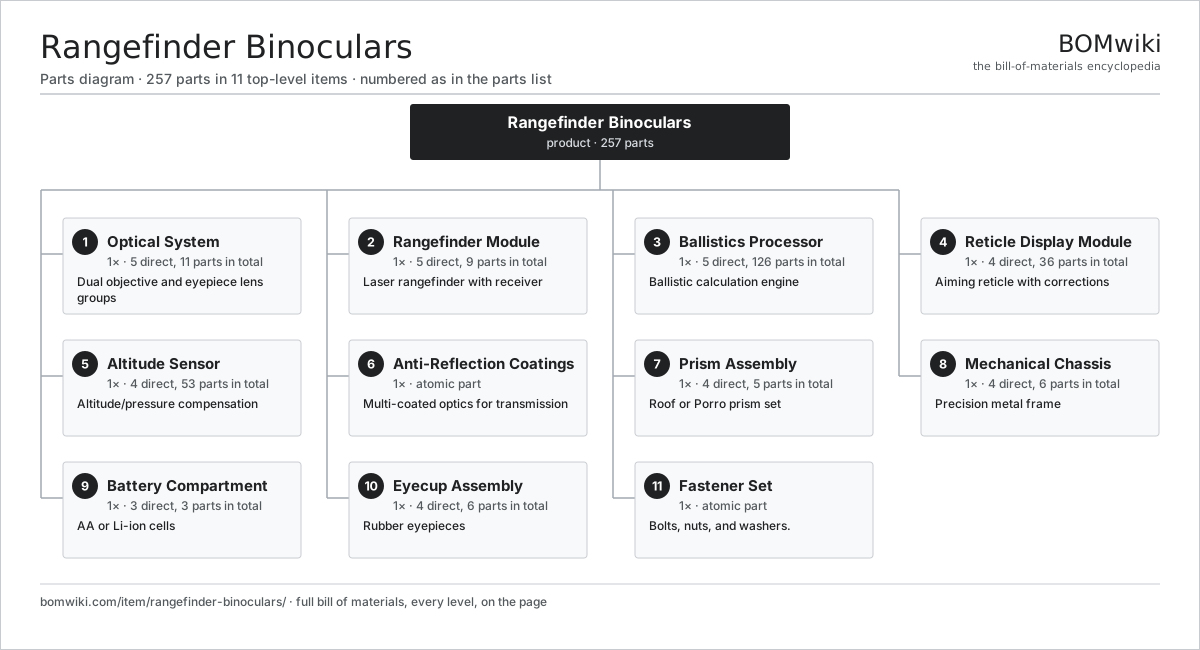
| # | Part | Qty | What it does |
|---|---|---|---|
| 1 | Optical System 5 parts | 1× | Dual objective and eyepiece lens groups |
| 2 | Rangefinder Module 5 parts | 1× | Laser rangefinder with receiver |
| 3 | Ballistics Processor 5 parts | 1× | Ballistic calculation engine |
| 4 | Reticle Display Module 4 parts | 1× | Aiming reticle with corrections |
| 5 | Altitude Sensor 4 parts | 1× | Altitude/pressure compensation |
| 6 | Anti-Reflection Coatings | 1× | Multi-coated optics for transmission |
| 7 | Prism Assembly 4 parts | 1× | Roof or Porro prism set |
| 8 | Mechanical Chassis 4 parts | 1× | Precision metal frame |
| 9 | Battery Compartment 3 parts | 1× | AA or Li-ion cells |
| 10 | Eyecup Assembly 4 parts | 1× | Rubber eyepieces |
| 11 | Fastener Set | 1× | Bolts, nuts, and washers. |
3D model
No 3D model yet. Have a CAD file of this? Add a 3D model. STL renders right on this page; STEP, FreeCAD, and OpenSCAD sources are welcome too (openly licensed, like all 3D models on BOMwiki).
Build & assembly graph
expand / collapse · shared sub-assemblies converge · links to related products · est. labourTap an assembly to expand/collapse · tap a part to open it · use “Open page” for any node · drag to pan, scroll to zoom.
Bill of materials for Rangefinder Binoculars
11 top-level lines · 66 rows shown · 257 parts total · indented to 3 levels| # | Item / sub-assembly | Part no. | Qty/assy | Ext. qty | Parts | Type |
|---|---|---|---|---|---|---|
| 1 | Optical System 5 parts | rf-bino-optics | 1× | 1 | 11 | assembly |
| 1.1 | Left Objective Lens | rf-objective-left | 1× | 1 | · | part |
| 1.2 | Right Objective Lens | rf-objective-right | 1× | 1 | · | part |
| 1.3 | Eyepiece Assembly 2 parts | rf-eyepiece-assembly | 1× | 1 | 3 | assembly |
| 1.3.1 | Lens Assembly | camera-lens | 2× | 2 | · | part |
| 1.3.2 | Fastener Set | fastener-set | 1× | 1 | · | part |
| 1.4 | Prism Assembly 4 parts | rf-prism-assembly | 1× | 1 | 5 | assembly |
| 1.4.1 | Roof Prism | rf-roof-prism | 2× | 2 | · | part |
| 1.4.2 | Prism Housing | rf-prism-housing | 1× | 1 | · | part |
| 1.4.3 | O-Ring Set | oring-set | 1× | 1 | · | part |
| 1.4.4 | Fastener Set | fastener-set | 1× | 1 | · | part |
| 1.5 | Anti-Reflection Coatings | rf-lens-coatings | 1× | 1 | · | part |
| 2 | Rangefinder Module 5 parts | rf-rangefinder-module | 1× | 1 | 9 | assembly |
| 2.1 | Laser Transmitter 3 parts | rf-laser-transmitter | 1× | 1 | 3 | assembly |
| 2.1.1 | Rangefinder Laser Diode | rf-rangefinder-laser | 1× | 1 | · | part |
| 2.1.2 | Lens Assembly | camera-lens | 1× | 1 | · | part |
| 2.1.3 | Fastener Set | fastener-set | 1× | 1 | · | part |
| 2.2 | Receiver Optics 3 parts | rf-receiver-optics | 1× | 1 | 3 | assembly |
| 2.2.1 | Lens Assembly | camera-lens | 1× | 1 | · | part |
| 2.2.2 | O-Ring Set | oring-set | 1× | 1 | · | part |
| 2.2.3 | Fastener Set | fastener-set | 1× | 1 | · | part |
| 2.3 | Range Detector | rf-range-detector | 1× | 1 | · | part |
| 2.4 | Range Processor | rf-range-processor | 1× | 1 | · | part |
| 2.5 | Bare PCB | pcb-bare | 1× | 1 | · | part |
| 3 | Ballistics Processor 5 parts | rf-ballistics-processor | 1× | 1 | 126 | assembly |
| 3.1 | Bare PCB | pcb-bare | 1× | 1 | · | part |
| 3.2 | Microcontroller | mcu | 1× | 1 | · | part |
| 3.3 | Compute SoC Module | soc-module | 1× | 1 | · | part |
| 3.4 | SMD Passive (R/C/L) | smd-passives | 120× | 120 | · | part |
| 3.5 | Connector | connector | 3× | 3 | · | part |
| 4 | Reticle Display Module 4 parts | rf-reticle-display | 1× | 1 | 36 | assembly |
| 4.1 | Reticle Plate | rf-reticle-plate | 1× | 1 | · | part |
| 4.2 | Reticle LED Illuminator 3 parts | rf-reticle-illuminator | 1× | 1 | 32 | assembly |
| 4.2.1 | Bare PCB | pcb-bare | 1× | 1 | · | part |
| 4.2.2 | Power MOSFET | mosfet | 1× | 1 | · | part |
| 4.2.3 | SMD Passive (R/C/L) | smd-passives | 30× | 30 | · | part |
| 4.3 | Eyepiece Focus Wheel 2 parts | rf-focus-mechanism | 1× | 1 | 2 | assembly |
| 4.3.1 | Ball Bearing | ball-bearing | 1× | 1 | · | part |
| 4.3.2 | Fastener Set | fastener-set | 1× | 1 | · | part |
| 4.4 | Connector | connector | 1× | 1 | · | part |
| 5 | Altitude Sensor 4 parts | rf-distance-sensor | 1× | 1 | 53 | assembly |
| 5.1 | Bare PCB | pcb-bare | 1× | 1 | · | part |
| 5.2 | Pressure Sensor | pressure-sensor | 1× | 1 | · | part |
| 5.3 | Microcontroller | mcu | 1× | 1 | · | part |
| 5.4 | SMD Passive (R/C/L) | smd-passives | 50× | 50 | · | part |
| 6 | Anti-Reflection Coatings | rf-lens-coatings | 1× | 1 | · | part |
| 7 | Prism Assembly 4 parts | rf-prism-assembly | 1× | 1 | 5 | assembly |
| 7.1 | Roof Prism | rf-roof-prism | 2× | 2 | · | part |
| 7.2 | Prism Housing | rf-prism-housing | 1× | 1 | · | part |
| 7.3 | O-Ring Set | oring-set | 1× | 1 | · | part |
| 7.4 | Fastener Set | fastener-set | 1× | 1 | · | part |
| 8 | Mechanical Chassis 4 parts | rf-mechanical-chassis | 1× | 1 | 6 | assembly |
| 8.1 | Main Barrel | rf-main-body | 1× | 1 | · | part |
| 8.2 | Bridge Assembly | rf-bridge-piece | 1× | 1 | · | part |
| 8.3 | Ball Bearing | ball-bearing | 2× | 2 | · | part |
| 8.4 | Fastener Set | fastener-set | 2× | 2 | · | part |
| 9 | Battery Compartment 3 parts | rf-battery-pack | 1× | 1 | 3 | assembly |
| 9.1 | Li-ion Cell, 18650 | li-cell-18650 | 1× | 1 | · | part |
| 9.2 | Bare PCB | pcb-bare | 1× | 1 | · | part |
| 9.3 | Connector | connector | 1× | 1 | · | part |
| 10 | Eyecup Assembly 4 parts | rf-eyecup-assembly | 1× | 1 | 6 | assembly |
| 10.1 | Rubber Eyecup | rf-eyecup-rubber | 2× | 2 | · | part |
| 10.2 | Diopter Adjustment Ring | rf-diopter-ring | 1× | 1 | · | part |
| 10.3 | Twist-Up Eyecup Cover | rf-twist-up-cup | 2× | 2 | · | part |
| 10.4 | Fastener Set | fastener-set | 1× | 1 | · | part |
| 11 | Fastener Set | fastener-set | 1× | 1 | · | part |
Something wrong in this list? Report a problem with this BOM.
Related products
same domain, ranked by shared parts Photo Minilab
454 parts · shares 8 with this page
Photo Minilab
454 parts · shares 8 with this page
 Cable Camera System
138 parts · shares 5 with this page
Cable Camera System
138 parts · shares 5 with this page
 Laser Rangefinder
220 parts · shares 7 with this page
Terrestrial Laser Scanner
570 parts · shares 7 with this page
Laser Rangefinder
220 parts · shares 7 with this page
Terrestrial Laser Scanner
570 parts · shares 7 with this page
 Structured-Light 3D Scanner
373 parts · shares 6 with this page
Structured-Light 3D Scanner
373 parts · shares 6 with this page
 Laser Tracker
142 parts · shares 5 with this page
Laser Tracker
142 parts · shares 5 with this page
Sourcing: possible vendors
Browse the supplier directory → Prices, MOQ, and lead times are algorithmic estimates, not quotes, and not claims about these companies. Company mappings are curated by keyword; est. price band $100–$8k. How estimates work| Vendor | HQ | Specialty | MOQ | Lead time |
|---|---|---|---|---|
|
🇯🇵Canon
canon.com ↗
|
Tokyo, JP | Imaging & optics | 500 units | 10–16 wks |
|
🇯🇵Nikon
nikon.com ↗
|
Tokyo, JP | Imaging & optics | 500 units | 10–16 wks |
|
🇩🇪ZEISS
zeiss.com ↗
|
Oberkochen, DE | Optics & optoelectronics | 500 units | 10–16 wks |
| leica-camera.com ↗ | Wetzlar, DE | Cameras & optics | 500 units | 10–16 wks |
| flir.com ↗ | Wilsonville, US | Thermal imaging | 500 units | 10–16 wks |
702-word article