Ratchet Tie-Down Strap
ProductOverview
A ratchet strap is a reusable cargo securing device used to lash down loads on trailers, flatbeds, or roof racks. It consists of a webbing loop with a Hook Assembly on each end and a Ratchet Mechanism Assembly in the middle that tightens the loop via a hand-operated lever. Each pull of the Release Lever Assembly advances the Webbing Assembly a fixed distance, typically 1–2 inches, creating a notch-by-notch ratcheting action that can tension the load to thousands of pounds of force.
The design is standard across the industry: the Ratchet Wheel is a plastic or aluminum drum with teeth; the Pawl Lever is a spring-loaded bar that engages those teeth and prevents backward slip. The Webbing Assembly threads through the Ratchet Mechanism Assembly, and as you pump the Release Lever Assembly, the drum rotates and winds the strap tighter.
Professional users (truckers, construction crews) use ratchet straps daily. Casual users (boaters, RVers) use them for seasonal equipment securing. They are far more reliable than rope or bungee cords, which can break or slip under vibration and temperature changes.
How it works
The Webbing Assembly enters the Ratchet Mechanism Assembly from one side. Inside the Ratchet Housing, the Webbing Assembly wraps halfway around the Ratchet Wheel, a plastic or aluminum drum about 2–3 inches in diameter. The drum is mounted on a Drum Axle that allows it to rotate freely in one direction only.
The Pawl Lever is a hinged metal or plastic bar anchored above the drum. When you pull the Release Lever Assembly, a Lever Linkage pushes or rotates the pawl, and the pawl moves down to engage the teeth on the drum. As the pawl descends, it catches a tooth and forces the drum to rotate, pulling more Webbing Assembly through the mechanism. Each notch on the drum corresponds to a fixed increment of webbing, typically 1.5–2 inches of tightening per stroke.
When you release the lever, the Pawl Spring pushes the Pawl Lever upward, disengaging from the current tooth. The Lever Spring returns the Release Lever Assembly to its rest position. The drum cannot rotate backward because the pawl has already moved out of engagement.
The Webbing Assembly then exits the mechanism and runs to the Hook Assembly at the other end, which hooks onto a cargo anchor point (trailer eye, D-ring, or tie-down rail).
Releasing the strap requires pushing the Release Lever Assembly in the opposite direction (or pulling it a different way, depending on the design). This disengages the Pawl Lever fully and allows the drum to reverse, feeding the Webbing Assembly back out.
Webbing strength and load capacity
The Webbing Material is the critical component. Nylon webbing is more durable and flexible; polypropylene is cheaper but stiffer and weaker. A 1.5-inch-wide nylon webbing rated for 1,500 lbs Safe Working Load (SWL) can handle standard pickup truck loads. A 2-inch-wide nylon webbing rated for 5,000 lbs is used on commercial flatbed trailers.
The Webbing Stitching at the attachment points must be extremely robust. A single thread seam will fail under load; professional straps use double or triple stitching, often in a X or ⊞ pattern, to distribute stress.
The Edge Binding prevents fraying and increases durability. Heat-sealed edges last longer than stitched binding, as stitches can be snagged and pulled.
Hook design
The Hook Eye must be sized for the anchor points on your cargo. A standard welded cargo hook has a 5/8 inch or 3/4 inch opening; a D-ring has a 3/8 inch or 1/2 inch opening. The wrong hook size will slip off under load or be impossible to attach.
The Hook Keeper is the webbing segment that attaches the hook to the main strap. It must be stitched or bonded strongly; failure here causes the hook to detach under load, potentially allowing the cargo to shift or slide.
Some designs use J-hooks (open J-shape) instead of traditional hooks; J-hooks are slightly easier to attach to anchor points but can slip off if not seated properly.
Ratchet mechanism reliability
The Ratchet Wheel teeth can break if overloaded or struck. Plastic drums are lighter and cheaper but more prone to tooth fracture; aluminum drums are tougher. Once teeth break, the ratchet loses the ability to hold that region of the drum, and tightening becomes spotty.
The Pawl Spring can lose tension over 10+ years or break from fatigue if the strap is used intensively. A weak spring causes the pawl to disengage prematurely, and the strap will slip under load.
The Drum Axle must be precisely aligned. If bent or misaligned, it causes the drum to rub against the Ratchet Housing, creating friction that makes tightening difficult.
Field use and safety
Professional truckers use a specific technique: route the Webbing Assembly across the load diagonally, attach it to opposite anchor points, and ratchet until the load doesn't shift. Over-tightening can crush cardboard boxes or dent metal; under-tightening leaves the load free to shift, which is dangerous at highway speeds.
The Release Lever Assembly can pinch fingers if not operated carefully. Always pull the lever smoothly; a sudden jerk can cause the lever to bind and trap skin.
A ratchet strap can be reused indefinitely if the Webbing Assembly remains intact. If a strap breaks (the webbing tears), it is typically discarded rather than repaired, as a patched strap is weaker than the original.
Weather exposure degrades Webbing Assembly. UV light breaks down nylon over 2–3 years of outdoor storage; storing straps in a covered area extends their life. Salt air (near coasts) accelerates corrosion of the Hook Eye, so rinsing salt-exposed straps with fresh water extends longevity.
Ratchet Tie-Down Strap parts and their functions
4 top-level parts · 18 parts in total · full bill of materials below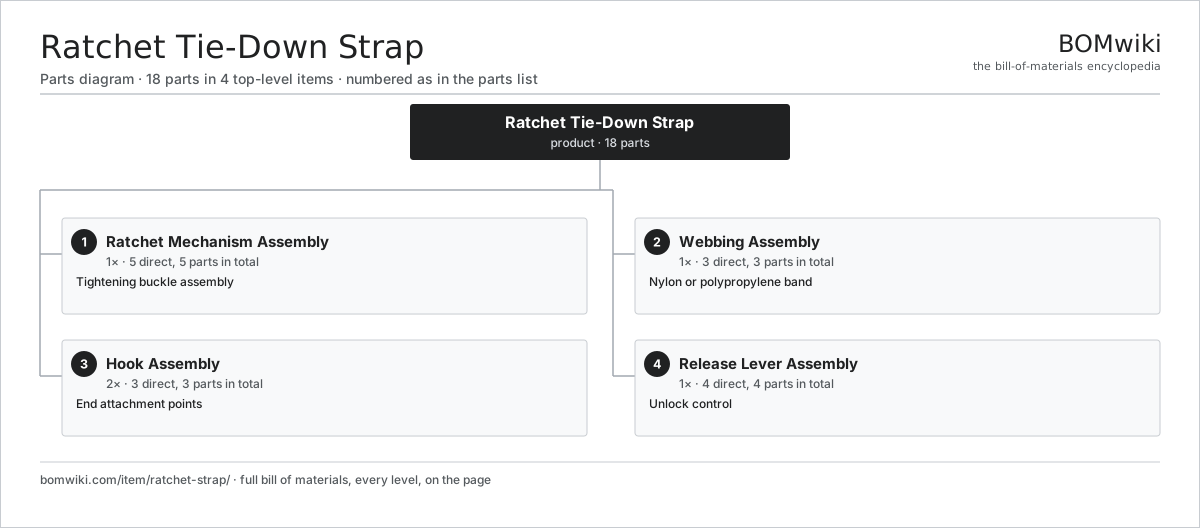
| # | Part | Qty | What it does |
|---|---|---|---|
| 1 | Ratchet Mechanism Assembly 5 parts | 1× | Tightening buckle assembly |
| 2 | Webbing Assembly 3 parts | 1× | Nylon or polypropylene band |
| 3 | Hook Assembly 3 parts | 2× | End attachment points |
| 4 | Release Lever Assembly 4 parts | 1× | Unlock control |
3D model
No 3D model yet. Have a CAD file of this? Add a 3D model. STL renders right on this page; STEP, FreeCAD, and OpenSCAD sources are welcome too (openly licensed, like all 3D models on BOMwiki).
Build & assembly graph
expand / collapse · shared sub-assemblies converge · links to related products · est. labourTap an assembly to expand/collapse · tap a part to open it · use “Open page” for any node · drag to pan, scroll to zoom.
Bill of materials for Ratchet Tie-Down Strap
4 top-level lines · 19 rows shown · 18 parts total · indented to 3 levels| # | Item / sub-assembly | Part no. | Qty/assy | Ext. qty | Parts | Type |
|---|---|---|---|---|---|---|
| 1 | Ratchet Mechanism Assembly 5 parts | ratchet-strap-ratchet-mechanism | 1× | 1 | 5 | assembly |
| 1.1 | Ratchet Wheel | ratchet-strap-ratchet-wheel | 1× | 1 | · | part |
| 1.2 | Pawl Lever | ratchet-strap-pawl | 1× | 1 | · | part |
| 1.3 | Pawl Spring | ratchet-strap-pawl-spring | 1× | 1 | · | part |
| 1.4 | Ratchet Housing | ratchet-strap-ratchet-housing | 1× | 1 | · | part |
| 1.5 | Drum Axle | ratchet-strap-drum-axle | 1× | 1 | · | part |
| 2 | Webbing Assembly 3 parts | ratchet-strap-webbing | 1× | 1 | 3 | assembly |
| 2.1 | Webbing Material | ratchet-strap-webbing-main | 1× | 1 | · | part |
| 2.2 | Webbing Stitching | ratchet-strap-webbing-stitching | 1× | 1 | · | part |
| 2.3 | Edge Binding | ratchet-strap-webbing-edge-binding | 1× | 1 | · | part |
| 3 | Hook Assembly 3 parts | ratchet-strap-hook-assembly | 2× | 2 | 3 | assembly |
| 3.1 | Hook Eye | ratchet-strap-hook-eye | 1× | 2 | · | part |
| 3.2 | Hook Keeper | ratchet-strap-hook-keeper | 1× | 2 | · | part |
| 3.3 | Hook Rivet | ratchet-strap-hook-rivet | 1× | 2 | · | part |
| 4 | Release Lever Assembly 4 parts | ratchet-strap-release-lever | 1× | 1 | 4 | assembly |
| 4.1 | Lever Handle | ratchet-strap-lever-handle | 1× | 1 | · | part |
| 4.2 | Lever Pivot | ratchet-strap-lever-pivot | 1× | 1 | · | part |
| 4.3 | Lever Linkage | ratchet-strap-lever-linkage | 1× | 1 | · | part |
| 4.4 | Lever Spring | ratchet-strap-lever-spring | 1× | 1 | · | part |
Something wrong in this list? Report a problem with this BOM.
Sourcing: possible vendors
Browse the supplier directory → Prices, MOQ, and lead times are algorithmic estimates, not quotes, and not claims about these companies. Company mappings are curated by keyword; est. price band $30–$800. How estimates work| Vendor | HQ | Specialty | MOQ | Lead time |
|---|---|---|---|---|
| stanleyblackanddecker.com ↗ | New Britain, US | Tools (DeWalt, Craftsman) | 500 units | 6–12 wks |
| bosch-professional.com ↗ | Leinfelden, DE | Power tools | 500 units | 6–12 wks |
| ttigroup.com ↗ | Hong Kong, CN | Tools (Milwaukee, Ryobi) | 500 units | 6–12 wks |
|
🇯🇵Makita
makita.com ↗
|
Anjo, JP | Power tools | 500 units | 6–12 wks |
|
🇨🇭Hilti
hilti.com ↗
|
Schaan, CH | Construction tools | 500 units | 6–12 wks |
1,027-word article