Reaction Wheel Assembly
ProductOverview
A reaction wheel is a momentum storage device used for spacecraft attitude control. The core principle is conservation of angular momentum: if the spacecraft spins a massive Flywheel Rotor disk faster, the spacecraft body must spin slower to conserve total angular momentum. By carefully accelerating and decelerating multiple reaction wheels (typically three or four per spacecraft, aligned with the X, Y, Z axes), the flight computer can control the spacecraft's pitch, roll, and yaw attitude without expelling any propellant.
This makes reaction wheels far more efficient than thrusters for precise attitude control. A spacecraft might use Reaction Wheel Assembly wheels for 99% of its attitude maneuvers, reserving chemical or ion thrusters only for large, slow maneuvers or for momentum desaturation (when the wheels have accumulated too much angular momentum and must be unspun).
Momentum and angular velocity
The angular momentum (or "momentum" stored in a wheel is the product of the moment of inertia and angular velocity:
L = I ω
For a solid cylindrical disk, the moment of inertia is I = (1/2) M R², where M is the disk mass and R is the disk radius. A 5 kg disk with 0.1 m radius has I ≈ 0.025 kg⋅m².
If this wheel spins at 8000 RPM (ω = 838 rad/s), the stored angular momentum is: L = 0.025 × 838 ≈ 21 N⋅m⋅s
If the spacecraft has a total inertia of 100 kg⋅m² (a typical small satellite), then the momentum stored in one wheel (21 N⋅m⋅s) induces a reaction angular velocity in the spacecraft of ω_sc = 21 / 100 ≈ 0.21 rad/s (about 2 degrees per second). By controlling the torque applied to the wheels, the flight computer can precisely control this reaction angular velocity and thereby control the spacecraft attitude.
Reaction wheel architecture
The Reaction Wheel Assembly comprises four main subsystems:
Flywheel rotor. The Flywheel Rotor is a solid or hollow disk mounted on a motor shaft. The rotor is made of steel (high density, high moment of inertia per unit volume) or aluminum (lower mass, lower inertia per unit volume, used when the overall wheel mass must be minimized). The Rotor Disk is precisely balanced during manufacturing; any slight asymmetry in mass distribution would cause the wheel to vibrate, transmitting vibration to the spacecraft.
The Rotor Hub is the central hub through which the rotor is mounted on the motor shaft. A Balance Ring is sometimes added, a ring of adjustable mass that can be rotated to correct residual dynamic imbalance.
Motor. The Brushless DC Motor is a brushless DC motor (or synchronous motor), selected for its low friction, long life, and precise speed control. The motor stator is the Motor Housing, containing a Copper Winding that generates an electromagnetic field. The rotor, mounted on the same shaft as the flywheel, carries Neodymium Magnet permanent magnets. As the stator field rotates, it pulls the permanent magnets, spinning the rotor and flywheel.
Electronic commutation is provided by Hall Sensor feedback, which detects the rotor position and signals the Motor Drive Electronics to switch the current direction in the stator windings at the appropriate time. This keeps the magnetic field in phase with the rotor magnets, producing continuous torque.
Bearings and damping. The rotor is supported on Ball Bearing angular contact ball bearings, which provide low-friction rotation. The Bearing Preload Spring applies a spring load to the bearings, reducing internal clearance and improving precision. Some wheels use hybrid ceramic bearings (ceramic rolling elements with steel races), which further reduce friction and heat generation.
The Vibration Damping System vibration isolation mounts decouple the spinning wheel from the spacecraft structure, reducing the transmission of micro-vibrations and imbalances to sensitive instruments. These are elastomeric isolators (rubber or viscoelastic polymers) or spring-mass dampers.
Control electronics. The Motor Drive Electronics include a H-Bridge Driver power converter (switching MOSFET or IGBT devices) that reverses the stator current to control motor speed and direction. A Controller PCB microcontroller executes the commutation algorithm and torque servo loop.
The Encoder provides feedback on rotor speed; the microcontroller compares the commanded speed (from the spacecraft's attitude control system) with the actual speed and adjusts the motor current to maintain the desired speed to within ±1 RPM.
Power and torque
When the spacecraft commands the reaction wheel to accelerate at a given torque (e.g., 0.1 N⋅m), the motor Motor Drive Electronics supply a corresponding current to the motor winding, creating a magnetic force on the rotor. The torque is:
τ = k_t I_motor
where k_t is the motor torque constant (typically 0.05–0.5 N⋅m/A) and I_motor is the stator current.
Accelerating a wheel with moment of inertia 0.025 kg⋅m² at a torque of 0.1 N⋅m produces an angular acceleration of:
α = τ / I = 0.1 / 0.025 = 4 rad/s²
This means the wheel speed increases by 4 rad/s every second, reaching 838 rad/s (8000 RPM) in about 210 seconds.
During this acceleration, the motor consumes electrical power:
P = τ ω = 0.1 N⋅m × 838 rad/s ≈ 84 W
Additionally, friction in the bearings and electrical losses in the motor produce waste heat, typically 10–20% of input power. This waste heat must be dissipated by the Thermal Radiator.
Attitude control with reaction wheels
A spacecraft attitude control system (ACS) uses reaction wheels in a feedback loop:
Measurement. The spacecraft's star trackers or sun sensors measure the actual attitude (pitch, roll, yaw angles).
Computation. The flight computer compares the actual attitude to the desired attitude, computing the three-axis attitude error.
Control law. The ACS applies a proportional-derivative (PD) or proportional-integral-derivative (PID) control law, computing the desired angular rates (ω_x, ω_y, ω_z) to bring the attitude error to zero.
Wheel commands. The flight computer commands the three reaction wheels (one per axis) to produce the desired torques. For example, to achieve a pitch rate of +0.1 rad/s, the pitch wheel is commanded to increase speed, while the roll and yaw wheels maintain nominal speed.
Feedback. The wheel encoders report actual wheel speeds back to the flight computer, closing the servo loop.
Modern ACS computers achieve attitude knowledge (how well they know the actual attitude) of ±0.1 degrees and attitude control (how tightly they maintain desired attitude) of ±0.05 degrees.
Momentum saturation and desaturation
Over time, as the spacecraft performs repeated attitude maneuvers, the reaction wheels accumulate angular momentum. If all maneuvers were perfectly symmetrical, momentum would cancel, but in practice, asymmetries in mission planning lead to a net accumulation, typically 10–50 N⋅m⋅s per week for a large Earth-observing satellite.
Once the wheels reach their maximum safe speed (typically 8000–10000 RPM), they cannot accelerate further, and the spacecraft's attitude control authority is lost. To prevent this, the ACS periodically executes "desaturation maneuvers" using the spacecraft's primary thrusters. The thrusters apply external torque to the spacecraft, spinning it in the opposite direction from the wheels. This "unloads" the wheels, bringing them back to nominal speed (e.g., 4000 RPM) and freeing up momentum capacity.
Desaturation typically occurs once per week to once per month, depending on mission dynamics. Each desaturation maneuver consumes a small amount of propellant, the cost of using reaction wheels instead of pure thrusters.
Reliability and redundancy
Most spacecraft carry three reaction wheels (one per axis) plus a fourth as a spare. The three primary wheels are aligned with the spacecraft X, Y, Z axes. If one wheel fails (motor stall, bearing seizure), the ACS can still control spacecraft attitude using the remaining two wheels, though with reduced control authority (losing control about one axis). The spare wheel is activated to restore full three-axis control.
Modern reaction wheels, using brushless motors and hybrid ceramic bearings, have demonstrated MTBF (mean time between failures) exceeding 50,000 hours on Earth-orbit spacecraft. Wheels typically last the full 10–15 year mission lifetime without failure.
Thermal management
The Thermal Radiator must dissipate the continuous waste heat from the motor. For a wheel continuously spinning at 50% power (25–50 W dissipation), a radiator area of 100–500 cm² is typical, depending on the operating temperature of the spacecraft and the radiator coating emissivity.
The MLI Blanket insulation prevents heat from being conducted to the spacecraft bus, allowing the radiator to reach equilibrium temperature via radiation to space.
Reaction Wheel Assembly parts and their functions
8 top-level parts · 39 parts in total · full bill of materials below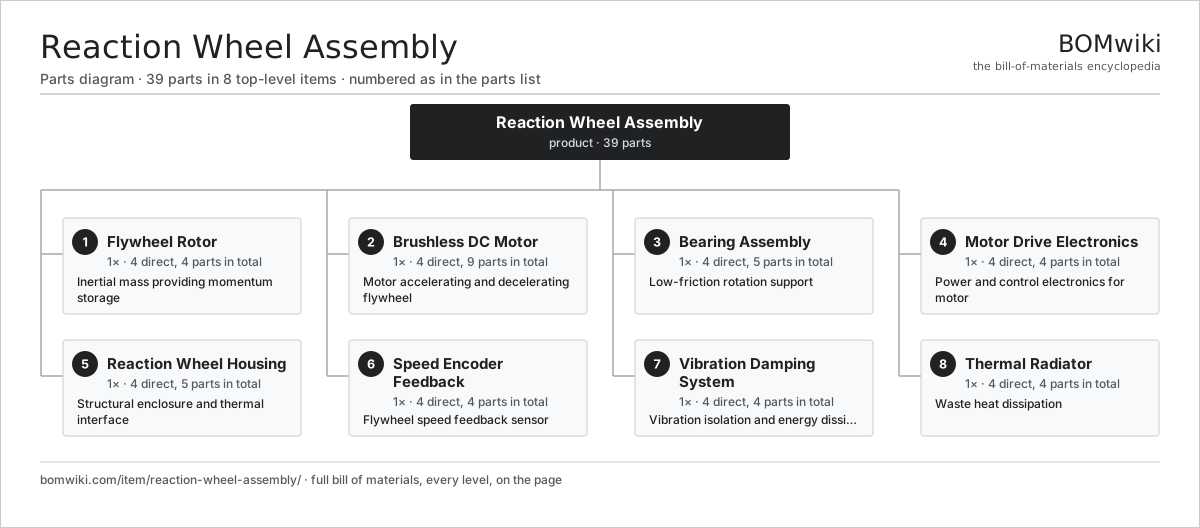
| # | Part | Qty | What it does |
|---|---|---|---|
| 1 | Flywheel Rotor 4 parts | 1× | Inertial mass providing momentum storage |
| 2 | Brushless DC Motor 4 parts | 1× | Motor accelerating and decelerating flywheel |
| 3 | Bearing Assembly 4 parts | 1× | Low-friction rotation support |
| 4 | Motor Drive Electronics 4 parts | 1× | Power and control electronics for motor |
| 5 | Reaction Wheel Housing 4 parts | 1× | Structural enclosure and thermal interface |
| 6 | Speed Encoder Feedback 4 parts | 1× | Flywheel speed feedback sensor |
| 7 | Vibration Damping System 4 parts | 1× | Vibration isolation and energy dissipation |
| 8 | Thermal Radiator 4 parts | 1× | Waste heat dissipation |
3D model
No 3D model yet. Have a CAD file of this? Add a 3D model. STL renders right on this page; STEP, FreeCAD, and OpenSCAD sources are welcome too (openly licensed, like all 3D models on BOMwiki).
Build & assembly graph
expand / collapse · shared sub-assemblies converge · links to related products · est. labourTap an assembly to expand/collapse · tap a part to open it · use “Open page” for any node · drag to pan, scroll to zoom.
Bill of materials for Reaction Wheel Assembly
8 top-level lines · 40 rows shown · 39 parts total · indented to 3 levels| # | Item / sub-assembly | Part no. | Qty/assy | Ext. qty | Parts | Type |
|---|---|---|---|---|---|---|
| 1 | Flywheel Rotor 4 parts | reaction-wheel-assembly-flywheel-rotor | 1× | 1 | 4 | assembly |
| 1.1 | Rotor Disk | reaction-wheel-assembly-rotor-disk | 1× | 1 | · | part |
| 1.2 | Rotor Hub | reaction-wheel-assembly-rotor-hub | 1× | 1 | · | part |
| 1.3 | Balance Ring | reaction-wheel-assembly-balance-ring | 1× | 1 | · | part |
| 1.4 | Fastener Set | fastener-set | 1× | 1 | · | part |
| 2 | Brushless DC Motor 4 parts | reaction-wheel-assembly-brushless-motor | 1× | 1 | 9 | assembly |
| 2.1 | Motor Housing | motor-housing | 1× | 1 | · | part |
| 2.2 | Neodymium Magnet | neodymium-magnet | 4× | 4 | · | part |
| 2.3 | Copper Winding | copper-winding | 1× | 1 | · | part |
| 2.4 | Hall Sensor | hall-sensor | 3× | 3 | · | part |
| 3 | Bearing Assembly 4 parts | reaction-wheel-assembly-bearings | 1× | 1 | 5 | assembly |
| 3.1 | Ball Bearing | ball-bearing | 2× | 2 | · | part |
| 3.2 | Bearing Preload Spring | reaction-wheel-assembly-bearing-preload | 1× | 1 | · | part |
| 3.3 | Bearing Shield | reaction-wheel-assembly-bearing-shield | 1× | 1 | · | part |
| 3.4 | Fastener Set | fastener-set | 1× | 1 | · | part |
| 4 | Motor Drive Electronics 4 parts | reaction-wheel-assembly-drive-electronics | 1× | 1 | 4 | assembly |
| 4.1 | H-Bridge Driver | reaction-wheel-assembly-h-bridge | 1× | 1 | · | part |
| 4.2 | Controller PCB | reaction-wheel-assembly-controller-pcb | 1× | 1 | · | part |
| 4.3 | SMD Passive (R/C/L) | smd-passives | 1× | 1 | · | part |
| 4.4 | Connector | connector | 1× | 1 | · | part |
| 5 | Reaction Wheel Housing 4 parts | reaction-wheel-assembly-housing | 1× | 1 | 5 | assembly |
| 5.1 | Housing Body | reaction-wheel-assembly-housing-body | 1× | 1 | · | part |
| 5.2 | End Plate | reaction-wheel-assembly-end-plate | 2× | 2 | · | part |
| 5.3 | Thermal Interface | reaction-wheel-assembly-thermal-path | 1× | 1 | · | part |
| 5.4 | Fastener Set | fastener-set | 1× | 1 | · | part |
| 6 | Speed Encoder Feedback 4 parts | reaction-wheel-assembly-encoder | 1× | 1 | 4 | assembly |
| 6.1 | Encoder | encoder | 1× | 1 | · | part |
| 6.2 | Bare PCB | pcb-bare | 1× | 1 | · | part |
| 6.3 | Connector | connector | 1× | 1 | · | part |
| 6.4 | Fastener Set | fastener-set | 1× | 1 | · | part |
| 7 | Vibration Damping System 4 parts | reaction-wheel-assembly-dampers | 1× | 1 | 4 | assembly |
| 7.1 | Isolator Mounts | reaction-wheel-assembly-isolator-mounts | 1× | 1 | · | part |
| 7.2 | Coil Spring | coil-spring | 1× | 1 | · | part |
| 7.3 | Fastener Set | fastener-set | 1× | 1 | · | part |
| 7.4 | Damping Fluid | reaction-wheel-assembly-damping-fluid | 1× | 1 | · | part |
| 8 | Thermal Radiator 4 parts | reaction-wheel-assembly-thermal-radiator | 1× | 1 | 4 | assembly |
| 8.1 | Radiator | radiator | 1× | 1 | · | part |
| 8.2 | MLI Blanket | reaction-wheel-assembly-mli-blanket | 1× | 1 | · | part |
| 8.3 | Fastener Set | fastener-set | 1× | 1 | · | part |
| 8.4 | Sheet Metal Panel | sheet-panel | 1× | 1 | · | part |
Something wrong in this list? Report a problem with this BOM.
Related products
same domain, ranked by shared parts Hall Effect Thruster
32 parts · shares 2 with this page
Hall Effect Thruster
32 parts · shares 2 with this page
 GPS Navigation Satellite
2,640 parts · shares 6 with this page
GPS Navigation Satellite
2,640 parts · shares 6 with this page
 Weather Satellite
1,765 parts · shares 6 with this page
Weather Satellite
1,765 parts · shares 6 with this page
 Lunar Lander
1,803 parts · shares 6 with this page
Lunar Lander
1,803 parts · shares 6 with this page
 Spacecraft Docking Adapter
41 parts · shares 4 with this page
Spacecraft Docking Adapter
41 parts · shares 4 with this page
 Deployable Solar Array Wing
37 parts · shares 4 with this page
Deployable Solar Array Wing
37 parts · shares 4 with this page
Sourcing: possible vendors
Browse the supplier directory → Prices, MOQ, and lead times are algorithmic estimates, not quotes, and not claims about these companies. Company mappings are curated by keyword; est. price band $50k–$500M. How estimates work| Vendor | HQ | Specialty | MOQ | Lead time |
|---|---|---|---|---|
|
🇺🇸SpaceX
spacex.com ↗
|
Hawthorne, US | Launch & spacecraft | made to order | 52–104 wks |
| northropgrumman.com ↗ | Falls Church, US | Space & defense | made to order | 52–104 wks |
|
🇫🇷Airbus
airbus.com ↗
|
Toulouse, FR | Aerospace OEM | made to order | 52–104 wks |
| rocketlabusa.com ↗ | Long Beach, US | Launch & spacecraft | made to order | 52–104 wks |
| thalesaleniaspace.com ↗ | Cannes, FR | Satellites | made to order | 52–104 wks |
1,444-word article