Automatic Circuit Recloser
ProductOverview
An automatic circuit recloser (ACR) is an intelligent distribution-voltage circuit breaker that detects faults, interrupts current, and automatically restores power after a brief delay if the fault has cleared. Mounted on distribution poles or in substations, reclosers reduce customer outage duration by distinguishing between permanent faults (downed trees, failed equipment) and transient faults (lightning flashover, wind-induced contact).
The recloser embodies a control algorithm: if a fault current is sensed, it trips open; after 5–30 seconds, solenoid-driven mechanism recloses the breaker; if fault current reappears, it trips again. After a preset number of operations (typically 2–4), the recloser locks in the open position, signaling a permanent fault that requires manual crew intervention. This coordination minimizes customer minutes-of-interruption while protecting feeder infrastructure from cascading damage.
How it Works
Mechanical System and Operating Mechanism
The main tank assembly is a welded steel pressure vessel filled with dielectric fluid (mineral oil or SF₆ gas) at low pressure. Inside, three vacuum or gas interrupter chambers mount vertically, one per phase.
Each interrupter chamber contains:
- A fixed copper contact attached to the incoming line conductor
- A moving copper contact linked to an operating mechanism
- A vacuum gap (at 0.001 mm Hg) or SF₆ atmosphere
The operating mechanism is the mechanical brain. A strong coil spring (the Closing Spring) is wound and stored with potential energy. When the recloser is closed, the spring is compressed by a latch mechanism (Main Trip Latch). During a fault, a solenoid coil is energized, releasing the latch and allowing the spring to push the moving contacts apart in all three phases simultaneously. The dielectric fluid quenches the arc as contacts separate.
Once open, the spring begins to rewind itself through a mechanical linkage (rods and cams). If no fault is detected during the reclosing delay (5–30 seconds), the solenoid is de-energized, the latch re-engages, and the spring force closes the contacts, restoring power. If fault current reappears when contacts touch, the current coil again senses overcurrent, the solenoid trips instantly, and the cycle repeats.
After 2–4 trip-and-reclose cycles, if a fault persists, the mechanism transitions to a mechanical lock-out state, preventing further reclose attempts. The recloser remains open until a utility crew manually or electrically resets it.
Fault Detection and Current Sensing
The current sensing system employs a toroidal current transformer (CT) wrapped around the main bus or tank. This CT steps down the line current (e.g., 560 A) to a manageable secondary range (typically 1–5 A).
The secondary current feeds into the protection relay inside the control cabinet. The relay compares secondary current to a pickup threshold (e.g., 150–600% of rated full load). When fault current exceeds pickup for a time period set by the time-characteristic dial, the relay energizes the trip solenoid.
Different time characteristics serve different purposes:
- Instantaneous: Current exceeds 10× pickup → trip in <50 ms. Protects against severe bolted faults.
- Very-Inverse: Trip time decreases as current increases (characteristic equation: t = K/I^1.35). Coordinates with fuses downstream, allowing fuses to clear low-current faults before the recloser reacts.
- Extremely-Inverse: t = K/I^2. Slower at lower currents, allowing higher-impedance faults to stabilize before reclosure attempts.
Reclosing Logic and Count-to-Lockout
The microprocessor controller implements the intelligence:
- First trip: Fault sensed → solenoid trips → records this as operation #1.
- Reclosing delay: For 5–30 seconds (depending on setting), the breaker stays open. The controller monitors if voltage returns to normal on the feeder. If transient event, voltage restores.
- Reclose attempt: After delay, solenoid is de-energized, spring reclosing mechanism engages. If no fault current appears during the reclose transient, the mechanism locks in closed position. Power is restored.
- Fault recurs: If fault current appears again immediately after reclose (or any subsequent closure), trip again. Increment operation counter.
- Lock-out: After the preset number (e.g., 3 operations), the mechanism enters lockout, preventing any further reclosures. An alarm lamp on the control cabinet glows, signaling a permanent fault.
This algorithm handles three common scenarios:
- Lightning transient: Lightning strikes insulator, causing a brief arc that clears in <1 second. First reclose attempt succeeds; power is restored. Customers experience a momentary flicker, not a multi-minute outage.
- Wind-blown tree limb: Limb touches line, is cleared by wind. Same as lightning, transient fault, successful reclose.
- Downed tree: Tree falls across line permanently. First trip, first reclose attempt fails immediately (fault reappears). Second trip, second reclose attempt fails. After 2–3 failures, recloser locks out, notifying the utility that a crew is needed. Without a recloser, the utility wouldn't detect the fault until a customer called to report an outage.
Control Signals and Safety
The control cabinet operates on low-voltage DC power (110 or 240 V DC), derived from either:
- An on-site battery (primary power in utility pole-top installations)
- An AC-to-DC converter powered by the feeder itself (substation installations)
This decoupling is critical: even if the feeder loses AC power due to a fault, the battery-backed DC system allows the control logic to operate the solenoid, ensuring the recloser can trip and reclose independently.
The output drivers amplify the microcontroller's logic signals to high current (typically 10–50 A at 110 V DC) needed to energize the solenoid coil. The dashpot (hydraulic damper) provides tuning to prevent solenoid chatter and ensures consistent trip timing.
Pole-Top vs. Substation Configurations
Pole-Top Three-Phase: The recloser is mounted directly on a utility distribution pole, controlling an entire three-phase feeder. The cross-arm bracket and porcelain insulators support it above the wooden cross-arm. Incoming and outgoing distribution cables crimp onto the cable lugs. This is the most common deployment in rural and suburban areas. The recloser is accessible by a bucket truck for testing and resetting.
Substation Dead-Tank: A larger recloser (often 1000+ A rating) is permanently installed in a substation, mounted on a concrete platform. It controls a major feeder or transformer secondary. Integration with SCADA systems allows remote monitoring of operation count and electrical parameters.
Coordination with Downstream Protection
A key design principle: the recloser coordinates with protective devices downstream (fuses and other reclosers) using time-current selectivity.
Example: A distribution line has a recloser at the substation and a fused lateral branch. If the lateral has a fault:
- Fault current surges through both the lateral fuse and the recloser.
- The recloser's time characteristic is set to be slower (higher inverse curve).
- The lateral fuse is sized to melt in <0.5 seconds under that fault current.
- The fuse melts first, isolating the lateral.
- Current to the recloser drops below pickup.
- The recloser never trips; the rest of the feeder remains powered.
If coordination is poor, if the recloser trips before the fuse melts, the entire feeder loses power even though only one branch has a permanent fault. Good recloser settings maximize customer service continuity.
Modern Recloser Features
Contemporary reclosers integrate digital communication:
- SCADA integration: Operation count, fault current magnitude, voltage profile, and trip times telemetered to a utility operations center in real-time.
- Capacitor switching: Electronic detection of switching transients; logic prevents false trips when utility capacitor banks are switched.
- Harmonic filtering: Immunity to high-frequency noise from power electronics on the feeder (solar inverters, EV chargers).
- Synchrophasor data: Phase angle measurements enabling grid stability analysis and optimal recloser positioning.
Service Life and Maintenance
The vacuum interrupter tubes are rated for 10,000–20,000 mechanical operations (trips and reclosures combined). A pole-top recloser in a rural area might see only a few faults per year, lasting 30–50 years. An urban feeder with frequent transients might reach end-of-life in 10–15 years.
Maintenance is minimal: annual inspection of the silica-gel breather (desiccant replacement if saturated with moisture), visual check of cable lug tightness (vibration can loosen connections), and periodic function tests under controlled conditions (manually tripping the recloser and confirming reclose operation).
Fluid analysis (oil dielectric strength, moisture content, acid number) every 5 years identifies incipient insulation degradation. If fluid degrades, it is reconditioned or replaced.
Standards and Application
Reclosers are standardized under:
- IEEE C37.60: Recloser definitions, ratings, and test procedures.
- IEEE C37.61: Coordination with fuses and other protective devices (selectivity tables).
- IEEE 1366: Reliability and outage metrics (SAIDI, SAIFI, etc.).
Utility engineers use recloser coordination studies to optimize settings, balancing protection speed, fault clearance, and customer impact. The goal is to eliminate as many transient faults as possible while protecting equipment from permanent faults with minimal collateral customer impact.
Automatic Circuit Recloser parts and their functions
7 top-level parts · 64 parts in total · full bill of materials below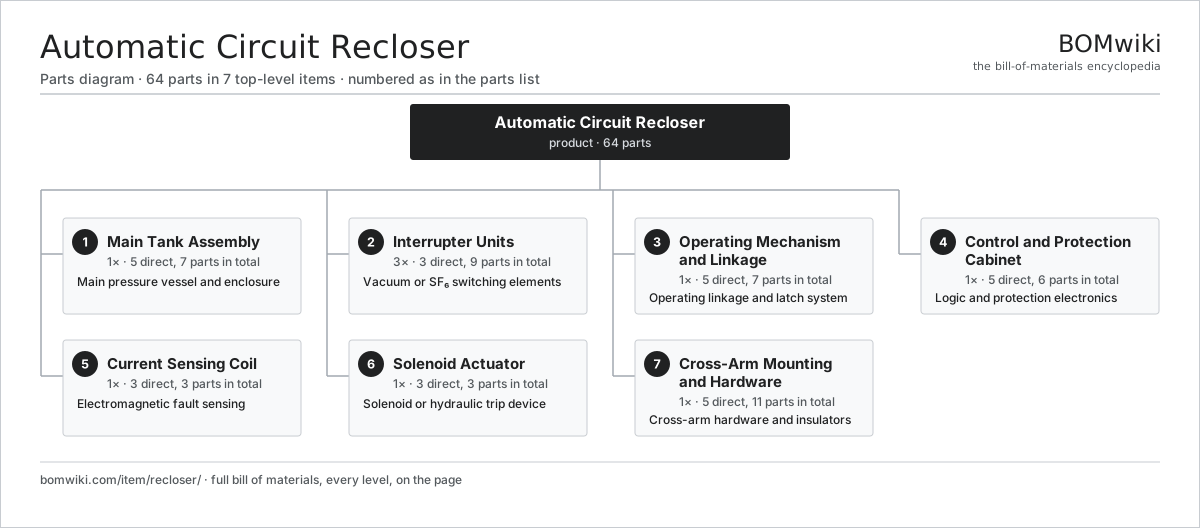
| # | Part | Qty | What it does |
|---|---|---|---|
| 1 | Main Tank Assembly 5 parts | 1× | Main pressure vessel and enclosure |
| 2 | Interrupter Units 3 parts | 3× | Vacuum or SF₆ switching elements |
| 3 | Operating Mechanism and Linkage 5 parts | 1× | Operating linkage and latch system |
| 4 | Control and Protection Cabinet 5 parts | 1× | Logic and protection electronics |
| 5 | Current Sensing Coil 3 parts | 1× | Electromagnetic fault sensing |
| 6 | Solenoid Actuator 3 parts | 1× | Solenoid or hydraulic trip device |
| 7 | Cross-Arm Mounting and Hardware 5 parts | 1× | Cross-arm hardware and insulators |
3D model
No 3D model yet. Have a CAD file of this? Add a 3D model. STL renders right on this page; STEP, FreeCAD, and OpenSCAD sources are welcome too (openly licensed, like all 3D models on BOMwiki).
Build & assembly graph
expand / collapse · shared sub-assemblies converge · links to related products · est. labourTap an assembly to expand/collapse · tap a part to open it · use “Open page” for any node · drag to pan, scroll to zoom.
Bill of materials for Automatic Circuit Recloser
7 top-level lines · 36 rows shown · 64 parts total · indented to 3 levels| # | Item / sub-assembly | Part no. | Qty/assy | Ext. qty | Parts | Type |
|---|---|---|---|---|---|---|
| 1 | Main Tank Assembly 5 parts | recloser-tank | 1× | 1 | 7 | assembly |
| 1.1 | Steel Tank Cylinder | recloser-tank-body | 1× | 1 | · | part |
| 1.2 | Tank Top Cover | recloser-tank-top | 1× | 1 | · | part |
| 1.3 | Bushing Assembly | recloser-tank-bushings | 3× | 3 | · | part |
| 1.4 | Silica-Gel Breather | recloser-tank-vent | 1× | 1 | · | part |
| 1.5 | Pressure Relief Valve | recloser-tank-relief | 1× | 1 | · | part |
| 2 | Interrupter Units 3 parts | recloser-interrupters | 3× | 3 | 9 | assembly |
| 2.1 | Vacuum Interrupter Tube | recloser-vacuum-chamber | 3× | 9 | · | part |
| 2.2 | Moving Contact Rod | recloser-contact-rod | 3× | 9 | · | part |
| 2.3 | Contact Spring Stack | recloser-spring-stack | 3× | 9 | · | part |
| 3 | Operating Mechanism and Linkage 5 parts | recloser-mechanism | 1× | 1 | 7 | assembly |
| 3.1 | Main Trip Latch | recloser-main-latch | 1× | 1 | · | part |
| 3.2 | Closing Spring | recloser-closing-spring | 1× | 1 | · | part |
| 3.3 | Trip Solenoid | recloser-trip-solenoid | 1× | 1 | · | part |
| 3.4 | Mechanical Linkage Rod | recloser-linkage-rod | 3× | 3 | · | part |
| 3.5 | Mechanical Timing Cam | recloser-cam-follower | 1× | 1 | · | part |
| 4 | Control and Protection Cabinet 5 parts | recloser-control-cabinet | 1× | 1 | 6 | assembly |
| 4.1 | Microprocessor Controller | recloser-controller | 1× | 1 | · | part |
| 4.2 | Protection Relay Board | recloser-relay-board | 1× | 1 | · | part |
| 4.3 | Timing Control Board | recloser-timer-board | 1× | 1 | · | part |
| 4.4 | Solenoid Driver Circuit | recloser-output-drivers | 2× | 2 | · | part |
| 4.5 | LCD Panel | lcd-panel | 1× | 1 | · | part |
| 5 | Current Sensing Coil 3 parts | recloser-current-coil | 1× | 1 | 3 | assembly |
| 5.1 | Current Transformer Toroid | recloser-ct-toroid | 1× | 1 | · | part |
| 5.2 | Pickup Potentiometer | recloser-pickup-adjustment | 1× | 1 | · | part |
| 5.3 | Time-Characteristic Dial | recloser-time-dial | 1× | 1 | · | part |
| 6 | Solenoid Actuator 3 parts | recloser-actuator | 1× | 1 | 3 | assembly |
| 6.1 | Solenoid Coil Winding | recloser-solenoid-coil | 1× | 1 | · | part |
| 6.2 | Solenoid Armature and Plunger | recloser-armature | 1× | 1 | · | part |
| 6.3 | Dashpot Damper | recloser-dashpot | 1× | 1 | · | part |
| 7 | Cross-Arm Mounting and Hardware 5 parts | recloser-mounting | 1× | 1 | 11 | assembly |
| 7.1 | Wooden Cross-Arm | recloser-cross-arm | 1× | 1 | · | part |
| 7.2 | Mounting Bracket | recloser-mounting-bracket | 1× | 1 | · | part |
| 7.3 | Porcelain Insulator Pin | recloser-porcelain-insulators | 2× | 2 | · | part |
| 7.4 | U-Bolt Fastener Set | recloser-u-bolts | 4× | 4 | · | part |
| 7.5 | Cable Lug Connector | recloser-cable-lugs | 3× | 3 | · | part |
Something wrong in this list? Report a problem with this BOM.
Related products
same domain, ranked by shared parts Air-Insulated Substation Bay
1,329 parts · shares 1 with this page
Automatic Transfer Switch
212 parts · shares 1 with this page
Air-Insulated Substation Bay
1,329 parts · shares 1 with this page
Automatic Transfer Switch
212 parts · shares 1 with this page
 Automatic Voltage Regulator
83 parts · shares 1 with this page
Biogas Generator (CHP)
338 parts · shares 1 with this page
Bottom Ash Handling System
1,782 parts · shares 1 with this page
Automatic Voltage Regulator
83 parts · shares 1 with this page
Biogas Generator (CHP)
338 parts · shares 1 with this page
Bottom Ash Handling System
1,782 parts · shares 1 with this page
Sourcing: possible vendors
Browse the supplier directory → Prices, MOQ, and lead times are algorithmic estimates, not quotes, and not claims about these companies. Company mappings are curated by keyword; est. price band $5k–$50M. How estimates work| Vendor | HQ | Specialty | MOQ | Lead time |
|---|---|---|---|---|
| gevernova.com ↗ | Cambridge, US | Power generation | made to order | 20–40 wks |
| siemens-energy.com ↗ | Munich, DE | Power & grid | made to order | 20–40 wks |
| hitachienergy.com ↗ | Zurich, CH | Grid & transformers | made to order | 20–40 wks |
|
🇨🇭ABB
abb.com ↗
|
Zurich, CH | Electrification & automation | made to order | 20–40 wks |
| se.com ↗ | Rueil-Malmaison, FR | Electrical & automation | made to order | 20–40 wks |
1,519-word article