SMT Reflow Oven
ProductOverview
The reflow oven is the most critical tool in surface-mount technology (SMT) assembly, melting solder paste that bonds components to printed circuit boards. As populated PCBs travel through the oven on a conveyor, they experience a precisely controlled thermal profile: slow preheat (raising temperature 1–3 °C/sec) to drive off volatile flux solvents without shocking components, a thermal soak zone (maintaining 180–200 °C) to allow solder paste to wet and spread, a peak reflow zone (reaching 240–260 °C) where solder actually melts and forms joints, and finally a cooling zone (rapid cool to <100 °C) to solidify the joints. This entire cycle takes 3–5 minutes.
Reflow quality directly impacts board reliability. Inadequate peak temperature leaves solder partially melted (cold joints with high resistance); excessive peak temperature or dwell damages components (ceramic capacitors crack, plastic packages warp). Temperature overshoot spikes can reach 300 °C momentarily, creating brittle intermetallic layers. The industry relies on detailed thermal profiling, measuring temperature at multiple points on the PCB during reflow, to validate that process parameters (oven setpoints, conveyor speed, zone power) are correct.
Thermal Profile and Solder Reflow
The reflow process follows industry standards (IPC-9201 for lead-free solder, IPC-9202 for lead-based). The standard SAC305 lead-free solder (Sn-Ag-Cu) has a solidus (melting start) temperature of 217 °C and liquidus (fully melted) of 220 °C. The process uses a steep temperature ramp to liquidus, holds at peak temperature (240–260 °C) for 10–30 seconds, then cools at a controlled rate (<6 °C/sec) to avoid thermal stress. Total time above 217 °C must be 30–60 seconds for adequate wetting; less time risks incomplete wetting and void formation.
The preheat zone is typically the largest, 60–120 seconds at 150–180 °C, allowing time for flux to activate and solvent vapors to evaporate. Flux is an acidic or no-clean organic material that removes oxide from solder paste and copper pads, enabling wetting. Too-fast preheat traps solvents, creating pressure that splatters molten solder; too-slow preheat wastes time and cools the board excessively.
The Heating Zones are individual chambers with heater elements and separate PID control loops. The Temperature Control system monitors each zone's thermocouple and adjusts heater power (0–100%) to maintain the target temperature. Zone controllers communicate with the main PLC, which computes setpoints based on the selected reflow profile.
Convection and Temperature Uniformity
Temperature uniformity across the PCB is critical. A 10 °C difference between cold and hot areas leads to different solder melt rates, non-uniform wetting, and solder balling (molten solder separating into spheres). The Air Circulation circulates hot air via centrifugal fans and ductwork, ensuring even heating. The fans are variable-speed, allowing profile tuning: slower air flow reduces convection and allows slower heating; faster flow achieves steeper ramps and higher peak temperatures.
Modern ovens achieve ±5 °C uniformity across a 600 mm × 300 mm PCB, sufficient for most applications. Some boards have dense component areas that act as heat sinks; profiling (actual temperature measurement with thermocouples or infrared) reveals these hot/cold spots, and zone setpoints are adjusted to compensate.
Cooling Strategy
Rapid cooling (after peak) reduces the time spent at high temperature, minimizing thermal stress on components. Many ovens use passive cooling (natural convection as the board moves from peak to cool zone), achieving cool rates of 3–5 °C/sec. High-performance cooling zones use forced air or water-based heat exchangers, achieving 6–10 °C/sec cool rates. The cooling zone Cooling System often includes a separate blower and heat exchanger; some premium ovens integrate water-cooled chilled-plate systems.
Over-aggressive cooling (>10 °C/sec) can create thermal stress cracks in components and solder, especially in large BGAs (ball-grid-array) packages. The solder balls cool unevenly, creating internal stress that propagates through the attach as microcracks. IPC standards limit cool rates to 6 °C/sec maximum to avoid this.
Conveyor and PCB Transport
The Conveyor System is a motorized mesh or modular belt driven at adjustable speed (0.5–2 m/min). PCB dwell time in each zone is determined by conveyor speed and zone length. Slower speed (e.g., 0.8 m/min) increases dwell, allowing more time for heating; faster speed (1.5 m/min) compresses dwell. For a 3-meter oven, slow speed yields 3–4 minutes total time, fast speed 2–2.5 minutes. The system must accommodate different PCB sizes without major rework; modular belt systems can be reconfigured for various widths.
The Oven Chamber floor is typically a stainless steel mesh allowing air circulation below the PCB. Condensation from cooling zones drains through the mesh via a drain system at the oven base. PCBs are placed on the conveyor manually or via automated placement arms; at the exit, they cool briefly on air-cooled racks before handling.
Control and Recipe Management
The Main Control Board is typically an embedded PC or PLC with a touchscreen interface. Reflow profiles are stored as recipes, specifying zone setpoints vs. time. A typical recipe has 20–40 setpoint steps covering the 3–5 minute cycle. The main controller loops at 100–1000 Hz, reading thermocouples, computing zone errors (target – actual), and commanding heater power via pulse-width modulation (PWM) or burst firing of SSRs.
Advanced ovens support multi-recipe operation and can switch recipes in seconds. Some systems include adaptive control, using early measurements to predict final board temperature and adjust heater power in real-time if the board is running cold or hot.
Data Logging and Profiling
The Data Logger records temperature from each zone (or selectable board thermocouple sites) every 1–2 seconds during the reflow cycle. Data is downloaded to a PC where profiling software (such as Profiling Software) compares the measured curve against process limits:
- Preheat rate: 2–3 °C/sec (reject if >4 °C/sec)
- Time-to-peak: typically 3.5–4.5 minutes
- Peak temperature: 245–260 °C (reject if <240 or >270)
- Time above 217 °C: 40–70 seconds (reject if <30 or >100)
- Cool rate: <6 °C/sec (reject if steeper)
- Overshoot: <10 °C above peak (reject if >15)
Each board run generates a profile curve. Operators print and file these curves for product traceability; if field failures occur, profiles can be reviewed to confirm the process was correct. Many companies require first-article profiling (FAP) for new products, running 5–10 samples per board design and validating profile compliance before production release.
Maintenance and Thermal Management
Heating elements degrade over time, losing efficiency and drifting setpoint. Annual maintenance includes element inspection, thermocouple calibration, and heater power supply checks. SSRs are checked for leakage (especially important in high-humidity environments); excessive leakage prevents full heater shutdown and raises baseline chamber temperature.
Ductwork accumulates solder vapors and dust from flux. Annual cleaning with appropriate solvents restores air flow and heat transfer efficiency. Insulation degrades from thermal cycling; it should be inspected annually and replaced every 5–10 years.
Temperature control boards (PLC, zone controllers) are typically sealed potted modules or board-level components protected from thermal and mechanical shock. Thermocouples are the most failure-prone item; they're replaced every 1–3 years as drift accumulates.
Solder Paste and Flux Considerations
Solder paste is a mixture of fine solder powder (20–50 μm size) suspended in a tacky flux vehicle. The paste is printed onto PCB pads via a stencil, then components are placed on top. During reflow, the solder powder melts and coalesces, bonding the component lead to the PCB pad. Flux residues remain on the board and are typically cleaned with water-based or solvent-based wash equipment post-reflow (for lead-free processes) or left as no-clean residues.
No-clean flux formulations don't require post-reflow cleaning, saving cost. However, residues can be conductive if humidity is high, potentially causing electrical leakage. Critical applications (aerospace, military, automotive) often use aggressive (acidic) flux and require complete cleaning, adding process steps but ensuring reliability.
Process Variations and Specialized Techniques
Selective reflow heats only specific areas (e.g., reflow one side of a PCB while protecting components on the other). This requires masks and focused heat sources, reducing production speed. Vapor-phase reflow uses saturated solvent vapor (e.g., inert perfluorocarbon) to heat the PCB uniformly, achieving excellent uniformity. However, vapor-phase ovens are expensive ($500k+) and are only used for high-reliability, high-complexity boards.
Some specialty processes use infrared (IR) reflow, with IR heater lamps focused on the board. IR provides good ramp rates but can overheat large copper planes or components with dark finishes. Modern IR ovens use multi-zone control and pyrometric feedback to compensate.
Throughput and Production Planning
Typical production throughput is 200–1000 boards per hour, depending on reflow cycle time and oven capacity. A single-lane 3-meter oven running 3-minute cycles processes ~20 boards/minute or 1200 boards/hour. High-volume fabs run multiple ovens in parallel and use automated part placement (pick-and-place) to feed boards continuously.
Oven availability is critical; downtime for maintenance directly impacts factory throughput. Many facilities run 24/7, with preventive maintenance on scheduled off-shifts. Real-time monitoring of zone temperatures and heater current flags anomalies early, enabling proactive maintenance before failures occur.
SMT Reflow Oven parts and their functions
8 top-level parts · 59 parts in total · full bill of materials below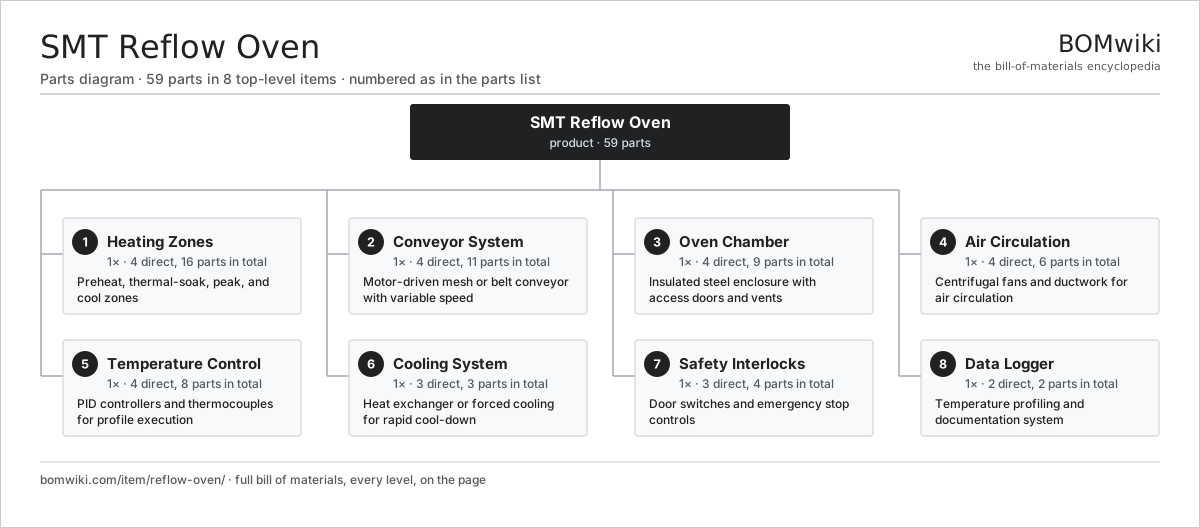
| # | Part | Qty | What it does |
|---|---|---|---|
| 1 | Heating Zones 4 parts | 1× | Preheat, thermal-soak, peak, and cool zones |
| 2 | Conveyor System 4 parts | 1× | Motor-driven mesh or belt conveyor with variable speed |
| 3 | Oven Chamber 4 parts | 1× | Insulated steel enclosure with access doors and vents |
| 4 | Air Circulation 4 parts | 1× | Centrifugal fans and ductwork for air circulation |
| 5 | Temperature Control 4 parts | 1× | PID controllers and thermocouples for profile execution |
| 6 | Cooling System 3 parts | 1× | Heat exchanger or forced cooling for rapid cool-down |
| 7 | Safety Interlocks 3 parts | 1× | Door switches and emergency stop controls |
| 8 | Data Logger 2 parts | 1× | Temperature profiling and documentation system |
3D model
No 3D model yet. Have a CAD file of this? Add a 3D model. STL renders right on this page; STEP, FreeCAD, and OpenSCAD sources are welcome too (openly licensed, like all 3D models on BOMwiki).
Build & assembly graph
expand / collapse · shared sub-assemblies converge · links to related products · est. labourTap an assembly to expand/collapse · tap a part to open it · use “Open page” for any node · drag to pan, scroll to zoom.
Bill of materials for SMT Reflow Oven
8 top-level lines · 36 rows shown · 59 parts total · indented to 3 levels| # | Item / sub-assembly | Part no. | Qty/assy | Ext. qty | Parts | Type |
|---|---|---|---|---|---|---|
| 1 | Heating Zones 4 parts | reflow-oven-heating-zones | 1× | 1 | 16 | assembly |
| 1.1 | Heating Element | heating-element | 4× | 4 | · | part |
| 1.2 | Zone Controller | reflow-oven-zone-controller | 4× | 4 | · | part |
| 1.3 | Thermocouple | reflow-oven-thermocouple | 4× | 4 | · | part |
| 1.4 | Relay | relay | 4× | 4 | · | part |
| 2 | Conveyor System 4 parts | reflow-oven-conveyor | 1× | 1 | 11 | assembly |
| 2.1 | Blower Motor | blower-motor | 1× | 1 | · | part |
| 2.2 | Drive Chain | reflow-oven-conveyor-chain | 1× | 1 | · | part |
| 2.3 | Conveyor Belt | reflow-oven-mesh-belt | 1× | 1 | · | part |
| 2.4 | Ball Bearing | ball-bearing | 8× | 8 | · | part |
| 3 | Oven Chamber 4 parts | reflow-oven-chamber | 1× | 1 | 9 | assembly |
| 3.1 | Sheet Metal Panel | sheet-panel | 6× | 6 | · | part |
| 3.2 | Chamber Door | reflow-oven-door | 1× | 1 | · | part |
| 3.3 | Chamber Floor | reflow-oven-bottom-plate | 1× | 1 | · | part |
| 3.4 | Sight Glass | reflow-oven-sight-glass | 1× | 1 | · | part |
| 4 | Air Circulation 4 parts | reflow-oven-blower-system | 1× | 1 | 6 | assembly |
| 4.1 | Blower Motor | blower-motor | 2× | 2 | · | part |
| 4.2 | Blower Wheel | reflow-oven-fan-blades | 2× | 2 | · | part |
| 4.3 | Air Ducts | reflow-oven-ductwork | 1× | 1 | · | part |
| 4.4 | Internal Baffles | reflow-oven-baffles | 1× | 1 | · | part |
| 5 | Temperature Control 4 parts | reflow-oven-temperature-control | 1× | 1 | 8 | assembly |
| 5.1 | Main Control Board | reflow-oven-main-control-board | 1× | 1 | · | part |
| 5.2 | Power Supply | power-supply | 2× | 2 | · | part |
| 5.3 | Analog I/O Module | reflow-oven-analog-module | 1× | 1 | · | part |
| 5.4 | Solid-State Relay | reflow-oven-solid-state-relay | 4× | 4 | · | part |
| 6 | Cooling System 3 parts | reflow-oven-cooling-zone | 1× | 1 | 3 | assembly |
| 6.1 | Radiator | radiator | 1× | 1 | · | part |
| 6.2 | Blower Motor | blower-motor | 1× | 1 | · | part |
| 6.3 | Water Chiller | reflow-oven-water-chiller | 1× | 1 | · | part |
| 7 | Safety Interlocks 3 parts | reflow-oven-safety-interlocks | 1× | 1 | 4 | assembly |
| 7.1 | Relay | relay | 2× | 2 | · | part |
| 7.2 | Thermal Cutout | reflow-oven-thermostatic-cutout | 1× | 1 | · | part |
| 7.3 | E-Stop Button | reflow-oven-e-stop-button | 1× | 1 | · | part |
| 8 | Data Logger 2 parts | reflow-oven-data-logger | 1× | 1 | 2 | assembly |
| 8.1 | Datalogger Hardware | reflow-oven-logger-hardware | 1× | 1 | · | part |
| 8.2 | Profiling Software | reflow-oven-logger-software | 1× | 1 | · | part |
Something wrong in this list? Report a problem with this BOM.
Related products
same domain, ranked by shared parts Industrial FDM Printer
98 parts · shares 6 with this page
Electron Beam PBF
128 parts · shares 5 with this page
Industrial FDM Printer
98 parts · shares 6 with this page
Electron Beam PBF
128 parts · shares 5 with this page
 Industrial SLA Printer
94 parts · shares 4 with this page
DED Printer
84 parts · shares 2 with this page
WAAM System
83 parts · shares 2 with this page
Industrial SLA Printer
94 parts · shares 4 with this page
DED Printer
84 parts · shares 2 with this page
WAAM System
83 parts · shares 2 with this page
 Ice Resurfacer
133 parts · shares 2 with this page
Ice Resurfacer
133 parts · shares 2 with this page
Sourcing: possible vendors
Browse the supplier directory → Prices, MOQ, and lead times are algorithmic estimates, not quotes, and not claims about these companies. Company mappings are curated by keyword; est. price band $5k–$2M. How estimates work| Vendor | HQ | Specialty | MOQ | Lead time |
|---|---|---|---|---|
| atlascopco.com ↗ | Stockholm, SE | Compressors & industrial | 10 units | 12–20 wks |
|
🇦🇹Andritz
andritz.com ↗
|
Graz, AT | Process plants & machinery | 10 units | 12–20 wks |
| buhlergroup.com ↗ | Uzwil, CH | Food & materials processing | 10 units | 12–20 wks |
| gea.com ↗ | Düsseldorf, DE | Process technology | 10 units | 12–20 wks |
| mhi.com ↗ | Tokyo, JP | Heavy machinery | 10 units | 12–20 wks |
1,567-word article