Digital Refractometer
ProductOverview
A digital refractometer measures the refractive index of a liquid, the ratio of the speed of light in vacuum to its speed in the sample, which depends on the substance and its concentration. Because dissolved solids raise refractive index in a predictable way, the instrument is widely used to report sugar content as degrees Brix in food and beverage work, to check concentrations of acids and glycols, and to identify or grade chemical and pharmaceutical liquids. A benchtop digital model removes the eye-judgement of a handheld optical refractometer and adds tight temperature control and direct numeric readout.
The measurement rests on total internal reflection. When light inside a dense medium meets a less dense one, beyond a certain incidence angle, the critical angle, all light reflects back. That critical angle depends on the refractive indices of the two media. With a prism of known index, measuring the critical angle at the prism–sample interface yields the sample's refractive index directly.
Construction
The optical heart is the Prism Assembly. A synthetic-sapphire Measuring Prism presents a flat, hard, chemically inert surface to the liquid, and its high, stable index sets the reference for the critical-angle measurement. The Sample Well retains a small drop over the prism, and an optional Flow Cell Cover cover adapts the same prism for inline sampling. Light reaches the interface through the Optical Path: a Collimating Lens shapes the beam, a Polarizer sharpens the boundary contrast, and after reflection a Imaging Lens and Folding Mirror project the result onto the detector.
Illumination comes from the LED Source. The LED Emitter emits near 589 nm, the sodium D line, because refractive-index reference tables are defined at that wavelength; a Source Filter narrows the band so the boundary is crisp, and a LED Driver with a Source Thermistor holds the output and wavelength steady. The reflected pattern is captured by the Detector Array, a linear CMOS Image Sensor whose pixels record an illuminated region and a dark region separated by the shadow line of the critical angle.
Temperature matters because refractive index falls roughly 0.0001 per degree for typical aqueous samples, so a reading is meaningless without a stated temperature. The Temperature Control uses a Peltier Module module and a Prism RTD to hold the prism and sample at a setpoint, conventionally 20.00 °C, within hundredths of a degree, dumping heat through a Heat Sink and fan.
How it works
When a drop is placed on the prism, light striking the interface at angles below the critical angle partly enters the sample and is lost, while light at angles above it totally reflects. The detector therefore sees a bright band and a dark band with a sharp transition between them. The pixel position of that transition encodes the critical angle, and hence the refractive index.
The Controller Board reads the per-pixel intensity profile through its Signal ADC and fits the bright-to-dark edge to sub-pixel precision, which is what gives the instrument its five-decimal resolution. It converts the angle to refractive index using the known prism index and the measured wavelength, applies a temperature correction from the Prism RTD when the sample is not exactly at setpoint, and maps the result onto application scales such as Brix, concentration percent, or user-defined calibration curves. Results appear on the Display Module and can be logged to a LIMS.
Calibration is straightforward: water has a precisely known refractive index of 1.33299 at 20 °C and 589 nm, so a single water reading verifies the zero, and a certified reference liquid checks the span at higher index. The Housing seals the optics and electronics beneath a wipe-clean Top Deck, because the open sample well sits directly above sensitive components and routine use involves sugary or corrosive liquids that must not reach the interior.
Digital Refractometer parts and their functions
10 top-level parts · 42 parts in total · full bill of materials below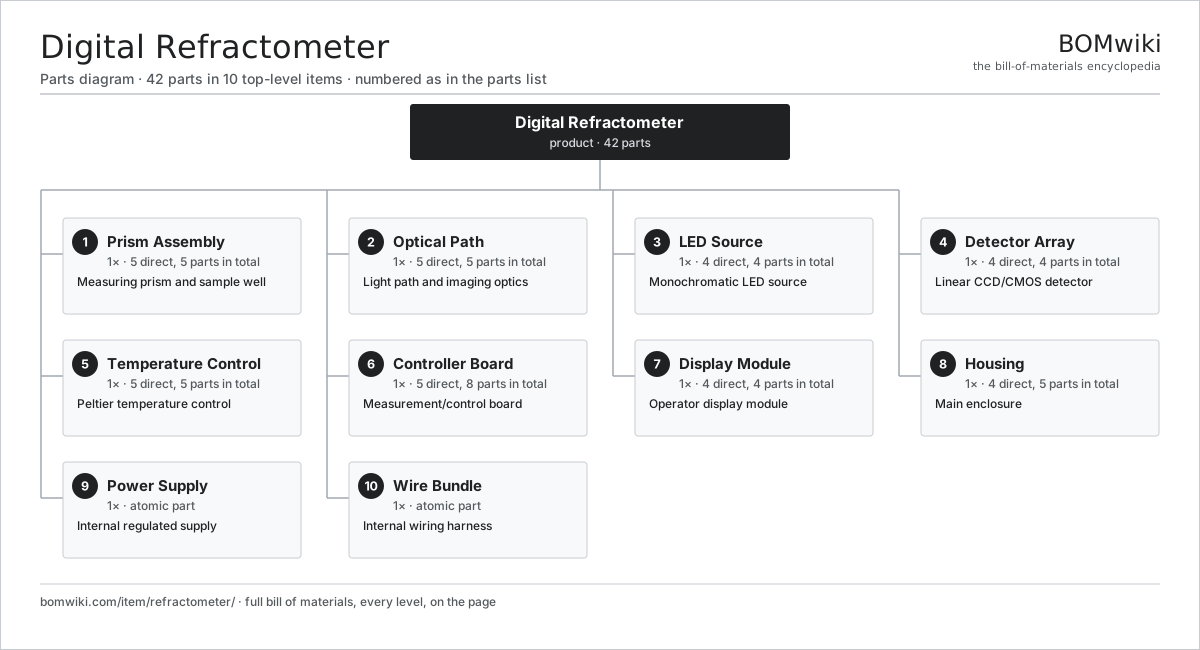
| # | Part | Qty | What it does |
|---|---|---|---|
| 1 | Prism Assembly 5 parts | 1× | Measuring prism and sample well |
| 2 | Optical Path 5 parts | 1× | Light path and imaging optics |
| 3 | LED Source 4 parts | 1× | Monochromatic LED source |
| 4 | Detector Array 4 parts | 1× | Linear CCD/CMOS detector |
| 5 | Temperature Control 5 parts | 1× | Peltier temperature control |
| 6 | Controller Board 5 parts | 1× | Measurement/control board |
| 7 | Display Module 4 parts | 1× | Operator display module |
| 8 | Housing 4 parts | 1× | Main enclosure |
| 9 | Power Supply | 1× | Internal regulated supply |
| 10 | Wire Bundle | 1× | Internal wiring harness |
3D model
No 3D model yet. Have a CAD file of this? Add a 3D model. STL renders right on this page; STEP, FreeCAD, and OpenSCAD sources are welcome too (openly licensed, like all 3D models on BOMwiki).
Build & assembly graph
expand / collapse · shared sub-assemblies converge · links to related products · est. labourTap an assembly to expand/collapse · tap a part to open it · use “Open page” for any node · drag to pan, scroll to zoom.
Bill of materials for Digital Refractometer
10 top-level lines · 46 rows shown · 42 parts total · indented to 3 levels| # | Item / sub-assembly | Part no. | Qty/assy | Ext. qty | Parts | Type |
|---|---|---|---|---|---|---|
| 1 | Prism Assembly 5 parts | refractometer-prism-assembly | 1× | 1 | 5 | assembly |
| 1.1 | Measuring Prism | refractometer-prism | 1× | 1 | · | part |
| 1.2 | Sample Well | refractometer-sample-well | 1× | 1 | · | part |
| 1.3 | Flow Cell Cover | refractometer-flow-cell | 1× | 1 | · | part |
| 1.4 | O-Ring Set | oring-set | 1× | 1 | · | part |
| 1.5 | Fastener Set | fastener-set | 1× | 1 | · | part |
| 2 | Optical Path 5 parts | refractometer-optics | 1× | 1 | 5 | assembly |
| 2.1 | Collimating Lens | refractometer-collimator | 1× | 1 | · | part |
| 2.2 | Field Aperture | refractometer-aperture | 1× | 1 | · | part |
| 2.3 | Imaging Lens | refractometer-imaging-lens | 1× | 1 | · | part |
| 2.4 | Polarizer | refractometer-polarizer | 1× | 1 | · | part |
| 2.5 | Folding Mirror | refractometer-mirror | 1× | 1 | · | part |
| 3 | LED Source 4 parts | refractometer-led-source | 1× | 1 | 4 | assembly |
| 3.1 | LED Emitter | refractometer-led | 1× | 1 | · | part |
| 3.2 | Source Filter | refractometer-source-filter | 1× | 1 | · | part |
| 3.3 | LED Driver | refractometer-led-driver | 1× | 1 | · | part |
| 3.4 | Source Thermistor | refractometer-source-thermistor | 1× | 1 | · | part |
| 4 | Detector Array 4 parts | refractometer-detector-array | 1× | 1 | 4 | assembly |
| 4.1 | CMOS Image Sensor | image-sensor | 1× | 1 | · | part |
| 4.2 | Sensor Board | refractometer-sensor-board | 1× | 1 | · | part |
| 4.3 | Readout ASIC | refractometer-readout-asic | 1× | 1 | · | part |
| 4.4 | Connector | connector | 1× | 1 | · | part |
| 5 | Temperature Control 5 parts | refractometer-temperature-control | 1× | 1 | 5 | assembly |
| 5.1 | Peltier Module | refractometer-peltier | 1× | 1 | · | part |
| 5.2 | Prism RTD | refractometer-prism-rtd | 1× | 1 | · | part |
| 5.3 | Heat Sink | refractometer-heat-sink | 1× | 1 | · | part |
| 5.4 | Blower Motor | blower-motor | 1× | 1 | · | part |
| 5.5 | TEC Driver | refractometer-tec-driver | 1× | 1 | · | part |
| 6 | Controller Board 5 parts | refractometer-controller | 1× | 1 | 8 | assembly |
| 6.1 | Bare PCB | pcb-bare | 1× | 1 | · | part |
| 6.2 | Microcontroller | mcu | 1× | 1 | · | part |
| 6.3 | Signal ADC | refractometer-signal-adc | 1× | 1 | · | part |
| 6.4 | SMD Passive (R/C/L) | smd-passives | 1× | 1 | · | part |
| 6.5 | Connector | connector | 4× | 4 | · | part |
| 7 | Display Module 4 parts | refractometer-display | 1× | 1 | 4 | assembly |
| 7.1 | LCD Panel | lcd-panel | 1× | 1 | · | part |
| 7.2 | Touch Digitizer | touch-digitizer | 1× | 1 | · | part |
| 7.3 | Display Bezel | refractometer-display-bezel | 1× | 1 | · | part |
| 7.4 | Connector | connector | 1× | 1 | · | part |
| 8 | Housing 4 parts | refractometer-housing | 1× | 1 | 5 | assembly |
| 8.1 | Top Deck | refractometer-top-deck | 1× | 1 | · | part |
| 8.2 | Base Frame | refractometer-base-frame | 1× | 1 | · | part |
| 8.3 | Sheet Metal Panel | sheet-panel | 2× | 2 | · | part |
| 8.4 | Fastener Set | fastener-set | 1× | 1 | · | part |
| 9 | Power Supply | power-supply | 1× | 1 | · | part |
| 10 | Wire Bundle | wire-bundle | 1× | 1 | · | part |
Something wrong in this list? Report a problem with this BOM.
Related products
same domain, ranked by shared parts Climate Test Chamber
64 parts · shares 7 with this page
Automated Colony Counter
322 parts · shares 6 with this page
Climate Test Chamber
64 parts · shares 7 with this page
Automated Colony Counter
322 parts · shares 6 with this page
 X-Ray Diffractometer
705 parts · shares 6 with this page
Automatic Titrator
65 parts · shares 6 with this page
X-Ray Diffractometer
705 parts · shares 6 with this page
Automatic Titrator
65 parts · shares 6 with this page
 Flow Cytometer
110 parts · shares 6 with this page
Flow Cytometer
110 parts · shares 6 with this page
Sourcing: possible vendors
Browse the supplier directory → Prices, MOQ, and lead times are algorithmic estimates, not quotes, and not claims about these companies. Company mappings are curated by keyword; est. price band $1k–$500k. How estimates work| Vendor | HQ | Specialty | MOQ | Lead time |
|---|---|---|---|---|
| thermofisher.com ↗ | Waltham, US | Lab instruments | 100 units | 10–18 wks |
|
🇺🇸Agilent
agilent.com ↗
|
Santa Clara, US | Analytical instruments | 100 units | 10–18 wks |
|
🇺🇸Bruker
bruker.com ↗
|
Billerica, US | Scientific instruments | 100 units | 10–18 wks |
|
🇯🇵Shimadzu
shimadzu.com ↗
|
Kyoto, JP | Analytical instruments | 100 units | 10–18 wks |
|
🇺🇸Waters
waters.com ↗
|
Milford, US | Chromatography & MS | 100 units | 10–18 wks |
659-word article