Protection Relay Test Set
ProductOverview
A Protection Relay Test Set is a precision instrument designed to verify the correct operation of protection relays that guard power systems against faults. Protection relays are specialized computers that monitor current and voltage on transmission and distribution lines; when abnormal conditions (overcurrent, overvoltage, underfrequency, loss of synchronism) are detected, relays send trip commands to circuit breakers, isolating the faulted circuit. A Protection Relay Test Set simulates these fault conditions with high accuracy, allowing utility engineers to confirm that relays will operate correctly when called upon.
The Protection Relay Test Set generates four key test signals: (1) adjustable AC current (0–100 A RMS) representing the fault current flowing through the protection relay coil; (2) adjustable AC voltage (0–240 V) representing the system voltage during the fault; (3) phase-angle control between current and voltage, simulating different fault types (3-phase faults, phase-to-phase faults, phase-to-ground faults); (4) harmonic injection to test relay response to distorted waveforms caused by power-electronic loads on modern systems.
Current and Voltage Amplifiers
The Current Amplifier Output Stage is the core output stage, based on a high-power IGBT H-bridge or three-phase converter. The IGBT Current Bridge switches at kilohertz rates, modulating a DC supply to produce a sinusoidal AC current output. The relay-test-set-current-oscillator provides a precise 50 or 60 Hz reference, phase-locked to the mains if desired, ensuring synchronization with the power system.
The output of the IGBT bridge is filtered through a series Output Series Inductor to smooth the switching ripple and limit dI/dt (rate of change of current), protecting semiconductor components from excessive stress. The Current Output Transformer provides galvanic isolation between the high-voltage supply and the test terminals, critical for safety.
The Voltage Amplifier Output Stage operates similarly, using PWM to synthesize AC voltage. A Voltage Reference Oscillator phase-locks the voltage to the current source, allowing independent phase-angle control. The Voltage Output Filter attenuates the PWM switching frequency (typically 10–20 kHz), ensuring the output voltage is nearly sinusoidal.
Synchronization and Phase Control
A key feature of a Protection Relay Test Set is precise phase-angle control between current and voltage. Different power-system faults produce different phase angles: a 3-phase (balanced) fault has voltage and current nearly in-phase; a single-phase-to-ground fault has voltage and current with a phase shift that depends on system impedance. By adjusting the phase angle in 1° increments, the operator can simulate any fault scenario.
Modern relays use phasor measurements (voltage magnitude, current magnitude, and the angle between them) to determine fault type and distance. A Protection Relay Test Set that reproduces these phasors with high precision is essential for validating these algorithms.
Harmonic Injection
Real power faults and loads produce harmonic distortion: the current waveform is not a pure 50 or 60 Hz sine wave but a composite of odd harmonics (3rd, 5th, 7th, etc., up to the 31st or higher). A Protection Relay Test Set with a Waveform and Function Generator can synthesize arbitrary waveforms by superimposing fundamental and harmonic sine waves.
This capability tests whether relays correctly measure RMS current and voltage under distortion. Older relay designs that assumed sinusoidal waveforms may malfunction or produce erroneous fault classifications if exposed to high harmonic content. Modern relays using true RMS calculation and harmonic filtering are resistant to distortion, but verification via Protection Relay Test Set testing confirms proper design.
Test Sequence Automation
The Software and Control Interface automates repetitive test sequences according to standards such as IEEE C37.114 or IEC 60255-6. A standard test suite for a distance relay might include: (1) threshold test: gradually increase current from 0 until the relay trips, confirming the trip current matches the relay setting (e.g., 1.5 A = 300 A at the 200:1 current transformer ratio); (2) timing test: apply a constant overload current and measure the time-to-trip, verifying that the inverse-time characteristic is correct; (3) phase angle test: apply current at various phase angles relative to voltage, confirming the relay only trips for forward faults.
Each test generates a pass/fail result and logs the measured values. A test report is generated automatically, suitable for inclusion in maintenance records and regulatory compliance files.
Measurement Inputs and Response Verification
The Measurement and Response Monitoring section includes a Digital Input Board with 16 isolated channels for monitoring relay output contacts (trip outputs, alarm outputs, LED indicators). A Timing Counter with nanosecond resolution measures the exact time between the test stimulus (e.g., overcurrent injection) and the relay response (contact closure), verifying that the relay response time is within specification (typically <50 ms for electromechanical relays, <5 ms for numeric relays).
The Analog Input ADC Board captures the actual voltage and current waveforms being applied, confirming that the instrument is behaving as programmed. This closed-loop feedback is essential for troubleshooting: if a relay appears to malfunction, the operator can review the recorded stimulus to verify that the test was actually applied correctly.
Test Panel and Wiring
The Test Connection Panel provides Binding Post Connector for high-current connections and Input Terminal Block for low-current relay signal connections. Safety is paramount: the Safety Shroud Assembly enclose live terminals, and all output terminals are designed to prevent accidental contact. Some instruments include a "dead front" philosophy: all high-voltage terminals are enclosed behind a hinged or removable panel that must be consciously opened to access them.
Common Relay Testing Scenarios
Distance Relay Testing: A distance relay protects transmission lines by measuring the impedance (Z = V/I) between the relay location and the fault. The Protection Relay Test Set applies voltage and current at variable phase angles, simulating faults at different distances along the line. The relay's distance characteristic (typically a circle or polygon on a Z-plane diagram) is verified by applying impedances inside and outside the trip region, confirming that the relay trips only for legitimate faults.
Overcurrent Relay Testing: An overcurrent relay trips if the current magnitude exceeds a threshold. The Protection Relay Test Set gradually increases current from zero until the relay trips, confirming the threshold matches the relay setting. If the relay has an inverse-time characteristic (e.g., trip time = 0.14 × I² / (I/Is - 1), where Is is the pickup current), the Protection Relay Test Set applies various current levels and measures trip times, comparing against the known curve.
Differential Relay Testing: Differential relays compare current flowing in versus current flowing out of a protected zone (e.g., the two ends of a transformer). The Protection Relay Test Set applies equal currents to both inputs (normal operation, no relay trip) and then applies unequal currents (simulating a fault inside the zone, causing relay trip). This verifies correct load-compensation and sensitivity settings.
Harmonic and Interharmonic Testing
Modern relays include harmonic-filtering algorithms to reject spurious signals and improve noise immunity. A Protection Relay Test Set can generate waveforms containing high 5th and 7th harmonics (typical of power-electronic loads) and verify that the relay's RMS measurement and threshold comparisons are unaffected.
Some relays use sub-synchronous or interharmonic signals for monitoring (e.g., 10 Hz injected signal for line-impedance tracking). The Waveform and Function Generator synthesizes these signals, allowing the engineer to verify the relay's demodulation and filtering algorithms.
Frequency Response Testing
Relays used in weak grids or microgrids must respond to frequency deviations (underfrequency or overfrequency from nominal 50 or 60 Hz). The Protection Relay Test Set can sweep frequency from 45 to 65 Hz while holding voltage and current constant, measuring the relay's response. Underfrequency relays that trip at 59 Hz (±0.1 Hz accuracy) can be validated, confirming they will not nuisance-trip during normal frequency variations (±0.2 Hz is typical) while still responding to genuine grid collapses.
Calibration and Uncertainty
Precision of a Protection Relay Test Set is critical: a 1% error in current output could cause a relay that is set to trip at 1000 A to actually trip at 990 A or 1010 A, potentially missing faults or tripping on false alarms. The current amplifier is calibrated annually using a primary standard ammeter, with traceability to national laboratories. Typical uncertainty is ±0.1% of full scale (±0.1 A for a 100 A output).
The Timing Counter is calibrated using a precision frequency source (Rubidium or GPS-disciplined oscillator), achieving nanosecond-level accuracy. This ensures that relay response-time measurements are reliable to better than 1 microsecond, far superior to the 1–10 millisecond tolerances of the relays themselves.
Integration with Relay Management Systems
Large utilities manage hundreds of relays across their networks. Test results from Protection Relay Test Set instruments are stored in a central database, indexed by relay serial number and date. Trending analysis identifies relays with degrading performance (e.g., increasing trip time) that require maintenance or replacement. This predictive approach improves grid reliability and extends equipment life.
Some modern Protection Relay Test Set instruments integrate with SCADA, allowing remote scheduling of test campaigns and automated result uploads to a utility's asset management system.
Protection Relay Test Set parts and their functions
6 top-level parts · 47 parts in total · full bill of materials below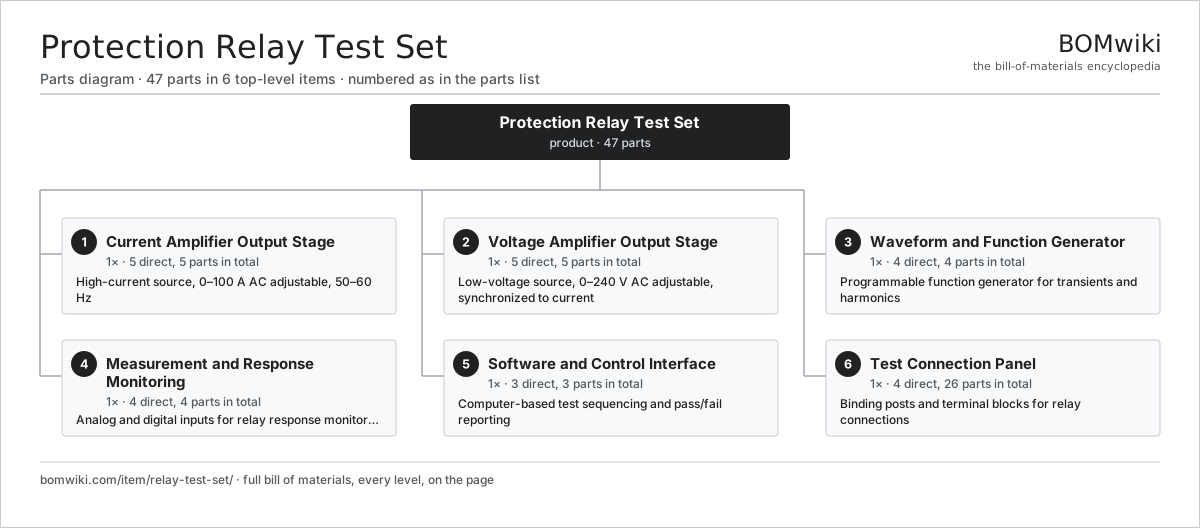
| # | Part | Qty | What it does |
|---|---|---|---|
| 1 | Current Amplifier Output Stage 5 parts | 1× | High-current source, 0–100 A AC adjustable, 50–60 Hz |
| 2 | Voltage Amplifier Output Stage 5 parts | 1× | Low-voltage source, 0–240 V AC adjustable, synchronized to current |
| 3 | Waveform and Function Generator 4 parts | 1× | Programmable function generator for transients and harmonics |
| 4 | Measurement and Response Monitoring 4 parts | 1× | Analog and digital inputs for relay response monitoring |
| 5 | Software and Control Interface 3 parts | 1× | Computer-based test sequencing and pass/fail reporting |
| 6 | Test Connection Panel 4 parts | 1× | Binding posts and terminal blocks for relay connections |
3D model
No 3D model yet. Have a CAD file of this? Add a 3D model. STL renders right on this page; STEP, FreeCAD, and OpenSCAD sources are welcome too (openly licensed, like all 3D models on BOMwiki).
Build & assembly graph
expand / collapse · shared sub-assemblies converge · links to related products · est. labourTap an assembly to expand/collapse · tap a part to open it · use “Open page” for any node · drag to pan, scroll to zoom.
Bill of materials for Protection Relay Test Set
6 top-level lines · 31 rows shown · 47 parts total · indented to 3 levels| # | Item / sub-assembly | Part no. | Qty/assy | Ext. qty | Parts | Type |
|---|---|---|---|---|---|---|
| 1 | Current Amplifier Output Stage 5 parts | relay-test-set-current-amplifier | 1× | 1 | 5 | assembly |
| 1.1 | Current Oscillator Reference | relay-test-set-current-oscilator | 1× | 1 | · | part |
| 1.2 | IGBT Current Bridge | relay-test-set-current-igbt-bridge | 1× | 1 | · | part |
| 1.3 | Current Output Transformer | relay-test-set-current-output-transformer | 1× | 1 | · | part |
| 1.4 | Output Series Inductor | relay-test-set-output-inductor | 1× | 1 | · | part |
| 1.5 | Connector | connector | 1× | 1 | · | part |
| 2 | Voltage Amplifier Output Stage 5 parts | relay-test-set-voltage-amplifier | 1× | 1 | 5 | assembly |
| 2.1 | Voltage Reference Oscillator | relay-test-set-voltage-reference-oscillator | 1× | 1 | · | part |
| 2.2 | Voltage PWM Amplifier | relay-test-set-voltage-pwm-amplifier | 1× | 1 | · | part |
| 2.3 | Voltage Output Filter | relay-test-set-voltage-output-filter | 1× | 1 | · | part |
| 2.4 | Voltage Output Transformer | relay-test-set-voltage-transformer | 1× | 1 | · | part |
| 2.5 | Connector | connector | 1× | 1 | · | part |
| 3 | Waveform and Function Generator 4 parts | relay-test-set-waveform-generator | 1× | 1 | 4 | assembly |
| 3.1 | DAC Waveform Module | relay-test-set-dac-module | 1× | 1 | · | part |
| 3.2 | Function Generator DSP | relay-test-set-function-gen-dsp | 1× | 1 | · | part |
| 3.3 | Waveform Memory Buffer | relay-test-set-waveform-memory | 1× | 1 | · | part |
| 3.4 | Connector | connector | 1× | 1 | · | part |
| 4 | Measurement and Response Monitoring 4 parts | relay-test-set-measurement-inputs | 1× | 1 | 4 | assembly |
| 4.1 | Analog Input ADC Board | relay-test-set-analog-input-board | 1× | 1 | · | part |
| 4.2 | Digital Input Board | relay-test-set-digital-input-board | 1× | 1 | · | part |
| 4.3 | Timing Counter | relay-test-set-timing-counter | 1× | 1 | · | part |
| 4.4 | Connector | connector | 1× | 1 | · | part |
| 5 | Software and Control Interface 3 parts | relay-test-set-software-interface | 1× | 1 | 3 | assembly |
| 5.1 | Main CPU Board | relay-test-set-main-pcb | 1× | 1 | · | part |
| 5.2 | Touchscreen Display | relay-test-set-display-screen | 1× | 1 | · | part |
| 5.3 | Connector | connector | 1× | 1 | · | part |
| 6 | Test Connection Panel 4 parts | relay-test-set-test-panel | 1× | 1 | 26 | assembly |
| 6.1 | Binding Post Connector | relay-test-set-binding-posts | 16× | 16 | · | part |
| 6.2 | Input Terminal Block | relay-test-set-input-terminal-block | 8× | 8 | · | part |
| 6.3 | Safety Shroud Assembly | relay-test-set-safety-shrouds | 1× | 1 | · | part |
| 6.4 | Fastener Set | fastener-set | 1× | 1 | · | part |
Something wrong in this list? Report a problem with this BOM.
Sourcing: possible vendors
Browse the supplier directory → Prices, MOQ, and lead times are algorithmic estimates, not quotes, and not claims about these companies. Company mappings are curated by keyword; est. price band $5k–$50M. How estimates work| Vendor | HQ | Specialty | MOQ | Lead time |
|---|---|---|---|---|
| gevernova.com ↗ | Cambridge, US | Power generation | made to order | 20–40 wks |
| siemens-energy.com ↗ | Munich, DE | Power & grid | made to order | 20–40 wks |
| hitachienergy.com ↗ | Zurich, CH | Grid & transformers | made to order | 20–40 wks |
|
🇨🇭ABB
abb.com ↗
|
Zurich, CH | Electrification & automation | made to order | 20–40 wks |
| se.com ↗ | Rueil-Malmaison, FR | Electrical & automation | made to order | 20–40 wks |
1,550-word article