Helicopter Rescue Winch
ProductOverview
A helicopter rescue winch (hoist) lets a hovering aircraft lift people from places it cannot land: ship decks, cliff faces, flood water, mountainsides. A rescuer rides the hook down, secures the casualty in a strop or litter, and both are raised to the cabin door, up to a 272 kg dual-person rated load on roughly 88 m of wire rope. The winch hangs from a certified Mounting Frame above the cabin door, operated by a crew member at the door with the Control Pendant while conning the pilot over intercom.
The design problem is unforgiving: the machine carries human beings on a 4.8 mm wire under a hovering aircraft, so every failure mode must end with the load held, not dropped, and in the one scenario where holding the load endangers the aircraft, the cable must be severable instantly.
Drive and braking
The Drive Train runs from the 28 V aircraft bus. The Hoist Motor is a brushed DC machine (its Brush Set is a scheduled replacement item) driving the drum through a multi-stage Planetary Gearbox whose stacked Planet Stage sets convert motor speed into drum torque inside a sealed Gearbox Housing. Repeated full-load cycles heat the motor, so operations respect a duty cycle, typically around six consecutive rated lifts before a cooling pause.
Two devices make the train fail-safe. The Load Brake is spring-applied and electrically released: any loss of power clamps the drum with the load held where it is. The Slip Clutch limits torque so a cable snagged on a moving ship or tree cannot overload the structure before the crew reacts.
Cable management
The Cable Drum Assembly stores the Wire Rope, 19×7 rotation-resistant stainless construction, with a breaking strength several times rated load, on a helically grooved Drum Barrel between Drum Flange ends. Neat spooling is a safety function, not cosmetics: a cable that piles up can cut down into lower layers under load and jam or damage strands. The Level Wind prevents this with a Traverse Screw geared to the drum; its diamond-pattern reversing groove shuttles the Cable Follower one cable width per drum turn, guiding the rope through Guide Roller pairs into even layers. An Encoder on the drum gives the operator a payout readout.
At the working end, the Hook End terminates the rope in a proof-loaded Swage Fitting feeding a Hook Swivel, which lets the load spin without untwisting the rope, rotation-resistant rope plus a swivel is what keeps a litter from spinning in rotor downwash. The Rescue Hook is self-locking with a keeper that cannot open under load, and a rubber Cable Bumper cushions the fitting against the boom head at full retraction.
Control and safety electronics
The operator's pendant, a sealed Pendant Housing with a center-return Speed Thumbwheel, commands speed proportionally from creep to about 1.3 m/s through the coiled Pendant Cable. The Control Electronics turn that command into motor current: the Control Unit's Power MOSFET bridge ramps the motor, automatically slowing near cable extremes, while Limit Switch contacts provide hard stops at full-up and at the last safe drum wraps. A Load Cell in the cable path reports hook load for overload cutback and cockpit display.
The last resort is the Cable Cutter, a cartridge-fired guillotine at the boom head. If a snagged cable starts pulling the helicopter down, the classic case is a hook fouled on a rolling vessel, the operator lifts the guard on the Cut Switch and severs the rope in milliseconds. Both pilot and hoist operator stations can fire it.
Installation and service
The Support Frame cantilevers the boom head outboard of the door sill so the cable falls clear of the airframe, bolted through Attach Fitting lugs to certified hard points, with Vibration Isolator mounts attenuating rotor-frequency vibration and a composite Fairing cleaning up the airflow. The installation is part of the aircraft's type design or a supplemental type certificate, with the full crash and fatigue load cases that implies.
Maintenance is dominated by the cable: it is inspected by hand along its full length at short intervals and retired on condition or hours regardless of appearance, because broken wires near the swage are the most common defect. Brushes, brake wear, and clutch calibration follow fixed schedules; the hoist is bench-load-tested after any overload or cutter event.
Helicopter Rescue Winch parts and their functions
7 top-level parts · 93 parts in total · full bill of materials below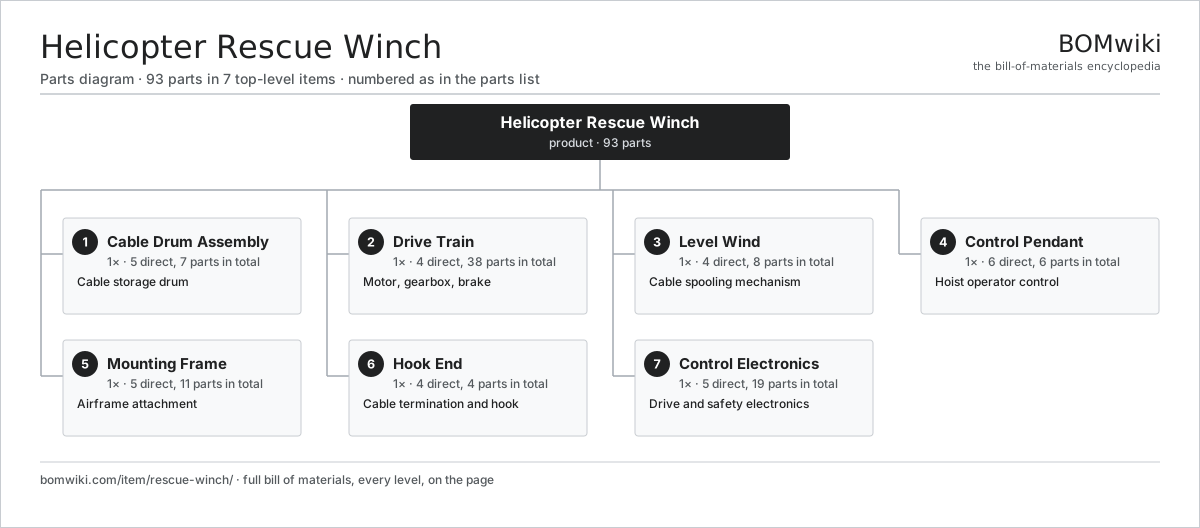
| # | Part | Qty | What it does |
|---|---|---|---|
| 1 | Cable Drum Assembly 5 parts | 1× | Cable storage drum |
| 2 | Drive Train 4 parts | 1× | Motor, gearbox, brake |
| 3 | Level Wind 4 parts | 1× | Cable spooling mechanism |
| 4 | Control Pendant 6 parts | 1× | Hoist operator control |
| 5 | Mounting Frame 5 parts | 1× | Airframe attachment |
| 6 | Hook End 4 parts | 1× | Cable termination and hook |
| 7 | Control Electronics 5 parts | 1× | Drive and safety electronics |
3D model
No 3D model yet. Have a CAD file of this? Add a 3D model. STL renders right on this page; STEP, FreeCAD, and OpenSCAD sources are welcome too (openly licensed, like all 3D models on BOMwiki).
Build & assembly graph
expand / collapse · shared sub-assemblies converge · links to related products · est. labourTap an assembly to expand/collapse · tap a part to open it · use “Open page” for any node · drag to pan, scroll to zoom.
Bill of materials for Helicopter Rescue Winch
7 top-level lines · 55 rows shown · 93 parts total · indented to 3 levels| # | Item / sub-assembly | Part no. | Qty/assy | Ext. qty | Parts | Type |
|---|---|---|---|---|---|---|
| 1 | Cable Drum Assembly 5 parts | rescue-winch-drum-assembly | 1× | 1 | 7 | assembly |
| 1.1 | Drum Barrel | rescue-winch-drum-barrel | 1× | 1 | · | part |
| 1.2 | Wire Rope | rescue-winch-wire-rope | 1× | 1 | · | part |
| 1.3 | Drum Flange | rescue-winch-drum-flange | 2× | 2 | · | part |
| 1.4 | Ball Bearing | ball-bearing | 2× | 2 | · | part |
| 1.5 | Encoder | encoder | 1× | 1 | · | part |
| 2 | Drive Train 4 parts | rescue-winch-drive-train | 1× | 1 | 38 | assembly |
| 2.1 | Hoist Motor 5 parts | rescue-winch-hoist-motor | 1× | 1 | 26 | assembly |
| 2.1.1 | Stator Assembly 3 parts + deeper › | stator-assembly | 1× | 1 | 3 | assembly |
| 2.1.2 | Rotor Assembly 4 parts + deeper › | rotor-assembly | 1× | 1 | 19 | assembly |
| 2.1.3 | Motor Housing | motor-housing | 1× | 1 | · | part |
| 2.1.4 | Ball Bearing | ball-bearing | 2× | 2 | · | part |
| 2.1.5 | Brush Set | rescue-winch-brush-set | 1× | 1 | · | part |
| 2.2 | Planetary Gearbox 4 parts | rescue-winch-planetary-gearbox | 1× | 1 | 10 | assembly |
| 2.2.1 | Gearbox Housing | gearbox-housing | 1× | 1 | · | part |
| 2.2.2 | Planet Stage | rescue-winch-planet-stage | 3× | 3 | · | part |
| 2.2.3 | Ball Bearing | ball-bearing | 4× | 4 | · | part |
| 2.2.4 | Oil Seal | oil-seal | 2× | 2 | · | part |
| 2.3 | Load Brake | rescue-winch-load-brake | 1× | 1 | · | part |
| 2.4 | Slip Clutch | rescue-winch-slip-clutch | 1× | 1 | · | part |
| 3 | Level Wind 4 parts | rescue-winch-level-wind | 1× | 1 | 8 | assembly |
| 3.1 | Traverse Screw | rescue-winch-traverse-screw | 1× | 1 | · | part |
| 3.2 | Cable Follower | rescue-winch-cable-follower | 1× | 1 | · | part |
| 3.3 | Guide Roller | rescue-winch-guide-roller | 4× | 4 | · | part |
| 3.4 | Ball Bearing | ball-bearing | 2× | 2 | · | part |
| 4 | Control Pendant 6 parts | rescue-winch-control-pendant | 1× | 1 | 6 | assembly |
| 4.1 | Pendant Housing | rescue-winch-pendant-housing | 1× | 1 | · | part |
| 4.2 | Speed Thumbwheel | rescue-winch-speed-thumbwheel | 1× | 1 | · | part |
| 4.3 | Cut Switch | rescue-winch-cut-switch | 1× | 1 | · | part |
| 4.4 | Pendant Cable | rescue-winch-pendant-cable | 1× | 1 | · | part |
| 4.5 | Bare PCB | pcb-bare | 1× | 1 | · | part |
| 4.6 | SMD Passive (R/C/L) | smd-passives | 1× | 1 | · | part |
| 5 | Mounting Frame 5 parts | rescue-winch-mounting-frame | 1× | 1 | 11 | assembly |
| 5.1 | Support Frame | rescue-winch-support-frame | 1× | 1 | · | part |
| 5.2 | Attach Fitting | rescue-winch-attach-fitting | 4× | 4 | · | part |
| 5.3 | Vibration Isolator | rescue-winch-vibration-isolator | 4× | 4 | · | part |
| 5.4 | Fairing | rescue-winch-fairing | 1× | 1 | · | part |
| 5.5 | Fastener Set | fastener-set | 1× | 1 | · | part |
| 6 | Hook End 4 parts | rescue-winch-hook-end | 1× | 1 | 4 | assembly |
| 6.1 | Rescue Hook | rescue-winch-rescue-hook | 1× | 1 | · | part |
| 6.2 | Hook Swivel | rescue-winch-hook-swivel | 1× | 1 | · | part |
| 6.3 | Cable Bumper | rescue-winch-cable-bumper | 1× | 1 | · | part |
| 6.4 | Swage Fitting | rescue-winch-swage-fitting | 1× | 1 | · | part |
| 7 | Control Electronics 5 parts | rescue-winch-control-electronics | 1× | 1 | 19 | assembly |
| 7.1 | Control Unit 6 parts | rescue-winch-control-unit | 1× | 1 | 14 | assembly |
| 7.1.1 | Bare PCB | pcb-bare | 1× | 1 | · | part |
| 7.1.2 | Microcontroller | mcu | 1× | 1 | · | part |
| 7.1.3 | Power MOSFET | mosfet | 6× | 6 | · | part |
| 7.1.4 | Relay | relay | 2× | 2 | · | part |
| 7.1.5 | SMD Passive (R/C/L) | smd-passives | 1× | 1 | · | part |
| 7.1.6 | Connector | connector | 3× | 3 | · | part |
| 7.2 | Load Cell | rescue-winch-load-cell | 1× | 1 | · | part |
| 7.3 | Limit Switch | rescue-winch-limit-switch | 2× | 2 | · | part |
| 7.4 | Cable Cutter | rescue-winch-cable-cutter | 1× | 1 | · | part |
| 7.5 | Wire Bundle | wire-bundle | 1× | 1 | · | part |
Something wrong in this list? Report a problem with this BOM.
Related products
same domain, ranked by shared parts Fireboat
236 parts · shares 14 with this page
Fireboat
236 parts · shares 14 with this page
 Aerial Ladder Truck
256 parts · shares 13 with this page
Aerial Ladder Truck
256 parts · shares 13 with this page
 Air Ambulance Helicopter
150 parts · shares 12 with this page
Air Ambulance Helicopter
150 parts · shares 12 with this page
 Foam Proportioning System
75 parts · shares 13 with this page
Foam Proportioning System
75 parts · shares 13 with this page
 Heavy Recovery Wrecker
308 parts · shares 12 with this page
Heavy Recovery Wrecker
308 parts · shares 12 with this page
 Breathing Air Compressor
96 parts · shares 12 with this page
Breathing Air Compressor
96 parts · shares 12 with this page
Sourcing: possible vendors
Browse the supplier directory → Prices, MOQ, and lead times are algorithmic estimates, not quotes, and not claims about these companies. Company mappings are curated by keyword; est. price band $30–$1M. How estimates work| Vendor | HQ | Specialty | MOQ | Lead time |
|---|---|---|---|---|
| rosenbauer.com ↗ | Leonding, AT | Fire apparatus | 200 units | 8–14 wks |
|
🇺🇸Oshkosh
oshkoshcorp.com ↗
|
Oshkosh, US | Specialty trucks (Pierce) | 200 units | 8–14 wks |
| msasafety.com ↗ | Cranberry Township, US | Safety equipment | 200 units | 8–14 wks |
|
🇩🇪Dräger
draeger.com ↗
|
Lübeck, DE | Safety & medical tech | 200 units | 8–14 wks |
| honeywell.com ↗ | Charlotte, US | Building & safety tech | 200 units | 8–14 wks |
805-word article