Wash & Cure Station
ProductOverview
A wash-and-cure station is an essential post-processing workstation for photopolymer-based additive manufacturing (stereolithography, material jetting, polyjet). After parts are 3D-printed in liquid resin, they are tacky and partially cured, containing unreacted oligomers and monomers that must be removed before the parts are suitable for use.
The two-stage process, wash and cure, is labor-intensive if done manually. A dedicated Wash & Cure Station automates both steps: the Wash Tank agitates parts in solvent (isopropyl alcohol or acetone), removing uncrosslinked resin, while the UV Cure Oven uses UV-LED arrays to complete polymerization, hardening the parts to their final mechanical properties.
How it works
Stage 1: Wash, The operator places freshly printed parts in the Agitation Basket and lowers it into the Wash Tank Container filled with isopropyl alcohol (IPA) or acetone. The Solvent Pump & Filter Loop pump circulates solvent through an Activated-Charcoal Filter, and the Blower Motor ultrasonic transducer agitates at 40 kHz.
The solvent wicks into uncrosslinked resin, dissolving oligomers (uncrosslinked chains) and monomers (individual molecules). The detergent effect of agitation accelerates this extraction. Wash time is 5–10 minutes. The solvent gradually darkens as dissolved resin accumulates; the Activated-Charcoal Filter continuously passes solvent through activated charcoal, removing color and regenerating it.
After the wash cycle, the basket is lifted and drained. Excess solvent drips back into the tank. The parts are still wet with IPA/acetone, which evaporates over 10–20 minutes in air, or can be accelerated by a short hot-air dry step.
The Solvent Vapor Extraction and VOC Adsorbent Filter capture solvent vapors, preventing exposure to the operator and surrounding area.
Stage 2: Cure, Washed and dried parts are transferred to the UV Cure Oven and placed on the Motorized Turntable. The Wash & Cure Timer Controller is set for the desired cure time (typically 30 minutes to 2 hours, depending on part thickness and material).
The UV-LED Panel arrays (ceiling, sides, base) emit 365–405 nm UV light at 1–5 W/cm². The Motorized Turntable slowly rotates (0–100 RPM), ensuring even exposure of all surfaces.
UV photons are absorbed by residual photoinitiators in the resin, triggering free-radical polymerization. Cross-link density increases, raising mechanical properties (tensile strength, elongation, impact resistance) toward design values. The Temperature Control & Heating system maintains 60–80 °C ambient, accelerating cure kinetics without causing thermal yellowing or volatilization of monomers.
After cure, parts are fully hardened and ready for support removal, finishing, and assembly.
Chemistry & Material Considerations
Wash solvents: Isopropyl alcohol (IPA) is the most common, balancing efficacy (excellent solubility for acrylates) with safety and cost. Acetone is stronger but more volatile and hazardous. Mixed alcohols (IPA + ethanol) are used for some resins.
The Activated-Charcoal Filter activated charcoal extends solvent life by adsorbing dissolved resin oligomers. Spent solvent (after 10–20 wash batches) is disposed as hazardous chemical waste; charcoal cartridges are replaced monthly or as pressure drop indicates saturation.
Cure kinetics: UV absorption depends on photoinitiator concentration (typically 1–3 wt%). Thicker parts (>5 mm) require longer cure times or higher UV intensity to ensure complete polymerization throughout the interior. Underexposure leaves tacky, uncrosslinked resin; overexposure can yellow the material or volatilize monomers, leaving porosity.
The 60–80 °C ambient temperature is optimal: below 50 °C, cure kinetics are slow; above 90 °C, yellowing occurs. Some material data sheets specify a specific cure profile (ramp to 60 °C over 30 minutes, hold 1 hour, cool to room temp).
Support Removal & Finishing
After cure, mechanical supports (struts holding the part during printing) are removed via careful breaking, drilling, or dissolving (if water-soluble support was used). Surface scars are then smoothed by light sanding (220–400 grit) or chemical etching.
For parts requiring high surface finish (optical surfaces, molds for cosmetic injection molding), post-cure polishing with fine abrasives or solvent vapor smoothing is common.
Solvent Handling & Sustainability
Isopropyl alcohol and acetone are volatile organic compounds (VOCs) and classified as hazardous waste on disposal. The Solvent Vapor Extraction with VOC Adsorbent Filter captures 80–95% of evaporated solvent, significantly reducing workplace exposure and environmental release.
Spent solvent is typically collected in a 55-gallon drum and transported to a licensed hazardous-waste facility for incineration or recycling. A single wash-and-cure station processes ~100–200 parts/week, generating ~20–40 L/month of spent solvent.
Batch Processing & Capacity
The wash chamber holds 10–15 parts per batch. Wash-and-cure cycles are sequential (wash, then cure), requiring 1–3 hours total per batch. For high-volume production (500+ parts/day), multiple stations or a continuous conveyor line is used.
Small shops (10–50 parts/day) use a single unit, batching parts by material or size.
Multi-Material & Elastomer Cure
Rigid acrylic resins cure fastest (30–45 minutes at 60 °C, 365 nm). Elastomeric resins (flexible, shore 40–60 durometer) cure slower due to lower photoinitiator levels (to prevent network cross-linking too densely). Cure times may extend to 2–3 hours.
The Wash & Cure Timer Controller timer and Temperature Control & Heating heater allow material-specific cure profiles to be stored and recalled.
Safety & Ergonomics
Uncrosslinked photopolymer oligomers are skin and respiratory sensitizers. Operators wear nitrile gloves and work over the Solvent Vapor Extraction. The VOC Adsorbent Filter and Solvent Vapor Extraction exhaust system prevent accumulation of VOC vapors in the workplace.
UV exposure is minimal due to the enclosed UV Cure Oven, but repeated exposure to leaked UV is a long-term concern. Safety interlocks (door open = LEDs off) prevent accidental exposure.
Wash & Cure Station parts and their functions
8 top-level parts · 65 parts in total · full bill of materials below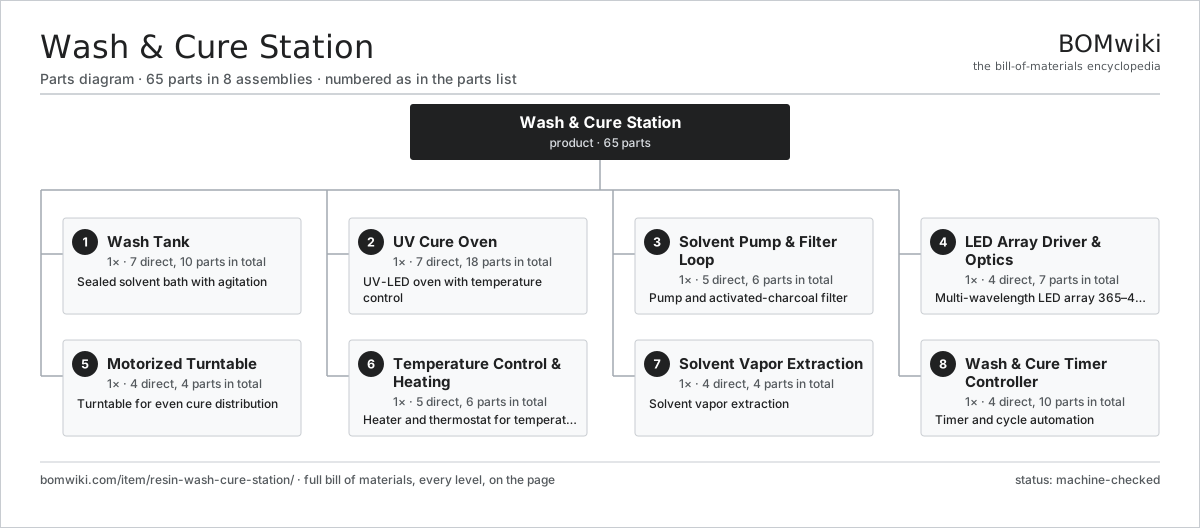
| # | Part | Qty | What it does |
|---|---|---|---|
| 1 | Wash Tank 7 parts | 1× | Sealed solvent bath with agitation |
| 2 | UV Cure Oven 7 parts | 1× | UV-LED oven with temperature control |
| 3 | Solvent Pump & Filter Loop 5 parts | 1× | Pump and activated-charcoal filter |
| 4 | LED Array Driver & Optics 4 parts | 1× | Multi-wavelength LED array 365–405 nm |
| 5 | Motorized Turntable 4 parts | 1× | Turntable for even cure distribution |
| 6 | Temperature Control & Heating 5 parts | 1× | Heater and thermostat for temperature control |
| 7 | Solvent Vapor Extraction 4 parts | 1× | Solvent vapor extraction |
| 8 | Wash & Cure Timer Controller 4 parts | 1× | Timer and cycle automation |
3D model
No 3D model yet. Have a CAD file of this? Add a 3D model — STL renders right on this page; STEP, FreeCAD, and OpenSCAD sources are welcome too (openly licensed, like all 3D models on BOMwiki).
Build & assembly graph
expand / collapse · shared sub-assemblies converge · links to related products · est. labourTap an assembly to expand/collapse · tap a part to open it · use “Open page” for any node · drag to pan, scroll to zoom.
Bill of materials for Wash & Cure Station
8 top-level lines · 52 rows shown · 65 parts total · indented to 3 levels| # | Item / sub-assembly | Part no. | Qty/assy | Ext. qty | Parts | Type |
|---|---|---|---|---|---|---|
| 1 | Wash Tank 7 parts | resin-wash-cure-station-wash-chamber | 1× | 1 | 10 | assembly |
| 1.1 | Wash Tank Container | resin-wash-cure-station-tank-body | 1× | 1 | · | part |
| 1.2 | Agitation Basket | resin-wash-cure-station-wash-basket | 1× | 1 | · | part |
| 1.3 | Blower Motor | blower-motor | 1× | 1 | · | part |
| 1.4 | Heating Element | heating-element | 1× | 1 | · | part |
| 1.5 | Pressure Sensor | pressure-sensor | 1× | 1 | · | part |
| 1.6 | Connector | connector | 3× | 3 | · | part |
| 1.7 | Fastener Set | fastener-set | 2× | 2 | · | part |
| 2 | UV Cure Oven 7 parts | resin-wash-cure-station-cure-chamber | 1× | 1 | 18 | assembly |
| 2.1 | Cure Oven Enclosure | resin-wash-cure-station-cure-box | 1× | 1 | · | part |
| 2.2 | UV-LED Panel | resin-wash-cure-station-uv-led-module | 3× | 3 | · | part |
| 2.3 | Motorized Turntable 4 parts | resin-wash-cure-station-rotating-platform | 1× | 1 | 4 | assembly |
| 2.3.1 | Stepper Motor | stepper-motor | 1× | 1 | · | part |
| 2.3.2 | Encoder | encoder | 1× | 1 | · | part |
| 2.3.3 | Connector | connector | 1× | 1 | · | part |
| 2.3.4 | Fastener Set | fastener-set | 1× | 1 | · | part |
| 2.4 | Heating Element | heating-element | 1× | 1 | · | part |
| 2.5 | Pressure Sensor | pressure-sensor | 1× | 1 | · | part |
| 2.6 | Connector | connector | 6× | 6 | · | part |
| 2.7 | Fastener Set | fastener-set | 2× | 2 | · | part |
| 3 | Solvent Pump & Filter Loop 5 parts | resin-wash-cure-station-solvent-circulation | 1× | 1 | 6 | assembly |
| 3.1 | Coolant Pump | coolant-pump | 1× | 1 | · | part |
| 3.2 | Activated-Charcoal Filter | resin-wash-cure-station-filter-cartridge | 1× | 1 | · | part |
| 3.3 | Pressure Sensor | pressure-sensor | 1× | 1 | · | part |
| 3.4 | Connector | connector | 2× | 2 | · | part |
| 3.5 | Fastener Set | fastener-set | 1× | 1 | · | part |
| 4 | LED Array Driver & Optics 4 parts | resin-wash-cure-station-uv-light-array | 1× | 1 | 7 | assembly |
| 4.1 | Power Supply | power-supply | 1× | 1 | · | part |
| 4.2 | Relay | relay | 1× | 1 | · | part |
| 4.3 | Connector | connector | 4× | 4 | · | part |
| 4.4 | Fastener Set | fastener-set | 1× | 1 | · | part |
| 5 | Motorized Turntable 4 parts | resin-wash-cure-station-rotating-platform | 1× | 1 | 4 | assembly |
| 5.1 | Stepper Motor | stepper-motor | 1× | 1 | · | part |
| 5.2 | Encoder | encoder | 1× | 1 | · | part |
| 5.3 | Connector | connector | 1× | 1 | · | part |
| 5.4 | Fastener Set | fastener-set | 1× | 1 | · | part |
| 6 | Temperature Control & Heating 5 parts | resin-wash-cure-station-thermal-management | 1× | 1 | 6 | assembly |
| 6.1 | Heating Element | heating-element | 1× | 1 | · | part |
| 6.2 | Pressure Sensor | pressure-sensor | 1× | 1 | · | part |
| 6.3 | Relay | relay | 1× | 1 | · | part |
| 6.4 | Connector | connector | 2× | 2 | · | part |
| 6.5 | Fastener Set | fastener-set | 1× | 1 | · | part |
| 7 | Solvent Vapor Extraction 4 parts | resin-wash-cure-station-fume-hood | 1× | 1 | 4 | assembly |
| 7.1 | Blower Motor | blower-motor | 1× | 1 | · | part |
| 7.2 | VOC Adsorbent Filter | resin-wash-cure-station-fume-filter | 1× | 1 | · | part |
| 7.3 | Connector | connector | 1× | 1 | · | part |
| 7.4 | Fastener Set | fastener-set | 1× | 1 | · | part |
| 8 | Wash & Cure Timer Controller 4 parts | resin-wash-cure-station-control-panel | 1× | 1 | 10 | assembly |
| 8.1 | Relay | relay | 3× | 3 | · | part |
| 8.2 | Pressure Sensor | pressure-sensor | 2× | 2 | · | part |
| 8.3 | Connector | connector | 4× | 4 | · | part |
| 8.4 | Fastener Set | fastener-set | 1× | 1 | · | part |
Related products
same domain, ranked by shared parts Industrial FDM Printer
98 parts · shares 8 with this page
Industrial FDM Printer
98 parts · shares 8 with this page
 Pencil Making Machine
43 parts · shares 8 with this page
Pencil Making Machine
43 parts · shares 8 with this page
 Industrial SLA Printer
94 parts · shares 7 with this page
WAAM System
83 parts · shares 6 with this page
Industrial SLA Printer
94 parts · shares 7 with this page
WAAM System
83 parts · shares 6 with this page
Sourcing: possible vendors
Prices, MOQ, and lead times are algorithmic estimates, not quotes, and not claims about these companies. Company mappings are curated by keyword; est. price band $5k–$2M. How estimates work| Vendor | HQ | Specialty | MOQ | Lead time |
|---|---|---|---|---|
| atlascopco.com ↗ | Stockholm, SE | Compressors & industrial | 10 units | 12–20 wks |
|
🇦🇹Andritz
andritz.com ↗
|
Graz, AT | Process plants & machinery | 10 units | 12–20 wks |
| buhlergroup.com ↗ | Uzwil, CH | Food & materials processing | 10 units | 12–20 wks |
| gea.com ↗ | Düsseldorf, DE | Process technology | 10 units | 12–20 wks |
| mhi.com ↗ | Tokyo, JP | Heavy machinery | 10 units | 12–20 wks |
1,000-word article