Restaurant Booth
ProductOverview
A restaurant booth is a fixed paired seating arrangement, two benches facing each other across a central table, designed to maximize seating efficiency in a compact footprint while providing privacy and comfort. The Left Bench Assembly and Right Bench Assembly are structurally identical: welded steel frames with integral backrests, upholstered in high-durability vinyl or leather. Each bench typically seats two to three adults. The Table Top Assembly is a separate worktop mounted on a pedestal or four-leg base, creating a 0.7–1.0 m span between bench cushions, enough for place settings, glasses, and condiments without knees touching.
Booth seating has dominated American diners, casual restaurants, and fast-casual chains since the 1950s because it offers multiple advantages: guests feel semi-private even in an open dining room; the fixed position prevents guests sliding between chairs; and the footprint (roughly 1.5 m × 2.0 m for a full booth) uses floor area more efficiently than movable chairs and tables. Upholstered benches also absorb acoustic noise better than wooden chairs, reducing clamor in busy restaurants.
Structure and frame
The left bench comprises a Bench Frame of welded square-tube steel (38–50 mm), typically 0.6–0.8 m deep. This depth accommodates a diner's back without encroaching on the pedestrian aisle behind. The Seat Base, a plywood or steel platform bolted to the frame, supports the cushion and upholstery. The Back Support is a separate welded or bolted assembly angled 10–15 degrees from vertical, resisting the forward shear that occurs when guests lean back or when the table is pulled (a common motion during dish clearing or guest movement). Back-frame welds or bolts are the primary wear points and are inspected quarterly in high-volume operations.
The Right Bench Assembly is a mirror image with identical frame geometry and material specs, ensuring symmetrical appearance and equal comfort on both sides. Both benches are bolted to the floor or wall via heavy-duty brackets, preventing lateral or rocking motion under load. Wall mounting is typical if the booth is placed against a wall; a single rear bracket suffices. If the booth is freestanding (against a pillar or in the center of a room), both benches require floor mounting at all four corners.
Seating comfort
Each Seat Cushion is a laminate of polyurethane foam (100–120 kg/m³ density, 120–150 mm thick) bonded to a 5 mm plywood base, then wrapped in polyester batting (25 mm) to smooth the surface and reduce fabric friction. The fabric layer is commercial vinyl or faux-leather, chosen for stain resistance and cleanability; genuine leather is premium but requires monthly conditioning. A removable zipper on three sides of the cover lets restaurant staff detach the cushion cover for dry cleaning, typically done quarterly in a 24-hour-per-day operation.
The back cushion is slightly softer (80–100 kg/m³ foam) than the seat cushion, promoting the shallow recline that dining etiquette expects. Height is typically 1.5 m from the floor to the top of the back, creating a visual enclosure without blocking sightlines across the dining room. Comfort is calibrated for meals lasting 45–90 minutes; longer stays (such as all-day coffee service) would benefit from firmer, lower-density foam to prevent the "bottom out" sensation.
Table interface
The Table Top Assembly worktop is a laminated surface, 25 mm thick, typically in a neutral colour (tan, grey, or white) to minimize visible food stains. Edge banding is thermofused PVC, mitered at corners and glued to the substrate, providing both aesthetics and protection from chipping when a guest's knee bumps the edge during entry or exit. The underside sub-frame is 20 mm plywood, with a central bushing or collar that slides onto the pedestal base.
The Table Base Assembly can be either a single-column pedestal or a four-leg frame. Pedestal designs maximize legroom, guests can shift their feet without hitting table legs, and are preferred in compact spaces. The pedestal foot, typically a four-pointed cast-iron star, spreads the table's dead load and live load (plates, elbows, guest leaning back) across a 0.4–0.5 m footprint. Four-leg tables are more common in classic diners and offer better visual proportion in taller ceilings, but they reduce legroom and are harder to clean around.
Elastomer levelling pads under each foot allow the server or manager to fine-tune level using a bubble level, compensating for settlement, sloped concrete, or uneven tile flooring. A rocking table is a customer complaint that drives repeated adjustment calls; a 30-second shimming job during setup prevents hours of service interruptions.
Maintenance and durability
The vinyl or leather facing is the primary wear surface. Commercial vinyl (e.g., Naugahyde, Duralite) is treated to resist spills, a quick wipe with a damp cloth removes most food and drink without staining. Genuine leather is more luxurious but requires re-oiling and is vulnerable to alcohol-based hand sanitizer, so casual restaurants avoid it. Colour choice is strategic: darker fabrics (charcoal, burgundy, black) hide stains better than light colours (cream, white, beige) and are replenished less frequently.
The back-frame welds are the structural failure points under repeated loading. Seismic activity, vibration from adjacent kitchen equipment, and aggressive guest behaviour (standing on seats, jumping) can cause micro-cracks in welds. Monthly visual inspection of weld fillets, especially at stress concentrations, catches incipient failure before collapse. The floor anchor bolts also corrode over time in humid kitchens or near mop sinks; annual re-torquing and corrosion-inhibitor spray extend the life of the bolt connection.
The removable cushion covers are a maintenance game-changer: a stained or torn cover can be replaced in 15 minutes, and the foam core underneath, being glued to plywood, never comes into contact with food or beverage. If the foam eventually compresses (after 3–5 years of heavy use), the plywood base can be removed from the frame and a new foam-and-cover assembly glued on, deferring a full bench replacement.
Customization and installation
Booth configurations are highly customizable: bench lengths can be ordered in 0.3 m increments, allowing a booth footprint as small as 1.2 m × 1.5 m (tight seating for two couples) or as large as 2.0 m × 2.5 m (lounge-style corners). Corner units, where two booths meet at 90 degrees, are common in upscale establishments. L-shaped and U-shaped multi-booth units can be bolted together to seat 8–12 guests in a semi-private alcove.
Installation typically takes 2–4 hours per booth: anchoring the bases to the floor via lag bolts or concrete anchors, levelling the table, shimming the benches, and wiring any electrical elements if the booth includes a table-mounted card reader, charger, or light fixture. New-build restaurants often bolt booths down before flooring is poured, embedding anchors in the concrete to simplify future reinstallation.
Restaurant Booth parts and their functions
7 top-level parts · 67 parts in total · full bill of materials below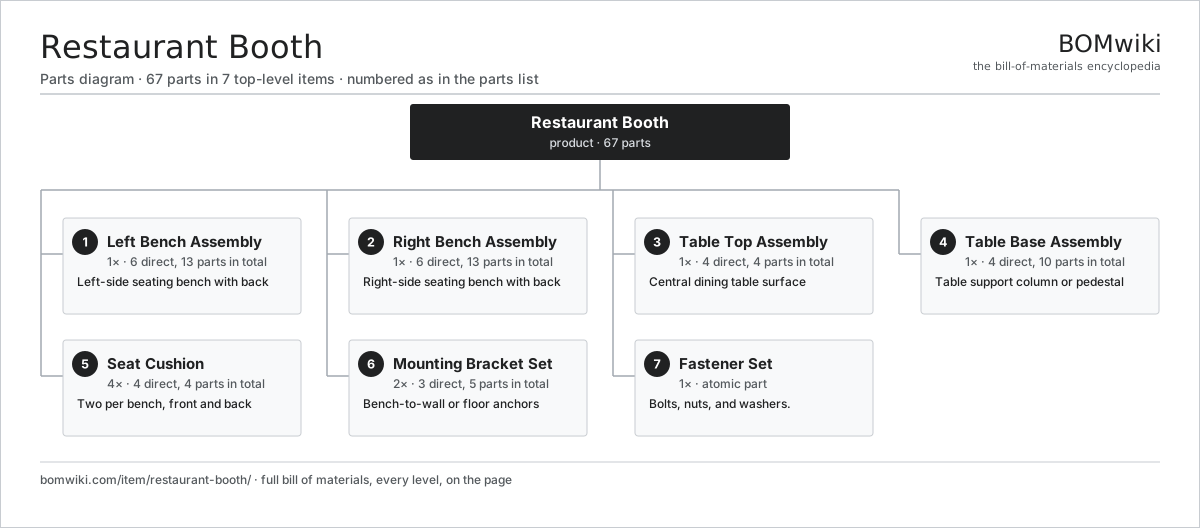
| # | Part | Qty | What it does |
|---|---|---|---|
| 1 | Left Bench Assembly 6 parts | 1× | Left-side seating bench with back |
| 2 | Right Bench Assembly 6 parts | 1× | Right-side seating bench with back |
| 3 | Table Top Assembly 4 parts | 1× | Central dining table surface |
| 4 | Table Base Assembly 4 parts | 1× | Table support column or pedestal |
| 5 | Seat Cushion 4 parts | 4× | Two per bench, front and back |
| 6 | Mounting Bracket Set 3 parts | 2× | Bench-to-wall or floor anchors |
| 7 | Fastener Set | 1× | Bolts, nuts, and washers. |
3D model
No 3D model yet. Have a CAD file of this? Add a 3D model. STL renders right on this page; STEP, FreeCAD, and OpenSCAD sources are welcome too (openly licensed, like all 3D models on BOMwiki).
Build & assembly graph
expand / collapse · shared sub-assemblies converge · links to related products · est. labourTap an assembly to expand/collapse · tap a part to open it · use “Open page” for any node · drag to pan, scroll to zoom.
Bill of materials for Restaurant Booth
7 top-level lines · 42 rows shown · 67 parts total · indented to 3 levels| # | Item / sub-assembly | Part no. | Qty/assy | Ext. qty | Parts | Type |
|---|---|---|---|---|---|---|
| 1 | Left Bench Assembly 6 parts | restaurant-booth-bench-left | 1× | 1 | 13 | assembly |
| 1.1 | Bench Frame | restaurant-booth-bench-frame | 1× | 1 | · | part |
| 1.2 | Seat Base | restaurant-booth-bench-seat-base | 1× | 1 | · | part |
| 1.3 | Back Support | restaurant-booth-back-frame | 1× | 1 | · | part |
| 1.4 | Seat Cushion 4 parts | restaurant-booth-seat-cushion | 2× | 2 | 4 | assembly |
| 1.4.1 | Foam Padding | restaurant-booth-foam-core | 1× | 2 | · | part |
| 1.4.2 | Dacron Layer | restaurant-booth-dacron-wrap | 1× | 2 | · | part |
| 1.4.3 | Upholstery Fabric | restaurant-booth-upholstery-fabric | 1× | 2 | · | part |
| 1.4.4 | Removable Zipper | restaurant-booth-zipper | 1× | 2 | · | part |
| 1.5 | Upholstery Fabric | restaurant-booth-upholstery-fabric | 1× | 1 | · | part |
| 1.6 | Corner Trim | restaurant-booth-corner-trim | 1× | 1 | · | part |
| 2 | Right Bench Assembly 6 parts | restaurant-booth-bench-right | 1× | 1 | 13 | assembly |
| 2.1 | Bench Frame | restaurant-booth-bench-frame | 1× | 1 | · | part |
| 2.2 | Seat Base | restaurant-booth-bench-seat-base | 1× | 1 | · | part |
| 2.3 | Back Support | restaurant-booth-back-frame | 1× | 1 | · | part |
| 2.4 | Seat Cushion 4 parts | restaurant-booth-seat-cushion | 2× | 2 | 4 | assembly |
| 2.4.1 | Foam Padding | restaurant-booth-foam-core | 1× | 2 | · | part |
| 2.4.2 | Dacron Layer | restaurant-booth-dacron-wrap | 1× | 2 | · | part |
| 2.4.3 | Upholstery Fabric | restaurant-booth-upholstery-fabric | 1× | 2 | · | part |
| 2.4.4 | Removable Zipper | restaurant-booth-zipper | 1× | 2 | · | part |
| 2.5 | Upholstery Fabric | restaurant-booth-upholstery-fabric | 1× | 1 | · | part |
| 2.6 | Corner Trim | restaurant-booth-corner-trim | 1× | 1 | · | part |
| 3 | Table Top Assembly 4 parts | restaurant-booth-table | 1× | 1 | 4 | assembly |
| 3.1 | Top Panel | restaurant-booth-table-top-panel | 1× | 1 | · | part |
| 3.2 | Table Edge | restaurant-booth-table-edge-banding | 1× | 1 | · | part |
| 3.3 | Top Sub-Frame | restaurant-booth-table-top-frame | 1× | 1 | · | part |
| 3.4 | Pedestal Bushing | restaurant-booth-table-leg-bushing | 1× | 1 | · | part |
| 4 | Table Base Assembly 4 parts | restaurant-booth-table-base | 1× | 1 | 10 | assembly |
| 4.1 | Base Column | restaurant-booth-base-column | 1× | 1 | · | part |
| 4.2 | Base Foot | restaurant-booth-base-foot | 4× | 4 | · | part |
| 4.3 | Base Crossbar | restaurant-booth-base-crossbar | 1× | 1 | · | part |
| 4.4 | Levelling Pad | restaurant-booth-base-levelling-pad | 4× | 4 | · | part |
| 5 | Seat Cushion 4 parts | restaurant-booth-seat-cushion | 4× | 4 | 4 | assembly |
| 5.1 | Foam Padding | restaurant-booth-foam-core | 1× | 4 | · | part |
| 5.2 | Dacron Layer | restaurant-booth-dacron-wrap | 1× | 4 | · | part |
| 5.3 | Upholstery Fabric | restaurant-booth-upholstery-fabric | 1× | 4 | · | part |
| 5.4 | Removable Zipper | restaurant-booth-zipper | 1× | 4 | · | part |
| 6 | Mounting Bracket Set 3 parts | restaurant-booth-mounting-bracket | 2× | 2 | 5 | assembly |
| 6.1 | Floor Bracket | restaurant-booth-floor-bracket | 2× | 4 | · | part |
| 6.2 | Wall Bracket | restaurant-booth-wall-bracket | 2× | 4 | · | part |
| 6.3 | Fastener Set | fastener-set | 1× | 2 | · | part |
| 7 | Fastener Set | fastener-set | 1× | 1 | · | part |
Something wrong in this list? Report a problem with this BOM.
Sourcing: possible vendors
Browse the supplier directory → Prices, MOQ, and lead times are algorithmic estimates, not quotes, and not claims about these companies. Company mappings are curated by keyword; est. price band $50–$3k. How estimates work| Vendor | HQ | Specialty | MOQ | Lead time |
|---|---|---|---|---|
| steelcase.com ↗ | Grand Rapids, US | Office furniture | 200 units | 6–12 wks |
| millerknoll.com ↗ | Zeeland, US | Furniture (Herman Miller) | 200 units | 6–12 wks |
|
🇺🇸Haworth
haworth.com ↗
|
Holland, US | Office furniture | 200 units | 6–12 wks |
|
🇺🇸HNI
hnicorp.com ↗
|
Muscatine, US | Furniture & hearth | 200 units | 6–12 wks |
| ikea.com ↗ | Älmhult, SE | Furniture manufacturing | 200 units | 6–12 wks |
1,266-word article