Ring Stretcher/Reducer
ProductOverview
A ring stretcher and reducer is a simple mechanical device for adjusting ring size without removing sizing beads, soldered bands, or stone settings. The expansion mandrel uses a hand-operated lever to expand the ring diameter by 3–4 sizes per pass; conversely, a set of stepped dies compress rings for size reduction. No heat is applied, reducing risk of annealing (softening) hardened rings or damaging gemstones.
Ring sizing is one of the most common jewelry repair operations. A customer purchases an inherited or ill-fitting ring; a jeweler uses the stretcher to enlarge or shrink it to the correct size. The tool is also used by jewelry manufacturers during production, allowing adjustment of sizing beads or band widths after stone setting.
How it works
For stretching: the jeweler inserts the ring onto the mandrel, which appears as a tapered steel shaft with radial fingers. The ring sits snugly on the mandrel surface. Depressing the hand lever drives a wedge block up the internal conical taper of the mandrel. As the wedge rises, it pushes outward on the mandrel's internal radial slots, forcing the expansion fingers to spread. The ring, sitting on the widening mandrel surface, is stretched elastically. The operator presses hard enough (typically 30–50 pounds of hand force) to expand the ring 1–2 sizes per pass.
Releasing the lever allows the return spring to open, the wedge retracts, the fingers collapse back, and the ring is removed. The process is repeated if further stretching is needed (a size-4 ring requiring a size-8 adjustment might need 2–3 passes).
For reducing: the ring is placed in the stepped dies, matching upper and lower hardened steel dies with circular grooves sized for each US ring size. The operator selects the die groove matching the target size, positions the ring, and presses the lever. The dies compress the ring radially, reducing its diameter. Repeated passes with progressively smaller die grooves reduce the ring to the final size. Reduction is limited; a ring that is too small after reducing is difficult to enlarge back without work-hardening cracks.
Mandrel Design and Mechanics
The mandrel is a precision-engineered taper. Most designs use an 8–15 degree cone angle; the steeper the taper, the greater the mechanical advantage (force multiplication), but also the narrower the range of ring sizes per mandrel segment. A typical mandrel is 4–6 inches long, supporting ring sizes 1–13 by varying the position of the ring axially along the taper.
The wedge is a hardened steel block with a matching taper surface and a flat front face. As the lever pushes the wedge into the mandrel, the taper forces radial outward displacement equal to the vertical distance traveled divided by the tangent of the taper angle. For an 8-degree taper, 1 inch of vertical wedge movement yields about 0.15 inches (approximately one-half size) of radial expansion on the ring. The lever provides 5–10:1 mechanical advantage, allowing an operator to apply 1000+ lbf radial force with just 100–200 lbf of hand pressure.
The radial fingers (typically 6–8) are individual hardened steel pieces fitting into slots in the mandrel shaft. They expand radially as the wedge rises, but do not separate from the mandrel; they provide uniform outward pressure around the ring's circumference, preventing tilting or jamming.
Reduction Die Details
The dies are hardened steel blocks (58–62 HRC) with a stepped circular profile. Each die pair is ground with a set of circular grooves, typically sized for rings 1, 3, 5, 7, 9, 11, 13 (odd sizes); additional die pairs cover even sizes or half-sizes. The grooves are typically 0.5–1.0 inches deep (enough to fully contain the ring), with a flat base to support the ring.
When the lever is pressed, the upper die descends and the lower die rises (or upper die descends while the ring rests on the base), compressing the ring in the groove. The ring deforms elastically, reducing diameter; when released, it slightly springs back but retains the smaller size. A stripper mechanism ejects the ring automatically or the operator removes it by hand.
Force and Load Capacity
The mechanical advantage of the lever is the ratio of the lever arm length to the distance from the pivot to the load point (mandrel wedge). A 16-inch lever arm with a 2-inch load distance gives 8:1 advantage. An operator applying 100 lbf hand force generates 800 lbf outward force on the mandrel. Since the expansion is distributed around the circumference (typically 8 fingers, or 360° of force), the stress on any single point of the ring is manageable.
Gold and platinum, being ductile, tolerate stretching well; they work-harden slightly but do not crack if properly annealed beforehand. Hardened alloys (high-tensile-strength ring blanks) risk cracking if overstretched. Work-hardened rings should be annealed (heated to 700–900°C and slow-cooled) before stretching to restore ductility.
Sizing Standards and Measurement
US ring sizes are standardized: size 1 ≈ 0.5 inches inner diameter, size 13 ≈ 2.5 inches inner diameter. Each whole size increases diameter by approximately 0.125 inches (3.2 mm). The size gauge is a set of 13 master rings or a mandrel stick engraved with size numbers, allowing the jeweler to verify the final size by fitting the ring onto the appropriate section of the gauge.
Measurement of an unsized ring is done by ring sizers, either a tapered mandrel with engraved size numbers (slipped over the ring until it fits snugly), or a set of sizing calipers marking the inner diameter.
Limitations and Precautions
Stretching can weaken a ring if it is too hard or has flaws (cracks, porosity); overstretching causes visible thinning and potential failure. Reducing a ring compresses and work-hardens the metal; multiple reduction passes can lead to brittle failure if the ring is not subsequently annealed.
Rings with stone settings (especially settings with epoxy adhesive) risk damage; heat from stretching or aggressive compression can weaken glue or crack brittle stones (emerald, opal). For stone-set rings, hand-stretching or reduction with extreme care is preferred.
Hollow rings (fabricated from sheet metal and soldered at a seam) risk splitting the seam if stretched too aggressively; these are often resized by saw-cutting and resoldering at the size seam, rather than stretching.
Workflow and Efficiency
A jewelry shop typically keeps one or two stretchers running; sizing takes 5–15 minutes per ring (measure original size, clean the ring, mount on mandrel/dies, stretch or reduce, measure final size, polish any surface scuffs). With multiple rings queued, a jeweler can process 15–30 sizing jobs per 8-hour shift, yielding rapid turnaround for customers.
Ring Stretcher/Reducer parts and their functions
7 top-level parts · 41 parts in total · full bill of materials below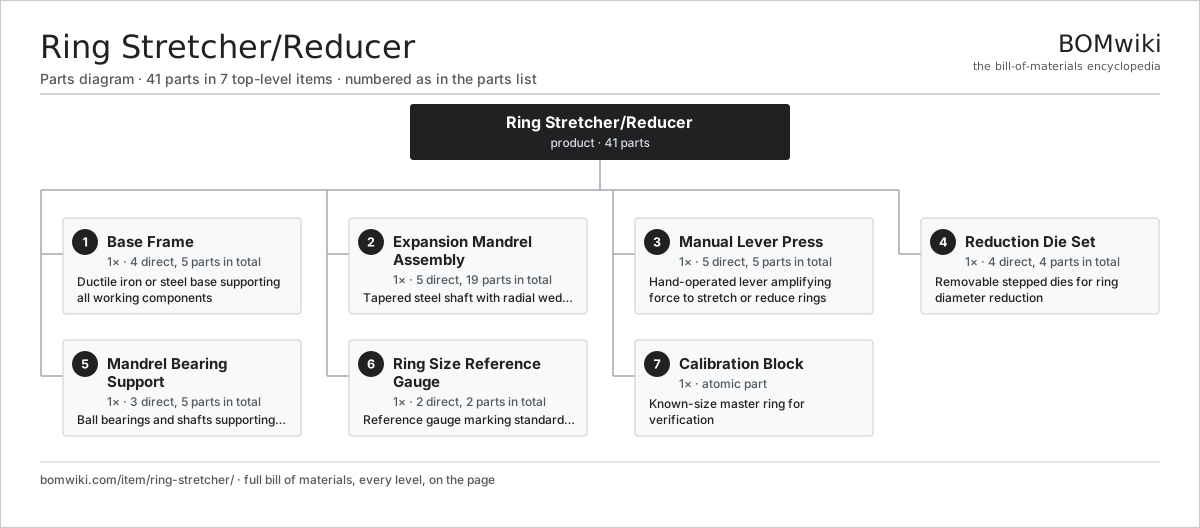
| # | Part | Qty | What it does |
|---|---|---|---|
| 1 | Base Frame 4 parts | 1× | Ductile iron or steel base supporting all working components |
| 2 | Expansion Mandrel Assembly 5 parts | 1× | Tapered steel shaft with radial wedge mechanism expanding rings |
| 3 | Manual Lever Press 5 parts | 1× | Hand-operated lever amplifying force to stretch or reduce rings |
| 4 | Reduction Die Set 4 parts | 1× | Removable stepped dies for ring diameter reduction |
| 5 | Mandrel Bearing Support 3 parts | 1× | Ball bearings and shafts supporting mandrel rotation and axial movement |
| 6 | Ring Size Reference Gauge 2 parts | 1× | Reference gauge marking standard US ring sizes 1–13 |
| 7 | Calibration Block | 1× | Known-size master ring for verification |
3D model
No 3D model yet. Have a CAD file of this? Add a 3D model. STL renders right on this page; STEP, FreeCAD, and OpenSCAD sources are welcome too (openly licensed, like all 3D models on BOMwiki).
Build & assembly graph
expand / collapse · shared sub-assemblies converge · links to related products · est. labourTap an assembly to expand/collapse · tap a part to open it · use “Open page” for any node · drag to pan, scroll to zoom.
Bill of materials for Ring Stretcher/Reducer
7 top-level lines · 30 rows shown · 41 parts total · indented to 3 levels| # | Item / sub-assembly | Part no. | Qty/assy | Ext. qty | Parts | Type |
|---|---|---|---|---|---|---|
| 1 | Base Frame 4 parts | ring-stretcher-base-frame | 1× | 1 | 5 | assembly |
| 1.1 | Frame Base Casting | ring-stretcher-frame-body | 1× | 1 | · | part |
| 1.2 | Frame Upright Posts | ring-stretcher-frame-uprights | 2× | 2 | · | part |
| 1.3 | Diagonal Frame Brace | ring-stretcher-frame-cross-brace | 1× | 1 | · | part |
| 1.4 | Fastener Set | fastener-set | 1× | 1 | · | part |
| 2 | Expansion Mandrel Assembly 5 parts | ring-stretcher-expansion-mandrel | 1× | 1 | 19 | assembly |
| 2.1 | Mandrel Shaft | ring-stretcher-mandrel-shaft | 1× | 1 | · | part |
| 2.2 | Mandrel Conical Taper | ring-stretcher-mandrel-taper | 1× | 1 | · | part |
| 2.3 | Wedge Block | ring-stretcher-mandrel-wedge | 1× | 1 | · | part |
| 2.4 | Mandrel Radial Slots | ring-stretcher-mandrel-slots | 8× | 8 | · | part |
| 2.5 | Expansion Finger | ring-stretcher-expansion-fingers | 8× | 8 | · | part |
| 3 | Manual Lever Press 5 parts | ring-stretcher-lever-press | 1× | 1 | 5 | assembly |
| 3.1 | Lever Arm | ring-stretcher-lever-arm | 1× | 1 | · | part |
| 3.2 | Lever Pivot Bearing | ring-stretcher-lever-pivot | 1× | 1 | · | part |
| 3.3 | Lever Linkage Rod | ring-stretcher-lever-linkage | 1× | 1 | · | part |
| 3.4 | Lever Return Spring | ring-stretcher-lever-spring | 1× | 1 | · | part |
| 3.5 | Lever Travel Stop | ring-stretcher-lever-stop | 1× | 1 | · | part |
| 4 | Reduction Die Set 4 parts | ring-stretcher-reduction-dies | 1× | 1 | 4 | assembly |
| 4.1 | Upper Die Block | ring-stretcher-die-upper | 1× | 1 | · | part |
| 4.2 | Lower Die Block | ring-stretcher-die-lower | 1× | 1 | · | part |
| 4.3 | Die Block Mount | ring-stretcher-die-mount | 1× | 1 | · | part |
| 4.4 | Die Stripper Plate | ring-stretcher-die-stripper | 1× | 1 | · | part |
| 5 | Mandrel Bearing Support 3 parts | ring-stretcher-mandrel-support | 1× | 1 | 5 | assembly |
| 5.1 | Ball Bearing | ball-bearing | 2× | 2 | · | part |
| 5.2 | Bearing Block Housing | ring-stretcher-bearing-block | 2× | 2 | · | part |
| 5.3 | Mandrel Adjustment Collar | ring-stretcher-adjustment-collar | 1× | 1 | · | part |
| 6 | Ring Size Reference Gauge 2 parts | ring-stretcher-size-gauge | 1× | 1 | 2 | assembly |
| 6.1 | Size Ring Samples | ring-stretcher-size-ring-set | 1× | 1 | · | part |
| 6.2 | Size Reference Chart | ring-stretcher-size-chart | 1× | 1 | · | part |
| 7 | Calibration Block | ring-stretcher-calibration-block | 1× | 1 | · | part |
Something wrong in this list? Report a problem with this BOM.
Sourcing: possible vendors
Browse the supplier directory → Prices, MOQ, and lead times are algorithmic estimates, not quotes, and not claims about these companies. Company mappings are curated by keyword; est. price band $10k–$1M. How estimates work| Vendor | HQ | Specialty | MOQ | Lead time |
|---|---|---|---|---|
|
🇩🇪DMG MORI
dmgmori.com ↗
|
Bielefeld, DE | Machine tools | 5 units | 12–20 wks |
|
🇯🇵Mazak
mazak.com ↗
|
Oguchi, JP | Machine tools | 5 units | 12–20 wks |
| haascnc.com ↗ | Oxnard, US | CNC machine tools | 5 units | 12–20 wks |
|
🇯🇵Okuma
okuma.com ↗
|
Niwa, JP | Machine tools | 5 units | 12–20 wks |
|
🇩🇪Trumpf
trumpf.com ↗
|
Ditzingen, DE | Laser & sheet-metal machines | 5 units | 12–20 wks |
1,199-word article