Rivet Header
ProductOverview
A rivet header, or rivet-making machine, is a specialized forming press that creates rivet heads on precut wire blanks. The machine uses a hardened die cavity and a centrally driven punch to forge a shaped head onto one end of the blank in a single impact stroke. Unlike transfer machines that perform multiple operations, a rivet header focuses exclusively on head formation.
Rivets are permanent mechanical fasteners used extensively in aerospace, appliances, automotive, and construction. A rivet consists of a shaft and a "factory head" (the head formed during manufacture) and a "shop head" (formed when the rivet is inserted and set in the assembly). The rivet header produces the factory head with precision and consistency.
Rivet headers are high-speed machines, producing 40–120 rivets per minute depending on size. They are economical for volumes exceeding 50,000 rivets per design per year.
How it works
Wire stock enters the feed system, where it is straightened and advanced to the feed nose. The feed nose positions the blank so that the head-forming end is precisely centered in the die cavity.
The drive system, powered by a 10–20 kW electric motor, rotates at 30–120 rpm (or higher, depending on setup). A cam on the main shaft drives a linkage that accelerates the punch downward at high speed. The punch strikes the blank's end with a sharp impact, forcing material to flow laterally and fill the die cavity.
The punch stroke lasts 50–200 milliseconds. As the punch penetrates, the blank's material plastically deforms, flowing outward to match the die cavity profile. The resulting head is semi-tubular (domed with a hollow center), countersunk (recessed), or solid (fully formed), depending on the die design.
At the bottom of the stroke, the punch dwells briefly (optional) to allow die cavity fill, then retracts rapidly. The ejector system then lifts the rivet out of the die cavity using a pin or cam-driven actuator.
The finished rivet drops into a collection chute and falls into a bin. The machine cycles immediately, advancing the next blank into the feed nose. The entire process, feed, punch, eject, takes 0.5 to 1.5 seconds per rivet.
Forming dynamics
Rivet heading is a high-energy forming operation. The punch velocity at impact is typically 2–5 m/s. The flywheel, rotated by the motor and gearbox, stores rotational energy. As the punch engages the blank, the motor load increases abruptly, and the flywheel releases its stored energy to maintain punch speed. This prevents motor speed collapse and ensures consistent rivet quality.
The forming force depends on blank diameter, material hardness, and head design. Typical forming pressures at the die contact are 500–1500 MPa. The die cavity must be hardened to 50–55 HRC to resist repeated impact loads without yielding.
Material flow during heading is complex. The blank is compressed axially while its sides are constrained by the die cavity walls. Material flows radially outward and upward, filling the cavity and forming the head perimeter. Flash (thin excess material) may form at the die parting line and is typically removed by a secondary operation (trimming, shaving) or left in place if the design tolerates it.
Die types and rivet designs
Common rivet designs produced include:
- Semi-tubular rivets: A domed head with a hollow pocket underneath, allowing partial deformation during setting
- Solid rivets: Completely filled head, for high-strength applications
- Countersunk rivets: Flush head with a conical shape, for flush-mounted assemblies
- Drive rivets: Hard-set head with a built-in mandrel, used in blind applications
Each design requires a specific die cavity. Changing from semi-tubular to countersunk requires swapping the entire die (upper and lower cavities). This is a complete changeover, taking 20–30 minutes.
Punch and die materials
The upper punch is hardened to 55–60 HRC and must be durable enough to strike thousands of rivets without chipping or flattening. Tool steel (D2, A2, or H13) is standard. Punch designs often include a guide bushing or piloted end to ensure alignment with the die cavity and prevent punch deflection.
The die cavity is hardened to 50–55 HRC. Excessive hardness (above 55 HRC) makes the die brittle and prone to chipping; insufficient hardness allows plastic deformation of the cavity, causing size creep. The die life is typically 100,000 to 300,000 rivets before resharpening or replacement.
Speed and cycle control
The punch cam is precision-ground to a specific stroke velocity profile. High-speed headers use aggressive cam lobes that accelerate the punch quickly, generating high impact energy. Low-speed headers use gentler profiles, suitable for softer materials or delicate rivet designs.
The stroke limiter is an adjustable mechanical stop that sets the maximum punch penetration. If the punch goes too deep, it may damage the die or cause punch deflection. If it doesn't penetrate far enough, the head won't fill completely. Correct setting is critical and is verified by test headers before production begins.
The speed controller adjusts the operating frequency (40–120 strokes per minute). This is controlled by varying motor speed via a variable-frequency drive. Slower speeds allow more time for die fill and reduce impact shock on the machine structure; faster speeds increase output but may compromise head quality if die cooling lags.
Blank preparation
Rivets are manufactured from precut blanks produced by cold heading machines, wire cutting machines, or simple shearing. The blank length must be precise (±0.5 mm) to ensure consistent head height. Too-long blanks produce oversized, bulging heads; too-short blanks produce incomplete, undersized heads.
Blank surface condition matters. Burrs or nicks can cause uneven die fill or cause the punch to deflect. Blanks are typically deburred in a tumbler or vibratory finisher before being fed to the rivet header.
Cooling and production
Most rivet headers run continuously at full speed without coolant, relying on air cooling. The die cavity heats up during production, typically reaching 40–80 °C after 2–3 hours of continuous operation. At this temperature, die lubricant (oil film) can break down, increasing friction and producing poor rivet finish.
Water cooling jackets are available on industrial headers, reducing die temperature to 30–40 °C and extending die life by 20–30%. Cooled headers are more expensive but justify themselves at high production volumes (over 500,000 rivets/year).
Quality and inspection
Rivet quality is assessed by:
- Head diameter: Typically ±0.1 mm (e.g., a 6 mm head is 6.0 ± 0.1 mm)
- Head height: Typically ±0.05 mm
- Head shape: Dome, countersink, or solid profile must match specification
- Surface finish: Smooth, work-hardened, free of cracks or flakes
- Shaft straightness: ±0.5 mm total runout
In-process inspection uses gauge pins and fixed-limit gauges. Production is monitored every 50–100 parts. If rivets fall out of tolerance, the machine is stopped and the stroke limiter or pressure is adjusted.
Maintenance
- Punch and die inspected for wear every 100,000 rivets
- Flywheel balance checked annually
- Motor and gearbox oil changed every 500 operating hours
- Cam followers and pivot bearings lubricated weekly
Economics and applications
A new rivet header costs 30,000 to 80,000 EUR. Used machines are available for 10,000 to 30,000 EUR. Dies and punches cost 400–1200 EUR per pair.
Production cost per rivet (labor, dies, tooling, scrap) is 0.005–0.02 EUR, making rivet headers economical for volumes exceeding 50,000 rivets. High-volume aerospace suppliers run headers continuously on single designs, producing 5–20 million rivets per year per machine.
Typical applications include:
- Aircraft fuselage and wing structure rivets (100,000+ per aircraft)
- Appliance cabinets and frames
- Automotive body panels (blind rivets) and trim
- Bridge and structural steel assemblies
- Electrical enclosures and control boxes
An estimated 50,000+ rivet headers operate globally, producing over 200 billion rivets annually.
Rivet Header parts and their functions
7 top-level parts · 32 parts in total · full bill of materials below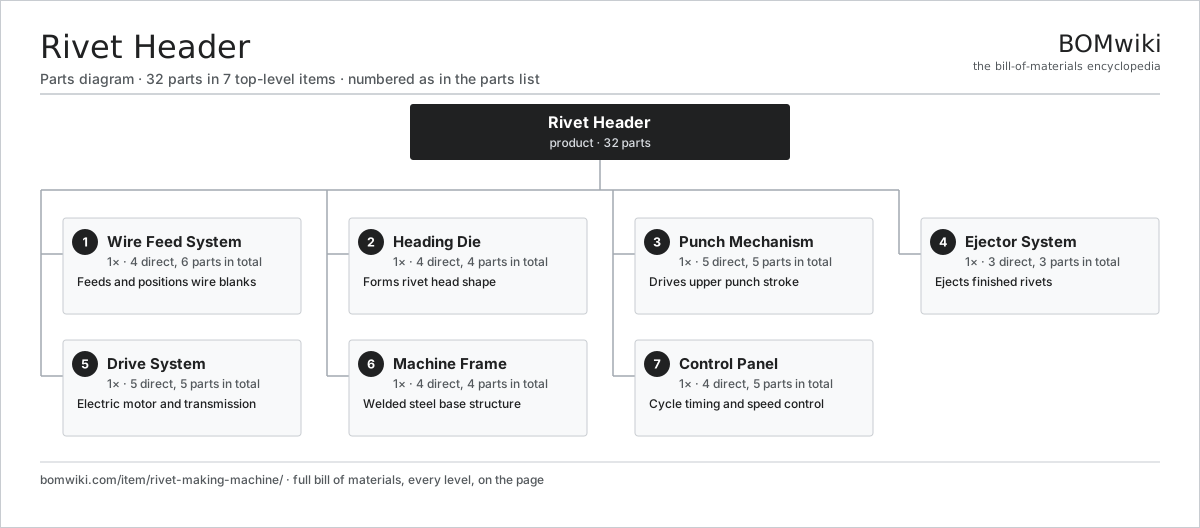
| # | Part | Qty | What it does |
|---|---|---|---|
| 1 | Wire Feed System 4 parts | 1× | Feeds and positions wire blanks |
| 2 | Heading Die 4 parts | 1× | Forms rivet head shape |
| 3 | Punch Mechanism 5 parts | 1× | Drives upper punch stroke |
| 4 | Ejector System 3 parts | 1× | Ejects finished rivets |
| 5 | Drive System 5 parts | 1× | Electric motor and transmission |
| 6 | Machine Frame 4 parts | 1× | Welded steel base structure |
| 7 | Control Panel 4 parts | 1× | Cycle timing and speed control |
3D model
No 3D model yet. Have a CAD file of this? Add a 3D model. STL renders right on this page; STEP, FreeCAD, and OpenSCAD sources are welcome too (openly licensed, like all 3D models on BOMwiki).
Build & assembly graph
expand / collapse · shared sub-assemblies converge · links to related products · est. labourTap an assembly to expand/collapse · tap a part to open it · use “Open page” for any node · drag to pan, scroll to zoom.
Bill of materials for Rivet Header
7 top-level lines · 36 rows shown · 32 parts total · indented to 3 levels| # | Item / sub-assembly | Part no. | Qty/assy | Ext. qty | Parts | Type |
|---|---|---|---|---|---|---|
| 1 | Wire Feed System 4 parts | rivet-making-machine-wire-feed-system | 1× | 1 | 6 | assembly |
| 1.1 | Wire Reel | rivet-making-machine-wire-reel | 1× | 1 | · | part |
| 1.2 | Straightener Rolls | rivet-making-machine-straightener-rolls | 1× | 1 | · | part |
| 1.3 | Feed Nose | rivet-making-machine-feed-nose | 1× | 1 | · | part |
| 1.4 | Ball Bearing | ball-bearing | 3× | 3 | · | part |
| 2 | Heading Die 4 parts | rivet-making-machine-heading-die | 1× | 1 | 4 | assembly |
| 2.1 | Die Cavity | rivet-making-machine-die-cavity | 1× | 1 | · | part |
| 2.2 | Die Holder | rivet-making-machine-die-holder | 1× | 1 | · | part |
| 2.3 | Die Punch | rivet-making-machine-die-punch | 1× | 1 | · | part |
| 2.4 | Fastener Set | fastener-set | 1× | 1 | · | part |
| 3 | Punch Mechanism 5 parts | rivet-making-machine-punch-mechanism | 1× | 1 | 5 | assembly |
| 3.1 | Punch Rod | rivet-making-machine-punch-rod | 1× | 1 | · | part |
| 3.2 | Punch Cam | rivet-making-machine-punch-cam | 1× | 1 | · | part |
| 3.3 | Punch Linkage | rivet-making-machine-punch-linkage | 1× | 1 | · | part |
| 3.4 | Ball Bearing | ball-bearing | 1× | 1 | · | part |
| 3.5 | O-Ring Set | oring-set | 1× | 1 | · | part |
| 4 | Ejector System 3 parts | rivet-making-machine-ejector-system | 1× | 1 | 3 | assembly |
| 4.1 | Ejector Pin | rivet-making-machine-ejector-pin | 1× | 1 | · | part |
| 4.2 | Ejector Actuator | rivet-making-machine-ejector-actuator | 1× | 1 | · | part |
| 4.3 | Collection Chute | rivet-making-machine-collection-chute | 1× | 1 | · | part |
| 5 | Drive System 5 parts | rivet-making-machine-drive-system | 1× | 1 | 5 | assembly |
| 5.1 | Electric Motor | rivet-making-machine-motor | 1× | 1 | · | part |
| 5.2 | Gearbox | rivet-making-machine-gearbox | 1× | 1 | · | part |
| 5.3 | Flywheel | rivet-making-machine-flywheel | 1× | 1 | · | part |
| 5.4 | Main Shaft | rivet-making-machine-main-shaft | 1× | 1 | · | part |
| 5.5 | Drive Belt | drive-belt | 1× | 1 | · | part |
| 6 | Machine Frame 4 parts | rivet-making-machine-machine-frame | 1× | 1 | 4 | assembly |
| 6.1 | Frame Base | rivet-making-machine-frame-base | 1× | 1 | · | part |
| 6.2 | Frame Uprights | rivet-making-machine-frame-uprights | 1× | 1 | · | part |
| 6.3 | Work Table | rivet-making-machine-work-table | 1× | 1 | · | part |
| 6.4 | Sheet Metal Panel | sheet-panel | 1× | 1 | · | part |
| 7 | Control Panel 4 parts | rivet-making-machine-control-panel | 1× | 1 | 5 | assembly |
| 7.1 | Speed Controller | rivet-making-machine-speed-control | 1× | 1 | · | part |
| 7.2 | Stroke Limiter | rivet-making-machine-stroke-limiter | 1× | 1 | · | part |
| 7.3 | Relay | relay | 2× | 2 | · | part |
| 7.4 | Pressure Sensor | pressure-sensor | 1× | 1 | · | part |
Something wrong in this list? Report a problem with this BOM.
Related products
same domain, ranked by shared parts Centrifugal Disc Finishing Machine
326 parts · shares 3 with this page
Cold Heading Machine
40 parts · shares 3 with this page
Centrifugal Disc Finishing Machine
326 parts · shares 3 with this page
Cold Heading Machine
40 parts · shares 3 with this page
 Crankshaft Grinder
511 parts · shares 3 with this page
Crankshaft Grinder
511 parts · shares 3 with this page
 Creep-Feed Grinder
571 parts · shares 3 with this page
Creep-Feed Grinder
571 parts · shares 3 with this page
Sourcing: possible vendors
Browse the supplier directory → Prices, MOQ, and lead times are algorithmic estimates, not quotes, and not claims about these companies. Company mappings are curated by keyword; est. price band $10k–$1M. How estimates work| Vendor | HQ | Specialty | MOQ | Lead time |
|---|---|---|---|---|
|
🇩🇪DMG MORI
dmgmori.com ↗
|
Bielefeld, DE | Machine tools | 5 units | 12–20 wks |
|
🇯🇵Mazak
mazak.com ↗
|
Oguchi, JP | Machine tools | 5 units | 12–20 wks |
| haascnc.com ↗ | Oxnard, US | CNC machine tools | 5 units | 12–20 wks |
|
🇯🇵Okuma
okuma.com ↗
|
Niwa, JP | Machine tools | 5 units | 12–20 wks |
|
🇩🇪Trumpf
trumpf.com ↗
|
Ditzingen, DE | Laser & sheet-metal machines | 5 units | 12–20 wks |
1,449-word article