Roll Laminator
ProductOverview
Roll laminators are workhorse machines in print finishing. They apply a protective or decorative adhesive film to printed sheets using heated rollers, bonding the film and paper together in a single pass. Common applications include book covers, business cards, packaging, and signage protection.
The process is simple but effective: an adhesive-coated film from a supply roll is positioned on top of a printed sheet. As both materials pass through heated rollers, the adhesive melts and bonds them together. The heat also seals any micro-gaps, creating a hermetic, durable laminate.
Roll laminators are available in two main variants: wet-glue (adhesive applied by the machine) and adhesive-coated film (film arrives pre-glued). Most modern machines use pre-glued adhesive-coated film because it's faster, cleaner, and requires less maintenance.
How it works
An operator positions a printed sheet on the Feed Table. The Film Unwind Section continuously feeds adhesive-coated film from a roll above the sheet. As both materials advance together via the Feed Motor, they enter the nip between the Upper Pressure Roller and Lower Backup Roller.
The Upper Roller Heater and Lower Roller Heater maintain temperatures 60-120 C depending on the adhesive type. Most hot-melt adhesives activate fully between 80-100 C. The Roller Temperature Sensor on each roller provides feedback to a thermostat keeping temperatures stable.
The Nip Adjustment Mechanism system (hydraulic or screw-based) sets the gap between rollers to approximately 0.1-1 mm, depending on laminate thickness and pressure requirements. As the sheet and film pass through the nip, pressure (typically 50-300 bar applied hydraulic load) squeezes them together, melting the adhesive and creating a uniform bond.
Exit time is critical: the hot laminate must be handled carefully to avoid wrinkling as the adhesive cools. Many machines include a Cooling Section with a fan blowing cool air onto the laminate, accelerating cure and allowing immediate downstream handling (cutting, stacking).
The laminated product can be slit to width using the Slitter Section, which cuts longitudinal edges off for waste removal or trims excess film. The finished laminate exits as a continuous web (for further processing) or is sheeted by downstream equipment.
Film Types and Adhesives
Modern adhesive-coated films are typically manufactured from polyester (PET), polypropylene (PP), or polyethylene (PE) with a pressure-sensitive or hot-melt adhesive backcoating. Hot-melt adhesive laminators are standard because they cure instantly (no solvent evaporation needed).
Common film weights: 25, 36, 50, and 75 microns. Thicker films provide better durability; thinner films reduce cost. The adhesive activation temperature is matched to the film: most are 80-110 C.
For special applications, laminators can apply liquid adhesive using a glue applicator roll, but modern shops prefer pre-glued film for speed and cleanliness.
Temperature Control
Precise temperature control is critical. Too cool and the adhesive doesn't melt, resulting in poor bonding. Too hot and the adhesive can bleed through the film or damage the substrate (especially photos or dye-sublimation prints).
The Temperature Controller allows separate temperature setpoints for upper and lower rollers. This is useful when laminating sensitive stocks (photo paper) to use lower lower-roller temperature while the upper roller provides laminate-film heat.
Most machines stabilize within ±2-3 C, adequate for most applications. Premium machines maintain ±1 C.
Pressure and Nip Setting
Nip pressure directly affects adhesive transfer and laminate quality. Low pressure results in weak bonding or air bubbles. High pressure can squeeze out the adhesive film (creating a dry bond that fails) or damage the substrate.
Pressure is typically set per stock type and film. A calibration chart (supplied with the machine) suggests starting pressures. Fine-tuning is done by running samples and inspecting for bubbles and peel strength.
The Nip Adjustment Mechanism is usually a manually-set lever or screw on entry-level machines, or a hydraulic system on large production laminators. Hydraulic systems allow programmable pressure profiles, useful for processing mixed stocks.
Speed Control
The Variable Frequency Drive allows stepless speed adjustment from 0-100%. Slower speeds (0.5-1 m/min) increase dwell time in the nip, improving adhesive wetting and reducing bubbles. Faster speeds (3-5 m/min) increase throughput but may sacrifice quality if adhesive hasn't fully transferred.
The Unwind Motor is servo-controlled to maintain constant web tension during feed. A slack film causes misalignment; excessive tension can stretch the film or tear it.
Web Alignment and Slitting
The Film Guide Rail and Registration Guide position the film and printed sheet to prevent skew. A Web Position Sensor detects lateral film position and signals the guide to correct any drift.
The Slitter Section is optional but common. It trims excess film or cuts the laminate to width. A rotary slitter blade runs continuously; a reciprocating shear blade is also available. Blade choice depends on laminate thickness and material.
Adhesive Bleeding and Curling
Two problems plague low-quality lamination:
Adhesive bleed: Hot adhesive squeezes out from under the film, creating a messy edge. This results from excessive pressure or high temperature. Solution: lower pressure or temperature slightly.
Laminate curl: The laminate curls after cooling if the upper and lower substrate layers shrink unevenly. This is common with thin films over thick paper. Solution: apply a backing film to both sides (face and back lamination) to balance shrinkage.
Cooling and Stacking
After exiting the nip, the hot laminate (80-100 C) must cool before handling. The Cooling Fan accelerates cooling to 40-50 C within 10-20 cm of exit, allowing safe handling and stacking.
Without cooling, hot laminates block (stick) when stacked, requiring manual separation. Pre-cooling also prevents adhesive reflow under stacking weight.
Maintenance
Daily: Verify temperature setpoints, check for paper dust or adhesive residue on rollers, ensure film tension. Weekly: Inspect roller surfaces for scoring or adhesive buildup, clean feed table of debris.
Monthly: Deep-clean roller surfaces with approved solvents (varies by adhesive type), check thermostat calibration, verify heater power output.
Roller resurfacing (honing) is required every 2-5 years depending on use. Resurfacing costs $1000-$3000 per roller.
Adhesive residue on rollers is the leading cause of laminator failure. If buildup accumulates, bond quality drops and laminates wrinkle. Regular cleaning extends roller life and prevents downtime.
Roll Laminator parts and their functions
8 top-level parts · 59 parts in total · full bill of materials below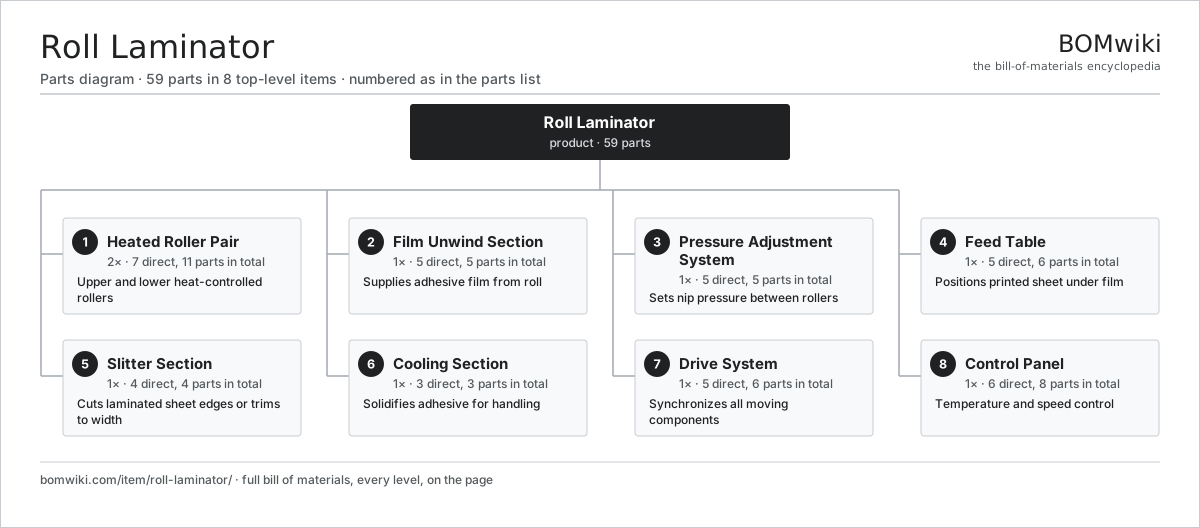
| # | Part | Qty | What it does |
|---|---|---|---|
| 1 | Heated Roller Pair 7 parts | 2× | Upper and lower heat-controlled rollers |
| 2 | Film Unwind Section 5 parts | 1× | Supplies adhesive film from roll |
| 3 | Pressure Adjustment System 5 parts | 1× | Sets nip pressure between rollers |
| 4 | Feed Table 5 parts | 1× | Positions printed sheet under film |
| 5 | Slitter Section 4 parts | 1× | Cuts laminated sheet edges or trims to width |
| 6 | Cooling Section 3 parts | 1× | Solidifies adhesive for handling |
| 7 | Drive System 5 parts | 1× | Synchronizes all moving components |
| 8 | Control Panel 6 parts | 1× | Temperature and speed control |
3D model
No 3D model yet. Have a CAD file of this? Add a 3D model. STL renders right on this page; STEP, FreeCAD, and OpenSCAD sources are welcome too (openly licensed, like all 3D models on BOMwiki).
Build & assembly graph
expand / collapse · shared sub-assemblies converge · links to related products · est. labourTap an assembly to expand/collapse · tap a part to open it · use “Open page” for any node · drag to pan, scroll to zoom.
Bill of materials for Roll Laminator
8 top-level lines · 48 rows shown · 59 parts total · indented to 3 levels| # | Item / sub-assembly | Part no. | Qty/assy | Ext. qty | Parts | Type |
|---|---|---|---|---|---|---|
| 1 | Heated Roller Pair 7 parts | roll-laminator-heated-roller-pair | 2× | 2 | 11 | assembly |
| 1.1 | Upper Pressure Roller | roll-laminator-roller-upper | 1× | 2 | · | part |
| 1.2 | Lower Backup Roller | roll-laminator-roller-lower | 1× | 2 | · | part |
| 1.3 | Upper Roller Heater | roll-laminator-roller-heater-upper | 1× | 2 | · | part |
| 1.4 | Lower Roller Heater | roll-laminator-roller-heater-lower | 1× | 2 | · | part |
| 1.5 | Roller Temperature Sensor | roll-laminator-temperature-sensor | 2× | 4 | · | part |
| 1.6 | Nip Adjustment Mechanism | roll-laminator-nip-adjustment | 1× | 2 | · | part |
| 1.7 | Ball Bearing | ball-bearing | 4× | 8 | · | part |
| 2 | Film Unwind Section 5 parts | roll-laminator-film-unwind | 1× | 1 | 5 | assembly |
| 2.1 | Unwind Motor | roll-laminator-unwind-motor | 1× | 1 | · | part |
| 2.2 | Dancer Roller | roll-laminator-dancer-roller | 1× | 1 | · | part |
| 2.3 | Tension Brake | roll-laminator-tension-brake | 1× | 1 | · | part |
| 2.4 | Film Guide Rail | roll-laminator-film-guide | 1× | 1 | · | part |
| 2.5 | Web Position Sensor | roll-laminator-web-sensor | 1× | 1 | · | part |
| 3 | Pressure Adjustment System 5 parts | roll-laminator-pressure-adjustment | 1× | 1 | 5 | assembly |
| 3.1 | Pressure Pump | roll-laminator-pressure-pump | 1× | 1 | · | part |
| 3.2 | Pressure Relief Valve | roll-laminator-pressure-valve | 1× | 1 | · | part |
| 3.3 | Pressure Cylinder | roll-laminator-pressure-cylinder | 1× | 1 | · | part |
| 3.4 | Pressure Sensor | pressure-sensor | 1× | 1 | · | part |
| 3.5 | Pressure Gauge | roll-laminator-pressure-gauge | 1× | 1 | · | part |
| 4 | Feed Table 5 parts | roll-laminator-feed-table | 1× | 1 | 6 | assembly |
| 4.1 | Table Bed | roll-laminator-table-bed | 1× | 1 | · | part |
| 4.2 | Feed Roller | roll-laminator-feed-roller | 1× | 1 | · | part |
| 4.3 | Feed Motor | roll-laminator-feed-motor | 1× | 1 | · | part |
| 4.4 | Registration Guide | roll-laminator-registration-guide | 1× | 1 | · | part |
| 4.5 | Ball Bearing | ball-bearing | 2× | 2 | · | part |
| 5 | Slitter Section 4 parts | roll-laminator-slitter | 1× | 1 | 4 | assembly |
| 5.1 | Rotary Slitter Blade | roll-laminator-slitter-blade-rotary | 1× | 1 | · | part |
| 5.2 | Slitter Motor | roll-laminator-slitter-blade-motor | 1× | 1 | · | part |
| 5.3 | Slitter Backup Roller | roll-laminator-slitter-pressure-roller | 1× | 1 | · | part |
| 5.4 | Slitter Positioning | roll-laminator-slitter-positioning | 1× | 1 | · | part |
| 6 | Cooling Section 3 parts | roll-laminator-cooling-section | 1× | 1 | 3 | assembly |
| 6.1 | Cooling Fan | roll-laminator-cooling-fan | 1× | 1 | · | part |
| 6.2 | Cooling Duct | roll-laminator-cooling-duct | 1× | 1 | · | part |
| 6.3 | Exit Temperature Sensor | roll-laminator-temperature-sensor-exit | 1× | 1 | · | part |
| 7 | Drive System 5 parts | roll-laminator-drive-system | 1× | 1 | 6 | assembly |
| 7.1 | Main Drive Motor | roll-laminator-main-motor | 1× | 1 | · | part |
| 7.2 | Variable Frequency Drive | roll-laminator-vfd | 1× | 1 | · | part |
| 7.3 | Drive Belt | roll-laminator-drive-belt | 1× | 1 | · | part |
| 7.4 | Drive Pulley | roll-laminator-pulley | 2× | 2 | · | part |
| 7.5 | Shaft Coupler | roll-laminator-shaft-coupler | 1× | 1 | · | part |
| 8 | Control Panel 6 parts | roll-laminator-control-panel | 1× | 1 | 8 | assembly |
| 8.1 | Microcontroller | mcu | 1× | 1 | · | part |
| 8.2 | LCD Panel | lcd-panel | 1× | 1 | · | part |
| 8.3 | Temperature Controller | roll-laminator-thermostat | 1× | 1 | · | part |
| 8.4 | Speed Control Pot | roll-laminator-speed-potentiometer | 1× | 1 | · | part |
| 8.5 | Relay | relay | 3× | 3 | · | part |
| 8.6 | Bare PCB | pcb-bare | 1× | 1 | · | part |
Something wrong in this list? Report a problem with this BOM.
Related products
same domain, ranked by shared parts Aerosol Filling Machine
119 parts · shares 1 with this page
Aerosol Filling Machine
119 parts · shares 1 with this page
 Automatic Strapping Machine
251 parts · shares 1 with this page
Banner Welder
90 parts · shares 1 with this page
Automatic Strapping Machine
251 parts · shares 1 with this page
Banner Welder
90 parts · shares 1 with this page
 Blister Packaging Machine
256 parts · shares 1 with this page
Blister Packaging Machine
256 parts · shares 1 with this page
 Cartoning Machine
280 parts · shares 1 with this page
Case Labeling Machine
120 parts · shares 1 with this page
Cartoning Machine
280 parts · shares 1 with this page
Case Labeling Machine
120 parts · shares 1 with this page
Sourcing: possible vendors
Browse the supplier directory → Prices, MOQ, and lead times are algorithmic estimates, not quotes, and not claims about these companies. Company mappings are curated by keyword; est. price band $10k–$3M. How estimates work| Vendor | HQ | Specialty | MOQ | Lead time |
|---|---|---|---|---|
| heidelberg.com ↗ | Heidelberg, DE | Printing presses | 10 units | 12–22 wks |
|
🇨🇭Bobst
bobst.com ↗
|
Lausanne, CH | Packaging machinery | 10 units | 12–22 wks |
| koenig-bauer.com ↗ | Würzburg, DE | Printing presses | 10 units | 12–22 wks |
| wuh-group.com ↗ | Lengerich, DE | Flexible packaging machines | 10 units | 12–22 wks |
| markandy.com ↗ | Chesterfield, US | Label presses | 10 units | 12–22 wks |
1,071-word article