Roller Coaster
ProductOverview
A roller coaster is a gravity-driven amusement ride consisting of wheeled passenger trains traversing a predetermined rail structure. The trains are lifted to a crest via chain or launch system, then gain speed through successive descents, climbs, and inversions while experiencing controlled lateral acceleration. Magnetic or friction brakes decelerate the train to a safe speed in the station; all critical functions, dispatch, brake engagement, and restraint verification, are orchestrated by a hardwired safety controller.
Modern coasters use either steel tubular track (allowing inversions) or wooden track with multiple guide rails. The track profile comprises three independent wheel sets per car: road wheels (underneath), guide wheels (lateral restraint), and anti-rollback wheels (preventing upside-down derailment on inversions).
How It Works
Lift Phase
Trains are pulled up to crest height via a chain running under the track, or launched horizontally using a cable system or linear synchronous motor (LSM). Hall-effect sensors track the train's position; slip-detection circuits disengage the lift if the train stalls. A secondary chain brake ensures the train does not free-fall if the main chain breaks.
Descent and Maneuvers
Once crested, trains accelerate under gravity through the first drop, then navigate a sequence of elements (banked turns, inversions, airtime hills) designed to produce peak g-forces between 2–4 g. The track geometry is calculated so that the train never lifts off the road wheels (except during airtime, when multiple guide wheels hold the car on the rail).
Brake and Station Stop
Eddy-current magnetic brakes (or friction fins) are positioned at the exit. As each wheel set passes through the brake zone, induced currents in aluminum fins resist the magnetic field, creating progressive deceleration. The train coasts into the station at 5–10 km/h, where a final friction brake or catch-car mechanism brings it to rest. Restraint sensors then unlock only when the control system confirms zero motion.
Control System
A hardwired PLC monitors:
- Restraint position (closed) via Hall sensors
- Brake fin passage (eddy-current sensor or rotary encoder)
- Lift chain tension (pressure transducer)
- Train position (photoeyes or inductive loops at key points)
- Hourly cycle counter
The PLC enforces an interlock: brakes must be armed, restraints confirmed closed, and the previous train fully departed before dispatch. Dual-channel safety relays ensure that a single short or disconnected sensor does not allow unsafe operation.
Structure and Track
The support structure is typically a lattice of welded I-beams for steel coasters, or cross-braced wooden columns for wooden coasters. Steel structures are bolted together in the field; wooden structures are lag-bolted and may require seasonal truss-cable bracing.
Track is either:
- Tubular steel: Hollow round or teardrop profile, allowing complete inversions.
- Wooden with rails: Wooden beams with bolted-on steel rails; does not permit inversions, but allows overbanked turns up to 110°.
Guide wheels and road wheels are made of polyurethane or aluminum alloy and run on sealed roller bearings. Wheel assemblies are bolted to the car frame in pairs (each car typically has 6 wheels) and are designed to be user-serviceable every 500–1,000 operating hours.
Passenger Cars and Restraints
Passenger cars are welded steel frames with bolted-on seat subframes. Seating ranges from individual molded plastic shells to bench-style seats. Restraints vary:
- Lap bars: For non-inversion coasters; two points of attachment per car.
- Over-shoulder harnesses: Required for inversions; typically four attachment points (two over shoulders, two across thighs).
- Automated seat belts: Increasingly common; dual-redundant buckles with pilot-operated check valves to prevent accidental release.
Each restraint has a proximity or Hall-effect sensor. The PLC monitors every restraint individually; if even one is open at dispatch time, a solenoid shuts off the lift motor and activates brakes.
Maintenance and Reliability
Key wear items include wheel assemblies (replaced every 2–5 years depending on track surface), bearings (sealed units, service-free), and brake fins or eddy-current magnets (inspected annually for cracks). The control system logs every dispatch and fault code in non-volatile memory; operators review logs daily and file incident reports for any sensor glitches.
Coasters typically achieve 95–99% uptime during the operating season. Seasonal shutdown includes full wheel and bearing inspection, track surface cleaning, and recalibration of all brake and restraint sensors.
Standards and Safety
Coasters are designed to ASTM F24 (primarily F2374 for fixed rides) and international EN 13814 standards. Key design factors include:
- Restraint hold-down force (varies by element and rider mass).
- Emergency egress: cars must be designed to allow rider evacuation in under 10 minutes if the train stalls on-course.
- Fatigue analysis: structures are typically designed for 30–50 years and 10 million+ cycles.
- Testing: new or modified coasters undergo 48-hour endurance runs with instrumented test vehicles before passenger operation.
Economic and Operational Context
A typical medium-sized coaster (80–100 m tall, 40-second ride) costs $15–35 million to design and construct. Annual operating and maintenance costs range $400,000–$1.5 million depending on season length and utilization. A well-managed coaster will generate $2–5 million in annual ticket revenue at busy regional parks, achieving ROI in 5–10 years.
Roller Coaster parts and their functions
7 top-level parts · 657 parts in total · full bill of materials below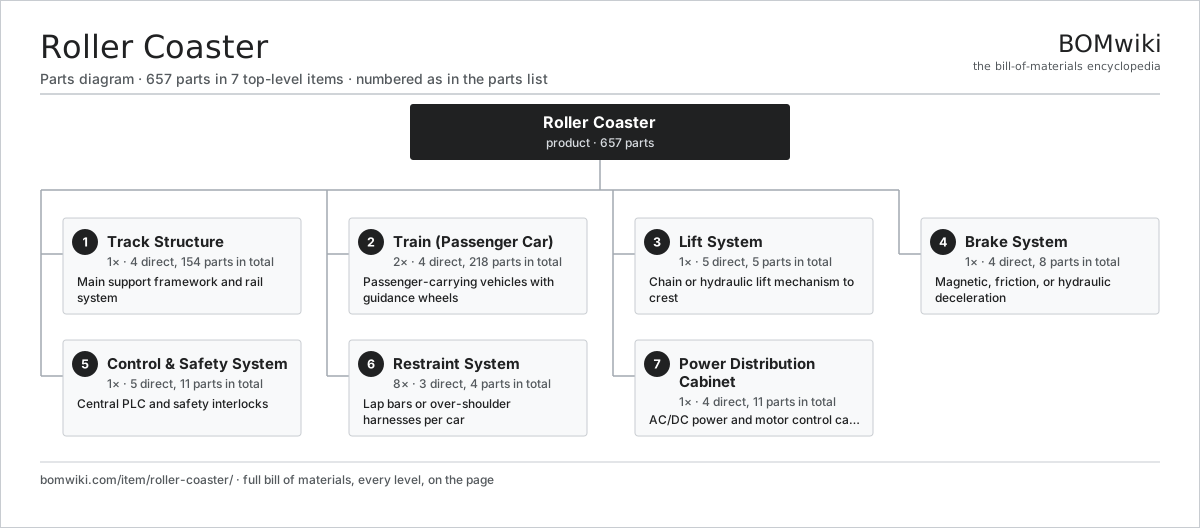
| # | Part | Qty | What it does |
|---|---|---|---|
| 1 | Track Structure 4 parts | 1× | Main support framework and rail system |
| 2 | Train (Passenger Car) 4 parts | 2× | Passenger-carrying vehicles with guidance wheels |
| 3 | Lift System 5 parts | 1× | Chain or hydraulic lift mechanism to crest |
| 4 | Brake System 4 parts | 1× | Magnetic, friction, or hydraulic deceleration |
| 5 | Control & Safety System 5 parts | 1× | Central PLC and safety interlocks |
| 6 | Restraint System 3 parts | 8× | Lap bars or over-shoulder harnesses per car |
| 7 | Power Distribution Cabinet 4 parts | 1× | AC/DC power and motor control cabinet |
3D model
No 3D model yet. Have a CAD file of this? Add a 3D model. STL renders right on this page; STEP, FreeCAD, and OpenSCAD sources are welcome too (openly licensed, like all 3D models on BOMwiki).
Build & assembly graph
expand / collapse · shared sub-assemblies converge · links to related products · est. labourTap an assembly to expand/collapse · tap a part to open it · use “Open page” for any node · drag to pan, scroll to zoom.
Bill of materials for Roller Coaster
7 top-level lines · 44 rows shown · 657 parts total · indented to 3 levels| # | Item / sub-assembly | Part no. | Qty/assy | Ext. qty | Parts | Type |
|---|---|---|---|---|---|---|
| 1 | Track Structure 4 parts | roller-coaster-track-structure | 1× | 1 | 154 | assembly |
| 1.1 | Sheet Metal Panel | sheet-panel | 120× | 120 | · | part |
| 1.2 | Fastener Set | fastener-set | 8× | 8 | · | part |
| 1.3 | Ball Bearing | ball-bearing | 24× | 24 | · | part |
| 1.4 | Welding Consumables | welding-consumables | 2× | 2 | · | part |
| 2 | Train (Passenger Car) 4 parts | roller-coaster-train-assembly | 2× | 2 | 218 | assembly |
| 2.1 | Wheel Set Assembly 3 parts | roller-coaster-wheel-assembly | 6× | 12 | 31 | assembly |
| 2.1.1 | Ball Bearing | ball-bearing | 3× | 36 | · | part |
| 2.1.2 | Wheel Assembly 5 parts + deeper › | wheel-assembly | 3× | 36 | 9 | assembly |
| 2.1.3 | Fastener Set | fastener-set | 1× | 12 | · | part |
| 2.2 | Seat Assembly 5 parts | seat-assembly | 4× | 8 | 7 | assembly |
| 2.2.1 | Seat Frame | seat-frame | 1× | 8 | · | part |
| 2.2.2 | Seat Foam | seat-foam | 2× | 16 | · | part |
| 2.2.3 | Seat Cover | seat-cover | 1× | 8 | · | part |
| 2.2.4 | Seat Motor | seat-motor | 2× | 16 | · | part |
| 2.2.5 | Seat Heater Mat | seat-heater | 1× | 8 | · | part |
| 2.3 | Fastener Set | fastener-set | 3× | 6 | · | part |
| 2.4 | Cable Harness | cable-harness | 1× | 2 | · | part |
| 3 | Lift System 5 parts | roller-coaster-lift-system | 1× | 1 | 5 | assembly |
| 3.1 | Blower Motor | blower-motor | 1× | 1 | · | part |
| 3.2 | Drive Belt | drive-belt | 1× | 1 | · | part |
| 3.3 | Gearbox Housing | gearbox-housing | 1× | 1 | · | part |
| 3.4 | Hall Sensor | hall-sensor | 1× | 1 | · | part |
| 3.5 | Pressure Sensor | pressure-sensor | 1× | 1 | · | part |
| 4 | Brake System 4 parts | roller-coaster-brake-system | 1× | 1 | 8 | assembly |
| 4.1 | Neodymium Magnet | neodymium-magnet | 4× | 4 | · | part |
| 4.2 | Pressure Sensor | pressure-sensor | 2× | 2 | · | part |
| 4.3 | Solenoid Valve | solenoid-valve | 1× | 1 | · | part |
| 4.4 | Fastener Set | fastener-set | 1× | 1 | · | part |
| 5 | Control & Safety System 5 parts | roller-coaster-control-system | 1× | 1 | 11 | assembly |
| 5.1 | Microcontroller | mcu | 1× | 1 | · | part |
| 5.2 | Relay | relay | 4× | 4 | · | part |
| 5.3 | Bare PCB | pcb-bare | 2× | 2 | · | part |
| 5.4 | LCD Panel | lcd-panel | 1× | 1 | · | part |
| 5.5 | Connector | connector | 3× | 3 | · | part |
| 6 | Restraint System 3 parts | roller-coaster-restraint-assembly | 8× | 8 | 4 | assembly |
| 6.1 | Fastener Set | fastener-set | 2× | 16 | · | part |
| 6.2 | Hall Sensor | hall-sensor | 1× | 8 | · | part |
| 6.3 | Wire Bundle | wire-bundle | 1× | 8 | · | part |
| 7 | Power Distribution Cabinet 4 parts | roller-coaster-power-distribution | 1× | 1 | 11 | assembly |
| 7.1 | Power Supply | power-supply | 2× | 2 | · | part |
| 7.2 | Relay | relay | 6× | 6 | · | part |
| 7.3 | Fastener Set | fastener-set | 1× | 1 | · | part |
| 7.4 | Connector | connector | 2× | 2 | · | part |
Something wrong in this list? Report a problem with this BOM.
Related products
same domain, ranked by shared parts Dark Ride System
1,005 parts · shares 21 with this page
Dark Ride System
1,005 parts · shares 21 with this page
 Ferris Wheel
3,547 parts · shares 19 with this page
Ferris Wheel
3,547 parts · shares 19 with this page
 Alpine Coaster
1,850 parts · shares 15 with this page
Alpine Coaster
1,850 parts · shares 15 with this page
 Drop Tower Ride
308 parts · shares 15 with this page
Drop Tower Ride
308 parts · shares 15 with this page
 Pirate Ship Ride
478 parts · shares 15 with this page
Pirate Ship Ride
478 parts · shares 15 with this page
 Teacup Ride
660 parts · shares 15 with this page
Teacup Ride
660 parts · shares 15 with this page
Sourcing: possible vendors
Browse the supplier directory → Prices, MOQ, and lead times are algorithmic estimates, not quotes, and not claims about these companies. Company mappings are curated by keyword; est. price band $20–$3k. How estimates work| Vendor | HQ | Specialty | MOQ | Lead time |
|---|---|---|---|---|
|
🇩🇰LEGO
lego.com ↗
|
Billund, DK | Construction toys | 2,000 units | 6–10 wks |
|
🇺🇸Mattel
mattel.com ↗
|
El Segundo, US | Toys | 2,000 units | 6–10 wks |
|
🇺🇸Hasbro
hasbro.com ↗
|
Pawtucket, US | Toys & games | 2,000 units | 6–10 wks |
| bandainamco.co.jp ↗ | Tokyo, JP | Toys & amusement | 2,000 units | 6–10 wks |
| spinmaster.com ↗ | Toronto, CA | Toys | 2,000 units | 6–10 wks |
872-word article