Rooftop Cargo Box
ProductOverview
A rooftop cargo box (roof box, roof pod, top box) is an aerodynamic external storage container mounted on a vehicle's roof rail system, providing 150–250 L of weatherproof cargo capacity for vacation travel, sports equipment, or extended camping trips. The boxes are molded from UV-resistant polyethylene or fiberglass, designed with streamlined contours to minimize aerodynamic drag and fuel economy penalty. A hinged lid with dual gas struts and push-button locks enables convenient access. Universal mounting brackets adapt to most factory roof rail systems, and continuous gasket strips prevent water infiltration. Roof boxes have become standard equipment for adventure travel, ski trips, and family road trips where extra storage extends vehicle range without requiring roof racks or towing trailers.
How It Works
The Molded Body Shell is a two-piece molded structure consisting of a Lower Shell Half lower body and Upper Shell Half upper body. The lower half is tapered at the front to reduce aerodynamic drag; the overall shape is elongated to maximize internal volume while fitting standard garage clearances (typically limiting height to ~40–50 cm above the roof rail).
The Shell Material Specification is typically rotational-molded polyethylene (plastic) or fiberglass composite. Rotational molding creates a seamless, hollow, rigid structure by rotating a mold half-filled with powdered resin in an oven. The resin melts and coats the mold interior evenly, producing uniform wall thickness (3–4 mm) without seams. This process is cost-effective for high-volume production and yields excellent durability. Fiberglass (glass-fiber-reinforced polyester) offers slightly better stiffness and lower weight but at higher cost.
Both materials are UV-stabilized to resist sunlight degradation. Polyethylene boxes typically last 8–12 years before becoming brittle; fiberglass lasts 15+ years.
The Hinged Top Lid Assembly is hinged on both sides via stainless-steel Left Lid Hinge and Right Lid Hinge piano-type hinges. These hinges are rated for 150+ kg loads, withstanding repeated opening/closing cycles (estimated 10,000+ cycles over the box's lifetime).
Two Left Gas Strut and Right Gas Strut assist lid opening. Gas struts are pressurized cylinders with a spring-loaded piston; applying a small upward force (a few kg) initiates opening, and the strut extends fully, holding the lid open. This eliminates the need for a prop rod and enables one-handed operation. Gas strut force is typically 50–80 N (equivalent to 5–8 kg upward push), enough to hold a 30–40 kg lid open.
The Primary Central Lock is a push-button or key-operated central lock engaging both hinges when closed. When locked, it prevents the lid from being opened and also serves as the primary connection point, preventing the lid from detaching even if the hinges fail. A Secondary Safety Lock is a child-safety pin or mechanical backup lock preventing accidental lid closure on occupants inside (e.g., a child reaching into the box).
The Weather Seal Gaskets is a critical component preventing water infiltration. A Lid Gasket Strip foam or rubber gasket runs continuously around the lid-to-body seam. When the lid is closed and locked, the gasket compresses against the shell lip, creating a water-tight seal. The Shell Seam Sealant compound seals the joint where the two body halves are glued or welded during manufacturing.
Inside, the Interior Tie-Down and Shelving include Left Interior Rail and Right Interior Rail aluminum or plastic rails running the full length. These rails have slots or D-ring anchors (Tie-Down D-Ring) allowing straps or ropes to secure cargo and prevent shifting during cornering. A Interior Floor Mat rubber mat lines the floor, damping noise and protecting cargo from scratches.
Mounting is via the Roof Rack Mounting System system. The Front Mounting Bracket and Rear Mounting Bracket brackets connect the cargo box to factory roof rail systems via Roof Rail Clamp clamps. The Rail Width Adjustment Mechanism mechanism allows the clamps to accommodate varying roof rail widths (typically 150–210 mm, depending on vehicle make). Clamp Padding rubber or foam pads between the clamp jaws and roof prevent paint damage. The entire mounting system is tool-free or requires only a hex wrench for final torque (typical specification: 25–30 N·m on M8 bolts).
Installation and Removal
Installation takes 15–30 minutes:
- Position Front Mounting Bracket and Rear Mounting Bracket on roof rails, aligned with the vehicle's centerline.
- Adjust Rail Width Adjustment Mechanism to match rail width, then tighten Roof Rail Clamp to snug (hand-tight).
- Lift cargo box onto brackets (requires 2–3 people or a hoist), aligning mounting holes.
- Insert and hand-tighten Roof Rail Bolts.
- Final torque bolts to 25–30 N·m specification.
- Test lid operation and lock engagement.
Removal is the reverse: loosen bolts, lower box with assistance, and remove brackets. The entire system is reversible with no permanent modifications to the vehicle.
Load Distribution and Stability
Load capacity is typically 150–200 kg maximum, including the box itself (35–65 kg). This limit is set by:
- Roof load rating (most vehicles specify 75–100 kg roof limit)
- Cargo box structural rating
- Mounting clamp strength
Exceeding load limits risks roof damage, hinge failure, or mounting clamp slipping.
Weight distribution is critical for vehicle handling. Cargo should be distributed evenly front-to-back (centered on the roof's length). A heavily rear-weighted load (e.g., all skis in the rear) raises the vehicle's center of gravity asymmetrically, affecting handling in curves and potentially causing oversteer or understeer changes.
Professional installers often recommend keeping total roof-mounted weight (box + cargo) below 50 kg for optimal handling preservation.
Aerodynamic and Fuel Economy Impact
An installed roof box increases aerodynamic drag by approximately 20–30%, resulting in 5–8% fuel economy penalty at highway speeds (80+ km/h). This drag is due to the box's frontal area and wake (the low-pressure zone behind the box). Streamlined designs (tapered nose, sloped tail) minimize this drag compared to rectangular boxes.
Fuel economy impact is greatest at highway speeds and becomes negligible in city driving. A vehicle achieving 10 L/100 km without a roof box might achieve 10.5–10.8 L/100 km with an installed box at continuous highway driving.
To minimize drag, the Lower Shell Half features a sloped nose (30–45° angle), directing air around the box rather than pushing it upward. The rear of the box is also tapered, reducing the wake pressure differential.
Weather Sealing and Maintenance
The Lid Gasket Strip gasket provides effective water-sealing when new, but after 5–8 years, the foam or rubber degrades (becomes hard and brittle), losing seal effectiveness. Water may begin seeping into the box during heavy rain or car washes.
Replacement is straightforward:
- Open the lid fully.
- Remove old gasket (often simply peels off).
- Clean the seam with rubbing alcohol.
- Apply new gasket material (available as pre-cut strips or bulk material).
- Press gasket into place and let cure (typically 24 hours).
Regular inspection of the Shell Seam Sealant manufacturing seam is also recommended. UV exposure and thermal cycling can cause seam splitting over 10+ years; sealing compound can be re-applied as needed.
Installation on Different Vehicle Types
Sedans and hatchbacks: Factory roof rails are standard. Installation is straightforward with universal brackets.
SUVs and crossovers: Higher roof height increases aerodynamic impact (taller vehicle profiles already experience high drag). Center of gravity is already elevated; additional rooftop weight exacerbates handling changes.
Trucks: Most trucks lack factory roof rails. Aftermarket racks must be installed first ($300–600), then the cargo box mounted. Total height above ground may exceed 2.5 m, limiting parking garage access.
Mini vans and sedans with roof rails: Factory rails are often low-profile and not all cargo boxes are compatible; compatibility should be verified before purchase.
Variants and Specialized Designs
Roof racks with basket: Open-air racks with mesh baskets, lower cost, but exposure to weather and theft risk.
Soft-sided roof bags: Nylon or canvas bags, lightweight and packable, but less weather protection and durability.
Hard-shell integrated roof racks: Some SUVs feature factory-integrated roof rails with hardened or lockable access panels, blending cargo box and roof architecture.
Gull-wing or panoramic roof boxes: Premium boxes feature motorized opening panels, allowing access without fully extending the lid (useful in tight garage spaces).
Lockable boxes: Premium models integrate electronic locks (keyfob opening) or mechanical key locks preventing theft of cargo.
Historical Context
Roof boxes emerged in the 1970s as plastic molding technology matured. Early designs were simple rectangular boxes with poor aerodynamics. The 1980s–2000s saw rapid evolution: streamlined shapes, better sealing, and improved mounting systems. Modern designs prioritize both aesthetics and function. The market is dominated by European brands (Thule, Yakima, Rhino) which pioneered the category, with Chinese manufacturers offering budget alternatives ($300–600 vs. $1000–1500 premium brands).
Rooftop Cargo Box parts and their functions
6 top-level parts · 48 parts in total · full bill of materials below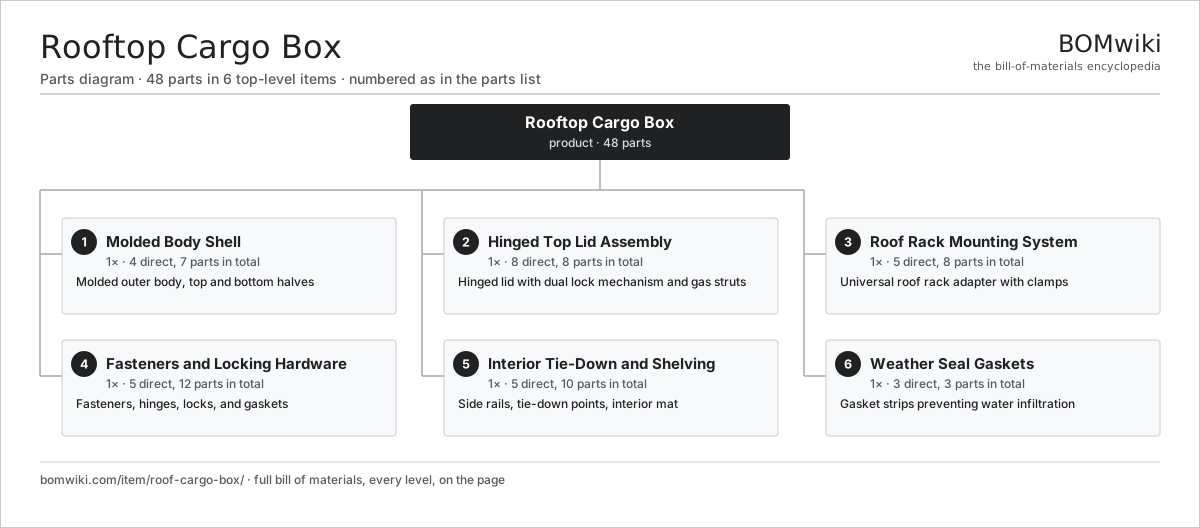
| # | Part | Qty | What it does |
|---|---|---|---|
| 1 | Molded Body Shell 4 parts | 1× | Molded outer body, top and bottom halves |
| 2 | Hinged Top Lid Assembly 8 parts | 1× | Hinged lid with dual lock mechanism and gas struts |
| 3 | Roof Rack Mounting System 5 parts | 1× | Universal roof rack adapter with clamps |
| 4 | Fasteners and Locking Hardware 5 parts | 1× | Fasteners, hinges, locks, and gaskets |
| 5 | Interior Tie-Down and Shelving 5 parts | 1× | Side rails, tie-down points, interior mat |
| 6 | Weather Seal Gaskets 3 parts | 1× | Gasket strips preventing water infiltration |
3D model
No 3D model yet. Have a CAD file of this? Add a 3D model. STL renders right on this page; STEP, FreeCAD, and OpenSCAD sources are welcome too (openly licensed, like all 3D models on BOMwiki).
Build & assembly graph
expand / collapse · shared sub-assemblies converge · links to related products · est. labourTap an assembly to expand/collapse · tap a part to open it · use “Open page” for any node · drag to pan, scroll to zoom.
Bill of materials for Rooftop Cargo Box
6 top-level lines · 36 rows shown · 48 parts total · indented to 3 levels| # | Item / sub-assembly | Part no. | Qty/assy | Ext. qty | Parts | Type |
|---|---|---|---|---|---|---|
| 1 | Molded Body Shell 4 parts | roof-cargo-box-shell | 1× | 1 | 7 | assembly |
| 1.1 | Upper Shell Half | roof-cargo-box-shell-top | 1× | 1 | · | part |
| 1.2 | Lower Shell Half | roof-cargo-box-shell-bottom | 1× | 1 | · | part |
| 1.3 | Shell Material Specification | roof-cargo-box-shell-material | 1× | 1 | · | part |
| 1.4 | Corner Reinforcement Gussets | roof-cargo-box-corner-reinforcement | 4× | 4 | · | part |
| 2 | Hinged Top Lid Assembly 8 parts | roof-cargo-box-lid | 1× | 1 | 8 | assembly |
| 2.1 | Lid Panel Assembly | roof-cargo-box-lid-panel | 1× | 1 | · | part |
| 2.2 | Left Lid Hinge | roof-cargo-box-lid-hinge-left | 1× | 1 | · | part |
| 2.3 | Right Lid Hinge | roof-cargo-box-lid-hinge-right | 1× | 1 | · | part |
| 2.4 | Left Gas Strut | roof-cargo-box-lid-gas-strut-left | 1× | 1 | · | part |
| 2.5 | Right Gas Strut | roof-cargo-box-lid-gas-strut-right | 1× | 1 | · | part |
| 2.6 | Primary Central Lock | roof-cargo-box-lid-lock-primary | 1× | 1 | · | part |
| 2.7 | Secondary Safety Lock | roof-cargo-box-lid-lock-secondary | 1× | 1 | · | part |
| 2.8 | Recessed Lid Handle | roof-cargo-box-lid-handle | 1× | 1 | · | part |
| 3 | Roof Rack Mounting System 5 parts | roof-cargo-box-mounting-bracket | 1× | 1 | 8 | assembly |
| 3.1 | Front Mounting Bracket | roof-cargo-box-bracket-front | 1× | 1 | · | part |
| 3.2 | Rear Mounting Bracket | roof-cargo-box-bracket-rear | 1× | 1 | · | part |
| 3.3 | Roof Rail Clamp | roof-cargo-box-bracket-clamp | 4× | 4 | · | part |
| 3.4 | Rail Width Adjustment Mechanism | roof-cargo-box-bracket-adjustment | 1× | 1 | · | part |
| 3.5 | Clamp Padding | roof-cargo-box-bracket-padding | 1× | 1 | · | part |
| 4 | Fasteners and Locking Hardware 5 parts | roof-cargo-box-hardware | 1× | 1 | 12 | assembly |
| 4.1 | Hinge Bolts | roof-cargo-box-hinge-bolt-set | 1× | 1 | · | part |
| 4.2 | Central Lock Mechanism | roof-cargo-box-lock-mechanism | 1× | 1 | · | part |
| 4.3 | Secondary Pin Lock | roof-cargo-box-secondary-lock | 1× | 1 | · | part |
| 4.4 | Gasket Strips | roof-cargo-box-gasket-material | 1× | 1 | · | part |
| 4.5 | Roof Rail Bolts | roof-cargo-box-mounting-bolts | 8× | 8 | · | part |
| 5 | Interior Tie-Down and Shelving 5 parts | roof-cargo-box-interior-fittings | 1× | 1 | 10 | assembly |
| 5.1 | Left Interior Rail | roof-cargo-box-side-rail-left | 1× | 1 | · | part |
| 5.2 | Right Interior Rail | roof-cargo-box-side-rail-right | 1× | 1 | · | part |
| 5.3 | Tie-Down D-Ring | roof-cargo-box-tie-down-point | 6× | 6 | · | part |
| 5.4 | Interior Floor Mat | roof-cargo-box-interior-mat | 1× | 1 | · | part |
| 5.5 | Internal Divider Shelf | roof-cargo-box-divider-shelf | 1× | 1 | · | part |
| 6 | Weather Seal Gaskets 3 parts | roof-cargo-box-weatherseal | 1× | 1 | 3 | assembly |
| 6.1 | Lid Gasket Strip | roof-cargo-box-gasket-lid-perimeter | 1× | 1 | · | part |
| 6.2 | Shell Seam Sealant | roof-cargo-box-gasket-shell-seam | 1× | 1 | · | part |
| 6.3 | Replacement Gasket Kit | roof-cargo-box-gasket-replacement-kit | 1× | 1 | · | part |
Something wrong in this list? Report a problem with this BOM.
Sourcing: possible vendors
Browse the supplier directory → Prices, MOQ, and lead times are algorithmic estimates, not quotes, and not claims about these companies. Company mappings are curated by keyword; est. price band $20–$2k. How estimates work| Vendor | HQ | Specialty | MOQ | Lead time |
|---|---|---|---|---|
|
🇺🇸Coleman
coleman.com ↗
|
Chicago, US | Camping gear | 1,000 units | 6–10 wks |
| thenorthface.com ↗ | Denver, US | Outdoor apparel & gear | 1,000 units | 6–10 wks |
|
🇺🇸YETI
yeti.com ↗
|
Austin, US | Coolers & drinkware | 1,000 units | 6–10 wks |
| decathlon.com ↗ | Villeneuve-d'Ascq, FR | Sporting goods | 1,000 units | 6–10 wks |
|
🇺🇸Garmin
garmin.com ↗
|
Olathe, US | GPS & wearables | 1,000 units | 6–10 wks |
1,560-word article