Roof Window
ProductOverview
Roof windows are fixed, dual-glazed window units installed in pitched roofs, offering natural light and passive ventilation to attic spaces, lofts, and upper floors. Unlike skylight wells (which are strictly structural shafts), roof windows integrate a sash mechanism that pivots horizontally, allowing occupants to open the window 0–45° for air exchange and egress during fires.
The modern motorized version automates opening and closing via a 24 VDC linear actuator, eliminating manual operation and enabling remote control via Wi-Fi. A rain sensor integrated into the control module automatically closes the window if precipitation is detected, protecting interiors from accidental water entry.
Integration with the roof structure requires careful flashing and underlayment to prevent water infiltration. Lead-free zinc flashing provides 50+ year lifespan, and synthetic underlayment with a peel-and-stick backing seals the aperture.
Design & Structure
The frame and sash are engineered as a single assembly, commonly made from laminated spruce or aluminum. The frame is the fixed part, secured to roof rafters and covered by exterior flashing. The sash is the operable glazed panel that rotates on two stainless steel ball-bearing hinges mounted at the frame's top edge.
A spring-assist balance mechanism reduces the opening force to under 20 N, making manual operation effortless. For motorized versions, a 24 VDC linear actuator is mounted between the sash and frame, pulling the sash open and using spring pressure for closure.
The insulated glazing unit is a sealed assembly comprising two panes separated by a warm-edge spacer containing desiccant. The outer pane (6 mm) is tempered low-iron glass with a hydrophobic coating; the inner pane (4 mm) carries a soft-coat low-E coating that reflects infrared radiation while transmitting visible light. Argon gas fills the 12 mm cavity, reducing conductive heat transfer.
U-value (thermal transmittance) for the complete window is typically 0.25 W/m²K, comparable to high-performance wall insulation. This is achieved through the low-E coating, argon fill, and warm-edge spacer design. Solar heat gain coefficient (SHGC) is 0.22, meaning 22% of incident solar energy enters the interior, desirable in winter, problematic in summer without external shading.
Ventilation & Rain Protection
The motorized ventilation flap is a damper integrated into the sash's bottom edge. A vane (louver blade) can rotate 0–90°, from fully blocking airflow to fully open. A small brushless motor (5 W) drives the vane via a stainless steel linkage.
Rain detection is achieved through a tipping-bucket rain sensor mounted on the exterior roof surface. Accumulation of 0.5 mm of rainfall closes a normally-open contact, signaling the controller to close the sash and flap. This prevents water entry if the window is left open during unexpected precipitation.
For occupied spaces, the flap's intermediate positions provide acoustic ventilation (reducing wind noise while allowing fresh air) or high-ventilation modes during daytime cooling cycles.
Motorized Operation
The control module is a Wi-Fi enabled microcontroller mounted in the window frame's upper rail. It accepts input from:
- Touch button: Capacitive sensor for manual open/close commands
- Rain sensor: Normally-open contact (0.5 mm trip threshold)
- Limit switches: Mechanical end-of-travel stops at open (45°) and closed (0°) positions
- Wi-Fi network: Remote commands via smartphone app (optional cloud connectivity)
The controller drives two loads:
- Window actuator: 24 VDC linear motor (500 N force, 200 mm stroke) opens the sash.
- Blind motor (if installed): 10 A relay switches 110 VAC to a roller shade motor.
A soft-start circuit limits inrush current to 5 A, reducing stress on the 24 VDC transformer and preventing voltage sag in adjacent circuits.
Flashing & Weather Sealing
Roof windows require four-sided flashing to shed water away from the window aperture. The flashing kit comprises:
- Upper apron: Slopes upslope to shed water above the window.
- Lower apron: Primary drain path, sloped 2° for positive gravity drainage.
- Side step flashings: Overlap existing roof courses (asphalt shingles, metal panels, tiles).
All flashings are lead-free zinc-coated steel or aluminum, with a 50+ year service life. A synthetic self-adhering underlayment (60 mil rubber-bitumen) provides a secondary water barrier and is adhered to the roof deck before flashings are installed.
The EPDM gasket profile runs the full perimeter of the sash, compressing against the frame face when closed. Compression set (permanent deformation) is held <25% at 70 °C (ASTM D395), ensuring reliable sealing for 20+ years.
Blinds Interface
Most roof windows are equipped with an optional blinds or shade system. The aluminum T-channel rail is pre-mounted to the sash interior, accepting carrier brackets for roller shades, roller blinds, or vertical blinds.
For motorized shades, a relay in the control module routes 110 VAC to a shade motor; a second relay can reverse polarity to lower or raise the blind. Manual shades use a return spring mechanism.
The shade panel is guided by bottom guide brackets to prevent rotation and rattling during wind or sash pivoting.
Installation Requirements
Roof windows require:
- Structural opening: 1200 mm × 1400 mm (nominal); reinforcement of adjacent rafters if opening spans load-bearing members.
- Slope: Effective on pitches 15°–90°; performance degrades on shallow pitches (<15°) due to water pooling.
- Attic ventilation: A ridge vent or gable vent must be present to allow air circulation above the window flashing; without ventilation, trapped moisture can rot roof sheathing.
- Electrical supply: 24 VDC transformer (wall-mounted or frame-integrated) for motorized models; 110 VAC if optional shade motor is fitted.
- Condensation risk: Interior finish should include a vapor barrier (polyethylene or latex paint) to prevent warm indoor air from condensing on the cold window glass during winter mornings.
Maintenance & Durability
Hinge maintenance is minimal; every 2 years, apply a light machine oil to the ball-bearing races. Gasket cleaning (damp cloth) removes dust and pollen buildup. Glazing can be cleaned with standard glass cleaner (avoid abrasive pads).
The rain sensor may accumulate debris; a simple wipe with a damp cloth restores function.
Motor failure is rare (<0.5% in first 10 years under normal use). If replacement is needed, the unit is modular, the entire actuator and linkage assembly can be swapped in situ without removing the sash or hinge.
Flashing durability is primarily dependent on proper installation. Improper overlapping of step flashings or use of corrosion-prone materials (galvanized steel in coastal salt-spray environments) can lead to leaks within 15–20 years.
Standards & Performance
- NFCA (National Fenestration Council) Rating Labels: U-value, Solar Heat Gain Coefficient, Visible Transmittance.
- ASTM E330: Water penetration testing under hydrostatic pressure and air pressure differentials.
- EN 1026: Air permeability testing (typically <0.3 m³/h·m² at 100 Pa).
- EN 1027: Water tightness testing to Class 4 (>600 Pa differential).
- DIN EN 13115: European standard for roof windows; covers design, performance, and safety.
Aesthetic & Daylighting
A typical 1200 mm × 1400 mm roof window admits approximately 1.7 m² of daylight. On a clear day at solar noon, an attic space with a single window achieves illuminances of 500–2000 lux, adequate for reading, office work, or recreational use. The low-E coating reduces glare while maintaining color rendering (CRI >95% for visible spectrum).
For pitched roofs with multiple windows installed along a ridge, daylighting can effectively eliminate daytime electric lighting needs in occupied upper floors, reducing energy consumption by 10–20% compared to all-artificial lighting scenarios.
Roof Window parts and their functions
8 top-level parts · 62 parts in total · full bill of materials below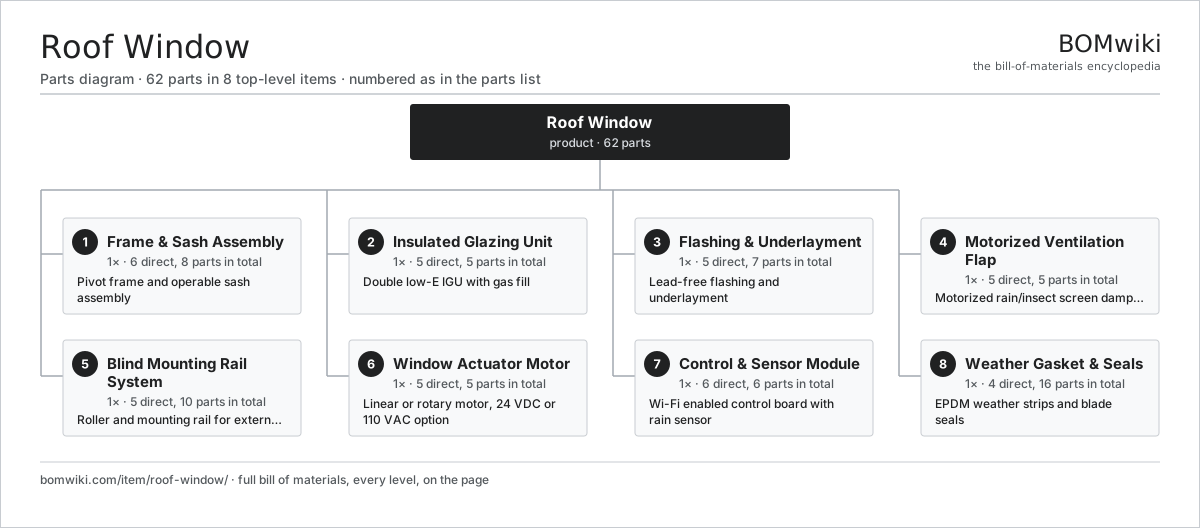
| # | Part | Qty | What it does |
|---|---|---|---|
| 1 | Frame & Sash Assembly 6 parts | 1× | Pivot frame and operable sash assembly |
| 2 | Insulated Glazing Unit 5 parts | 1× | Double low-E IGU with gas fill |
| 3 | Flashing & Underlayment 5 parts | 1× | Lead-free flashing and underlayment |
| 4 | Motorized Ventilation Flap 5 parts | 1× | Motorized rain/insect screen damper |
| 5 | Blind Mounting Rail System 5 parts | 1× | Roller and mounting rail for external or internal shades |
| 6 | Window Actuator Motor 5 parts | 1× | Linear or rotary motor, 24 VDC or 110 VAC option |
| 7 | Control & Sensor Module 6 parts | 1× | Wi-Fi enabled control board with rain sensor |
| 8 | Weather Gasket & Seals 4 parts | 1× | EPDM weather strips and blade seals |
3D model
No 3D model yet. Have a CAD file of this? Add a 3D model. STL renders right on this page; STEP, FreeCAD, and OpenSCAD sources are welcome too (openly licensed, like all 3D models on BOMwiki).
Build & assembly graph
expand / collapse · shared sub-assemblies converge · links to related products · est. labourTap an assembly to expand/collapse · tap a part to open it · use “Open page” for any node · drag to pan, scroll to zoom.
Bill of materials for Roof Window
8 top-level lines · 49 rows shown · 62 parts total · indented to 3 levels| # | Item / sub-assembly | Part no. | Qty/assy | Ext. qty | Parts | Type |
|---|---|---|---|---|---|---|
| 1 | Frame & Sash Assembly 6 parts | roof-window-frame-sash | 1× | 1 | 8 | assembly |
| 1.1 | Top Structural Rail | roof-window-top-frame | 1× | 1 | · | part |
| 1.2 | Bottom Sill Assembly | roof-window-bottom-frame | 1× | 1 | · | part |
| 1.3 | Side Frame Rail | roof-window-side-rails | 2× | 2 | · | part |
| 1.4 | Sash Frame Panel | roof-window-sash-panel | 1× | 1 | · | part |
| 1.5 | Ball-Bearing Hinge | roof-window-hinge-assembly | 2× | 2 | · | part |
| 1.6 | Spring-Assist Balance | roof-window-balance-spring | 1× | 1 | · | part |
| 2 | Insulated Glazing Unit 5 parts | roof-window-insulated-glazing | 1× | 1 | 5 | assembly |
| 2.1 | Outer Tempered Glass Pane | roof-window-outer-glass | 1× | 1 | · | part |
| 2.2 | Warm-Edge Spacer Bar | roof-window-spacer-frame | 1× | 1 | · | part |
| 2.3 | Inner Glass Pane | roof-window-inner-glass | 1× | 1 | · | part |
| 2.4 | Primary Sealant (PIB) | roof-window-sealant-primary | 1× | 1 | · | part |
| 2.5 | Secondary Structural Sealant | roof-window-sealant-secondary | 1× | 1 | · | part |
| 3 | Flashing & Underlayment 5 parts | roof-window-flashing-kit | 1× | 1 | 7 | assembly |
| 3.1 | Upper Flashing Apron | roof-window-flashing-upper | 1× | 1 | · | part |
| 3.2 | Lower Flashing Apron | roof-window-flashing-lower | 1× | 1 | · | part |
| 3.3 | Side Step Flashing Panel | roof-window-flashing-sides | 2× | 2 | · | part |
| 3.4 | Self-Adhering Underlayment | roof-window-underlayment-strip | 1× | 1 | · | part |
| 3.5 | Drip Edge Angle Trim | roof-window-drip-edge-trim | 2× | 2 | · | part |
| 4 | Motorized Ventilation Flap 5 parts | roof-window-ventilation-flap | 1× | 1 | 5 | assembly |
| 4.1 | Louver Blade | roof-window-damper-vane | 1× | 1 | · | part |
| 4.2 | Flap Housing Frame | roof-window-flap-frame | 1× | 1 | · | part |
| 4.3 | Brushless DC Motor | roof-window-micromotor | 1× | 1 | · | part |
| 4.4 | Push-Rod Linkage | roof-window-linkage-rod | 1× | 1 | · | part |
| 4.5 | Rain Sensor Switch | roof-window-rain-detection-switch | 1× | 1 | · | part |
| 5 | Blind Mounting Rail System 5 parts | roof-window-blinds-interface | 1× | 1 | 10 | assembly |
| 5.1 | T-Channel Mounting Rail | roof-window-mounting-rail | 1× | 1 | · | part |
| 5.2 | Shade Carrier Bracket | roof-window-carrier-bracket | 4× | 4 | · | part |
| 5.3 | Shade Roller Mechanism | roof-window-shade-roller | 1× | 1 | · | part |
| 5.4 | Bottom Guide Bracket | roof-window-guide-bracket | 2× | 2 | · | part |
| 5.5 | Tension Return Spring | roof-window-tension-spring | 2× | 2 | · | part |
| 6 | Window Actuator Motor 5 parts | roof-window-actuator-motor | 1× | 1 | 5 | assembly |
| 6.1 | Linear Actuator Motor | roof-window-linear-motor | 1× | 1 | · | part |
| 6.2 | Motor Mount Bracket | roof-window-motor-bracket | 1× | 1 | · | part |
| 6.3 | Open Limit Switch | roof-window-limit-switch-open | 1× | 1 | · | part |
| 6.4 | Closed Limit Switch | roof-window-limit-switch-closed | 1× | 1 | · | part |
| 6.5 | Safety Cable Assembly | roof-window-safety-cord | 1× | 1 | · | part |
| 7 | Control & Sensor Module 6 parts | roof-window-controller-module | 1× | 1 | 6 | assembly |
| 7.1 | Bare PCB | pcb-bare | 1× | 1 | · | part |
| 7.2 | Compute SoC Module | soc-module | 1× | 1 | · | part |
| 7.3 | Relay | relay | 1× | 1 | · | part |
| 7.4 | Power Supply | power-supply | 1× | 1 | · | part |
| 7.5 | Status LED Indicator | roof-window-led-indicator | 1× | 1 | · | part |
| 7.6 | Capacitive Touch Button | roof-window-touch-button | 1× | 1 | · | part |
| 8 | Weather Gasket & Seals 4 parts | roof-window-sealing-gasket | 1× | 1 | 16 | assembly |
| 8.1 | Sash Perimeter Gasket | roof-window-sash-gasket | 1× | 1 | · | part |
| 8.2 | Frame Aperture Gasket | roof-window-frame-gasket | 1× | 1 | · | part |
| 8.3 | Flap Blade Seal | roof-window-blade-seal | 2× | 2 | · | part |
| 8.4 | Fastener Set | fastener-set | 12× | 12 | · | part |
Something wrong in this list? Report a problem with this BOM.
Related products
same domain, ranked by shared parts Access Control Panel
52 parts · shares 2 with this page
Access Control Panel
52 parts · shares 2 with this page
 Intrusion Alarm Panel
40 parts · shares 2 with this page
Intrusion Alarm Panel
40 parts · shares 2 with this page
 Living Green Wall System
274 parts · shares 2 with this page
Living Green Wall System
274 parts · shares 2 with this page
 Motorized Louvered Pergola
404 parts · shares 2 with this page
Motorized Louvered Pergola
404 parts · shares 2 with this page
 Smart Parcel Locker
278 parts · shares 2 with this page
Smart Parcel Locker
278 parts · shares 2 with this page
 Video Intercom System
110 parts · shares 2 with this page
Video Intercom System
110 parts · shares 2 with this page
Sourcing: possible vendors
Browse the supplier directory → Prices, MOQ, and lead times are algorithmic estimates, not quotes, and not claims about these companies. Company mappings are curated by keyword; est. price band $50–$10k. How estimates work| Vendor | HQ | Specialty | MOQ | Lead time |
|---|---|---|---|---|
| assaabloy.com ↗ | Stockholm, SE | Locks & access | 1,000 units | 8–12 wks |
|
🇺🇸Allegion
allegion.com ↗
|
Dublin, US | Security products (Schlage) | 1,000 units | 8–12 wks |
| dormakaba.com ↗ | Rümlang, CH | Access & door systems | 1,000 units | 8–12 wks |
| honeywell.com ↗ | Charlotte, US | Building & safety tech | 1,000 units | 8–12 wks |
| hikvision.com ↗ | Hangzhou, CN | Surveillance & security | 1,000 units | 8–12 wks |
1,337-word article