Rotating Cow Brush
ProductOverview
A Rotating Cow Brush is a welfare-enhancing device that allows confined cattle to self-groom, an important behavioral need that cannot be fully satisfied on their own bodies or against barn structures. When cattle cannot scratch an itch properly, they show signs of frustration and discomfort. A brush positioned in a loafing area or milking queue allows cattle to self-service, rubbing against it to remove loose hair (especially important during shedding season), massage itchy spots, and engage in a natural grooming behavior. Research shows cattle spend 5-15 minutes per day using brushes and show improved welfare indicators (reduced stereotypic behavior, better immune response in some studies, behavioral enrichment).
The Rotating Cow Brush is now standard in progressive dairies, particularly in Northern Europe where animal welfare regulations encourage such provisions, and increasingly in North America where milk quality and herd health drive adoption. Cost is moderate (USD 1500-3500), lifespan is 8-12 years, and power draw is negligible (100-200 W running, perhaps 50 W idle), so ROI is primarily a welfare play rather than an economic one.
Motor and control
The Motor Unit is typically a brushless DC motor (0.3-0.5 HP, 24-48 VDC) or an AC motor (220 VAC) geared down to 20-60 RPM brush speed. The slow rotation is critical: fast brushing (>100 RPM) is jarring and uncomfortable; slow rotation (20-60 RPM) provides a gentle, sustained massage. The Motor Controller is a simple relay or MCU that implements auto-start-on-contact: when a cow presses the brush, a Pressure Switch (a pressure or proximity switch) triggers the motor to run. The motor automatically shuts off after 5-10 minutes idle, saving electricity.
Some modern systems include a timer bypass allowing a specific cow (identified by RFID collar) to use the brush only a certain number of minutes per day, though this is rarely needed in practice.
Brush and bristles
The Brush Head is a cylinder or tapered drum, 200-300 mm diameter, covered with stiff nylon or polypropylene bristles, 50-80 mm long, arranged radially or in a helical pattern. The bristles are intentionally firm, soft bristles feel like petting and are not satisfying; firm bristles provide the scratching sensation cattle seek. The brush rotates against the grain of the cow's coat, gently removing loose hair and matted dirt.
The Brush Bearing journals the brush shaft on a low-friction bearing; maintenance is minimal (periodic grease, annual inspection for bristle damage). Bristle wear is slow; they are typically replaced every 2-3 years (cost USD 200-500), when appearance or bristle stiffness has degraded.
Mount and spring suspension
The Mount Assembly is the clever part: the brush is not rigidly mounted but instead hangs from a Pivot Arm suspended by Return Spring springs. When a cow presses the brush with her body weight (100-200 kg), the springs compress and the arm pivots, allowing the brush to swing inward 10-20 cm without jamming or straining the motor. This gives the cow a comforting "give", the brush yields to her pressure, then springs back.
The Pivot Pin is hardened steel and runs on a bushing or bearing, allowing smooth pivoting for thousands of use cycles. Without spring suspension, the brush would be a rigid object that might cause back injury to the cow if she pressed hard.
Pressure sensing and auto-start
The Contact Detection is simple: a Contact Pad (a rubber or plastic block) is mounted on the underside of the pivot arm. When a cow pushes the brush, the arm rotates and the contact pad presses a Sensor Switch, typically a mechanical limit switch or an inductive proximity sensor. The switch closes, sending a 24 VDC signal to the motor controller, which energizes the motor. The motor runs while the contact pressure persists (for as long as the cow presses), then automatically shuts off 30-60 seconds after contact is released.
The auto-off timer prevents the motor from running indefinitely if the switch sticks or if a cow leans against the brush without moving.
Housing and safety
The entire Safety Housing is enclosed in a protective Protective Cage, a grid of stainless steel or galvanized wire (to allow visibility while protecting the brush). The cage prevents cattle from:
- Getting hair or skin caught in the rotating brush (a serious injury risk).
- Pushing the brush sideways and into the motor or bearing area.
- Using the brush as a scratching post for the structural post itself (which would damage both).
A removable or hinged Cover Hood protects the motor and bearings from water splash and manure spray in a wet barn environment. The Wall Bracket is a heavy-duty wall bracket bolting the assembly securely to a barn post or wall at shoulder height (1.3-1.5 m), so cattle can access it naturally without unusual postures.
Installation and positioning
Brushes are typically positioned in a few strategic locations:
- Milking queue or holding area: Before or after milking, giving cattle an opportunity to groom while waiting.
- High-traffic area: A loafing barn aisle where cattle pass regularly; some will stop and use it voluntarily.
- Heat stress area (summer): Positioned where cattle congregate during hot weather, providing both grooming and an enrichment outlet for heat-stressed cattle.
A 100-cow herd typically has 1-3 brushes; a 200-cow herd might have 4-6. Positioning is strategic, brushes in low-traffic areas go unused; brushes in natural cattle paths receive heavy use.
Behavioral and health benefits
Cattle use brushes most frequently during spring shedding (when hair loss is highest and itching is intense) and during hot weather (when flies and insect bites drive grooming behavior). Observational studies show cattle using brushes display:
- Reduced stereotypic behavior: Fewer repetitive or frustrated behaviors (head tossing, tail switching).
- Extended coat shedding: The brush accelerates and completes shedding, reducing fly breeding and disease vectors.
- Social hierarchy effects: Dominant cows monopolize the brush; subordinate cows may need a second unit to get access.
- Seasonal peaks: Use peaks in summer and spring; drops to near-zero in winter (when hair is not shedding).
Whether brushes improve milk yield or immune function is debated; the evidence is mixed. What is clear is that cattle show interest and use them, indicating a behavioral need is being met. In jurisdictions with animal welfare standards (EU, New Zealand, parts of Canada), access to grooming enrichment is now expected.
Troubleshooting and maintenance
- Low usage: Check positioning and motor responsiveness. A brush that does not spin when pressed quickly loses cattle interest.
- Motor failure: Check 24 VDC power at the motor terminal; replace brushless motor (USD 300-600) if faulty.
- Bristle matting: Occurs after 2-3 years of heavy use; replace bristle head (USD 200-500).
- Pivot stiffness: Spring fatigue or bearing wear causes the arm to move stiffly; inspect and replace bearing or spring (USD 100-300).
Modern brushes are designed for low maintenance; most failures are bristle wear or bearing fatigue, both predictable and inexpensive to address.
Economic perspective
At USD 1500-3500 capital cost, amortized over 10 years (USD 150-350/year), and negligible operating cost (electricity ~USD 50/year), the brush is a pure welfare investment. For dairies pursuing premium milk contracts (organic, grass-fed, welfare-certified), the brush is table-stakes; for conventional dairies, it is increasingly seen as a marker of progressive management and herd health commitment.
Rotating Cow Brush parts and their functions
5 top-level parts · 23 parts in total · full bill of materials below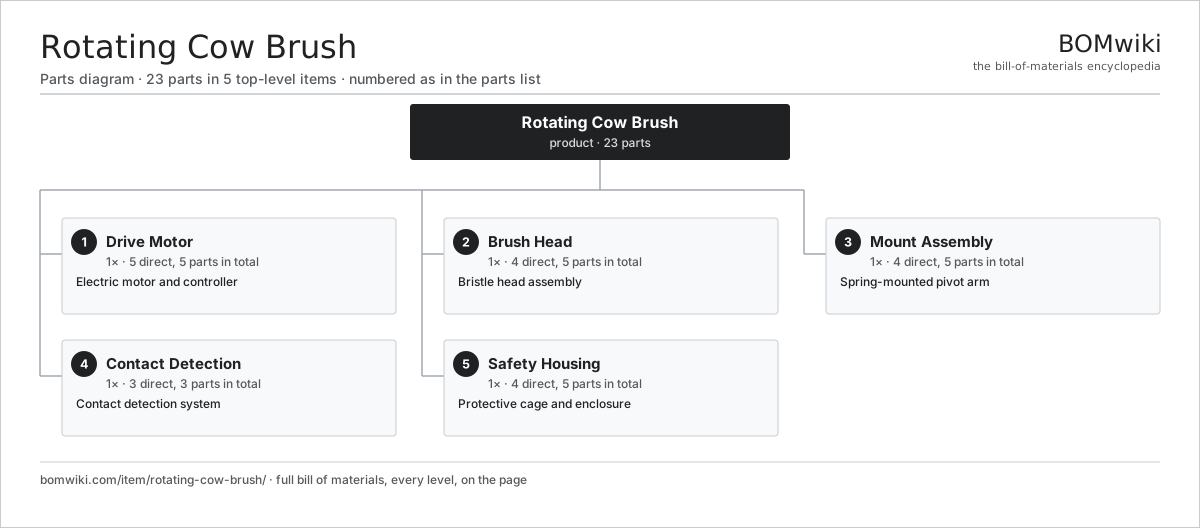
| # | Part | Qty | What it does |
|---|---|---|---|
| 1 | Drive Motor 5 parts | 1× | Electric motor and controller |
| 2 | Brush Head 4 parts | 1× | Bristle head assembly |
| 3 | Mount Assembly 4 parts | 1× | Spring-mounted pivot arm |
| 4 | Contact Detection 3 parts | 1× | Contact detection system |
| 5 | Safety Housing 4 parts | 1× | Protective cage and enclosure |
3D model
No 3D model yet. Have a CAD file of this? Add a 3D model. STL renders right on this page; STEP, FreeCAD, and OpenSCAD sources are welcome too (openly licensed, like all 3D models on BOMwiki).
Build & assembly graph
expand / collapse · shared sub-assemblies converge · links to related products · est. labourTap an assembly to expand/collapse · tap a part to open it · use “Open page” for any node · drag to pan, scroll to zoom.
Bill of materials for Rotating Cow Brush
5 top-level lines · 25 rows shown · 23 parts total · indented to 3 levels| # | Item / sub-assembly | Part no. | Qty/assy | Ext. qty | Parts | Type |
|---|---|---|---|---|---|---|
| 1 | Drive Motor 5 parts | rotating-cow-brush-motor | 1× | 1 | 5 | assembly |
| 1.1 | Motor Unit | rotating-cow-brush-motor-unit | 1× | 1 | · | part |
| 1.2 | Motor Controller | rotating-cow-brush-motor-controller | 1× | 1 | · | part |
| 1.3 | Pressure Switch | rotating-cow-brush-switch | 1× | 1 | · | part |
| 1.4 | Connector | connector | 1× | 1 | · | part |
| 1.5 | Relay | relay | 1× | 1 | · | part |
| 2 | Brush Head 4 parts | rotating-cow-brush-brush | 1× | 1 | 5 | assembly |
| 2.1 | Brush Core | rotating-cow-brush-bristle-core | 1× | 1 | · | part |
| 2.2 | Synthetic Bristles | rotating-cow-brush-bristle-tuft | 1× | 1 | · | part |
| 2.3 | Brush Bearing | rotating-cow-brush-bearing | 2× | 2 | · | part |
| 2.4 | Fastener Set | fastener-set | 1× | 1 | · | part |
| 3 | Mount Assembly 4 parts | rotating-cow-brush-mount | 1× | 1 | 5 | assembly |
| 3.1 | Pivot Arm | rotating-cow-brush-arm | 1× | 1 | · | part |
| 3.2 | Return Spring | rotating-cow-brush-spring | 2× | 2 | · | part |
| 3.3 | Pivot Pin | rotating-cow-brush-pivot-pin | 1× | 1 | · | part |
| 3.4 | Fastener Set | fastener-set | 1× | 1 | · | part |
| 4 | Contact Detection 3 parts | rotating-cow-brush-pressure-sensor | 1× | 1 | 3 | assembly |
| 4.1 | Contact Pad | rotating-cow-brush-contact-pad | 1× | 1 | · | part |
| 4.2 | Sensor Switch | rotating-cow-brush-sensor-switch | 1× | 1 | · | part |
| 4.3 | Connector | connector | 1× | 1 | · | part |
| 5 | Safety Housing 4 parts | rotating-cow-brush-housing | 1× | 1 | 5 | assembly |
| 5.1 | Protective Cage | rotating-cow-brush-cage | 1× | 1 | · | part |
| 5.2 | Cover Hood | rotating-cow-brush-weather-cover | 1× | 1 | · | part |
| 5.3 | Wall Bracket | rotating-cow-brush-mount-bracket | 1× | 1 | · | part |
| 5.4 | Fastener Set | fastener-set | 2× | 2 | · | part |
Something wrong in this list? Report a problem with this BOM.
Related products
same domain, ranked by shared parts Agricultural Tractor
306 parts · shares 1 with this page
Agricultural Tractor
306 parts · shares 1 with this page
 Articulated Tractor
1,229 parts · shares 1 with this page
Articulated Tractor
1,229 parts · shares 1 with this page
 Beet Cleaner Loader
228 parts · shares 1 with this page
Beet Cleaner Loader
228 parts · shares 1 with this page
 Boom Sprayer
356 parts · shares 1 with this page
Boom Sprayer
356 parts · shares 1 with this page
 Cane Harvester
287 parts · shares 1 with this page
Cane Harvester
287 parts · shares 1 with this page
 Center-Pivot Irrigator
945 parts · shares 1 with this page
Center-Pivot Irrigator
945 parts · shares 1 with this page
Sourcing: possible vendors
Browse the supplier directory → Prices, MOQ, and lead times are algorithmic estimates, not quotes, and not claims about these companies. Company mappings are curated by keyword; est. price band $5k–$800k. How estimates work| Vendor | HQ | Specialty | MOQ | Lead time |
|---|---|---|---|---|
| deere.com ↗ | Moline, US | Agriculture & turf | made to order | 14–24 wks |
| cnh.com ↗ | Basildon, GB | Agriculture (Case IH, New Holland) | made to order | 14–24 wks |
|
🇺🇸AGCO
agcocorp.com ↗
|
Duluth, US | Agriculture (Fendt, Massey Ferguson) | made to order | 14–24 wks |
|
🇩🇪Claas
claas.com ↗
|
Harsewinkel, DE | Harvesters & tractors | made to order | 14–24 wks |
|
🇯🇵Kubota
kubota.com ↗
|
Osaka, JP | Compact tractors & equipment | made to order | 14–24 wks |
1,278-word article