Roti Maker
ProductOverview
A roti maker is a simple electric appliance designed to cook flatbread by sandwiching dough between two heated platens. The user rolls or pats dough into a flat disc, places it on the lower Lower Cooking Platen, closes the Press Mechanism, and within 30–45 seconds the flatbread cooks, puffs, and is ready to serve.
The machine's core comprises two Heated Platens: a stationary lower plate and a hinged upper plate. Both are cast aluminum and directly embed electric heating elements. A Thermostat Assembly maintains platen temperature at 180–200°C by cycling power on and off, ensuring even cooking without burning.
The upper platen is suspended from a Hinge Pivot Joint and controlled by a simple lever handle, the Press Lever Arm. When the user pushes down, the upper platen descends and presses the dough against the lower plate. A pair of Pressure Return Springs return the upper platen to its open position when the user releases the lever. The pressure is uniform and safe for the operator because the mechanical advantage of the lever and the compliance of the spring system naturally limit force.
Control is minimal and mechanical: a Main Power Switch energizes the heating elements, and a Temperature Adjustment Dial selects the thermostat setpoint. Once the platens reach temperature, a Ready Light (powered light or glowing element) signals readiness.
How it works
Mains power (220–240 V, 50 Hz) enters through the Mains Cable and Mains Plug, with a Strain Relief Grommet protecting the cable. Inside, the Wire Bundle routes power to the Main Power Switch and then to two Heating Elements mounted inside the Lower Cooking Platen and Upper Pressing Platen.
Temperature control is achieved through a mechanical Bimetallic Snap Switch. This switch has two dissimilar metal strips bonded together; as temperature rises, they expand at different rates, causing the stack to curve. At the setpoint (controlled by the Temperature Adjustment Dial), the bimetallic strip snaps open a set of electrical contacts, cutting power to the heating elements. As the platen cools, the strip relaxes, the contacts re-close, and power flows again. This cycle holds the platen within a narrow band, typically ±10°C of the setpoint.
A Temperature Sensor Probe is sometimes included for redundancy, relaying platen temperature to the thermostat logic, though on simpler models it is absent and the bimetallic switch alone controls temperature.
The upper platen is mounted on a Hinge Pivot Joint, which uses a stainless steel Stainless Steel Hinge Pin and two Ball Bearings to allow smooth, low-friction rotation. The Press Lever Arm extends from the pivot to the handle. Two Pressure Return Springs are pre-compressed between the arm and the housing; they push the upper platen upward and prevent it from free-falling.
When the user places dough on the lower platen and presses the handle, they do work against gravity and spring tension. The upper platen descends, clamping the dough, and the two heating surfaces conduct heat into the dough from both sides simultaneously. Moisture in the dough turns to steam, creating the characteristic puff. Cooking time varies by dough thickness and temperature setpoint: typically 30–45 seconds at 200°C produces a soft, fluffy roti or paratha.
The non-stick coating on both Lower Cooking Platen and Upper Pressing Platen minimizes sticking and eases cleanup. A Thermal Insulation Pad layer beneath the lower platen reduces heat loss to the mounting frame and external surfaces, improving thermal efficiency and operator safety.
The Ergonomic Handle Grip is designed to isolate the operator from the hot platen housing. All external surfaces are plastic or insulated, and the Non-Slip Rubber Foot (non-slip rubber) prevent the machine from sliding on wet counters. Mechanically, the lever advantage and spring return mean the user never has to hold the platen down; they press once and release, making the operation safe and repeatable.
Roti Maker parts and their functions
8 top-level parts · 34 parts in total · full bill of materials below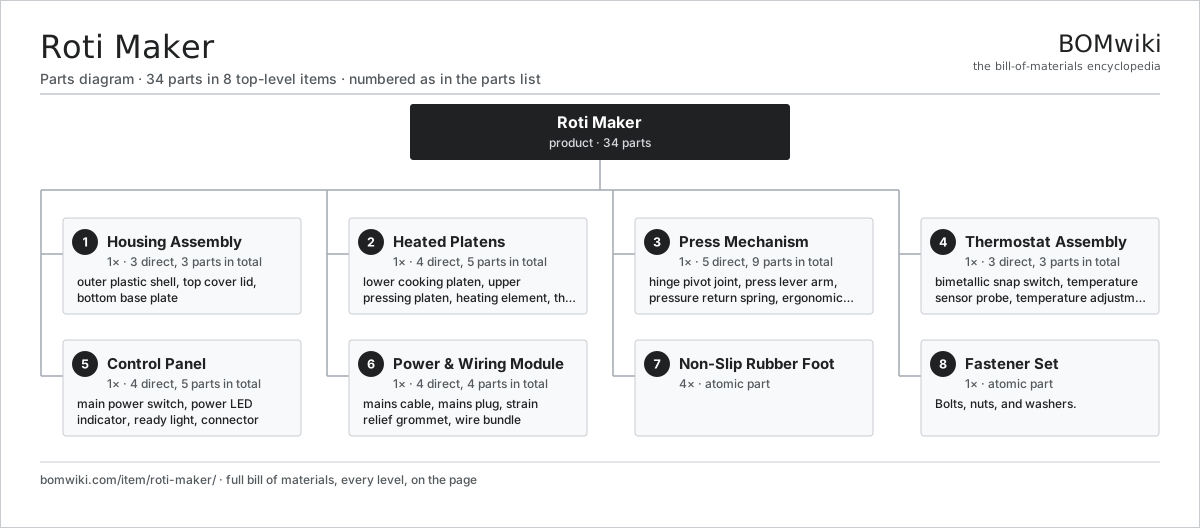
| # | Part | Qty | What it does |
|---|---|---|---|
| 1 | Housing Assembly 3 parts | 1× | Plastic and stainless steel casing that holds all components and protects the operator. |
| 2 | Heated Platens 4 parts | 1× | Upper and lower cast-aluminum plates with embedded heating elements. |
| 3 | Press Mechanism 5 parts | 1× | Lever and hinge system that lowers the upper platen to cook and press dough. |
| 4 | Thermostat Assembly 3 parts | 1× | Temperature sensor and bimetallic switch that maintain platen temperature at 180–200°C. |
| 5 | Control Panel 4 parts | 1× | Power switch, temperature dial, and indicator lights. |
| 6 | Power & Wiring Module 4 parts | 1× | Mains cord, plug, and internal wiring harness. |
| 7 | Non-Slip Rubber Foot | 4× | |
| 8 | Fastener Set | 1× | Bolts, nuts, and washers. |
3D model
No 3D model yet. Have a CAD file of this? Add a 3D model. STL renders right on this page; STEP, FreeCAD, and OpenSCAD sources are welcome too (openly licensed, like all 3D models on BOMwiki).
Build & assembly graph
expand / collapse · shared sub-assemblies converge · links to related products · est. labourTap an assembly to expand/collapse · tap a part to open it · use “Open page” for any node · drag to pan, scroll to zoom.
Bill of materials for Roti Maker
8 top-level lines · 33 rows shown · 34 parts total · indented to 3 levels| # | Item / sub-assembly | Part no. | Qty/assy | Ext. qty | Parts | Type |
|---|---|---|---|---|---|---|
| 1 | Housing Assembly 3 parts | roti-maker-housing | 1× | 1 | 3 | assembly |
| 1.1 | Outer Plastic Shell | roti-maker-outer-shell | 1× | 1 | · | part |
| 1.2 | Top Cover Lid | roti-maker-top-cover | 1× | 1 | · | part |
| 1.3 | Bottom Base Plate | roti-maker-bottom-plate | 1× | 1 | · | part |
| 2 | Heated Platens 4 parts | roti-maker-heated-platens | 1× | 1 | 5 | assembly |
| 2.1 | Lower Cooking Platen | roti-maker-lower-platen | 1× | 1 | · | part |
| 2.2 | Upper Pressing Platen | roti-maker-upper-platen | 1× | 1 | · | part |
| 2.3 | Heating Element | heating-element | 2× | 2 | · | part |
| 2.4 | Thermal Insulation Pad | roti-maker-platen-insulation | 1× | 1 | · | part |
| 3 | Press Mechanism 5 parts | roti-maker-press-mechanism | 1× | 1 | 9 | assembly |
| 3.1 | Hinge Pivot Joint 2 parts | roti-maker-hinge-pivot | 1× | 1 | 3 | assembly |
| 3.1.1 | Stainless Steel Hinge Pin | roti-maker-pivot-pin | 1× | 1 | · | part |
| 3.1.2 | Ball Bearing | ball-bearing | 2× | 2 | · | part |
| 3.2 | Press Lever Arm | roti-maker-press-arm | 1× | 1 | · | part |
| 3.3 | Pressure Return Spring | roti-maker-pressure-spring | 2× | 2 | · | part |
| 3.4 | Ergonomic Handle Grip | roti-maker-handle-grip | 1× | 1 | · | part |
| 3.5 | O-Ring Set | oring-set | 2× | 2 | · | part |
| 4 | Thermostat Assembly 3 parts | roti-maker-thermostat-assembly | 1× | 1 | 3 | assembly |
| 4.1 | Bimetallic Snap Switch | roti-maker-bimetallic-switch | 1× | 1 | · | part |
| 4.2 | Temperature Sensor Probe | roti-maker-thermostat-sensor | 1× | 1 | · | part |
| 4.3 | Temperature Adjustment Dial | roti-maker-temp-dial | 1× | 1 | · | part |
| 5 | Control Panel 4 parts | roti-maker-control-panel | 1× | 1 | 5 | assembly |
| 5.1 | Main Power Switch | roti-maker-power-switch | 1× | 1 | · | part |
| 5.2 | Power LED Indicator | roti-maker-power-indicator-light | 1× | 1 | · | part |
| 5.3 | Ready Light | roti-maker-ready-indicator-light | 1× | 1 | · | part |
| 5.4 | Connector | connector | 2× | 2 | · | part |
| 6 | Power & Wiring Module 4 parts | roti-maker-power-module | 1× | 1 | 4 | assembly |
| 6.1 | Mains Cable | roti-maker-mains-cord | 1× | 1 | · | part |
| 6.2 | Mains Plug | roti-maker-plug | 1× | 1 | · | part |
| 6.3 | Strain Relief Grommet | roti-maker-strain-relief | 1× | 1 | · | part |
| 6.4 | Wire Bundle | wire-bundle | 1× | 1 | · | part |
| 7 | Non-Slip Rubber Foot | roti-maker-base-feet | 4× | 4 | · | part |
| 8 | Fastener Set | fastener-set | 1× | 1 | · | part |
Something wrong in this list? Report a problem with this BOM.
Related products
same domain, ranked by shared parts Blender
68 parts · shares 2 with this page
Blender
68 parts · shares 2 with this page
 Compressor Ice Cream Maker
248 parts · shares 2 with this page
Electric Corkscrew
51 parts · shares 2 with this page
Compressor Ice Cream Maker
248 parts · shares 2 with this page
Electric Corkscrew
51 parts · shares 2 with this page
 Electric Meat Grinder
73 parts · shares 2 with this page
Electric Meat Grinder
73 parts · shares 2 with this page
 Electric Pasta Maker
63 parts · shares 2 with this page
Electric Spiralizer
63 parts · shares 2 with this page
Electric Pasta Maker
63 parts · shares 2 with this page
Electric Spiralizer
63 parts · shares 2 with this page
Sourcing: possible vendors
Browse the supplier directory → Prices, MOQ, and lead times are algorithmic estimates, not quotes, and not claims about these companies. Company mappings are curated by keyword; est. price band $20–$600. How estimates work| Vendor | HQ | Specialty | MOQ | Lead time |
|---|---|---|---|---|
|
🇦🇺Breville
breville.com ↗
|
Sydney, AU | Kitchen appliances | 2,000 units | 6–10 wks |
| groupeseb.com ↗ | Écully, FR | Cookware & small appliances | 2,000 units | 6–10 wks |
| hamiltonbeach.com ↗ | Glen Allen, US | Small appliances | 2,000 units | 6–10 wks |
| panasonic.com ↗ | Osaka, JP | Electronics & appliances | 2,000 units | 6–10 wks |
|
🇨🇳Midea
midea.com ↗
|
Foshan, CN | Home appliances | 2,000 units | 6–10 wks |
682-word article