Rugged Tablet
ProductOverview
A rugged tablet is the field worker's computer: a handheld device engineered to survive construction sites, warehouse floors, and delivery vans. Unlike consumer tablets (iPad, Galaxy Tab), which are designed for desk use and careful handling, rugged tablets are sealed against dust and water, have sunlight-readable displays, hot-swappable batteries for extended field shifts, and modular accessory ports for barcode scanners and RFID readers.
Warehouse logistics, field service (electrical, HVAC, plumbing), parcel delivery, equipment maintenance, and asset tracking are the primary markets. A delivery driver uses a rugged tablet to capture signatures and photos at each stop; a maintenance technician uses one to look up equipment manuals and log service visits; a warehouse picker uses one to scan barcodes and navigate fulfillment routes.
Display Technology
The Sunlight-Readable Display Assembly is engineered for outdoor readability. Most consumer tablets are unreadable in direct sunlight because their brightness is 300–400 cd/m² and they lack anti-glare coatings. A LCD Panel in an industrial tablet is 600–800 cd/m², and the High-Brightness Backlight array is thermistor-controlled: at 50 °C ambient, brightness reduces to prevent SoC overheating. Optical bonding (fusing the Touch Digitizer and Cover Glass directly to the LCD without air gaps) eliminates internal reflections and further improves readability.
The Cover Glass is a thick (5 mm) tempered or ion-strengthened piece (Gorilla Glass 5 or equivalent). It survives gloved-finger taps (critical for workers wearing safety gloves) and resists scratching from keys and tools in a work vest. An oleophobic coating reduces fingerprints and dirt accumulation. The Screen Bezel raised edge (10 mm lip) protects the screen from edge-to-edge contact if the tablet is dropped face-down.
The Panel Timing Controller is a standard LVDS-to-LCD timing bridge, but integrates additional protections: circuit-breaker fuses on the backlight power rail, preventing a short from damaging the SoC; DC-DC converter with active current limiting for LED cold-start (LEDs draw 5× nominal current at 0 °C until they warm).
Processor and Connectivity
The Processor and Storage is a mid-to-high-end ARM SoC. Most rugged tablets use Qualcomm Snapdragon 680 (budget tier, 6–7 W power) or 888+ (premium, allowing faster app launch and higher frame-rate video capture). MediaTek Dimensity is a popular alternative in Asia-Pacific markets. The SoC (System-on-Chip) integrates 8 CPU cores, a GPU (Adreno or Mali), and often a built-in modem for cellular.
The Cellular Modem (modem IP or fully integrated) supports CAT-12 LTE (600 Mbps downlink) or 5G NR in premium models. Dual SIM is standard: one SIM for the corporate network (company cellular plan), one for local providers when operating overseas. The separate Antenna Array array includes cellular (LTE/5G), WiFi 6 (802.11ax for 2.4 and 5 GHz), Bluetooth 5.0 for pairing headsets and accessories, and optionally GNSS (GPS/GLONASS/Galileo).
Battery and Field Endurance
The Hot-Swap Battery Module is the critical component for all-day field operation. Unlike consumer tablets with fixed batteries, rugged tablets have a rugged-tablet-battery-module with a Magnetic Quick-Disconnect that is magnetically quick-disconnect. A technician can hot-swap batteries without powering off the device, ideal for 12-hour field shifts where a second battery is carried as a backup.
Typical capacity is 8,000–12,000 mAh at 3.7 V nominal, providing 10–12 hours at moderate load (WiFi on, screen at medium brightness, intermittent scanning). The BMS Board (battery management system) monitors cell voltage, temperature, and charge cycles, communicating to the OS for remaining-time estimates. Lithium polymer packs are preferred over lithium-ion for safety (lower energy density = lower fire risk if punctured).
The 10–12 hour target is crucial: a worker's shift is 8–10 hours, and the device must last the full shift without drains on the IT team to source a spare. The battery heats during heavy processing (video recording, barcode scanning at 30 fps); the SoC (System-on-Chip) SoC integrates thermal throttling to reduce CPU clocks if die temperature exceeds 80 °C, preventing damage.
Sealed Enclosure
The Sealed Enclosure is the signature rugged-tablet design. A Co-Moulded Housing is co-moulded polycarbonate and TPE (thermoplastic elastomer), creating an outer skin that is soft (impact-absorbing) and integrated into the structural frame. The device weighs 450–600 g, roughly twice a consumer iPad but still one-handed. The Corner Bumper are 20 mm radius elastomer blocks on each corner, designed to absorb impacts from 1.5 m drops onto concrete. Internal Internal Shock Mount elastomer bushings suspend the motherboard, isolating it from high-frequency vibration (machinery, vehicles) that would otherwise accelerate solder joint fatigue.
The Sealing Gaskets seal the battery door, dock connector, and headphone jack to IP65. Water can splash the device, but cannot enter. A worker washing the tablet under a sink for 30 seconds will not damage it. The Sealed Physical Buttons (power, volume, function keys) have sealed rubber domes with diaphragm membranes underneath, preventing water from wicking around the edge of the button cap.
Modular Accessories via the Dock
The Charging Dock and IO Connector on the rear is a 10–20 pogo-pin connector carrying power, USB data, and serial console signals. This enables a rich ecosystem of modular accessories:
Charging dock: A powered stand holding the tablet vertically, with pogo pins for power and USB sync. Used in warehouses for end-of-shift charging and data upload.
Barcode reader module (Barcode Reader Module): 1D/2D barcode imager with autofocus (2–20 cm range), connected via USB. The app sees it as a HID keyboard device, so scanning a barcode is as simple as clicking a text field and triggering the reader, the barcode appears in the field. Dual-imager models (front and rear) support QR code scanning and document imaging.
RFID reader module (RFID Reader Module): UHF RFID tag reader (860–960 MHz, ~5 m range), essential for inventory management and asset tracking. Emulates USB HID keyboard to appear as a barcode scanner to legacy applications.
GPS module (GPS / GNSS Module): GNSS receiver for field crew location tracking, tied into route management and job-dispatch systems.
The dock connector is sealed with a Connector Gasket when no module is attached, maintaining the IP65 rating. Modules are keyed and aligned by Alignment Guide Pins guide pins, ensuring correct insertion and repeatable electrical contact.
Impact Resistance
Beyond the soft housing and corner bumpers, the Drop and Impact Protection strategy includes:
Raised screen bezel: The Screen Edge Guard is a 5–10 mm lip around the display edge, preventing the cover glass from contacting a hard surface if dropped face-down. This is the most common failure mode for tablets, cracked screen.
Internal shock suspension: The motherboard is not glued to the housing; instead, it is suspended on Internal Shock Mount bushings. This decouples the rigid PCB from the flexible outer shell, reducing peak accelerations during impact.
Cable routing: Internal flex cables (display, dock connector) are routed with generous slack and strain relief, preventing tearing if the housing flexes on impact.
Test drop heights are 1.5 m onto concrete for "rugged," 2 m for "ultra-rugged." A device that passes the 1.5 m drop test can absorb the energy of a technician accidentally dropping it from waist height.
Software: Rugged OS and Field Apps
Rugged tablets ship with Android 11+ or Linux (some high-security military models). Android is preferred for consumer app compatibility (mapping, logistics, CRM software). The OS is typically locked in "kiosk mode," restricting field workers from downloading apps or changing system settings, IT controls what they can run.
Field-oriented applications are purpose-built: warehouse management systems (WMS) integrate barcode scanning, inventory lookup, and task dispatch; field service apps display job tickets, allow technicians to log time, and capture photos/signatures; delivery apps track packages and record GPS breadcrumbs.
Rugged tablets run embedded cellular modems and WiFi, so they can sync with cloud backends in real-time or queue data for later sync if connectivity is lost (common in underground warehouses or rural service areas). The Storage (64–256 GB) holds offline maps, product databases, and historical data for when the network is unavailable.
Deployment and Economics
A typical logistics company equips 1000 delivery drivers with rugged tablets. Total cost of ownership (tablet + initial configuration + 3-year support) is ~$1000–1500 per device. The return comes from faster deliveries (GPS routing, barcode confirmation), fewer misdeliveries (address verification), and reduced paperwork (digital signatures and photos). Payback occurs within 1–2 years.
Rugged tablets are also gaining ground in construction (project documentation, equipment tracking), manufacturing (shop-floor work instructions and defect logging), and healthcare (patient monitoring, drug administration verification in hospitals). The sealed, modular design and daylight-readable display make them the computer of choice wherever fieldwork, dust, and occasional water exposure are unavoidable.
Rugged Tablet parts and their functions
9 top-level parts · 136 parts in total · full bill of materials below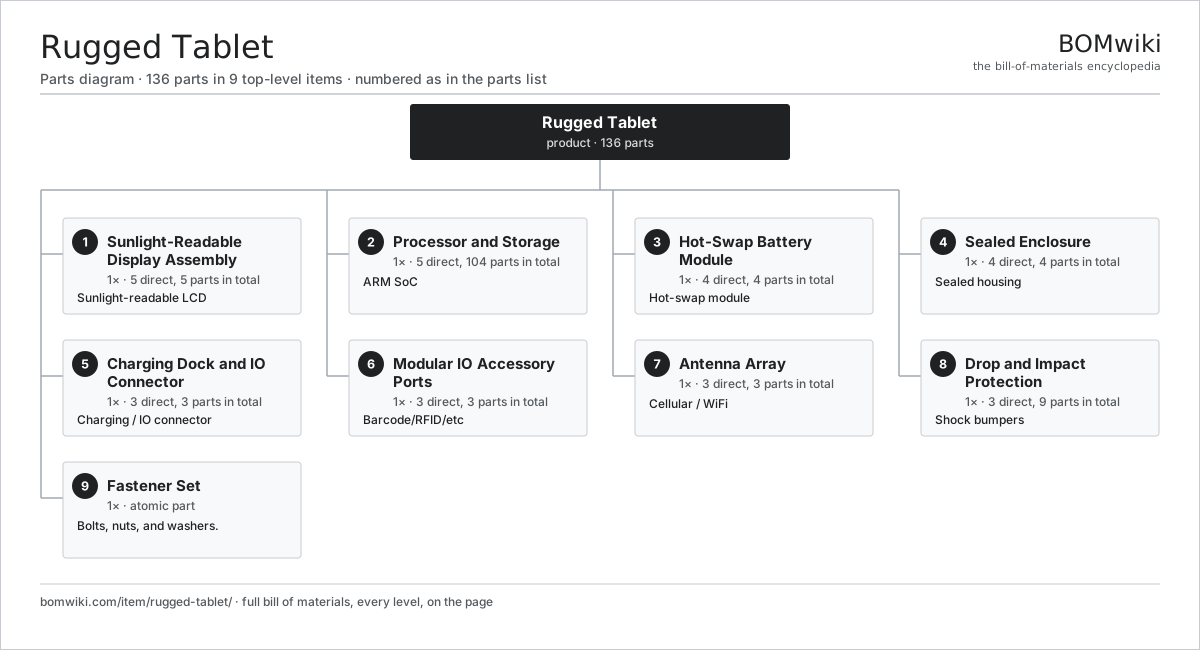
| # | Part | Qty | What it does |
|---|---|---|---|
| 1 | Sunlight-Readable Display Assembly 5 parts | 1× | Sunlight-readable LCD |
| 2 | Processor and Storage 5 parts | 1× | ARM SoC |
| 3 | Hot-Swap Battery Module 4 parts | 1× | Hot-swap module |
| 4 | Sealed Enclosure 4 parts | 1× | Sealed housing |
| 5 | Charging Dock and IO Connector 3 parts | 1× | Charging / IO connector |
| 6 | Modular IO Accessory Ports 3 parts | 1× | Barcode/RFID/etc |
| 7 | Antenna Array 3 parts | 1× | Cellular / WiFi |
| 8 | Drop and Impact Protection 3 parts | 1× | Shock bumpers |
| 9 | Fastener Set | 1× | Bolts, nuts, and washers. |
3D model
No 3D model yet. Have a CAD file of this? Add a 3D model. STL renders right on this page; STEP, FreeCAD, and OpenSCAD sources are welcome too (openly licensed, like all 3D models on BOMwiki).
Build & assembly graph
expand / collapse · shared sub-assemblies converge · links to related products · est. labourTap an assembly to expand/collapse · tap a part to open it · use “Open page” for any node · drag to pan, scroll to zoom.
Bill of materials for Rugged Tablet
9 top-level lines · 39 rows shown · 136 parts total · indented to 3 levels| # | Item / sub-assembly | Part no. | Qty/assy | Ext. qty | Parts | Type |
|---|---|---|---|---|---|---|
| 1 | Sunlight-Readable Display Assembly 5 parts | rugged-tablet-display | 1× | 1 | 5 | assembly |
| 1.1 | LCD Panel | rugged-tablet-lcd-panel | 1× | 1 | · | part |
| 1.2 | Touch Digitizer | touch-digitizer | 1× | 1 | · | part |
| 1.3 | Panel Timing Controller | rugged-tablet-display-controller | 1× | 1 | · | part |
| 1.4 | Cover Glass | rugged-tablet-cover-glass | 1× | 1 | · | part |
| 1.5 | High-Brightness Backlight | rugged-tablet-backlight-led | 1× | 1 | · | part |
| 2 | Processor and Storage 5 parts | rugged-tablet-processor | 1× | 1 | 104 | assembly |
| 2.1 | SoC (System-on-Chip) | rugged-tablet-soc | 1× | 1 | · | part |
| 2.2 | LPDDR4 RAM | rugged-tablet-ram | 1× | 1 | · | part |
| 2.3 | Storage | rugged-tablet-storage | 1× | 1 | · | part |
| 2.4 | Cellular Modem | rugged-tablet-modem | 1× | 1 | · | part |
| 2.5 | SMD Passive (R/C/L) | smd-passives | 100× | 100 | · | part |
| 3 | Hot-Swap Battery Module 4 parts | rugged-tablet-battery | 1× | 1 | 4 | assembly |
| 3.1 | Li-Polymer Battery | rugged-tablet-battery-cell | 1× | 1 | · | part |
| 3.2 | BMS Board | bms-board | 1× | 1 | · | part |
| 3.3 | Magnetic Quick-Disconnect | rugged-tablet-battery-connector | 1× | 1 | · | part |
| 3.4 | Thermal Fuse | thermal-fuse | 1× | 1 | · | part |
| 4 | Sealed Enclosure 4 parts | rugged-tablet-chassis | 1× | 1 | 4 | assembly |
| 4.1 | Co-Moulded Housing | rugged-tablet-housing-body | 1× | 1 | · | part |
| 4.2 | Sealing Gaskets | rugged-tablet-housing-gaskets | 1× | 1 | · | part |
| 4.3 | Sealed Physical Buttons | rugged-tablet-housing-buttons | 1× | 1 | · | part |
| 4.4 | Screen Bezel | rugged-tablet-screen-bezel | 1× | 1 | · | part |
| 5 | Charging Dock and IO Connector 3 parts | rugged-tablet-dock | 1× | 1 | 3 | assembly |
| 5.1 | Dock Pogo Pins | rugged-tablet-dock-connector | 1× | 1 | · | part |
| 5.2 | Alignment Guide Pins | rugged-tablet-dock-alignment | 1× | 1 | · | part |
| 5.3 | Connector Gasket | rugged-tablet-dock-gasket | 1× | 1 | · | part |
| 6 | Modular IO Accessory Ports 3 parts | rugged-tablet-io-modules | 1× | 1 | 3 | assembly |
| 6.1 | Barcode Reader Module | rugged-tablet-barcode-module | 1× | 1 | · | part |
| 6.2 | RFID Reader Module | rugged-tablet-rfid-module | 1× | 1 | · | part |
| 6.3 | GPS / GNSS Module | rugged-tablet-gps-module | 1× | 1 | · | part |
| 7 | Antenna Array 3 parts | rugged-tablet-antenna | 1× | 1 | 3 | assembly |
| 7.1 | Cellular Antenna | rugged-tablet-cellular-antenna | 1× | 1 | · | part |
| 7.2 | WiFi Antenna | rugged-tablet-wifi-antenna | 1× | 1 | · | part |
| 7.3 | GPS Antenna | rugged-tablet-gps-antenna | 1× | 1 | · | part |
| 8 | Drop and Impact Protection 3 parts | rugged-tablet-impact-protection | 1× | 1 | 9 | assembly |
| 8.1 | Corner Bumper | rugged-tablet-corner-bumpers | 4× | 4 | · | part |
| 8.2 | Internal Shock Mount | rugged-tablet-shock-isolators | 4× | 4 | · | part |
| 8.3 | Screen Edge Guard | rugged-tablet-screen-guard | 1× | 1 | · | part |
| 9 | Fastener Set | fastener-set | 1× | 1 | · | part |
Something wrong in this list? Report a problem with this BOM.
Related products
same domain, ranked by shared parts E-Reader
54 parts · shares 2 with this page
E-Reader
54 parts · shares 2 with this page
 Portable Monitor
218 parts · shares 2 with this page
Portable Monitor
218 parts · shares 2 with this page
 Tablet
61 parts · shares 2 with this page
Tablet
61 parts · shares 2 with this page
 Edge AI Inference Box
558 parts · shares 1 with this page
Edge AI Inference Box
558 parts · shares 1 with this page
 KVM-over-IP Switch
222 parts · shares 1 with this page
KVM-over-IP Switch
222 parts · shares 1 with this page
 Microcontroller Dev Board
49 parts · shares 1 with this page
Microcontroller Dev Board
49 parts · shares 1 with this page
Sourcing: possible vendors
Browse the supplier directory → Prices, MOQ, and lead times are algorithmic estimates, not quotes, and not claims about these companies. Company mappings are curated by keyword; est. price band $20–$3k. How estimates work| Vendor | HQ | Specialty | MOQ | Lead time |
|---|---|---|---|---|
| dell.com ↗ | Round Rock, US | Computers & infrastructure | 1,000 units | 8–14 wks |
|
🇺🇸HP
hp.com ↗
|
Palo Alto, US | Computers & printers | 1,000 units | 8–14 wks |
|
🇨🇳Lenovo
lenovo.com ↗
|
Beijing, CN | Computers | 1,000 units | 8–14 wks |
|
🇹🇼ASUS
asus.com ↗
|
Taipei, TW | Computers & components | 1,000 units | 8–14 wks |
|
🇨🇳Foxconn
foxconn.com ↗
|
Shenzhen, CN | Electronics contract mfg | 1,000 units | 8–14 wks |
1,516-word article