Airfield Runway Light
ProductOverview
An airfield runway light is a fixture set flush into the pavement that marks the runway centreline, edges, touchdown zone, or threshold to pilots at night and in low visibility. Unlike a streetlight, it is a precision optical instrument: standards from the FAA and ICAO specify, candela by candela, how bright the beam must be at each angle in a grid measured in fractions of a degree. A centreline fixture must be intense enough to be seen from 3 km out through rain, yet emit almost nothing upward where it would dazzle a flaring pilot. It must also survive being run over by a 380-tonne aircraft at 250 km/h, struck by snow ploughs, and soaked in glycol de-icing fluid.
The fixture is bidirectional: two independent Optical Assembly channels face opposite directions of operation, often in different colours. A centreline light shows white in both directions over most of its length, then white/red and red/red in the final 900 m to warn of remaining distance; threshold fixtures show green one way and red the other.
How it works
Each beam starts at a LED Light Module. Four to twelve High-Power LED Emitter dies on a metal-core LED Emitter PCB sit behind a Collimating Lens that compresses their output into a flat fan, wide in azimuth, only a few degrees tall. Because the module lies horizontal inside the shallow fixture, the beam must be folded: the Exit Prism, a block of toughened optical glass held in its Prism Seat, refracts the light up through the Light Exit Channel in the top casting and out across the pavement at 3–6° elevation. A Colour Filter sets chromaticity to the ICAO colour boxes. The prism doubles as the pressure boundary against tyres and jet blast, clamped by the Prism Clamp Plate onto a resilient Prism Gasket.
Mechanically everything hangs from the Top Casting, a heat-treated aluminium casting no more than 12.7 mm proud of the surface, with ramped leading edges so a tyre rolls over rather than strikes it. It bolts to a Flange Ring on the Shallow Base Can, a galvanised-steel L-868 can grouted into a cored hole in the pavement. The can is the permanent infrastructure: fixtures are swapped in minutes by undoing the clamp bolts, while ducting enters through Conduit Hub fittings and the whole assembly bonds to the airfield counterpoise through the Grounding Lug. The gasketed Inner Cover and Top Gasket seal the optics chamber; a membrane Breather Vent Plug breathes as pavement temperature swings between −40 and +55 °C so the seals are not pumped by pressure cycling.
The series circuit
Airfield lighting power is unlike normal building wiring. Hundreds of fixtures along a 3–4 km runway connect in a single series loop driven by a constant-current regulator (CCR) at exactly 6.6 A, so every light receives identical current regardless of cable length, and one cable fault dims nothing else. Each fixture taps the loop through an L-830 isolation transformer sitting in or near the base can; its secondary connects to the fixture lead through the standard L-823 Connector Kit, so a failed fixture is open-circuited safely without breaking the loop.
Inside the fixture, the Power Converter PCB makes an LED engine behave like the halogen lamp the circuit was designed for. A Bridge Rectifier converts the transformer secondary to DC, and a regulation stage maps the CCR's five brightness steps, 2.8 to 6.6 A, onto LED drive currents that reproduce the traditional intensity ratios from 0.15 % to 100 %. The board is fully potted against moisture and protected by a Surge Suppressor, because the kilometres of buried loop make an efficient antenna for lightning transients.
LED conversion and maintenance
LED fixtures have displaced halogen across most airfields since the 2010s. A 4-LED module drawing 15–30 W replaces a 45–200 W lamp, lasts 50,000 hours against a halogen's 1,000–2,000, and holds its photometrics as it ages rather than blackening. The one drawback is heat: halogen lamps melted snow off their own prisms, so LED inset fixtures in cold climates add resistive heating or rely on the LED Module Heatsink path into the casting to keep channels clear.
Maintenance is dominated by torque and photometrics. Clamp bolts are re-torqued on schedule because a loose fixture under repeated wheel loads destroys itself and FOD-damages aircraft. Mobile photometric vehicles drive the runway measuring every fixture's beam against the isocandela template; units that fall below 70 % of specification are flagged, and the top assembly is exchanged on the spot while the Base Can Body stays in the pavement for the life of the runway.
Airfield Runway Light parts and their functions
8 top-level parts · 174 parts in total · full bill of materials below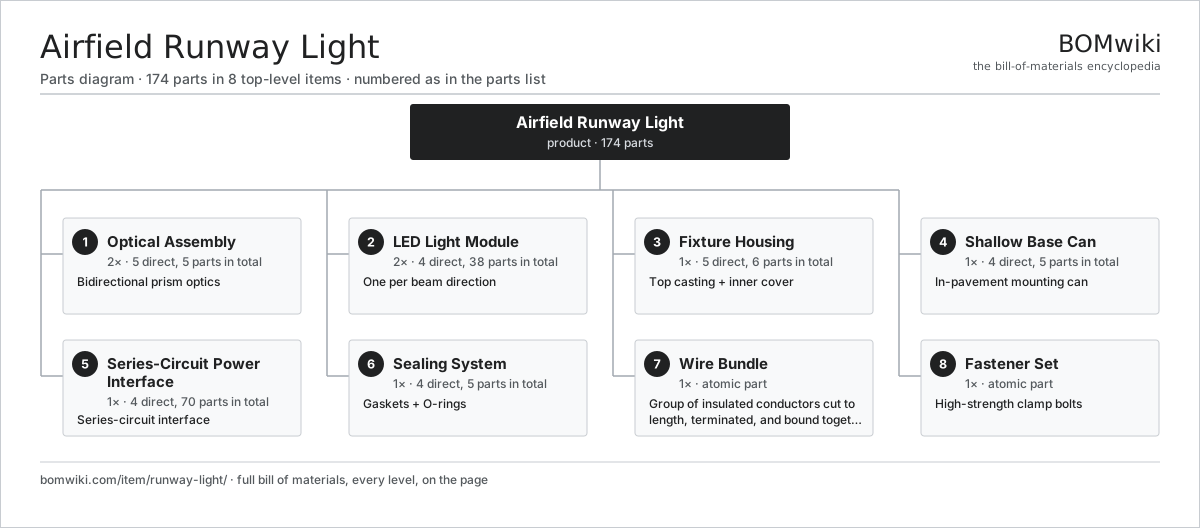
| # | Part | Qty | What it does |
|---|---|---|---|
| 1 | Optical Assembly 5 parts | 2× | Bidirectional prism optics |
| 2 | LED Light Module 4 parts | 2× | One per beam direction |
| 3 | Fixture Housing 5 parts | 1× | Top casting + inner cover |
| 4 | Shallow Base Can 4 parts | 1× | In-pavement mounting can |
| 5 | Series-Circuit Power Interface 4 parts | 1× | Series-circuit interface |
| 6 | Sealing System 4 parts | 1× | Gaskets + O-rings |
| 7 | Wire Bundle | 1× | Group of insulated conductors cut to length, terminated, and bound together to carry power and signals between the assemblies of a machine. |
| 8 | Fastener Set | 1× | High-strength clamp bolts |
3D model
No 3D model yet. Have a CAD file of this? Add a 3D model. STL renders right on this page; STEP, FreeCAD, and OpenSCAD sources are welcome too (openly licensed, like all 3D models on BOMwiki).
Build & assembly graph
expand / collapse · shared sub-assemblies converge · links to related products · est. labourTap an assembly to expand/collapse · tap a part to open it · use “Open page” for any node · drag to pan, scroll to zoom.
Bill of materials for Airfield Runway Light
8 top-level lines · 41 rows shown · 174 parts total · indented to 3 levels| # | Item / sub-assembly | Part no. | Qty/assy | Ext. qty | Parts | Type |
|---|---|---|---|---|---|---|
| 1 | Optical Assembly 5 parts | runway-light-optical | 2× | 2 | 5 | assembly |
| 1.1 | Exit Prism | runway-light-prism | 1× | 2 | · | part |
| 1.2 | Prism Seat | runway-light-prism-seat | 1× | 2 | · | part |
| 1.3 | Colour Filter | runway-light-color-filter | 1× | 2 | · | part |
| 1.4 | Prism Clamp Plate | runway-light-prism-clamp | 1× | 2 | · | part |
| 1.5 | O-Ring Set | oring-set | 1× | 2 | · | part |
| 2 | LED Light Module 4 parts | runway-light-led-module | 2× | 2 | 38 | assembly |
| 2.1 | LED Emitter PCB 3 parts | runway-light-led-pcb | 1× | 2 | 35 | assembly |
| 2.1.1 | Bare PCB | pcb-bare | 1× | 2 | · | part |
| 2.1.2 | High-Power LED Emitter | runway-light-led-emitter | 4× | 8 | · | part |
| 2.1.3 | SMD Passive (R/C/L) | smd-passives | 30× | 60 | · | part |
| 2.2 | Collimating Lens | runway-light-collimator | 1× | 2 | · | part |
| 2.3 | LED Module Heatsink | runway-light-led-heatsink | 1× | 2 | · | part |
| 2.4 | Connector | connector | 1× | 2 | · | part |
| 3 | Fixture Housing 5 parts | runway-light-housing | 1× | 1 | 6 | assembly |
| 3.1 | Top Casting | runway-light-top-body | 1× | 1 | · | part |
| 3.2 | Inner Cover | runway-light-inner-cover | 1× | 1 | · | part |
| 3.3 | Light Exit Channel | runway-light-light-channel | 2× | 2 | · | part |
| 3.4 | Identification Plate | runway-light-id-tag | 1× | 1 | · | part |
| 3.5 | Fastener Set | fastener-set | 1× | 1 | · | part |
| 4 | Shallow Base Can 4 parts | runway-light-base-can | 1× | 1 | 5 | assembly |
| 4.1 | Base Can Body | runway-light-can-body | 1× | 1 | · | part |
| 4.2 | Conduit Hub | runway-light-conduit-hub | 2× | 2 | · | part |
| 4.3 | Flange Ring | runway-light-flange-ring | 1× | 1 | · | part |
| 4.4 | Grounding Lug | runway-light-ground-lug | 1× | 1 | · | part |
| 5 | Series-Circuit Power Interface 4 parts | runway-light-power | 1× | 1 | 70 | assembly |
| 5.1 | L-823 Connector Kit | runway-light-l823-plug | 1× | 1 | · | part |
| 5.2 | Power Converter PCB 4 parts | runway-light-power-pcb | 1× | 1 | 66 | assembly |
| 5.2.1 | Bare PCB | pcb-bare | 1× | 1 | · | part |
| 5.2.2 | Bridge Rectifier | runway-light-bridge-rectifier | 1× | 1 | · | part |
| 5.2.3 | Power MOSFET | mosfet | 4× | 4 | · | part |
| 5.2.4 | SMD Passive (R/C/L) | smd-passives | 60× | 60 | · | part |
| 5.3 | Surge Suppressor | runway-light-surge-suppressor | 1× | 1 | · | part |
| 5.4 | Connector | connector | 2× | 2 | · | part |
| 6 | Sealing System 4 parts | runway-light-sealing | 1× | 1 | 5 | assembly |
| 6.1 | Top Gasket | runway-light-top-gasket | 1× | 1 | · | part |
| 6.2 | Prism Gasket | runway-light-prism-gasket | 2× | 2 | · | part |
| 6.3 | O-Ring Set | oring-set | 1× | 1 | · | part |
| 6.4 | Breather Vent Plug | runway-light-vent-plug | 1× | 1 | · | part |
| 7 | Wire Bundle | wire-bundle | 1× | 1 | · | part |
| 8 | Fastener Set | fastener-set | 1× | 1 | · | part |
Something wrong in this list? Report a problem with this BOM.
Related products
same domain, ranked by shared parts Aviation Obstruction Light
192 parts · shares 2 with this page
Aviation Obstruction Light
192 parts · shares 2 with this page
 Heliport Beacon
39 parts · shares 2 with this page
Heliport Beacon
39 parts · shares 2 with this page
 Tactical Flashlight
31 parts · shares 2 with this page
Underwater Pool Light
82 parts · shares 2 with this page
Industrial UV Curing Lamp
300 parts · shares 1 with this page
Lighthouse Rotating Beacon
250 parts · shares 1 with this page
Tactical Flashlight
31 parts · shares 2 with this page
Underwater Pool Light
82 parts · shares 2 with this page
Industrial UV Curing Lamp
300 parts · shares 1 with this page
Lighthouse Rotating Beacon
250 parts · shares 1 with this page
Sourcing: possible vendors
Browse the supplier directory → Prices, MOQ, and lead times are algorithmic estimates, not quotes, and not claims about these companies. Company mappings are curated by keyword; est. price band $3–$2k. How estimates work| Vendor | HQ | Specialty | MOQ | Lead time |
|---|---|---|---|---|
|
🇳🇱Signify
signify.com ↗
|
Eindhoven, NL | Lighting (Philips Hue) | 2,000 units | 6–10 wks |
| acuitybrands.com ↗ | Atlanta, US | Lighting & controls | 2,000 units | 6–10 wks |
|
🇦🇹Zumtobel
zumtobelgroup.com ↗
|
Dornbirn, AT | Lighting | 2,000 units | 6–10 wks |
| creelighting.com ↗ | Racine, US | LED lighting | 2,000 units | 6–10 wks |
|
🇮🇳Havells
havells.com ↗
|
Noida, IN | Electrical & lighting | 2,000 units | 6–10 wks |
827-word article