Sack Tip Station
ProductOverview
A sack-tipping station (or sack tipper) is an industrial material handling device designed to quickly and safely empty paper or burlap sacks into a downstream hopper, conveyor, or process. Instead of laboriously cutting open each sack and manually shoveling the contents, an operator places the sack on a Tipping Tray, presses a button, and the motorized Tilt Drive automatically tips the tray 90° to invert and empty the sack in seconds.
The system comprises a structural frame, a tilting Tipping Tray with perimeter rails, a motorized Tilt Drive (hydraulic or pneumatic cylinder), an optional vibrating discharge screen for contamination removal, and a dust enclosure with negative-pressure extraction to protect workers from airborne dust.
Common applications include polymer resin handling, cement and mineral processing, chemical powder unloading, and food ingredient discharge (flour, sugar, salt, grain).
How It Works
An operator positions an empty Collection Hopper below the station. They then open the Hood Access Door of the Dust Enclosure and manually place a 25–50 kg sack onto the Tipping Tray. The sack is positioned so its seam (the side with the open/tied end) faces downward, aiming at the Discharge Screen (if installed) or directly at the Collection Hopper.
The operator closes the hood door and presses the "Up" or "Tip" button on the Control Panel. A Motor Contactor energizes the Tilt Motor, which drives a hydraulic pump or pneumatic compressor. The pump pressurizes fluid to the Tilt Cylinder, which extends and lifts one end of the tray.
As the tray rises, the sack tilts and inverts. When the tray reaches exactly 90° (detected by Limit Switches), the motor de-energizes and holds position. Material falls from the open end of the sack, dropping through the Discharge Screen (which vibrates to shake fine dust and remove oversize contamination), and collects in the Collection Hopper.
The vibrating screen is optional but typical; it removes items like foreign metal, stones, or oversized clumps that shouldn't reach downstream processing.
Throughout the cycle, the Dust Enclosure surrounds the tray and screen, containing airborne dust. A Exhaust Blower (1–2 kW) draws air through the hood, pulling dust-laden air across a Filter Element (5–10 µm pleated fabric filter) that removes fine particles. The filtered, clean air is exhausted to the atmosphere. The captured dust collects in a hopper below the filter housing and is periodically dumped.
Typically, material discharge takes 3–5 seconds. The operator then presses "Down", and the Tilt Cylinder retracts, lowering the tray back to horizontal. The sack (now empty) is removed and disposed of (typically recycled or composted). The cycle repeats with the next sack.
Mechanical Design
The Main Frame is a welded structural steel assembly: four vertical Frame Posts (150 × 150 mm Grade 50 box section, 2–3 m tall) connected by Cross-Beams (I-beams). The Base Support Frame at ground level supports the Tipping Tray and Collection Hopper assembly.
The Tipping Tray (1200 × 1200 mm) is a welded steel plate with perimeter Tray Edge Rails (50 mm tall) preventing material spillage during tilt. The tray pivots on one end via a heavy-duty Tray Pivot Bearing (spherical roller or thrust bearing, rated 5 metric tons). The other end is lifted by the Tilt Cylinder.
Critical design feature: The tray's center of gravity is offset (slightly forward of the pivot) so that gravity naturally assists return to the horizontal (down) position. This allows gravity return when the hydraulic pressure is released, improving cycle speed and safety.
Mechanical Tray Mechanical Stops (adjustable steel bumpers) limit tilt angle to exactly 90°. Over-tilt is prevented, which would stress the pivot bearing and cylinder.
The Tilt Motor (1–2 kW, 230 V AC or 3-phase) drives either:
- Hydraulic: A small fixed-displacement pump (5 cc/rev) pressurizing fluid to the Tilt Cylinder.
- Pneumatic: A pneumatic compressor supplying 6 bar air to a pneumatic jack.
Hydraulic systems are preferred for their smooth, controllable motion and ability to hold the tray at any angle without drift. Pneumatic systems are simpler and cheaper but less precise.
The Discharge Screen (optional but typical) is a steel frame (1000 × 600 mm) holding a replaceable mesh. The mesh opening (typically 5–25 mm) depends on application: finer meshes (5 mm) remove small stones and dust; coarser meshes (25 mm) only remove large foreign objects. A Screen Vibrator (pneumatic 5–10 Hz or electric 1 kW motor) shakes the screen, promoting material passage and dislodging dust from the mesh.
The Collection Hopper is a conical stainless steel or mild steel vessel (1500–3000 liter capacity) collecting material from the screen. A Hopper Outlet Valve (solenoid-operated butterfly or slide valve) at the bottom controls downstream discharge rate, allowing the hopper to be isolated (valve closed) for emptying or maintenance.
Dust Containment
The Dust Enclosure is a three-sided sheet metal enclosure (the tray side is open for sack loading). The hood has a Hood Access Door with an elastomer gasket for tight sealing during operation. The door is latched or hinged so the operator can easily open it to place and remove sacks.
Air inside the hood is at negative pressure (50–100 Pa below atmospheric), created by the Exhaust Blower (230 V, 0.5–1.5 kW, 1000–2000 m³/h). Air is drawn from around the tray and screen through an Intake Ductwork (flexible 200 mm diameter hose) into a Filter Housing containing a Filter Element.
The filter uses pleated fabric (polyester or PTFE) with 5–10 µm absolute rating. As dust accumulates on the filter, differential pressure increases. A solenoid pulse-jet valve (24 V) automatically injects short bursts of compressed air backward through the filter every 5–10 minutes, dislodging dust cake into a collection bin below.
This reverse-pulse cleaning extends filter life from ~1 month (without cleaning) to ~6 months (with pulse cleaning).
Control & Safety
The Control Panel is a wall-mounted NEMA 4X stainless steel enclosure housing:
- PLC: An ARM Cortex-M4 processor monitoring limit switches and controlling the tilt motor.
- Motor Contactor: A three-phase or single-phase AC contactor (rated 2 kW) that switches power to the tilt motor.
- Push Buttons: Up (green, momentary contact), Down (black, momentary), Stop (red, latching), Emergency Stop (mushroom head).
Operation:
- Operator presses "Up" → Contactor closes, motor runs forward, tray tilts up.
- Limit switch detects tray reaches 90° → Contactor de-energizes, motor stops. Tray holds position (hydraulic lock or friction).
- Sack empties.
- Operator presses "Down" → Contactor closes, motor runs reverse, tray lowers.
- Limit switch detects tray reaches horizontal (0°) → Contactor de-energizes, motor stops.
Safety interlocks:
- Motor automatically stops if tray doesn't reach expected position within 15 seconds (jam detection).
- E-Stop button (red mushroom) immediately de-energizes motor and closes all solenoid valves.
- If hood door is opened during tipping, a door switch stops the cycle (prevents operator contact with moving tray).
Advantages vs. Manual Sack Handling
Manual Sack Tipping (traditional):
- Labor-intensive: 30–60 seconds per sack.
- Dust exposure: Workers inhale significant dust without containment.
- Ergonomic strain: Lifting, cutting, and pouring lead to repetitive stress injuries.
- Inconsistent: Variable spillage and material loss.
- Cost: High labor expense.
Motorized Sack Tipper:
- Fast: 5–10 seconds per sack (6–12× faster).
- Dust containment: OSHA/EN compliant extraction protects workers.
- Operator fatigue: Minimal physical effort (button press only).
- Consistent: Predictable discharge, minimal spillage.
- Cost: ~$15,000–50,000 capital, but ROI in <2 years for high-volume operations.
Maintenance
- Daily: Check exhaust filter pressure gauge; listen for unusual motor noise.
- Weekly: Inspect tray pivot for grease condition; test E-Stop button.
- Monthly: Clean hood interior; check cylinder seals for leakage; verify limit switch function.
- Quarterly: Replace exhaust filter cartridge if pressure gauge reads "high" (every 3–6 months typical).
- Annually: Rebuild hydraulic pump (fluid change, seal inspection); inspect frame welds for cracks; replace hood gasket.
Common issues:
- Tray won't tip fully: Hydraulic cylinder rod seal leaking; replace seal kit (~$200).
- Slow tilt cycle: Low pump pressure; check motor/pump coupling for wear.
- Dust leakage: Hood door gasket worn; replace (~$50).
- Screen plugging: Choose mesh opening appropriate for material; replace screen if permanently clogged (~$500).
Applications
- Polymer Resin: Emptying 25 kg sacks of polypropylene or polyethylene granules into silos.
- Cement & Lime: Discharge of Portland cement, hydrated lime, or other mineral powders.
- Food Ingredients: Flour, sugar, salt, spices (food-grade materials in clean enclosure).
- Chemicals: Pigments, dyes, catalysts, stabilizers (hazardous dust containment critical).
- Pharmaceuticals: Excipients and active ingredients (high dust control requirement).
- Ceramics & Clay: Powder discharges in pottery or tile manufacturing.
- Recycled Plastics: Regrind or reclaimed plastic powder (often dusty, contaminated).
Related Reading: Tipping Tray, Tilt Drive, Discharge Screen, Dust Enclosure.
Sack Tip Station parts and their functions
8 top-level parts · 27 parts in total · full bill of materials below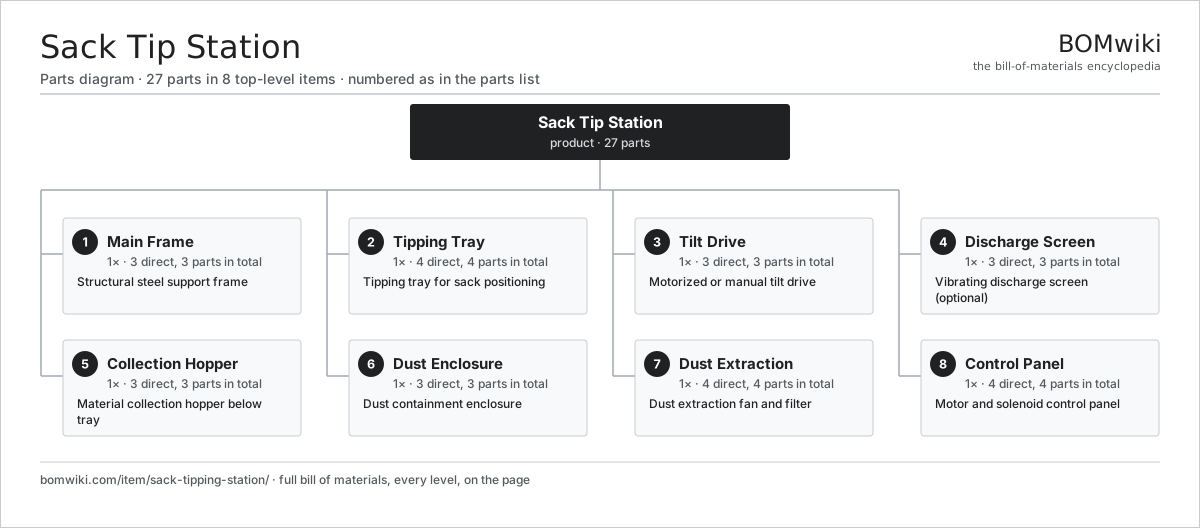
| # | Part | Qty | What it does |
|---|---|---|---|
| 1 | Main Frame 3 parts | 1× | Structural steel support frame |
| 2 | Tipping Tray 4 parts | 1× | Tipping tray for sack positioning |
| 3 | Tilt Drive 3 parts | 1× | Motorized or manual tilt drive |
| 4 | Discharge Screen 3 parts | 1× | Vibrating discharge screen (optional) |
| 5 | Collection Hopper 3 parts | 1× | Material collection hopper below tray |
| 6 | Dust Enclosure 3 parts | 1× | Dust containment enclosure |
| 7 | Dust Extraction 4 parts | 1× | Dust extraction fan and filter |
| 8 | Control Panel 4 parts | 1× | Motor and solenoid control panel |
3D model
No 3D model yet. Have a CAD file of this? Add a 3D model. STL renders right on this page; STEP, FreeCAD, and OpenSCAD sources are welcome too (openly licensed, like all 3D models on BOMwiki).
Build & assembly graph
expand / collapse · shared sub-assemblies converge · links to related products · est. labourTap an assembly to expand/collapse · tap a part to open it · use “Open page” for any node · drag to pan, scroll to zoom.
Bill of materials for Sack Tip Station
8 top-level lines · 35 rows shown · 27 parts total · indented to 3 levels| # | Item / sub-assembly | Part no. | Qty/assy | Ext. qty | Parts | Type |
|---|---|---|---|---|---|---|
| 1 | Main Frame 3 parts | sack-tipping-station-frame | 1× | 1 | 3 | assembly |
| 1.1 | Frame Posts | sack-tipping-station-frame-posts | 1× | 1 | · | part |
| 1.2 | Cross-Beams | sack-tipping-station-cross-beams | 1× | 1 | · | part |
| 1.3 | Base Support Frame | sack-tipping-station-base-frame | 1× | 1 | · | part |
| 2 | Tipping Tray 4 parts | sack-tipping-station-tray | 1× | 1 | 4 | assembly |
| 2.1 | Tray Plate | sack-tipping-station-tray-plate | 1× | 1 | · | part |
| 2.2 | Tray Pivot Bearing | sack-tipping-station-tray-pivot | 1× | 1 | · | part |
| 2.3 | Tray Mechanical Stops | sack-tipping-station-tray-stops | 1× | 1 | · | part |
| 2.4 | Tray Edge Rails | sack-tipping-station-tray-edge-rails | 1× | 1 | · | part |
| 3 | Tilt Drive 3 parts | sack-tipping-station-tilt-mechanism | 1× | 1 | 3 | assembly |
| 3.1 | Tilt Motor | sack-tipping-station-tilt-motor | 1× | 1 | · | part |
| 3.2 | Tilt Cylinder | sack-tipping-station-hydraulic-cylinder | 1× | 1 | · | part |
| 3.3 | Limit Switches | sack-tipping-station-limit-switches | 1× | 1 | · | part |
| 4 | Discharge Screen 3 parts | sack-tipping-station-screen | 1× | 1 | 3 | assembly |
| 4.1 | Screen Mesh | sack-tipping-station-screen-mesh | 1× | 1 | · | part |
| 4.2 | Screen Frame | sack-tipping-station-screen-frame | 1× | 1 | · | part |
| 4.3 | Screen Vibrator | sack-tipping-station-screen-vibrator | 1× | 1 | · | part |
| 5 | Collection Hopper 3 parts | sack-tipping-station-hopper | 1× | 1 | 3 | assembly |
| 5.1 | Hopper Body | sack-tipping-station-hopper-body | 1× | 1 | · | part |
| 5.2 | Hopper Outlet Valve | sack-tipping-station-hopper-outlet | 1× | 1 | · | part |
| 5.3 | Hopper Support Legs | sack-tipping-station-hopper-supports | 1× | 1 | · | part |
| 6 | Dust Enclosure 3 parts | sack-tipping-station-dust-hood | 1× | 1 | 3 | assembly |
| 6.1 | Hood Panels | sack-tipping-station-hood-panels | 1× | 1 | · | part |
| 6.2 | Hood Access Door | sack-tipping-station-hood-door | 1× | 1 | · | part |
| 6.3 | Hood Door Gasket | sack-tipping-station-hood-gasket | 1× | 1 | · | part |
| 7 | Dust Extraction 4 parts | sack-tipping-station-extraction | 1× | 1 | 4 | assembly |
| 7.1 | Filter Element | sack-tipping-station-filter-cartridge | 1× | 1 | · | part |
| 7.2 | Filter Housing | sack-tipping-station-filter-housing | 1× | 1 | · | part |
| 7.3 | Exhaust Blower | sack-tipping-station-exhaust-blower | 1× | 1 | · | part |
| 7.4 | Intake Ductwork | sack-tipping-station-intake-duct | 1× | 1 | · | part |
| 8 | Control Panel 4 parts | sack-tipping-station-control | 1× | 1 | 4 | assembly |
| 8.1 | Control PLC | sack-tipping-station-control-plc | 1× | 1 | · | part |
| 8.2 | Control Enclosure | sack-tipping-station-control-box | 1× | 1 | · | part |
| 8.3 | Motor Contactor | sack-tipping-station-motor-contactor | 1× | 1 | · | part |
| 8.4 | Control Buttons | sack-tipping-station-push-buttons | 1× | 1 | · | part |
Something wrong in this list? Report a problem with this BOM.
Sourcing: possible vendors
Browse the supplier directory → Prices, MOQ, and lead times are algorithmic estimates, not quotes, and not claims about these companies. Company mappings are curated by keyword; est. price band $5k–$2M. How estimates work| Vendor | HQ | Specialty | MOQ | Lead time |
|---|---|---|---|---|
| atlascopco.com ↗ | Stockholm, SE | Compressors & industrial | 10 units | 12–20 wks |
|
🇦🇹Andritz
andritz.com ↗
|
Graz, AT | Process plants & machinery | 10 units | 12–20 wks |
| buhlergroup.com ↗ | Uzwil, CH | Food & materials processing | 10 units | 12–20 wks |
| gea.com ↗ | Düsseldorf, DE | Process technology | 10 units | 12–20 wks |
| mhi.com ↗ | Tokyo, JP | Heavy machinery | 10 units | 12–20 wks |
1,592-word article