Safe Deposit Box System
ProductOverview
A safe deposit box system is the oldest and most secure method for retail banking customers to store valuables, documents, and heirlooms. For over 150 years, safe deposit services have been a cornerstone of banking, high-net-worth customers, small business owners, and families rent individual boxes, each protected by dual-key mechanical locks. The bank holds one key; the customer holds the other. Access requires both keys present, preventing either party from accessing the box unilaterally without the other's cooperation. Modern safe deposit systems expand this to include electronic access control, audit logging, and surveillance, while maintaining the security and privacy expectations that built these services into banking tradition.
The vault housing a safe deposit box system is itself a stronghold. The outer Vault Frame & Structure is 1/4 inch welded steel with a heavily reinforced door. Inside, individual Safe Deposit Box Nests are nested in rows, each secured by either a traditional Dual-Key Lock Mechanism mechanism or an electronic lock controlled by the Access Control Panel. Customers and bank officers access the vault only via the Access Control Panel, which enforces two-factor verification. An Surveillance & Audit Camera records every entry, and an Access Log & Audit Controller maintains a tamper-evident log of all events. Regulatory bodies require these safeguards: the Federal Reserve, OCC, and state banking departments mandate annual audits of safe deposit inventory, access logs, and surveillance footage.
Traditional Dual-Key System
The traditional safe deposit vault uses mechanical Dual-Key Lock Mechanism on each Safe Deposit Box Nests. Each lock has two independent pin-tumbler cylinders, one recessed into a bank key slot, the other into a customer key slot. The bank cuts the bank key with a unique pattern; the customer receives a separate customer key cut to a different (non-reproducible) keyway, often a high-security brand like Medeco or Abloy. To open the box, both keys must be inserted simultaneously. Each key rotates its cylinder; if both cylinders are properly aligned, their internal cams engage a single linkage cam that retracts the locking bar. The box drawer is now free to slide open. If either key is missing or incorrect, the mechanism jams and the bar remains locked.
This dual-key philosophy distributes trust: the bank cannot open a customer box alone, and a customer cannot breach the vault with only their own key. The bank supervisor or officer present during access acts as a neutral witness. The customer presents their key, the bank presents the bank key, they insert both together, verify the customer has signed the access log, and then allow the customer into a private viewing booth (a small private room adjacent to the vault, visible to staff but not recordable) where the customer may examine contents unobserved. After 15–30 minutes, the customer returns the box to the staff, the staff returns both keys to their secure storage (a second vault containing the bank's master key set), and the Access Log & Audit Controller is manually updated with the access time and customer name. This paper-based workflow is simple and foolproof but labor-intensive and prone to transcription errors.
Electronic Access Control System
Modern safe deposit systems, especially in large institutions, add electronic locks controlled by a Access Control Panel. Each box is fitted with a Solenoid Bolt powered by the Control Relay Board. Access is now credential-based: a customer presents a key card to the Card Reader, enters a PIN on the Keypad, and the Access Control Panel's embedded controller validates the credentials against a database (typically synced to the bank's core systems). If valid, the controller energizes the solenoid relay for that customer's designated box, retracting the bolt and unlocking the drawer. The Surveillance & Audit Camera records the event, timestamp, customer face, box ID, and the Access Log & Audit Controller writes an immutable entry to its SD card: "2024-03-15 14:30:22 | Customer 5847 | Box 12 | Officer: Sarah M. | Duration: 23 min". This log is write-protected; bank officers cannot delete or modify past entries, only add new ones. Regulatory audits now require only a printout of the log and a review of video footage, no manual ledger reconciliation.
Electronic systems can also enforce time-of-day restrictions, concurrent access limits (e.g., "two officers must authorize any afternoon access"), and audit flags (e.g., "audit this account, all accesses require supervisor override"). Some systems integrate with the bank's identity verification infrastructure, supporting biometric authentication (fingerprint, iris) or multi-factor token (smart card + PIN + biometric) for enhanced security. If a customer loses their key, the bank can simply deactivate their card credential; the customer retains access to their box via the bank's officer escort and new credentials, with no physical lock replacement needed.
Physical Layout & Integration
A typical 20-box safe deposit module is 4 feet wide, 2.5 feet tall, and 12 inches deep, sized to fit against a wall in a bank lobby or upstairs vault room. The outer Vault Frame & Structure door is hinged and can be fitted with an electronic solenoid main lock (separate from the individual box locks) to prevent after-hours access to the entire vault. Once a customer and officer are inside, they navigate to the numbered Safe Deposit Box Nests, insert keys or present a credential, and pull the drawer open. The box drawer uses Ball Bearing roller slides, allowing smooth extraction. Some designs allow complete box removal, the drawer slides all the way out and can be carried to the private viewing booth. Other designs restrict drawer travel to 6–8 inches, sufficient for the customer to reach in and manipulate contents without removing the box from its nest. The latter design improves security (the box never leaves the vault) but reduces accessibility.
Inside the vault, Interior Lighting Assembly LED strips activate when the vault door is opened (via a Motion Sensor or door switch), illuminating box faces and serial numbers. This allows the Surveillance & Audit Camera, mounted high above, to record both the customer's face and the specific box being accessed, preventing disputes ("I never rented box 15"; camera timestamp and footage prove otherwise).
Regulatory & Compliance Context
Safe deposit services are heavily regulated. The Federal Reserve and OCC require banks to:
- Maintain an unalterable access log (timestamp, customer ID, duration, staff present) for all boxes.
- Conduct annual physical inventory (count, verify serial numbers, spot-check for tampering).
- Retain and review surveillance footage for at least one year.
- Establish clear dual-control procedures to prevent unauthorized employee access.
- Disclose liability caps and insurance coverage to customers at rental signup.
The OCC's Bulletin 2009-11 mandates that access logs be "segregated from deposit account records" and "retained for the life of the account plus five years." The Access Log & Audit Controller's write-protected SD card satisfies this requirement. If the bank later faces a customer dispute ("You lost my diamonds") or a legal discovery request ("Show all access to box 47 in 2018"), the immutable audit log and video evidence are the bank's proof.
Some jurisdictions (e.g., New York, California) require notification to box renters if a box is accessed in their absence (e.g., during an officer audit). Modern systems can automatically email the customer a notification: "Your safe deposit box was accessed on [date] by authorized bank personnel for regulatory audit purposes." This transparency builds trust and deters insider theft.
Maintenance & Repairs
Mechanical locks in a traditional vault are low-maintenance. The Dual-Key Lock Mechanism contain no springs or complex mechanisms outside the standard pin-tumbler design. Wear is minimal; locks can operate for 30+ years without service. Keys should be periodically checked for corrosion and replaced if worn. The Lock Pocket (the cavity in the box face that recesses the dual locks) can accumulate dust; periodic cleaning with compressed air suffices.
Electronic systems require more oversight. The Solenoid Bolts are rated for 100,000+ duty cycles before replacement; at 30 accesses per box per year across 20 boxes, that's 600 accesses/year, or a 166-year component life. Practical replacement is typically 10–15 years due to cumulative wear and occasional jams. The Control Relay Board and safe-deposit-system-power-supply operate passively and rarely fail; battery backup in the Rtc Module should be tested annually and replaced every 2–3 years. The Surveillance & Audit Camera may require lens cleaning or seasonal adjustment if lighting conditions change (e.g., after a lobby renovation). The SD card in the Access Log & Audit Controller is rated for 10+ years of archival storage; it should be backed up to bank servers quarterly and rotated annually.
Installation & Decommissioning
Safe deposit systems are permanently installed. The Vault Frame & Structure is bolted to the building structure (wall studs or floor joists) with lag bolts, often requiring professional installation and wall reinforcement. Electrical installation for electronic systems requires 24 VDC power distribution, typically run through conduit and fused at the main electrical panel. Network Ethernet (for remote audit or camera feeds) may require runs to a server room. The Surveillance & Audit Camera and Access Log & Audit Controller should be installed by trained technicians to ensure proper positioning and power.
Decommissioning is unusual but can occur if a branch closes or consolidates. The bank must audit all boxes, notify customers, and provide a final opportunity for retrieval. Once empty, the system can be removed, but the Vault Frame & Structure's welded construction and weight (1200+ lbs) mean cutting it apart on-site or selling it to a scrap dealer. The Access Log & Audit Controller's SD card must be securely destroyed (incinerated or degaussed) to comply with data retention policies, or archived to microfilm if legal hold periods apply.
Safe Deposit Box System parts and their functions
8 top-level parts · 5,374 parts in total · full bill of materials below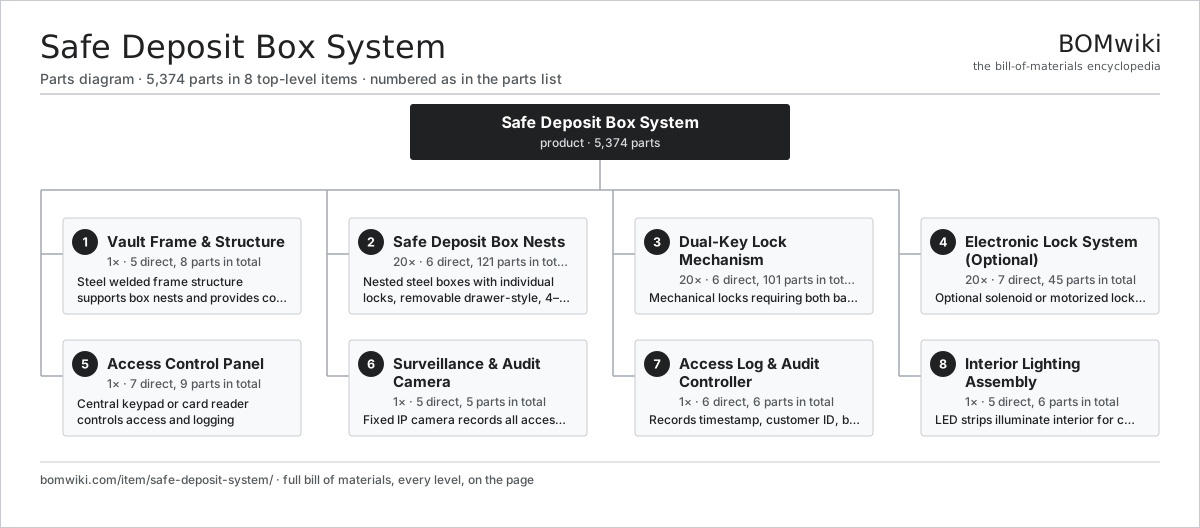
| # | Part | Qty | What it does |
|---|---|---|---|
| 1 | Vault Frame & Structure 5 parts | 1× | Steel welded frame structure supports box nests and provides containment |
| 2 | Safe Deposit Box Nests 6 parts | 20× | Nested steel boxes with individual locks, removable drawer-style, 4–6 inch depth |
| 3 | Dual-Key Lock Mechanism 6 parts | 20× | Mechanical locks requiring both bank key and customer key to open each box |
| 4 | Electronic Lock System (Optional) 7 parts | 20× | Optional solenoid or motorized locks tied to access control, audit log |
| 5 | Access Control Panel 7 parts | 1× | Central keypad or card reader controls access and logging |
| 6 | Surveillance & Audit Camera 5 parts | 1× | Fixed IP camera records all access events for regulatory compliance |
| 7 | Access Log & Audit Controller 6 parts | 1× | Records timestamp, customer ID, box ID, operator ID for each access |
| 8 | Interior Lighting Assembly 5 parts | 1× | LED strips illuminate interior for customer convenience during access |
3D model
No 3D model yet. Have a CAD file of this? Add a 3D model. STL renders right on this page; STEP, FreeCAD, and OpenSCAD sources are welcome too (openly licensed, like all 3D models on BOMwiki).
Build & assembly graph
expand / collapse · shared sub-assemblies converge · links to related products · est. labourTap an assembly to expand/collapse · tap a part to open it · use “Open page” for any node · drag to pan, scroll to zoom.
Bill of materials for Safe Deposit Box System
8 top-level lines · 55 rows shown · 5,374 parts total · indented to 3 levels| # | Item / sub-assembly | Part no. | Qty/assy | Ext. qty | Parts | Type |
|---|---|---|---|---|---|---|
| 1 | Vault Frame & Structure 5 parts | safe-deposit-system-vault-frame | 1× | 1 | 8 | assembly |
| 1.1 | Frame Body | safe-deposit-system-frame-body | 1× | 1 | · | part |
| 1.2 | Mounting Rails | safe-deposit-system-mounting-rails | 4× | 4 | · | part |
| 1.3 | Back Plate | safe-deposit-system-back-plate | 1× | 1 | · | part |
| 1.4 | Door Frame | safe-deposit-system-door-frame | 1× | 1 | · | part |
| 1.5 | Fastener Set | fastener-set | 1× | 1 | · | part |
| 2 | Safe Deposit Box Nests 6 parts | safe-deposit-system-box-nests | 20× | 20 | 121 | assembly |
| 2.1 | Box Body | safe-deposit-system-box-body | 20× | 400 | · | part |
| 2.2 | Box Drawer | safe-deposit-system-box-drawer | 20× | 400 | · | part |
| 2.3 | Lock Pocket | safe-deposit-system-lock-pocket | 20× | 400 | · | part |
| 2.4 | Locking Bar | safe-deposit-system-locking-bar | 20× | 400 | · | part |
| 2.5 | Ball Bearing | ball-bearing | 40× | 800 | · | part |
| 2.6 | Fastener Set | fastener-set | 1× | 20 | · | part |
| 3 | Dual-Key Lock Mechanism 6 parts | safe-deposit-system-dual-key-locks | 20× | 20 | 101 | assembly |
| 3.1 | Bank Key Cylinder | safe-deposit-system-bank-key-cylinder | 20× | 400 | · | part |
| 3.2 | Customer Key Cylinder | safe-deposit-system-customer-key-cylinder | 20× | 400 | · | part |
| 3.3 | Lock Body | safe-deposit-system-lock-body | 20× | 400 | · | part |
| 3.4 | Linkage Cam | safe-deposit-system-linkage-cam | 20× | 400 | · | part |
| 3.5 | Coil Spring | coil-spring | 20× | 400 | · | part |
| 3.6 | Fastener Set | fastener-set | 1× | 20 | · | part |
| 4 | Electronic Lock System (Optional) 7 parts | safe-deposit-system-electronic-locks | 20× | 20 | 45 | assembly |
| 4.1 | Solenoid Bolt | safe-deposit-system-solenoid-bolt | 20× | 400 | · | part |
| 4.2 | Access Reader | safe-deposit-system-access-reader | 1× | 20 | · | part |
| 4.3 | Control Relay Board | safe-deposit-system-control-relay-board | 1× | 20 | · | part |
| 4.4 | Bare PCB | pcb-bare | 1× | 20 | · | part |
| 4.5 | Relay | relay | 20× | 400 | · | part |
| 4.6 | Connector | connector | 1× | 20 | · | part |
| 4.7 | Power Supply | power-supply | 1× | 20 | · | part |
| 5 | Access Control Panel 7 parts | safe-deposit-system-master-panel | 1× | 1 | 9 | assembly |
| 5.1 | Panel Enclosure | safe-deposit-system-panel-enclosure | 1× | 1 | · | part |
| 5.2 | Microcontroller | mcu | 1× | 1 | · | part |
| 5.3 | Bare PCB | pcb-bare | 1× | 1 | · | part |
| 5.4 | Keypad | safe-deposit-system-keypad | 1× | 1 | · | part |
| 5.5 | Card Reader | safe-deposit-system-card-reader | 1× | 1 | · | part |
| 5.6 | Lcd Display | safe-deposit-system-lcd-display | 1× | 1 | · | part |
| 5.7 | Connector | connector | 3× | 3 | · | part |
| 6 | Surveillance & Audit Camera 5 parts | safe-deposit-system-access-camera | 1× | 1 | 5 | assembly |
| 6.1 | CMOS Image Sensor | image-sensor | 1× | 1 | · | part |
| 6.2 | Lens Assembly | camera-lens | 1× | 1 | · | part |
| 6.3 | Camera Enclosure | safe-deposit-system-camera-enclosure | 1× | 1 | · | part |
| 6.4 | Camera Poe Injector | safe-deposit-system-camera-poe-injector | 1× | 1 | · | part |
| 6.5 | Connector | connector | 1× | 1 | · | part |
| 7 | Access Log & Audit Controller 6 parts | safe-deposit-system-audit-log-board | 1× | 1 | 6 | assembly |
| 7.1 | Bare PCB | pcb-bare | 1× | 1 | · | part |
| 7.2 | Rtc Module | safe-deposit-system-rtc-module | 1× | 1 | · | part |
| 7.3 | Sd Card Socket | safe-deposit-system-sd-card-socket | 1× | 1 | · | part |
| 7.4 | Write Protect Switch | safe-deposit-system-write-protect-switch | 1× | 1 | · | part |
| 7.5 | Microcontroller | mcu | 1× | 1 | · | part |
| 7.6 | Connector | connector | 1× | 1 | · | part |
| 8 | Interior Lighting Assembly 5 parts | safe-deposit-system-interior-lighting | 1× | 1 | 6 | assembly |
| 8.1 | Led Strip | safe-deposit-system-led-strip | 2× | 2 | · | part |
| 8.2 | Motion Sensor | safe-deposit-system-motion-sensor | 1× | 1 | · | part |
| 8.3 | Led Driver | safe-deposit-system-led-driver | 1× | 1 | · | part |
| 8.4 | Connector | connector | 1× | 1 | · | part |
| 8.5 | Fastener Set | fastener-set | 1× | 1 | · | part |
Something wrong in this list? Report a problem with this BOM.
Related products
same domain, ranked by shared parts Cash Deposit Machine
64 parts · shares 5 with this page
Cash Deposit Machine
64 parts · shares 5 with this page
 Barcode Scanner
58 parts · shares 3 with this page
Overhead Book Scanner
35 parts · shares 3 with this page
Banknote Fitness Sorter
89 parts · shares 4 with this page
Coin Counting Kiosk
63 parts · shares 4 with this page
Barcode Scanner
58 parts · shares 3 with this page
Overhead Book Scanner
35 parts · shares 3 with this page
Banknote Fitness Sorter
89 parts · shares 4 with this page
Coin Counting Kiosk
63 parts · shares 4 with this page
Sourcing: possible vendors
Browse the supplier directory → Prices, MOQ, and lead times are algorithmic estimates, not quotes, and not claims about these companies. Company mappings are curated by keyword; est. price band $50–$15k. How estimates work| Vendor | HQ | Specialty | MOQ | Lead time |
|---|---|---|---|---|
|
🇯🇵Canon
canon.com ↗
|
Tokyo, JP | Imaging & optics | 500 units | 8–12 wks |
|
🇯🇵Ricoh
ricoh.com ↗
|
Tokyo, JP | Office imaging | 500 units | 8–12 wks |
|
🇺🇸Xerox
xerox.com ↗
|
Norwalk, US | Printers & copiers | 500 units | 8–12 wks |
|
🇯🇵Epson
epson.com ↗
|
Suwa, JP | Printers & projectors | 500 units | 8–12 wks |
|
🇯🇵Brother
brother.com ↗
|
Nagoya, JP | Printers & sewing | 500 units | 8–12 wks |
1,710-word article